ABC Family Arquivos Brasileiros de Cardiologia International Journal of Cardiovascular Sciences ABC Heart Failure & Cardiomyopathy ABC Imagem Cardiovascular
Português English
ABC Family
Português English
  • About
    • About ABC Family
    • Internal Regulation
    • Editorial Board
    • Brazilian Society of Cardiology (SBC)
  • Issues
  • SBC Guidelines
  • Content
    • Videos
    • Podcasts
    • News
  • About
    • About ABC Family
    • Internal Regulation
    • Editorial Board
    • Brazilian Society of Cardiology (SBC)
  • Issues
  • SBC Guidelines
  • Content
    • Videos
    • Podcasts
    • News

ABC Family

  • ABC Family
  • Arquivos Brasileiros de Cardiologia
  • International Journal of Cardiovascular Sciences
  • ABC Heart Failure & Cardiomyopathy
  • ABC Imagem Cardiovascular
Search in

No content found.

Journals
Ordering
Article types
Others

  1. Home
  2. Keyword: Learning Curve
Incorporating Intracoronary Lithotripsy into Daily Practice: A Temporal Comparative Analysis of Safety, Efficacy, and Learning Curve
ABC
Original Article

Incorporating Intracoronary Lithotripsy into Daily Practice: A Temporal Comparative Analysis of Safety, Efficacy, and Learning Curve

Guy F. A. Prado et al. Stefano Garzon José Mariani Junior Willterson Bandeira … Felipe Mateus Teixeira Bezerra Breno Oliveira Almeida Gustavo Neves de Araujo Ana Claudia Conrado João Silveira Emanuele Barbato Flavio Ribichini Pedro Alves Lemos

Abstract

Background

Intravascular lithotripsy (IVL) has emerged as a groundbreaking technology for treating calcified coronary lesions.

Objective

To assess whether case selection and interventional performance with IVL have evolved over time after its incorporation into daily practice.

Methods

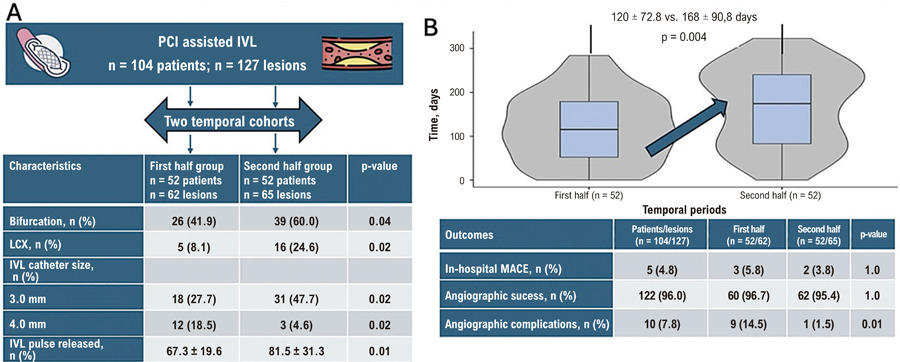
We prospectively included 104 consecutive patients with 127 calcified coronary lesions treated with IVL. The cohort was divided into two temporal groups (52 patients each) based on the order of patient inclusion. Clinical data and procedural performance were compared between the groups. All statistical tests were two-sided, with a significance level of 0.05.

Results

The mean age was 73.2 ± 10.2 years, and 62.5% of patients presented with acute coronary syndromes. Severe calcification and type B2/C lesions were identified in 73.2% and 98.4%, respectively. Upfront IVL was performed in 92.9% of lesions, intravascular imaging was used in 78%, rotational atherectomy in 6.3%, and angiographic success was achieved in 96.0%. Compared with the first cohort, the latter cohort had more bifurcation lesions (60.0% vs. 41.9%; p = 0.04), more interventions in the circumflex artery (24.6% vs. 8.1%; p = 0.02), and a lower use of 4.0-mm diameter balloons (4.6% vs. 18.5%; p = 0.02). The latter cohort spanned a longer inclusion period (168 ± 90.8 vs. 120 ± 72.8 days; p = 0.004) and had fewer angiographic complications (1.5% vs. 14.5%; p = 0.01), whereas in-hospital major adverse cardiac events did not differ (3.8% vs. 5.8%; p = 1.0).

Conclusion

IVL is an effective modality for coronary calcium modification. Temporal changes in case selection and interventional performance may reflect a learning-adaptation curve.

  • Interventional Ultrasonography
  • Learning Curve
  • Lithotripsy
  • Percutaneous Coronary Intervention
Read Full Article
Creative Commons Attribution (CC BY) Creative Commons license
21/09/2026 DOI: 10.36660/abc.20250783i Views 3
ABC
Editorial

Unlocking Transcatheter Aortic Valve Replacement Expertise in Brazil: Lessons from National Data

Sofia Cabral

Procedural outcomes in cardiology, as in other fields in Medicine, are influenced by numerous factors, including patient characteristics, procedural intricacy, operator proficiency, available technological differentiation, and healthcare resources. Higher volume centers report better results for many procedures, though the extent of that benefit varies depending on the procedure’s complexity. The more complex the procedure the higher the relationship between experience and outcomes. Additionally, each procedure has its learning curve (LC), both at individual and group levels, which adds density to the assessment. From an academic standpoint, an LC defines the relationship between performance (learning) and practice (effort). In health training, this learning process typically follows a non-linear pattern initially marked by a steep slope as the basics of the procedure are acquired, followed by an inflection point where the learning rate decelerates. Eventually, it reaches an asymptotic expression, representing the plateau phase of high proficiency. Understanding how a procedure’s LC behaves is important because it provides valuable insights for scientific societies and healthcare regulatory authorities in defining the competency requirements for practitioners and assisting decision-makers in effective resource allocation. Most importantly, it plays a critical role in maintaining high standards of care.

In the field of cardiovascular interventions, the LC phenomenon has extensively been verified, from cardiac surgery to coronary percutaneous intervention, and more recently, transcatheter aortic valve replacement (TAVR).4-7 Despite conflicting results from different series, researchers have consistently recognized a pattern in the LC of TAVR. This pattern depicts an early phase where procedure efficiency and safety outcomes steeply increase with increasing experience, followed by flattening out and eventual consolidation phases.

[…]

  • Brazil
  • Learning Curve
  • Transcatheter Aortic Valve Replacement
Read Full Article
Creative Commons Attribution (CC BY) Creative Commons license
12/08/2024 DOI: 10.36660/abc.20240302i Views 1

How to cite this article

EndNote RIS

Electronic Document Format (Vancouver)

Prado GFA, Garzon S, Mariani Junior J, Bandeira W, Bezerra FMT, Almeida BO, Araujo GN, et al. Incorporating Intracoronary Lithotripsy into Daily Practice: A Temporal Comparative Analysis of Safety, Efficacy, and Learning Curve. Arquivos Brasileiros de Cardiologia 2026;123(8):e20250783.

Electronic Document Format (ABNT)

Prado, Guy F. A.; Garzon, Stefano; Mariani Junior, José; Bandeira, Willterson; Bezerra, Felipe Mateus Teixeira; Almeida, Breno Oliveira; Araujo, Gustavo Neves de; Conrado, Ana Claudia; Silveira, João; Barbato, Emanuele; Ribichini, Flavio; Lemos, Pedro Alves. Incorporating Intracoronary Lithotripsy into Daily Practice: A Temporal Comparative Analysis of Safety, Efficacy, and Learning Curve. Arquivos Brasileiros de Cardiologia, v. 123, n. 8, e20250783, Sep. 2026.

Electronic Document Format (APA)

Prado, G. F. A., Garzon, S., Mariani Junior, J., Bandeira, W., Bezerra, F. M. T., Almeida, B. O., Araujo, G. N. , Conrado, A. C., Silveira, J., Barbato, E., Ribichini, F., & Lemos, P. A. (2026). Incorporating Intracoronary Lithotripsy into Daily Practice: A Temporal Comparative Analysis of Safety, Efficacy, and Learning Curve. Arquivos Brasileiros de Cardiologia, 123(8), e20250783.

Electronic Document Format (ISO)

Prado, Guy F. A. and Garzon, Stefano and Mariani Junior, José and Bandeira, Willterson and Bezerra, Felipe Mateus Teixeira and Almeida, Breno Oliveira and Araujo, Gustavo Neves de and Conrado, Ana Claudia and Silveira, João and Barbato, Emanuele and Ribichini, Flavio and Lemos, Pedro Alves. Incorporating Intracoronary Lithotripsy into Daily Practice: A Temporal Comparative Analysis of Safety, Efficacy, and Learning Curve. Arquivos Brasileiros de Cardiologia [online]. 2026, vol. 123, n. 8, [cited 2026-10-14], e20250783. Available from: <https://journals.cardiol.br/en/article/incorporating-intracoronary-lithotripsy-into-daily-practice-a-temporal-comparative-analysis-of-safety-efficacy-and-learning-curve/>. ISSN 0066-782X

EndNote RIS

Electronic Document Format (Vancouver)

Cabral S. Unlocking Transcatheter Aortic Valve Replacement Expertise in Brazil: Lessons from National Data. Arquivos Brasileiros de Cardiologia 2024;121(7):e20240302.

Electronic Document Format (ABNT)

Cabral, Sofia. Unlocking Transcatheter Aortic Valve Replacement Expertise in Brazil: Lessons from National Data. Arquivos Brasileiros de Cardiologia, v. 121, n. 7, e20240302, Aug. 2024.

Electronic Document Format (APA)

Cabral, S. (2024). Unlocking Transcatheter Aortic Valve Replacement Expertise in Brazil: Lessons from National Data. Arquivos Brasileiros de Cardiologia, 121(7), e20240302.

Electronic Document Format (ISO)

Cabral, Sofia. Unlocking Transcatheter Aortic Valve Replacement Expertise in Brazil: Lessons from National Data. Arquivos Brasileiros de Cardiologia [online]. 2024, vol. 121, n. 7, [cited 2026-10-14], e20240302. Available from: <https://journals.cardiol.br/en/article/unlocking-transcatheter-aortic-valve-replacement-expertise-in-brazil-lessons-from-national-data/>. ISSN 0066-782X

  • About ABC Family
  • Internal Regulation
  • Editorial Board
  • Brazilian Society of Cardiology (SBC)

Issues

SBC Guidelines

  • Videos
  • Podcasts
  • News