ABC Family Arquivos Brasileiros de Cardiologia International Journal of Cardiovascular Sciences ABC Heart Failure & Cardiomyopathy ABC Imagem Cardiovascular
Português English
ABC Family
Português English
  • About
    • About ABC Family
    • Internal Regulation
    • Editorial Board
    • Brazilian Society of Cardiology (SBC)
  • Issues
  • SBC Guidelines
  • Content
    • Videos
    • Podcasts
    • News
  • About
    • About ABC Family
    • Internal Regulation
    • Editorial Board
    • Brazilian Society of Cardiology (SBC)
  • Issues
  • SBC Guidelines
  • Content
    • Videos
    • Podcasts
    • News

ABC Family

  • ABC Family
  • Arquivos Brasileiros de Cardiologia
  • International Journal of Cardiovascular Sciences
  • ABC Heart Failure & Cardiomyopathy
  • ABC Imagem Cardiovascular
Search in

No content found.

Journals
Ordering
Article types
Others

  1. Home
  2. Keyword: Intensive Care Unit
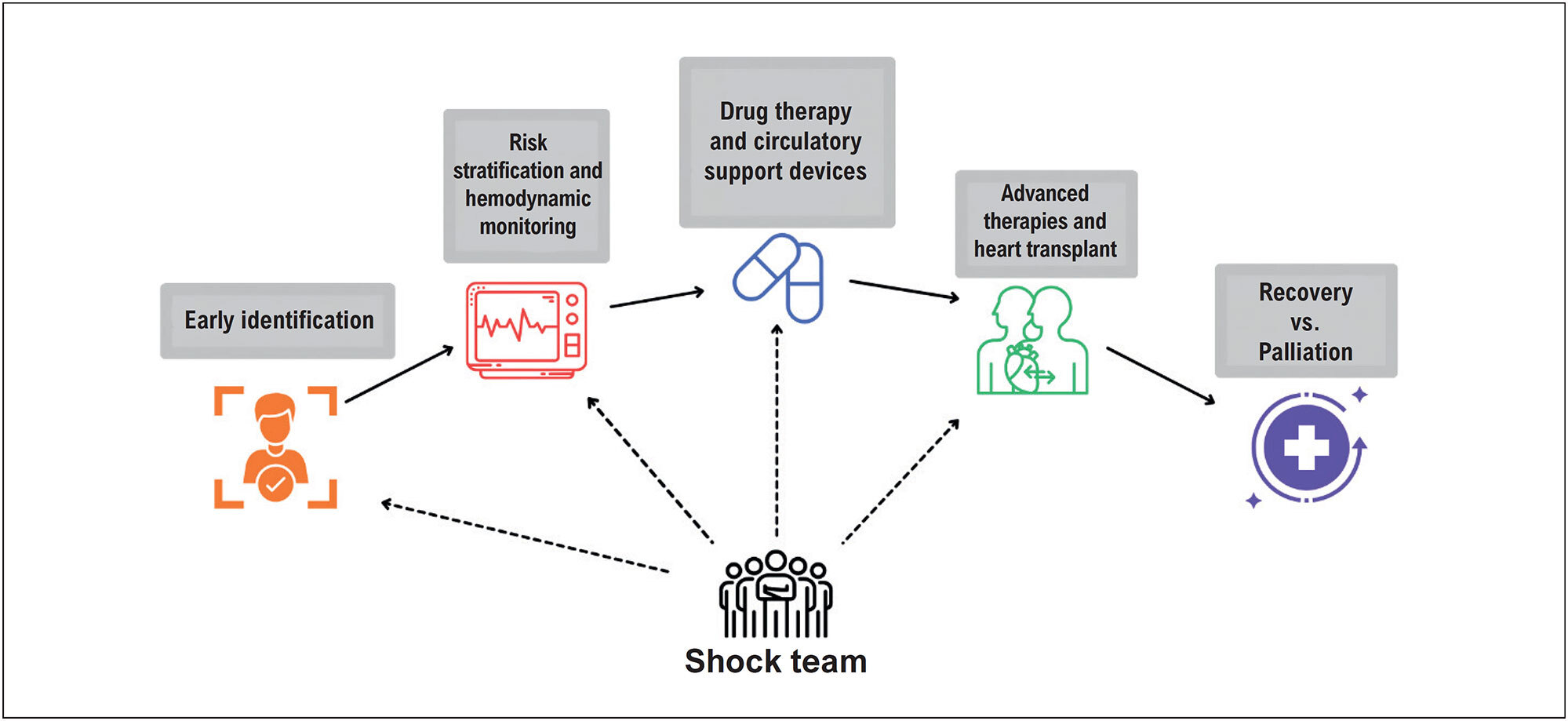
Figure 1
ABCHF
Viewpoint

Non-Ischemic Cardiogenic Shock: How to Improve Outcomes – From Early Recognition to Distinctive Management

Rodrigo P. Amantéa et al. Laura Hastenteufel Fernando Luís Scolari Lívia A. Goldraich Nadine Clausell

Introduction

Cardiogenic shock is a clinical condition with an increasing incidence that presents with tissue hypoperfusion, leading to multiorgan dysfunction with a high mortality rate. Non-ischemic cardiogenic shock has been recognized as an important cause of shock in emergency rooms, with an incidence exceeding that of shock related to acute myocardial infarction (AMI) in some populations. Recent data from the Cardiogenic Shock Working Group (CSWG), an international multicenter registry, reveals that the mortality rate for this condition varies from 22 to 32%, depending on the type of institution.

Unlike cardiogenic shock of ischemic origin, in which an index event marks the beginning of myocardial injury, potentially leading to the state of shock, in cardiogenic shock of non-ischemic origin the presentation represents the continuum of advanced heart failure. For the purposes of this article, we will be focusing exclusively on shock related to advanced heart failure, since it is the most prevalent type and often presents with a wide range of symptoms, which can delay diagnosis and contribute to poorer outcomes. The following topics will be covered: definitions pertinent to diagnosing cardiogenic shock and its various clinical presentations; initial systematic evaluation of these patients, including recent updates on the use of pulmonary artery catheters and individualized risk stratification for morbidity and mortality; and management strategies for non-ischemic cardiogenic shock, including pharmacological treatments, mechanical devices, and the role of “Shock Teams” in coordinated care.

[…]
  • Cardiogenic shock
  • Heart Failure
  • Intensive Care Unit
Read Full Article
Creative Commons Attribution (CC BY) Creative Commons license
18/10/2024 DOI: 10.36660/abchf.20240033i Views 2
Figure 1
ABCIC
Systematic Review

Inferior Vena Cava Ultrasound for Assessing Volume Status and Fluid Responsiveness in Critically ill Patients: A Systematic Review

Djalma Gomes Xavier Filho et al. Akeme Laissa Novais Coutinho Romero Henrique de Almeida Barbosa Matheus Rodrigues Lopes Adirlene Pontes de Oliveira Tenório

Abstract

Background:

The assessment of intravascular volume and fluid responsiveness is challenging in the management of critically ill patients. Diagnostic methods of hemodynamic monitoring must be safe, reproducible, and practical.

Objective:

To describe the applicability of ultrasound indices of the inferior vena cava in the assessment of intravascular volume and prediction of fluid responsiveness in critically ill patients.

Method:

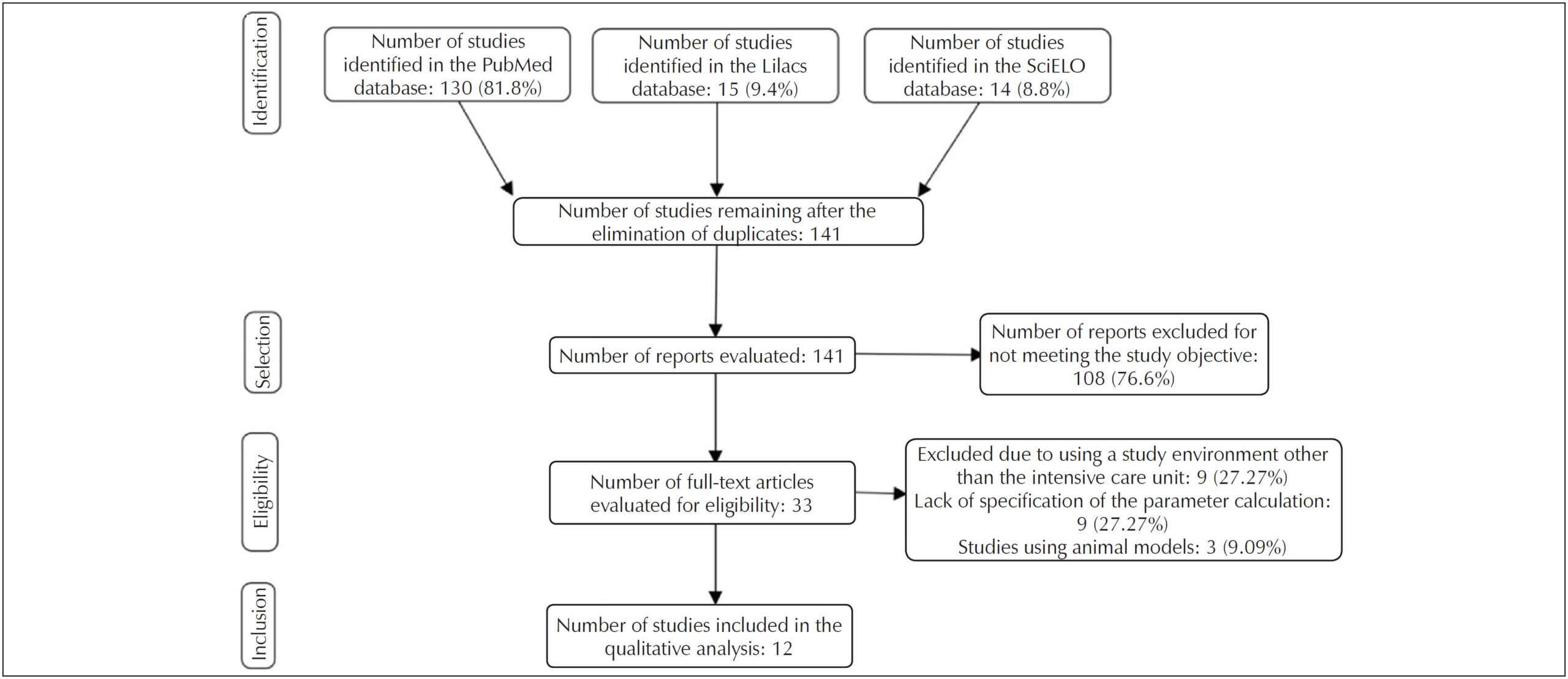
A systematic review performed of the PubMed®, Latin American and Caribbean Health Sciences Literature, and Scientific Electronic Library Online databases for articles published in the previous five years. The descriptors used were “inferior vena cava,” “ultrasonography,” “fluid responsiveness,” and “volume status.”

Results:

The search identified 13 relevant articles. The collapsibility index of the inferior vena cava was 25%–50% as the cutoff point for defining hypovolemia and showed applicability in predicting fluid responsiveness in patients breathing spontaneously with cutoff points of 25%–57%. In mechanical ventilation scenarios, the distensibility index of the inferior vena cava was more effective at predicting fluid responsiveness than the other measurements with variation of 10.2%–20.5%. The inferior vena cava/aorta diameter index was especially useful in the pediatric population for defining intravascular volume; however, in adults, there were many divergences in its applicability.

Conclusion:

The assessment of intravascular volume and fluid responsiveness through ultrasound indices of the inferior vena cava is applicable and safe for diagnosing and monitoring hemodynamic instability. However, studies of value standardization are necessary due to divergences in the cutoff points used in each index.

  • Hemodynamics
  • Inferior vena cava
  • Intensive Care Unit
  • Organism fluid status
  • Ultrasonography
Read Full Article
Creative Commons Attribution (CC BY) Creative Commons license
26/11/2021 DOI: 10.47593/2675-312X/20213403eabc193 Views 2
ABC
Artigo Original

Severe heart failure at intensive therapy unit: is there an ideal prognostic index?

Cristina Bueno Terzi et al. Silvia G. Lage Desanka Dragosavac Renato G. G. Terzi

OBJECTIVE: To assess the applicability of three prognostic indexes – APACHE II, SAPS II and UNICAMP II – in a subgroup of critical heart failure (HF) patients. METHODS: Ninety patients were studied, being 12 females and 78 males. Mean age was 56 (18-83). Patients were ranked in functional class IV (NYHA) or cardiogenic shock secondary to cardiomyopathies: dilated (44%), chagasic (25.5%), ischemic (18%), hypertensive (1.1%), hypertrophic (1.1%), alcoholic (1.1%), and secondary to valvopathies after surgical correction (7.7%). Tables with frequency of categorical variables and descriptive statistics of continuous variables were created in order to describe sample profile for the different variables under study. In order to analyze the relationship between prognostic indexes levels and course towards death, an analysis of the ROC curve, as well as Hosmer and Lemeshow Test of Goodness of Fit calculated, and Standardized Mortality Ratio (SMR) were carried out. RESULTS: The statistical analysis showed low sensitivity, specificity, and accuracy of the three prognostic indexes for HF patients. Mortality was underestimated in this group. Pulmonary thromboembolism (PTE) was a major factor of mortality rate in severe HF. CONCLUSION: The three prognostic indexes under study did not prove to be appropriate for the assessment of cardiopathy patients at Intensive Care Unit (ICU). For HF patients, PTE played a major role in mortality of heart failure. Specific prognostic indexes for cardiopathy patients with severe HF should be proposed, and the discussion on anticoagulation on those patients should be expanded.

  • Cardiogenic shock
  • Heart Failure
  • Intensive Care Unit
  • Prognostic disease severity indexes
  • Pulmonary embolism
Read Full Article
Creative Commons Attribution (CC BY) Creative Commons license
16/10/2006 DOI: 10.1590/S0066-782X2006001600018 Views 1
ABC
Original Article

Retrospective Study of the Survival of Patients who Underwent Cardiopulmonary Resuscitation in an Intensive Care Unit

Daniel Martins Moreira et al. Guilherme Mariante Neto Marcelo Wierzynski Oliveira Letícia Biscaino Alves … Luís Carlos Chorazje Adamatti Eliana de Andrade Trotta Sílvia Regina Rios Vieira

OBJECTIVE: To evaluate clinical and evolutive characteristics of patients admitted in an intensive care unit after cardiopulmonary resuscitation, identifying prognostic survival factors.METHODS: A retrospective study of 136 patients admitted between 1995 and 1999 to an intensive care unit, evaluating clinical conditions, mechanisms and causes of cardiopulmonary arrest, and their relation to hospital mortality.RESULTS: A 76% mortality rate independent of age and sex was observed. Asystole was the most frequent mechanism of death, and seen in isolation pulmonary arrest was the least frequent. Cardiac failure, need for mechanical ventilation, cirrhosis and previous stroke were clinically significant (p<0.01) death factors.CONCLUSION: Prognostic factors supplement the doctor's decision as to whether or not a patient will benefit from cardiopulmonary resuscitation.

  • cardiopulmonary arrest
  • Cardiopulmonary Resuscitation
  • Intensive Care Unit
Read Full Article
Creative Commons Attribution (CC BY) Creative Commons license
20/09/2002 DOI: 10.1590/S0066-782X2002000600002 Views 1

How to cite this article

EndNote RIS

Electronic Document Format (Vancouver)

Amantéa RP, Hastenteufel L, Scolari FL, Goldraich LA, Clausell N. Non-Ischemic Cardiogenic Shock: How to Improve Outcomes – From Early Recognition to Distinctive Management. ABC Heart Fail Cardiomyop 2024;4(1):e20240033.

Electronic Document Format (ABNT)

Amantéa, Rodrigo P.; Hastenteufel, Laura; Scolari, Fernando Luís; Goldraich, Lívia A.; Clausell, Nadine. Non-Ischemic Cardiogenic Shock: How to Improve Outcomes – From Early Recognition to Distinctive Management. ABC Heart Fail Cardiomyop, v. 4, n. 1, e20240033, Oct. 2024.

Electronic Document Format (APA)

Amantéa, R. P., Hastenteufel, L., Scolari, F. L., Goldraich, L. A., & Clausell, N. (2024). Non-Ischemic Cardiogenic Shock: How to Improve Outcomes – From Early Recognition to Distinctive Management. ABC Heart Fail Cardiomyop, 4(1), e20240033.

Electronic Document Format (ISO)

Amantéa, Rodrigo P. and Hastenteufel, Laura and Scolari, Fernando Luís and Goldraich, Lívia A. and Clausell, Nadine. Non-Ischemic Cardiogenic Shock: How to Improve Outcomes – From Early Recognition to Distinctive Management. ABC Heart Fail Cardiomyop [online]. 2024, vol. 4, n. 1, [cited 2026-10-14], e20240033. Available from: <https://journals.cardiol.br/en/article/non-ischemic-cardiogenic-shock-how-to-improve-outcomes-from-early-recognition-to-distinctive-management/>

EndNote RIS

Electronic Document Format (Vancouver)

Xavier Filho DG, Coutinho ALN, Barbosa RHA, Lopes MR, Tenório APO. Inferior Vena Cava Ultrasound for Assessing Volume Status and Fluid Responsiveness in Critically ill Patients: A Systematic Review. ABC Imagem Cardiovascular 2021;34(3):eabc193.

Electronic Document Format (ABNT)

Xavier Filho, Djalma Gomes; Coutinho, Akeme Laissa Novais; Barbosa, Romero Henrique de Almeida; Lopes, Matheus Rodrigues; Tenório, Adirlene Pontes de Oliveira. Inferior Vena Cava Ultrasound for Assessing Volume Status and Fluid Responsiveness in Critically ill Patients: A Systematic Review. ABC Imagem Cardiovascular, v. 34, n. 3, eabc193, Nov. 2021.

Electronic Document Format (APA)

Xavier Filho, D. G., Coutinho, A. L. N., Barbosa, R. H. A., Lopes, M. R., & Tenório, A. P. O. (2021). Inferior Vena Cava Ultrasound for Assessing Volume Status and Fluid Responsiveness in Critically ill Patients: A Systematic Review. ABC Imagem Cardiovascular, 34(3), eabc193.

Electronic Document Format (ISO)

Xavier Filho, Djalma Gomes and Coutinho, Akeme Laissa Novais and Barbosa, Romero Henrique de Almeida and Lopes, Matheus Rodrigues and Tenório, Adirlene Pontes de Oliveira. Inferior Vena Cava Ultrasound for Assessing Volume Status and Fluid Responsiveness in Critically ill Patients: A Systematic Review. ABC Imagem Cardiovascular [online]. 2021, vol. 34, n. 3, [cited 2026-10-14], eabc193. Available from: <https://journals.cardiol.br/en/article/inferior-vena-cava-ultrasound-for-assessing-volume-status-and-fluid-responsiveness-in-critically-ill-patients-a-systematic-review/>. ISSN 2318-8219

EndNote RIS

Electronic Document Format (Vancouver)

Terzi CB, Lage SG, Dragosavac D, Terzi RGG. Severe heart failure at intensive therapy unit: is there an ideal prognostic index?. Arquivos Brasileiros de Cardiologia 2006;87(3):344-51.

Electronic Document Format (ABNT)

Terzi, Cristina Bueno; Lage, Silvia G.; Dragosavac, Desanka; Terzi, Renato G. G.. Severe heart failure at intensive therapy unit: is there an ideal prognostic index?. Arquivos Brasileiros de Cardiologia, v. 87, n. 3, p. 344-351, Oct. 2006.

Electronic Document Format (APA)

Terzi, C. B., Lage, S. G., Dragosavac, D., & Terzi, R. G. G. (2006). Severe heart failure at intensive therapy unit: is there an ideal prognostic index?. Arquivos Brasileiros de Cardiologia, 87(3), 344-351.

Electronic Document Format (ISO)

Terzi, Cristina Bueno and Lage, Silvia G. and Dragosavac, Desanka and Terzi, Renato G. G.. Severe heart failure at intensive therapy unit: is there an ideal prognostic index?. Arquivos Brasileiros de Cardiologia [online]. 2006, vol. 87, n. 3, [cited 2026-10-14], pp. 344-351. Available from: <https://journals.cardiol.br/en/article/severe-heart-failure-at-intensive-therapy-unit-is-there-an-ideal-prognostic-index/>. ISSN 0066-782X

EndNote RIS

Electronic Document Format (Vancouver)

Moreira DM, Mariante Neto G, Oliveira MW, Alves LB, Adamatti LCC, Trotta EA, Vieira SRR, et al. Retrospective Study of the Survival of Patients who Underwent Cardiopulmonary Resuscitation in an Intensive Care Unit. Arquivos Brasileiros de Cardiologia 2002;78(6):549-52.

Electronic Document Format (ABNT)

Moreira, Daniel Martins; Mariante Neto, Guilherme; Oliveira, Marcelo Wierzynski; Alves, Letícia Biscaino; Adamatti, Luís Carlos Chorazje; Trotta, Eliana de Andrade; Vieira, Sílvia Regina Rios. Retrospective Study of the Survival of Patients who Underwent Cardiopulmonary Resuscitation in an Intensive Care Unit. Arquivos Brasileiros de Cardiologia, v. 78, n. 6, p. 549-552, Sep. 2002.

Electronic Document Format (APA)

Moreira, D. M., Mariante Neto, G., Oliveira, M. W., Alves, L. B., Adamatti, L. C. C., Trotta, E. A., & Vieira, S. R. R. (2002). Retrospective Study of the Survival of Patients who Underwent Cardiopulmonary Resuscitation in an Intensive Care Unit. Arquivos Brasileiros de Cardiologia, 78(6), 549-552.

Electronic Document Format (ISO)

Moreira, Daniel Martins and Mariante Neto, Guilherme and Oliveira, Marcelo Wierzynski and Alves, Letícia Biscaino and Adamatti, Luís Carlos Chorazje and Trotta, Eliana de Andrade and Vieira, Sílvia Regina Rios. Retrospective Study of the Survival of Patients who Underwent Cardiopulmonary Resuscitation in an Intensive Care Unit. Arquivos Brasileiros de Cardiologia [online]. 2002, vol. 78, n. 6, [cited 2026-10-14], pp. 549-552. Available from: <https://journals.cardiol.br/en/article/retrospective-study-of-the-survival-of-patients-who-underwent-cardiopulmonary-resuscitation-in-an-intensive-care-unit/>. ISSN 0066-782X

  • About ABC Family
  • Internal Regulation
  • Editorial Board
  • Brazilian Society of Cardiology (SBC)

Issues

SBC Guidelines

  • Videos
  • Podcasts
  • News