ABC Family Arquivos Brasileiros de Cardiologia International Journal of Cardiovascular Sciences ABC Heart Failure & Cardiomyopathy ABC Imagem Cardiovascular
Português English
ABC Family
Português English
  • About
    • About ABC Family
    • Internal Regulation
    • Editorial Board
    • Brazilian Society of Cardiology (SBC)
  • Issues
  • SBC Guidelines
  • Content
    • Videos
    • Podcasts
    • News
  • About
    • About ABC Family
    • Internal Regulation
    • Editorial Board
    • Brazilian Society of Cardiology (SBC)
  • Issues
  • SBC Guidelines
  • Content
    • Videos
    • Podcasts
    • News

ABC Family

  • ABC Family
  • Arquivos Brasileiros de Cardiologia
  • International Journal of Cardiovascular Sciences
  • ABC Heart Failure & Cardiomyopathy
  • ABC Imagem Cardiovascular
Search in

No content found.

Journals
Ordering
Article types
Others

  1. Home
  2. Keyword: Holter
Figure 1
ABC
Original Article

Reconnection Sites in Redo Ablation after Cryoballoon Pulmonary Vein Isolation in Patients with Paroxysmal Atrial Fibrillation

Rogelio Robledo Nolasco et al. Gerardo De Leon-Larios David Eduardo Bazzini-Carranza Elias Zavaleta Omar Calixto-Vargas

Abstract

Background

In paroxysmal atrial fibrillation (PAF), pulmonary vein isolation using cryoballoon (CB-PVI) has similar efficacy as radiofrequency ablation (RF-PVI) has. In redo ablation procedures following RF-PVI, PV reconnection is high, whereas in patients with redo following CB-PVI, information is scarce.

Objective

To determine the sites of PV reconnection in patients who underwent redo ablation after initial CB-PVI.

Methods

Patients who underwent an AF redo procedure, following an initial CB-PVI for PAF were included. LA electroanatomic mapping was used. A reconnection site was defined as the presence of a voltage of 0.3mV or greater in the PV and unidirectional or bidirectional conduction in the PV during sinus rhythm. Reconnections sites were identified using a clock-face view description and were ablated with radiofrequency afterwards.

Results

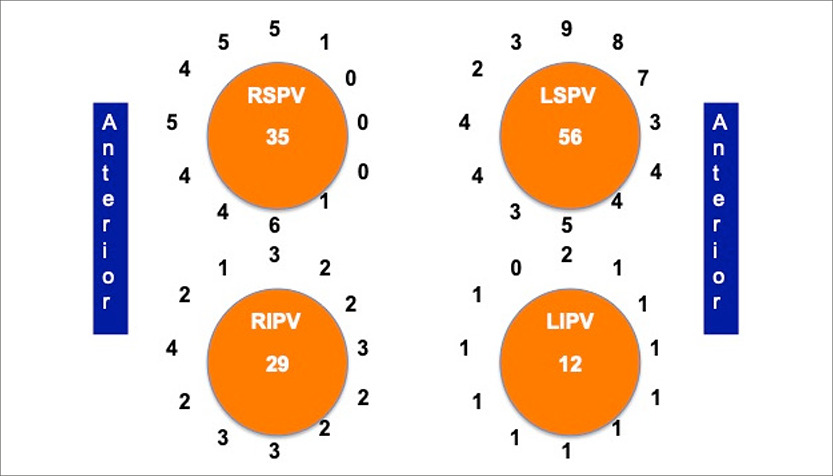
Out of the 165 patients who underwent initial PVI, 27 required redo ablations, of which 18 (66.6%) were males, with a mean age of 55+12.3 years. The time of recurrence was 8.9+6.4 months. PV reconnection was found in 21 (77.8%) patients. There was a total of 132 conduction gaps, six per patient, 3.6 per PV. A significant number of gaps were in the anterosuperior region of the left superior PV (LSPV), and in the septal and inferior regions of the right superior PV (RSPV).

Conclusions

The upper PVs had the most reconnection sites, mostly at the anterior region of the LSPV and the septal region of the RSPV. The reason behind this may be due to greater atrial wall thickness, and difficulty in achieving adequate cryoballoon contact.
  • Arrhythmias Cardiac
  • Atrial Fibrillation, Pulmonary Veins
  • Electrocardiography, Ambulatory
  • Electrocardiography/methods
  • Holter
  • Radio Waves
  • Tachycardia, Ectopic Atrial
Read Full Article
Creative Commons Attribution (CC BY) Creative Commons license
26/07/2021 DOI: 10.36660/abc.20190503
Seasonal variation of ventricular tachycardia registered in 24-hour Holter monitoring
ABC
Artigo Original

Seasonal variation of ventricular tachycardia registered in 24-hour Holter monitoring

Maurício Pimentel et al. Letícia Grüdtner Leandro I. Zimerman

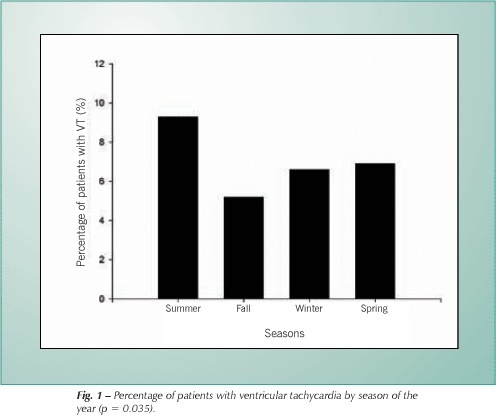
OBJECTIVE: To evaluate the seasonal variation of ventricular arrhythmias and its correlation with ambient temperature in patients submitted to 24-hour Holter monitoring in the city of Porto Alegre, southern Brazil. METHODS: Holter monitoring reports of 3,034 patients from 1996 to 2002 were analyzed. Ventricular tachycardia (VT) was defined as the presence of 3 or more consecutive ventricular beats, at a rate equal to or higher than 100 beats per minute. Percentage distribution of patients presenting VT by seasons and its correlation with ambient temperature were analyzed. RESULTS: Mean age was 59.2 ± 17.4 years, with a predominance of the female sex (61.9%). Patient distribution by season of the year was: 561 (18.5%) in summer, 756 (24.9%) in fall, 843 (27.8%) in winter and 874 (28.8%) in spring. Fifty-two patients (9.3%) presented VT episodes in summer, 39 (5.2%) in autumn, 56 (6.6%) in winter and 60 (6.9%) in spring (p = 0.035). There was a 40% relative increase in the proportion of patients presenting VT during summer in comparison to winter. There was a trend of increase in the proportion of patients presenting VT with rising temperatures (r = 0.57; p = 0.052). CONCLUSION: The occurrence of VT presents seasonal variations in southern Brazil, with a higher proportion of episodes occurring in summer. There is an association trend between VT and temperature increase.

  • Holter
  • seasons
  • Ventricular tachycardia
Read Full Article
Creative Commons Attribution (CC BY) Creative Commons license
21/11/2006 DOI: 10.1590/S0066-782X2006001700002
ABC
Artigo Original

Contribution of the dynamic eletrocardiography by Holter monitoring in the evaluation of congenital long QT syndrome patients

Ivan G. Maia et al. Marcio L. A. Fagundes Fernando E. S. Cruz Fº Rosa Célia P. Barbosa Paulo A. G. Alves

PURPOSE: The purpose of this study was to evaluate the value of ambulatory electrocardiogram as a clinical tool to assess ventricular repolarization in patients with the congenital long QT syndrome. METHODS: The study population comprised six patients and their data were compared to a control group of six patients matched in age and gender. The QT interval (ms), corrected by the heart rate, was measured in the first minute of each hour using two monitoring leads, with the mean of six consecutives complexes. The data obtained include the morphologic pattern of T wave, the mean 24-h QTc interval, relation between QT and cardiac cycle, QTc variability (assessed calculating hourly standard deviation of the interval and then obtaining the global 24-h mean), QTc dispersion (difference between the longest and shortest QTc interval). RESULTS: In all patients abnormal patterns of T waves were detected with frequent episodes of T wave alternans. Mean 24-h QTc – patients: 598.2±73.8ms; controls: 436.1±8.9ms (p=0.000). Linear correlation and regression between QT and heart rate – patients: r= 0.812; controls: r= 0.967 (p=0.000). QTc variability – patients: 36.9±17.2ms; controls: 14.7±2.1ms (p=0.01). QTc dispersion – patients: 168.3±70.2ms; controls: 53.3±8.1ms (p=0.000). CONCLUSION: The data showed increased hourly QTc variability, QTc dispersion and worse correlation between QT and heart rate. This data may reflect an abnormally augmented ventricular vulnerability.

  • congenital long QT syndrome
  • Holter
  • QT interval
Read Full Article
Creative Commons Attribution (CC BY) Creative Commons license
07/12/2000 DOI: 10.1590/S0066-782X1998000700009 Views 1

How to cite this article

EndNote RIS

Electronic Document Format (Vancouver)

Nolasco RR, Leon-Larios GD, Bazzini-Carranza DE, Zavaleta E, Calixto-Vargas O. Reconnection Sites in Redo Ablation after Cryoballoon Pulmonary Vein Isolation in Patients with Paroxysmal Atrial Fibrillation. Arquivos Brasileiros de Cardiologia 2021;117(1):100-5.

Electronic Document Format (ABNT)

Nolasco, Rogelio Robledo; Leon-Larios, Gerardo De; Bazzini-Carranza, David Eduardo; Zavaleta, Elias; Calixto-Vargas, Omar. Reconnection Sites in Redo Ablation after Cryoballoon Pulmonary Vein Isolation in Patients with Paroxysmal Atrial Fibrillation. Arquivos Brasileiros de Cardiologia, v. 117, n. 1, p. 100-105, Jul. 2021.

Electronic Document Format (APA)

Nolasco, R. R., Leon-Larios, G. D., Bazzini-Carranza, D. E., Zavaleta, E., & Calixto-Vargas, O. (2021). Reconnection Sites in Redo Ablation after Cryoballoon Pulmonary Vein Isolation in Patients with Paroxysmal Atrial Fibrillation. Arquivos Brasileiros de Cardiologia, 117(1), 100-105.

Electronic Document Format (ISO)

Nolasco, Rogelio Robledo and Leon-Larios, Gerardo De and Bazzini-Carranza, David Eduardo and Zavaleta, Elias and Calixto-Vargas, Omar. Reconnection Sites in Redo Ablation after Cryoballoon Pulmonary Vein Isolation in Patients with Paroxysmal Atrial Fibrillation. Arquivos Brasileiros de Cardiologia [online]. 2021, vol. 117, n. 1, [cited 2026-10-14], pp. 100-105. Available from: <https://journals.cardiol.br/en/article/reconnection-sites-in-redo-ablation-after-cryoballoon-pulmonary-vein-isolation-in-patients-with-paroxysmal-atrial-fibrillation/>. ISSN 0066-782X

EndNote RIS

Electronic Document Format (Vancouver)

Pimentel M, Grüdtner L, Zimerman LI. Seasonal variation of ventricular tachycardia registered in 24-hour Holter monitoring. Arquivos Brasileiros de Cardiologia 2006;87(4):403-6.

Electronic Document Format (ABNT)

Pimentel, Maurício; Grüdtner, Letícia; Zimerman, Leandro I.. Seasonal variation of ventricular tachycardia registered in 24-hour Holter monitoring. Arquivos Brasileiros de Cardiologia, v. 87, n. 4, p. 403-406, Nov. 2006.

Electronic Document Format (APA)

Pimentel, M., Grüdtner, L., & Zimerman, L. I. (2006). Seasonal variation of ventricular tachycardia registered in 24-hour Holter monitoring. Arquivos Brasileiros de Cardiologia, 87(4), 403-406.

Electronic Document Format (ISO)

Pimentel, Maurício and Grüdtner, Letícia and Zimerman, Leandro I.. Seasonal variation of ventricular tachycardia registered in 24-hour Holter monitoring. Arquivos Brasileiros de Cardiologia [online]. 2006, vol. 87, n. 4, [cited 2026-10-14], pp. 403-406. Available from: <https://journals.cardiol.br/en/article/seasonal-variation-of-ventricular-tachycardia-registered-in-24-hour-holter-monitoring/>. ISSN 0066-782X

EndNote RIS

Electronic Document Format (Vancouver)

Maia IG, Fagundes MLA, Fº FESC, Barbosa RCP, Alves PAG. Contribution of the dynamic eletrocardiography by Holter monitoring in the evaluation of congenital long QT syndrome patients. Arquivos Brasileiros de Cardiologia 2000;71(1):49-54.

Electronic Document Format (ABNT)

Maia, Ivan G.; Fagundes, Marcio L. A.; Fº, Fernando E. S. Cruz; Barbosa, Rosa Célia P.; Alves, Paulo A. G.. Contribution of the dynamic eletrocardiography by Holter monitoring in the evaluation of congenital long QT syndrome patients. Arquivos Brasileiros de Cardiologia, v. 71, n. 1, p. 49-54, Dec. 2000.

Electronic Document Format (APA)

Maia, I. G., Fagundes, M. L. A., Fº, F. E. S. C., Barbosa, R. C. P., & Alves, P. A. G. (2000). Contribution of the dynamic eletrocardiography by Holter monitoring in the evaluation of congenital long QT syndrome patients. Arquivos Brasileiros de Cardiologia, 71(1), 49-54.

Electronic Document Format (ISO)

Maia, Ivan G. and Fagundes, Marcio L. A. and Fº, Fernando E. S. Cruz and Barbosa, Rosa Célia P. and Alves, Paulo A. G.. Contribution of the dynamic eletrocardiography by Holter monitoring in the evaluation of congenital long QT syndrome patients. Arquivos Brasileiros de Cardiologia [online]. 2000, vol. 71, n. 1, [cited 2026-10-14], pp. 49-54. Available from: <https://journals.cardiol.br/en/article/contribution-of-the-dynamic-eletrocardiography-by-holter-monitoring-in-the-evaluation-of-congenital-long-qt-syndrome-patients/>. ISSN 0066-782X

  • About ABC Family
  • Internal Regulation
  • Editorial Board
  • Brazilian Society of Cardiology (SBC)

Issues

SBC Guidelines

  • Videos
  • Podcasts
  • News