ABC Family Arquivos Brasileiros de Cardiologia International Journal of Cardiovascular Sciences ABC Heart Failure & Cardiomyopathy ABC Imagem Cardiovascular
Português English
ABC Family
Português English
  • About
    • About ABC Family
    • Internal Regulation
    • Editorial Board
    • Brazilian Society of Cardiology (SBC)
  • Issues
  • SBC Guidelines
  • Content
    • Videos
    • Podcasts
    • News
  • About
    • About ABC Family
    • Internal Regulation
    • Editorial Board
    • Brazilian Society of Cardiology (SBC)
  • Issues
  • SBC Guidelines
  • Content
    • Videos
    • Podcasts
    • News

ABC Family

  • ABC Family
  • Arquivos Brasileiros de Cardiologia
  • International Journal of Cardiovascular Sciences
  • ABC Heart Failure & Cardiomyopathy
  • ABC Imagem Cardiovascular
Search in

No content found.

Journals
Ordering
Article types
Others

  1. Home
  2. Keyword: QT interval
ABC
Editorial

Revisiting the QT Interval: An Old Marker for a New Disease?

Luiz Eduardo Montenegro Camanho

The SARS-Cov-2 (Covid-19) infection had its first cases reported in December 2019 in China and quickly spread worldwide, being announced as a pandemic in March 2020 by the World Health Organization. Respiratory manifestations are classic; however, cardiovascular complications can occur due to an indirect cardiac involvement or a direct action of the virus in the myocardial tissue. Consequently, we can find heart failure, myocarditis, arrhythmias, and cardiogenic shock.

The QT interval, measured from the beginning of the QRS complex to the end of the T wave, represents the process of ventricular depolarization and repolarization and varies with heart rate. Normal values for the corrected QT interval (QTc) would be≥450 ms in men and≥460 ms in women. Prolongation of the QTc interval≥500 ms is strongly associated with the occurrence of malignant arrhythmias and sudden death. Every 10 ms of QTc interval increment, there is a 5 to 7% increase in the risk of torsade de Pointes (TdP); every 20 ms, there is a substantial imminent risk.

[…]

  • Long QT
  • Long QT Syndrome
  • QT interval
Read Full Article
Creative Commons Attribution (CC BY) Creative Commons license
13/02/2023 DOI: 10.36660/abc.20220878 Views 1
Electrocardiographic abnormalities in neurological diseases
ABC
Original Article

Electrocardiographic abnormalities in neurological diseases

Rui Póvoa et al. Luciano Cavichio Ana Lúcia de Almeida Danielle Viotti … Celso Ferreira Luciane Galvão João Pimenta

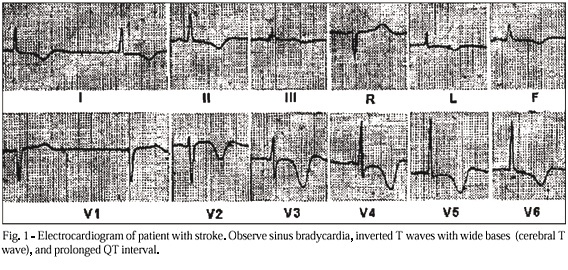
OBJECTIVE: To evaluate electrocardiographic abnormalities in patients with neurologic diseases. METHODS: We studied 161 patients with neurologic disorders by analyzing the 12-lead electrocardiogram during the pathological process. An expert who did not know anything about the patients evaluated the traces. RESULTS: Neurological process included brain tumor (41%), stroke (27.3%), cerebral aneurysm (15.5%), subarachnoid hemorrhage (6.8%), subdural hemorrhage (5%), and head injury (4.4%). Electrocardiograms were normal in 61% of cases, and the most frequent abnormality was ventricular repolarization (23.7%). The presence of T waves (4.6%) and prolonged QT intervals (8.8%) was the most characteristic of brain injuries. CONCLUSION: We observed a lower incidence of electrocardiographic abnormalities than that described in the literature.

  • Electrocardiography
  • neurologic diseases
  • QT interval
Read Full Article
Creative Commons Attribution (CC BY) Creative Commons license
19/05/2003 DOI: 10.1590/S0066-782X2003000400001 Views 1
ABC
Artigo Original

Contribution of the dynamic eletrocardiography by Holter monitoring in the evaluation of congenital long QT syndrome patients

Ivan G. Maia et al. Marcio L. A. Fagundes Fernando E. S. Cruz Fº Rosa Célia P. Barbosa Paulo A. G. Alves

PURPOSE: The purpose of this study was to evaluate the value of ambulatory electrocardiogram as a clinical tool to assess ventricular repolarization in patients with the congenital long QT syndrome. METHODS: The study population comprised six patients and their data were compared to a control group of six patients matched in age and gender. The QT interval (ms), corrected by the heart rate, was measured in the first minute of each hour using two monitoring leads, with the mean of six consecutives complexes. The data obtained include the morphologic pattern of T wave, the mean 24-h QTc interval, relation between QT and cardiac cycle, QTc variability (assessed calculating hourly standard deviation of the interval and then obtaining the global 24-h mean), QTc dispersion (difference between the longest and shortest QTc interval). RESULTS: In all patients abnormal patterns of T waves were detected with frequent episodes of T wave alternans. Mean 24-h QTc – patients: 598.2±73.8ms; controls: 436.1±8.9ms (p=0.000). Linear correlation and regression between QT and heart rate – patients: r= 0.812; controls: r= 0.967 (p=0.000). QTc variability – patients: 36.9±17.2ms; controls: 14.7±2.1ms (p=0.01). QTc dispersion – patients: 168.3±70.2ms; controls: 53.3±8.1ms (p=0.000). CONCLUSION: The data showed increased hourly QTc variability, QTc dispersion and worse correlation between QT and heart rate. This data may reflect an abnormally augmented ventricular vulnerability.

  • congenital long QT syndrome
  • Holter
  • QT interval
Read Full Article
Creative Commons Attribution (CC BY) Creative Commons license
07/12/2000 DOI: 10.1590/S0066-782X1998000700009 Views 1

How to cite this article

EndNote RIS

Electronic Document Format (Vancouver)

Camanho LEM. Revisiting the QT Interval: An Old Marker for a New Disease?. Arquivos Brasileiros de Cardiologia 2023;120(1):e20220878.

Electronic Document Format (ABNT)

Camanho, Luiz Eduardo Montenegro. Revisiting the QT Interval: An Old Marker for a New Disease?. Arquivos Brasileiros de Cardiologia, v. 120, n. 1, e20220878, Feb. 2023.

Electronic Document Format (APA)

Camanho, L. E. M. (2023). Revisiting the QT Interval: An Old Marker for a New Disease?. Arquivos Brasileiros de Cardiologia, 120(1), e20220878.

Electronic Document Format (ISO)

Camanho, Luiz Eduardo Montenegro. Revisiting the QT Interval: An Old Marker for a New Disease?. Arquivos Brasileiros de Cardiologia [online]. 2023, vol. 120, n. 1, [cited 2026-10-14], e20220878. Available from: <https://journals.cardiol.br/en/article/revisiting-the-qt-interval-an-old-marker-for-a-new-disease/>. ISSN 0066-782X

EndNote RIS

Electronic Document Format (Vancouver)

Póvoa R, Cavichio L, Almeida AL, Viotti D, Ferreira C, Galvão L, Pimenta J, et al. Electrocardiographic abnormalities in neurological diseases. Arquivos Brasileiros de Cardiologia 2003;80(4):355-8.

Electronic Document Format (ABNT)

Póvoa, Rui; Cavichio, Luciano; Almeida, Ana Lúcia de; Viotti, Danielle; Ferreira, Celso; Galvão, Luciane; Pimenta, João. Electrocardiographic abnormalities in neurological diseases. Arquivos Brasileiros de Cardiologia, v. 80, n. 4, p. 355-358, May. 2003.

Electronic Document Format (APA)

Póvoa, R., Cavichio, L., Almeida, A. L. , Viotti, D., Ferreira, C., Galvão, L., & Pimenta, J. (2003). Electrocardiographic abnormalities in neurological diseases. Arquivos Brasileiros de Cardiologia, 80(4), 355-358.

Electronic Document Format (ISO)

Póvoa, Rui and Cavichio, Luciano and Almeida, Ana Lúcia de and Viotti, Danielle and Ferreira, Celso and Galvão, Luciane and Pimenta, João. Electrocardiographic abnormalities in neurological diseases. Arquivos Brasileiros de Cardiologia [online]. 2003, vol. 80, n. 4, [cited 2026-10-14], pp. 355-358. Available from: <https://journals.cardiol.br/en/article/electrocardiographic-abnormalities-in-neurological-diseases/>. ISSN 0066-782X

EndNote RIS

Electronic Document Format (Vancouver)

Maia IG, Fagundes MLA, Fº FESC, Barbosa RCP, Alves PAG. Contribution of the dynamic eletrocardiography by Holter monitoring in the evaluation of congenital long QT syndrome patients. Arquivos Brasileiros de Cardiologia 2000;71(1):49-54.

Electronic Document Format (ABNT)

Maia, Ivan G.; Fagundes, Marcio L. A.; Fº, Fernando E. S. Cruz; Barbosa, Rosa Célia P.; Alves, Paulo A. G.. Contribution of the dynamic eletrocardiography by Holter monitoring in the evaluation of congenital long QT syndrome patients. Arquivos Brasileiros de Cardiologia, v. 71, n. 1, p. 49-54, Dec. 2000.

Electronic Document Format (APA)

Maia, I. G., Fagundes, M. L. A., Fº, F. E. S. C., Barbosa, R. C. P., & Alves, P. A. G. (2000). Contribution of the dynamic eletrocardiography by Holter monitoring in the evaluation of congenital long QT syndrome patients. Arquivos Brasileiros de Cardiologia, 71(1), 49-54.

Electronic Document Format (ISO)

Maia, Ivan G. and Fagundes, Marcio L. A. and Fº, Fernando E. S. Cruz and Barbosa, Rosa Célia P. and Alves, Paulo A. G.. Contribution of the dynamic eletrocardiography by Holter monitoring in the evaluation of congenital long QT syndrome patients. Arquivos Brasileiros de Cardiologia [online]. 2000, vol. 71, n. 1, [cited 2026-10-14], pp. 49-54. Available from: <https://journals.cardiol.br/en/article/contribution-of-the-dynamic-eletrocardiography-by-holter-monitoring-in-the-evaluation-of-congenital-long-qt-syndrome-patients/>. ISSN 0066-782X

  • About ABC Family
  • Internal Regulation
  • Editorial Board
  • Brazilian Society of Cardiology (SBC)

Issues

SBC Guidelines

  • Videos
  • Podcasts
  • News