ABC Family Arquivos Brasileiros de Cardiologia International Journal of Cardiovascular Sciences ABC Heart Failure & Cardiomyopathy ABC Imagem Cardiovascular
Português English
ABC Family
Português English
  • About
    • About ABC Family
    • Internal Regulation
    • Editorial Board
    • Brazilian Society of Cardiology (SBC)
  • Issues
  • SBC Guidelines
  • Content
    • Videos
    • Podcasts
    • News
  • About
    • About ABC Family
    • Internal Regulation
    • Editorial Board
    • Brazilian Society of Cardiology (SBC)
  • Issues
  • SBC Guidelines
  • Content
    • Videos
    • Podcasts
    • News

ABC Family

  • ABC Family
  • Arquivos Brasileiros de Cardiologia
  • International Journal of Cardiovascular Sciences
  • ABC Heart Failure & Cardiomyopathy
  • ABC Imagem Cardiovascular
Search in

No content found.

Journals
Ordering
Article types
Others

  1. Home
  2. Keyword: Flexibility
Figure 1
IJCS
Original Article

Poor Trunk Flexibility is Associated with Cardiovascular Risk Factors

Rafael Felipe Cardoso et al. Maria Sebastiana Silva Cristiane Cominetti Maria Margareth V. Naves

Abstract

Background:

Poor flexibility is a predictor of reduced physical activity. The association between trunk flexibility and cardiovascular risk factors (CVRFs) is not well understood.

Objective:

To identify the prevalence of CVRFs and their association with trunk flexibility in individuals participating in a community-based health education program.

Methods:

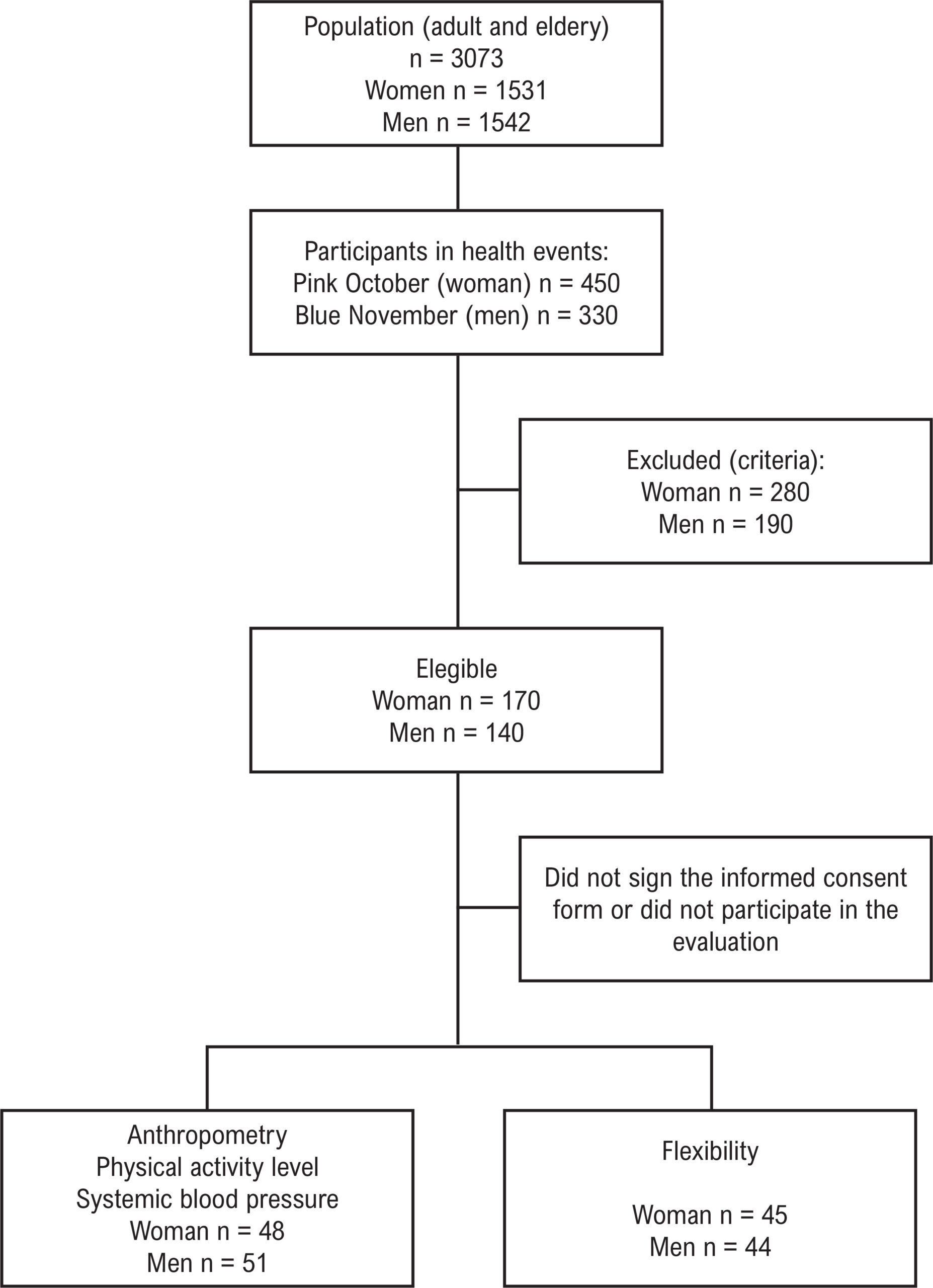
Volunteers (51 men, 48 women) aged 20-85 years old, participants in a community-based health education program in the city of Santo Antônio de Goiás, Brazil, were selected for this study. Anthropometric measures including body mass, height, body mass index (BMI), waist circumference (WC) and waist/height ratio (WHtR) were evaluated. Physical activity level was evaluated based on leisure activity participation, and trunk flexibility was evaluated by the sit and reach test. Data distribution was assessed using the Shapiro-Wilk test; Pearson’s chi-square or Fisher’s exact and Student t tests were performed for comparisons. To analyze the association between trunk flexibility and concomitant CVRFs, Spearman’s correlation test and linear regression were employed. Statistical significance was defined as p < 0.05.

Results:

7.2% of the volunteers had no CVRF, 10.3% had only one CVRF and 82.5% had two or more CVRFs, with no differences between sexes. Increased abdominal adiposity, as assessed by WHtR (p = 0.0097), and systemic arterial hypertension (p = 0.0003) were the most prevalent CVRFs, with differences between age groups. A strong negative correlation was found between mean trunk flexibility and the number of concomitant CVRFs (r = -0.96, p < 0.0028).

Conclusion:

The strong negative correlation between trunk flexibility and concomitant CVRF indicates an increased risk for cardiovascular events. Therefore, trunk flexibility measurement may be an additional tool for health promotion and prevention of cardiovascular and associated diseases in community health programs.
  • Abdominal Adiposity
  • Cardiovascular Diseases
  • Flexibility
  • Risk Factors
  • Waist Height Ratio
Read Full Article
Creative Commons Attribution (CC BY) Creative Commons license
11/02/2022 DOI: 10.36660/ijcs.20210045 Views 1
ABC
Editorial

Cardiac Rehabilitation: Far Beyond Coronary Artery Disease

Claudio Gil Soares de Araújo

Cardiac rehabilitation (CR), as originally proposed in the mid of last century, was primarily aimed at returning life back to normal, with emphasis on aspects of physical, mental and professional plenitude. At that time, a few paradigms were modified. Instead of four to six weeks of bed rest and immobilization following acute myocardial infarction, patients were oriented to sit on chairs, which was described as “armchair treatment“; right after, studies began to show the favorable results of early ambulation. This has evolved and currently the Brazilian Society of Cardiology guidelines proposing and advising how to implement and to start supervised exercise programs for CR. Those guidelines comprise aerobic, muscle strengthening and flexibility exercises to be started as soon as clinical stability is reached after myocardial infarction. Currently CR is aimed at providing patients with better or much better conditions than those prior to the cardiac event or the diagnosis of cardiovascular disease.

Although CR is a frequent and recurring theme of several presentations in scientific meetings of the specialty, being thus known by clinical cardiologists, there is worldwide consensus that only a very small part of patients with coronary artery disease is usually referred by their physicians for CR programs. Several are the reasons for that insufficient referral and they will not be addressed in this editorial.

[…]

  • Cardiovascular Diseases
  • Exercise Programs
  • exercise training
  • Flexibility
  • Physical Exercise
Read Full Article
Creative Commons Attribution (CC BY) Creative Commons license
01/12/2015 DOI: 10.5935/abc.20160002
Flexibility assessment: normative values for flexitest from 5 to 91 years of age
ABC
Artigo Original

Flexibility assessment: normative values for flexitest from 5 to 91 years of age

Claudio Gil Soares de Araújo

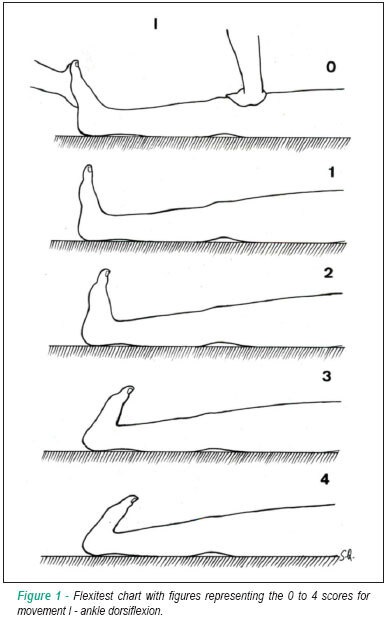
BACKGROUND: Physical exercise plays a role in health-promotion policies and its prescription should be scientifically based. Flexibility is one of the major components of health-related and performance-related physical fitness, and is defined as the maximum physiological passive range of motion of a given joint movement. According to its specificity, the assessment of flexibility should, ideally, incorporate multiple movements. Introduced in 1980 and with redesigned evaluation maps published in 1986, Flexitest consists of the assessment of mobility with the use of a scale from 0 to 4. By adding the individual results of the 20 joint movements assessed, it is possible to obtain a global score called Flexindex. OBJECTIVE: To present Flexitest updated normative values. METHODS: Data were obtained from 4711 non-athlete subjects (2943 men and 1768 women) with age ranging from 5 to 91 years, and were collected by experienced raters. Approximately 70% of the data were collected by the author of the method himself. RESULTS: Considering the data heteroscedasticity and non-parametric distribution, we chose to use age and gender-percentile tables. Flexindex decreases with age and the median results for females are higher than for males of the same age since childhood. This trend becomes stronger with physical development and, later, with the aging process. CONCLUSION: these normative data contribute to a better knowledge of the flexibility behavior with age and gender and will be useful for professionals who assess flexibility in their professional practice.

  • Exercise
  • Flexibility
  • joints
  • Motor Activity
  • range of motion articular
Read Full Article
Creative Commons Attribution (CC BY) Creative Commons license
29/05/2008 DOI: 10.1590/S0066-782X2008000400008 Views 2

How to cite this article

EndNote RIS

Electronic Document Format (Vancouver)

Cardoso RF, Silva MS, Cominetti C, Naves MMV. Poor Trunk Flexibility is Associated with Cardiovascular Risk Factors. International Journal of Cardiovascular Sciences 2022;35(3):391-9.

Electronic Document Format (ABNT)

Cardoso, Rafael Felipe; Silva, Maria Sebastiana; Cominetti, Cristiane; Naves, Maria Margareth V.. Poor Trunk Flexibility is Associated with Cardiovascular Risk Factors. International Journal of Cardiovascular Sciences, v. 35, n. 3, p. 391-399, Feb. 2022.

Electronic Document Format (APA)

Cardoso, R. F., Silva, M. S., Cominetti, C., & Naves, M. M. V. (2022). Poor Trunk Flexibility is Associated with Cardiovascular Risk Factors. International Journal of Cardiovascular Sciences, 35(3), 391-399.

Electronic Document Format (ISO)

Cardoso, Rafael Felipe and Silva, Maria Sebastiana and Cominetti, Cristiane and Naves, Maria Margareth V.. Poor Trunk Flexibility is Associated with Cardiovascular Risk Factors. International Journal of Cardiovascular Sciences [online]. 2022, vol. 35, n. 3, [cited 2026-10-14], pp. 391-399. Available from: <https://journals.cardiol.br/en/article/poor-trunk-flexibility-is-associated-with-cardiovascular-risk-factors/>. ISSN 2359-4802

EndNote RIS

Electronic Document Format (Vancouver)

Araújo CGS. Cardiac Rehabilitation: Far Beyond Coronary Artery Disease. Arquivos Brasileiros de Cardiologia 2015;105(6):549-51.

Electronic Document Format (ABNT)

Araújo, Claudio Gil Soares de. Cardiac Rehabilitation: Far Beyond Coronary Artery Disease. Arquivos Brasileiros de Cardiologia, v. 105, n. 6, p. 549-551, Nov. 2015.

Electronic Document Format (APA)

Araújo, C. G. S. (2015). Cardiac Rehabilitation: Far Beyond Coronary Artery Disease. Arquivos Brasileiros de Cardiologia, 105(6), 549-551.

Electronic Document Format (ISO)

Araújo, Claudio Gil Soares de. Cardiac Rehabilitation: Far Beyond Coronary Artery Disease. Arquivos Brasileiros de Cardiologia [online]. 2015, vol. 105, n. 6, [cited 2026-10-14], pp. 549-551. Available from: <https://journals.cardiol.br/en/article/cardiac-rehabilitation-far-beyond-coronary-artery-disease/>. ISSN 0066-782X

EndNote RIS

Electronic Document Format (Vancouver)

Araújo CGS. Flexibility assessment: normative values for flexitest from 5 to 91 years of age. Arquivos Brasileiros de Cardiologia 2008;90(4):280-7.

Electronic Document Format (ABNT)

Araújo, Claudio Gil Soares de. Flexibility assessment: normative values for flexitest from 5 to 91 years of age. Arquivos Brasileiros de Cardiologia, v. 90, n. 4, p. 280-287, May. 2008.

Electronic Document Format (APA)

Araújo, C. G. S. (2008). Flexibility assessment: normative values for flexitest from 5 to 91 years of age. Arquivos Brasileiros de Cardiologia, 90(4), 280-287.

Electronic Document Format (ISO)

Araújo, Claudio Gil Soares de. Flexibility assessment: normative values for flexitest from 5 to 91 years of age. Arquivos Brasileiros de Cardiologia [online]. 2008, vol. 90, n. 4, [cited 2026-10-14], pp. 280-287. Available from: <https://journals.cardiol.br/en/article/flexibility-assessment-normative-values-for-flexitest-from-5-to-91-years-of-age/>. ISSN 0066-782X

  • About ABC Family
  • Internal Regulation
  • Editorial Board
  • Brazilian Society of Cardiology (SBC)

Issues

SBC Guidelines

  • Videos
  • Podcasts
  • News