ABC Family Arquivos Brasileiros de Cardiologia International Journal of Cardiovascular Sciences ABC Heart Failure & Cardiomyopathy ABC Imagem Cardiovascular
Português English
ABC Family
Português English
  • About
    • About ABC Family
    • Internal Regulation
    • Editorial Board
    • Brazilian Society of Cardiology (SBC)
  • Issues
  • SBC Guidelines
  • Content
    • Videos
    • Podcasts
    • News
  • About
    • About ABC Family
    • Internal Regulation
    • Editorial Board
    • Brazilian Society of Cardiology (SBC)
  • Issues
  • SBC Guidelines
  • Content
    • Videos
    • Podcasts
    • News

ABC Family

  • ABC Family
  • Arquivos Brasileiros de Cardiologia
  • International Journal of Cardiovascular Sciences
  • ABC Heart Failure & Cardiomyopathy
  • ABC Imagem Cardiovascular
Search in

No content found.

Journals
Ordering
Article types
Others

  1. Home
  2. Keyword: exercise training
ABC
Editorial

Cardiac Rehabilitation: Far Beyond Coronary Artery Disease

Claudio Gil Soares de Araújo

Cardiac rehabilitation (CR), as originally proposed in the mid of last century, was primarily aimed at returning life back to normal, with emphasis on aspects of physical, mental and professional plenitude. At that time, a few paradigms were modified. Instead of four to six weeks of bed rest and immobilization following acute myocardial infarction, patients were oriented to sit on chairs, which was described as “armchair treatment“; right after, studies began to show the favorable results of early ambulation. This has evolved and currently the Brazilian Society of Cardiology guidelines proposing and advising how to implement and to start supervised exercise programs for CR. Those guidelines comprise aerobic, muscle strengthening and flexibility exercises to be started as soon as clinical stability is reached after myocardial infarction. Currently CR is aimed at providing patients with better or much better conditions than those prior to the cardiac event or the diagnosis of cardiovascular disease.

Although CR is a frequent and recurring theme of several presentations in scientific meetings of the specialty, being thus known by clinical cardiologists, there is worldwide consensus that only a very small part of patients with coronary artery disease is usually referred by their physicians for CR programs. Several are the reasons for that insufficient referral and they will not be addressed in this editorial.

[…]

  • Cardiovascular Diseases
  • Exercise Programs
  • exercise training
  • Flexibility
  • Physical Exercise
Read Full Article
Creative Commons Attribution (CC BY) Creative Commons license
01/12/2015 DOI: 10.5935/abc.20160002
Benefits of exercise training in the treatment of heart failure: study with a control group
ABC
Original Article

Benefits of exercise training in the treatment of heart failure: study with a control group

Mário Sérgio Vaz da Silva et al. Edimar Alcides Bocchi Guilherme Veiga Guimarães Carlos Roberto Padovani … Maria Helena Gaíva G. da Silva Shirley Ferreira Pereira Ronaldo Ducchesi Fontes

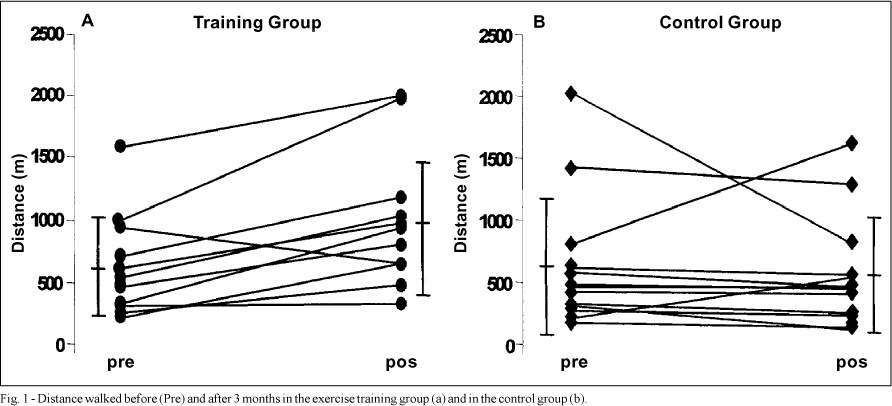
OBJECTIVE: Exercise training programs have been proposed as adjuncts to treatment of heart failure. The effects of a 3-month-exercise-training-program with 3 exercise sessions per week were assessed in patients with stable systolic chronic heart failure. METHODS: We studied 24 patients with final left ventricle diastolic diameter of 70±10mm and left ventricular ejection fraction of 37±4%. Mean age was 52±16 years. Twelve patients were assigned to an exercise training group (G1), and 12 patients were assigned to a control group (G2). Patients underwent treadmill testing, before and after exercise training, to assess distance walked, heart rate, systolic blood pressure, and double product. RESULTS: In G2 group, before and after 3 months, we observed, respectively distance walked, 623±553 and 561± 460m (ns); peak heart rate, 142±23 and 146± 33b/min (ns); systolic blood pressure, 154±36 and 164±26 mmHg (ns); and double product, 22211± 6454 and 24293±7373 (ns). In G1 group, before and after exercise, we observed: distance walked, 615±394 and 970± 537m (p<0.003) peak heart rate, 143±24 and 143±29b/min (ns); systolic blood pressure, 136±33 and 133±24 mmHg (ns); and double product, 19907± 7323 and 19115±5776, respectively. Comparing the groups, a significant difference existed regarding the variation in the double product, and in distance walked. CONCLUSION: Exercise training programs in patients with heart failure can bring about an improvement in physical capacity.

  • Exercise
  • exercise training
  • Heart Failure
Read Full Article
Creative Commons Attribution (CC BY) Creative Commons license
06/11/2002 DOI: 10.1590/S0066-782X2002001300003

How to cite this article

EndNote RIS

Electronic Document Format (Vancouver)

Araújo CGS. Cardiac Rehabilitation: Far Beyond Coronary Artery Disease. Arquivos Brasileiros de Cardiologia 2015;105(6):549-51.

Electronic Document Format (ABNT)

Araújo, Claudio Gil Soares de. Cardiac Rehabilitation: Far Beyond Coronary Artery Disease. Arquivos Brasileiros de Cardiologia, v. 105, n. 6, p. 549-551, Nov. 2015.

Electronic Document Format (APA)

Araújo, C. G. S. (2015). Cardiac Rehabilitation: Far Beyond Coronary Artery Disease. Arquivos Brasileiros de Cardiologia, 105(6), 549-551.

Electronic Document Format (ISO)

Araújo, Claudio Gil Soares de. Cardiac Rehabilitation: Far Beyond Coronary Artery Disease. Arquivos Brasileiros de Cardiologia [online]. 2015, vol. 105, n. 6, [cited 2026-10-14], pp. 549-551. Available from: <https://journals.cardiol.br/en/article/cardiac-rehabilitation-far-beyond-coronary-artery-disease/>. ISSN 0066-782X

EndNote RIS

Electronic Document Format (Vancouver)

Silva MSV, Bocchi EA, Guimarães GV, Padovani CR, Silva MHGG, Pereira SF, Fontes RD, et al. Benefits of exercise training in the treatment of heart failure: study with a control group. Arquivos Brasileiros de Cardiologia 2002;79(4):357-62.

Electronic Document Format (ABNT)

Silva, Mário Sérgio Vaz da; Bocchi, Edimar Alcides; Guimarães, Guilherme Veiga; Padovani, Carlos Roberto; Silva, Maria Helena Gaíva G. da; Pereira, Shirley Ferreira; Fontes, Ronaldo Ducchesi. Benefits of exercise training in the treatment of heart failure: study with a control group. Arquivos Brasileiros de Cardiologia, v. 79, n. 4, p. 357-362, Nov. 2002.

Electronic Document Format (APA)

Silva, M. S. V. , Bocchi, E. A., Guimarães, G. V., Padovani, C. R., Silva, M. H. G. G. , Pereira, S. F., & Fontes, R. D. (2002). Benefits of exercise training in the treatment of heart failure: study with a control group. Arquivos Brasileiros de Cardiologia, 79(4), 357-362.

Electronic Document Format (ISO)

Silva, Mário Sérgio Vaz da and Bocchi, Edimar Alcides and Guimarães, Guilherme Veiga and Padovani, Carlos Roberto and Silva, Maria Helena Gaíva G. da and Pereira, Shirley Ferreira and Fontes, Ronaldo Ducchesi. Benefits of exercise training in the treatment of heart failure: study with a control group. Arquivos Brasileiros de Cardiologia [online]. 2002, vol. 79, n. 4, [cited 2026-10-14], pp. 357-362. Available from: <https://journals.cardiol.br/en/article/benefits-of-exercise-training-in-the-treatment-of-heart-failure-study-with-a-control-group/>. ISSN 0066-782X

  • About ABC Family
  • Internal Regulation
  • Editorial Board
  • Brazilian Society of Cardiology (SBC)

Issues

SBC Guidelines

  • Videos
  • Podcasts
  • News