ABC Family Arquivos Brasileiros de Cardiologia International Journal of Cardiovascular Sciences ABC Heart Failure & Cardiomyopathy ABC Imagem Cardiovascular
Português English
ABC Family
Português English
  • About
    • About ABC Family
    • Internal Regulation
    • Editorial Board
    • Brazilian Society of Cardiology (SBC)
  • Issues
  • SBC Guidelines
  • Content
    • Videos
    • Podcasts
    • News
  • About
    • About ABC Family
    • Internal Regulation
    • Editorial Board
    • Brazilian Society of Cardiology (SBC)
  • Issues
  • SBC Guidelines
  • Content
    • Videos
    • Podcasts
    • News

ABC Family

  • ABC Family
  • Arquivos Brasileiros de Cardiologia
  • International Journal of Cardiovascular Sciences
  • ABC Heart Failure & Cardiomyopathy
  • ABC Imagem Cardiovascular
Search in

No content found.

Journals
Ordering
Article types
Others

  1. Home
  2. Keyword: range of motion articular
Flexibility assessment: normative values for flexitest from 5 to 91 years of age
ABC
Artigo Original

Flexibility assessment: normative values for flexitest from 5 to 91 years of age

Claudio Gil Soares de Araújo

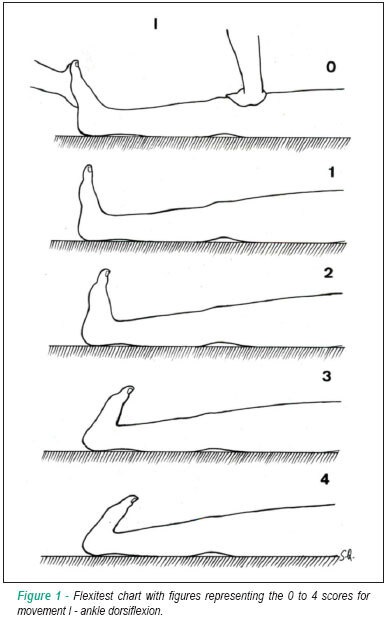
BACKGROUND: Physical exercise plays a role in health-promotion policies and its prescription should be scientifically based. Flexibility is one of the major components of health-related and performance-related physical fitness, and is defined as the maximum physiological passive range of motion of a given joint movement. According to its specificity, the assessment of flexibility should, ideally, incorporate multiple movements. Introduced in 1980 and with redesigned evaluation maps published in 1986, Flexitest consists of the assessment of mobility with the use of a scale from 0 to 4. By adding the individual results of the 20 joint movements assessed, it is possible to obtain a global score called Flexindex. OBJECTIVE: To present Flexitest updated normative values. METHODS: Data were obtained from 4711 non-athlete subjects (2943 men and 1768 women) with age ranging from 5 to 91 years, and were collected by experienced raters. Approximately 70% of the data were collected by the author of the method himself. RESULTS: Considering the data heteroscedasticity and non-parametric distribution, we chose to use age and gender-percentile tables. Flexindex decreases with age and the median results for females are higher than for males of the same age since childhood. This trend becomes stronger with physical development and, later, with the aging process. CONCLUSION: these normative data contribute to a better knowledge of the flexibility behavior with age and gender and will be useful for professionals who assess flexibility in their professional practice.

  • Exercise
  • Flexibility
  • joints
  • Motor Activity
  • range of motion articular
Read Full Article
Creative Commons Attribution (CC BY) Creative Commons license
29/05/2008 DOI: 10.1590/S0066-782X2008000400008 Views 2

How to cite this article

EndNote RIS

Electronic Document Format (Vancouver)

Araújo CGS. Flexibility assessment: normative values for flexitest from 5 to 91 years of age. Arquivos Brasileiros de Cardiologia 2008;90(4):280-7.

Electronic Document Format (ABNT)

Araújo, Claudio Gil Soares de. Flexibility assessment: normative values for flexitest from 5 to 91 years of age. Arquivos Brasileiros de Cardiologia, v. 90, n. 4, p. 280-287, May. 2008.

Electronic Document Format (APA)

Araújo, C. G. S. (2008). Flexibility assessment: normative values for flexitest from 5 to 91 years of age. Arquivos Brasileiros de Cardiologia, 90(4), 280-287.

Electronic Document Format (ISO)

Araújo, Claudio Gil Soares de. Flexibility assessment: normative values for flexitest from 5 to 91 years of age. Arquivos Brasileiros de Cardiologia [online]. 2008, vol. 90, n. 4, [cited 2026-10-14], pp. 280-287. Available from: <https://journals.cardiol.br/en/article/flexibility-assessment-normative-values-for-flexitest-from-5-to-91-years-of-age/>. ISSN 0066-782X

  • About ABC Family
  • Internal Regulation
  • Editorial Board
  • Brazilian Society of Cardiology (SBC)

Issues

SBC Guidelines

  • Videos
  • Podcasts
  • News