ABC Family Arquivos Brasileiros de Cardiologia International Journal of Cardiovascular Sciences ABC Heart Failure & Cardiomyopathy ABC Imagem Cardiovascular
Português English
ABC Family
Português English
  • About
    • About ABC Family
    • Internal Regulation
    • Editorial Board
    • Brazilian Society of Cardiology (SBC)
  • Issues
  • SBC Guidelines
  • Content
    • Videos
    • Podcasts
    • News
  • About
    • About ABC Family
    • Internal Regulation
    • Editorial Board
    • Brazilian Society of Cardiology (SBC)
  • Issues
  • SBC Guidelines
  • Content
    • Videos
    • Podcasts
    • News

ABC Family

  • ABC Family
  • Arquivos Brasileiros de Cardiologia
  • International Journal of Cardiovascular Sciences
  • ABC Heart Failure & Cardiomyopathy
  • ABC Imagem Cardiovascular
Search in

No content found.

Journals
Ordering
Article types
Others

  1. Home
  2. Keyword: Estrogen Replacement Therapy/adverse effects
ABC
Editorial

Overcoming Women’s Lifelong Hormonal Rollercoaster: A Turning Point for Cardiovascular Prevention

M. Julia Machline-Carrion

Although cardiovascular diseases (CVD), especially coronary artery disease and stroke, are the leading cause of death and disability in Brazil, both in women and men, , addressing cardiovascular (CV) prevention implies a comprehensive approach to the inherent differences related to sex. In this sense, understanding, for instance, the role of hypertension, a major risk factor for coronary artery disease and stroke in Brazilian women, in the context of this population’s specificities is key.

Hypertensive disorders, including pregnancy-induced hypertension (occurring in 6-7% of pregnancies) and preeclampsia/eclampsia (occurring in up to 10% of pregnancies), are important CV risk factors , that should be accounted for when assessing women’s CV risk.

[…]

  • Estrogen Replacement Therapy/adverse effects
  • Menopause
  • Prevention and Control
  • Progestins/adverse effects
  • Risk Factors
  • Women
Read Full Article
Creative Commons Attribution (CC BY) Creative Commons license
13/05/2022 DOI: 10.36660/abc.20220259
Figure 1
ABC
Original Article

Changes in Cardiac Autonomic Modulation in Women with Breast Cancer Using Aromatase Inhibitors and the Relation with Biochemical Variables

Luana Almeida Gonzaga et al. Thais Reis Silva de Paulo Juliana Viezel Laís Manata Vanzella … Ismael Forte Freitas Jr. Luiz Carlos Marques Vanderlei

Abstract

Background:

The use of autonomic modulation as a predictor of cardiovascular risk in women with breast cancer is important.

Objective:

To evaluate the cardiac autonomic modulation of postmenopausal women using aromatase inhibitors for breast cancer treatment, as well as its relation with the following biochemical variables.

Methods:

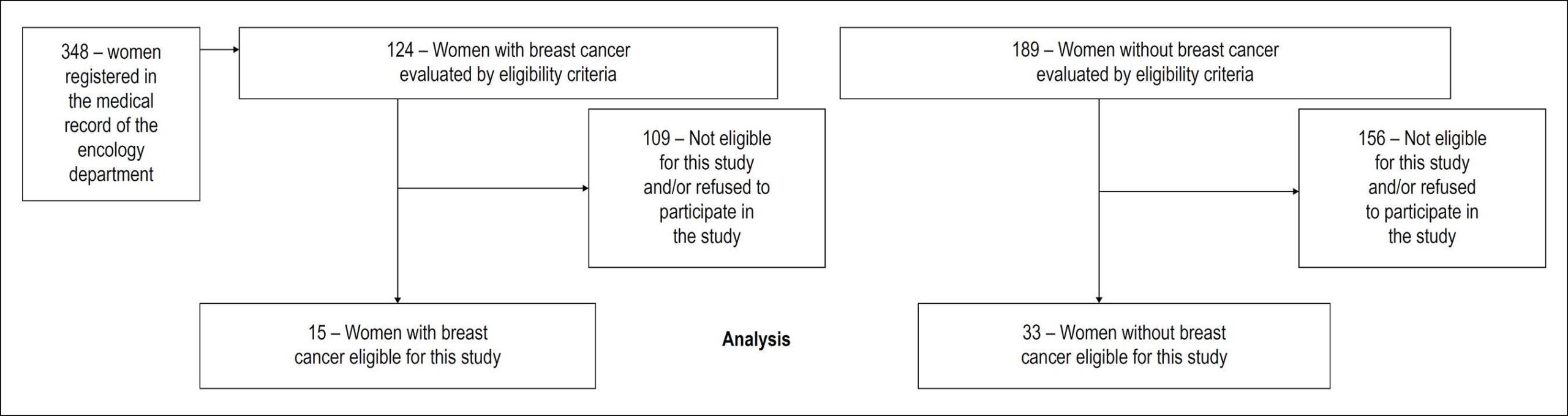
Postmenopausal women who did not have breast cancer (n = 33) and postmenopausal women with breast cancer (n = 15). For evaluation of the autonomic modulation the heart rate was recorded beat-to-beat for 30 minutes and the series of RR intervals obtained were used to calculate the following heart rate variability indices: Mean RR ms, SDNN (standard deviation of all normal RR intervals, expressed in milliseconds) ms, Mean HR, RMSSD (square root of the mean of the squared differences between adjacent normal RR interval) ms, NN50 (number of pairs of successive NNs that differ by more than 50 ms) count, pNN50% (proportion of NN50 divided by total number of NNs), RRtri (RR triangular), TINN (triangular interpolation of NN interval) ms, SD1 ms, SD2 ms, LF ms2, HF ms2, LH/HF ms2. The values of biochemical variables (fasting glycemia, triglycerides, HDL-cholesterol, and C-reactive protein) were analyzed by blood sample.

Results:

Lower values of heart rate variability indices were observed in postmenopausal women with breast cancer in relation to postmenopausal women who did not have breast cancer: Mean RR (p = 0.03); SDNN (p = 0.03); RMSSD (p = 0.03); NN50 count (p = 0.03); pNN50 % (p = 0.03); RRtri (p = 0.02); SD1 (p = 0.01); SD2 (p = 0.02); LF ms2 (p = 0.01); HF ms2 (p = 0.03).There was an inversely proportional correlation between the indices SDNN, SD2, and HFms2 with triglycerides (SDNN p = 0.04; SD2 p = 0.04; HF ms2 p = 0.04). No statistically significant correlations were found between heart rate variability indices and others variables. Statistical significance was set at 5% for all analyses.

Conclusion:

Women with breast cancer present reduced autonomic modulation and in these women of heart rate variability indices are inversely correlated with triglyceride values.

  • Aromatase Inhibitors
  • Blood Glucose
  • Breast Neoplasms
  • Cardiovascular Dieases/prevention and control
  • Cholesterol
  • Estrogen Replacement Therapy/adverse effects
Read Full Article
Creative Commons Attribution (CC BY) Creative Commons license
28/02/2019 DOI: 10.5935/abc.20190036 Views 1

How to cite this article

EndNote RIS

Electronic Document Format (Vancouver)

Machline-Carrion MJ. Overcoming Women’s Lifelong Hormonal Rollercoaster: A Turning Point for Cardiovascular Prevention. Arquivos Brasileiros de Cardiologia 2022;118(5):914-5.

Electronic Document Format (ABNT)

Machline-Carrion, M. Julia. Overcoming Women’s Lifelong Hormonal Rollercoaster: A Turning Point for Cardiovascular Prevention. Arquivos Brasileiros de Cardiologia, v. 118, n. 5, p. 914-915, May. 2022.

Electronic Document Format (APA)

Machline-Carrion, M. J. (2022). Overcoming Women’s Lifelong Hormonal Rollercoaster: A Turning Point for Cardiovascular Prevention. Arquivos Brasileiros de Cardiologia, 118(5), 914-915.

Electronic Document Format (ISO)

Machline-Carrion, M. Julia. Overcoming Women’s Lifelong Hormonal Rollercoaster: A Turning Point for Cardiovascular Prevention. Arquivos Brasileiros de Cardiologia [online]. 2022, vol. 118, n. 5, [cited 2026-10-14], pp. 914-915. Available from: <https://journals.cardiol.br/en/article/overcoming-womens-lifelong-hormonal-rollercoaster-a-turning-point-for-cardiovascular-prevention/>. ISSN 0066-782X

EndNote RIS

Electronic Document Format (Vancouver)

Gonzaga LA, Paulo TRS, Viezel J, Vanzella LM, Freitas Jr. IF, Vanderlei LCM. Changes in Cardiac Autonomic Modulation in Women with Breast Cancer Using Aromatase Inhibitors and the Relation with Biochemical Variables. Arquivos Brasileiros de Cardiologia 2019;112(5):555-63.

Electronic Document Format (ABNT)

Gonzaga, Luana Almeida; Paulo, Thais Reis Silva de; Viezel, Juliana; Vanzella, Laís Manata; Freitas Jr., Ismael Forte; Vanderlei, Luiz Carlos Marques. Changes in Cardiac Autonomic Modulation in Women with Breast Cancer Using Aromatase Inhibitors and the Relation with Biochemical Variables. Arquivos Brasileiros de Cardiologia, v. 112, n. 5, p. 555-563, Feb. 2019.

Electronic Document Format (APA)

Gonzaga, L. A., Paulo, T. R. S. , Viezel, J., Vanzella, L. M., Freitas Jr., I. F., & Vanderlei, L. C. M. (2019). Changes in Cardiac Autonomic Modulation in Women with Breast Cancer Using Aromatase Inhibitors and the Relation with Biochemical Variables. Arquivos Brasileiros de Cardiologia, 112(5), 555-563.

Electronic Document Format (ISO)

Gonzaga, Luana Almeida and Paulo, Thais Reis Silva de and Viezel, Juliana and Vanzella, Laís Manata and Freitas Jr., Ismael Forte and Vanderlei, Luiz Carlos Marques. Changes in Cardiac Autonomic Modulation in Women with Breast Cancer Using Aromatase Inhibitors and the Relation with Biochemical Variables. Arquivos Brasileiros de Cardiologia [online]. 2019, vol. 112, n. 5, [cited 2026-10-14], pp. 555-563. Available from: <https://journals.cardiol.br/en/article/changes-in-cardiac-autonomic-modulation-in-women-with-breast-cancer-using-aromatase-inhibitors-and-the-relation-with-biochemical-variables/>. ISSN 0066-782X

  • About ABC Family
  • Internal Regulation
  • Editorial Board
  • Brazilian Society of Cardiology (SBC)

Issues

SBC Guidelines

  • Videos
  • Podcasts
  • News