ABC Family Arquivos Brasileiros de Cardiologia International Journal of Cardiovascular Sciences ABC Heart Failure & Cardiomyopathy ABC Imagem Cardiovascular
Português English
ABC Family
Português English
  • About
    • About ABC Family
    • Internal Regulation
    • Editorial Board
    • Brazilian Society of Cardiology (SBC)
  • Issues
  • SBC Guidelines
  • Content
    • Videos
    • Podcasts
    • News
  • About
    • About ABC Family
    • Internal Regulation
    • Editorial Board
    • Brazilian Society of Cardiology (SBC)
  • Issues
  • SBC Guidelines
  • Content
    • Videos
    • Podcasts
    • News

ABC Family

  • ABC Family
  • Arquivos Brasileiros de Cardiologia
  • International Journal of Cardiovascular Sciences
  • ABC Heart Failure & Cardiomyopathy
  • ABC Imagem Cardiovascular
Search in

No content found.

Journals
Ordering
Article types
Others

  1. Home
  2. Keyword: Epicardial Fat
ABC
Editorial

Refining Cardiovascular Risk: Looking Beneath the Calcium Surface

Nick S. Nurmohamed et al. Catherine Cantlay Alfateh Sidahmed Andrew D. Choi

Atherosclerotic cardiovascular disease (ASCVD) is a systemic disease initiated by an endothelial influx of lipid particles, including low-density lipoproteins (LDL), with subsequent endothelial activation via local recruitment of inflammatory cells. This local process – elicited by age-determined exposure to genetic, environmental, and lifestyle ASCVD risk factors – is the first step of a process that will lead to a chronic, low-grade systemic inflammatory state. Prolonged exposure of the endothelium to ASCVD risk factors and this inflammatory state will increase the number of vulnerable plaques and may eventually lead to plaque rupture resulting in ASCVD events.

Multiple efforts have focused on measuring systemic and endothelial inflammation. Ridker et al. showed that C-reactive protein (CRP) levels were positively associated with future ASCVD events. Subsequent trials, including the Justification for the Use of Statins in Prevention: an Intervention Trial Evaluating Rosuvastatin (JUPITER), proved the existence of a targetable, important residual inflammation component (later denoted as the NLRP3 inflammasome) through treatment with rosuvastatin. On the imaging side, investigators from the Framingham Heart Study, were the first to show that pericardial and visceral fat volumes from non-contrast CT scans were associated with increased levels of inflammatory markers such as CRP and IL-6 as independent risk factors for ASCVD. Using coronary CT angiography (CCTA), it was discovered that measurement of pericoronary adipose tissue (PCAT) density – resembling perivascular fat inflammation – provided additional discriminatory value for predicting ASCVD events, independent from inflammatory high-risk plaque features.

[…]
  • Atherosclerosis
  • Coronary Artery Calcium
  • Coronary Computed Tomography Angiography
  • Epicardial Fat
  • Plaque
Read Full Article
Creative Commons Attribution (CC BY) Creative Commons license
19/12/2022 DOI: 10.36660/abc.20220763
Figure 1
IJCS
Original Article

Correlation between Epicardial Fat Thickness and Clinical and Anthropometric Variables in an Elderly Population

Joaquim Castanheira et al. Cristiana Nunes Telmo Pereira

Abstract

Background

Epicardial fat (EF) thickness is a marker of visceral adiposity and consequently considered an important predictive marker of cardiovascular and metabolic risk.

Objective

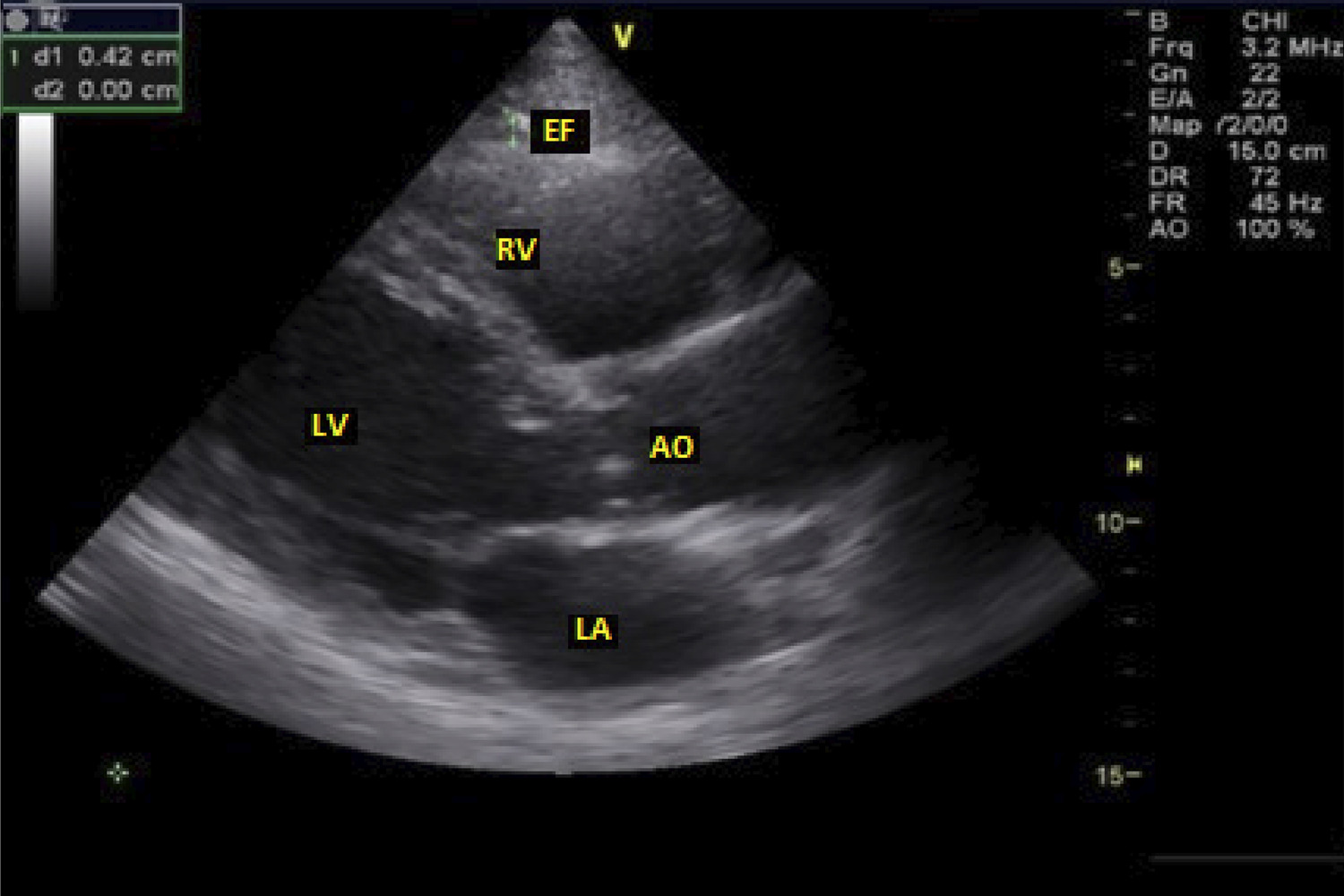
To describe echocardiographic features of the heart in an elderly population and to study the correlation between EF thickness and clinical and anthropometric variables.

Methods

A sample of 34 individuals (25 women) aged between 65 and 92 years, who attended a private institution in the central region of Continental Portugal, was analyzed. A standardized sociodemographic questionnaire was applied, and anthropometric assessment, echocardiography and blood pressure measurement were performed in all subjects. A correlational analysis of EF thickness with anthropometric and clinical parameters was performed. The association between variables was tested by Pearson’s correlation and point-biserial correlation. A value of p < 0.05 was defined as statistically significant.

Results

EF thickness was higher in males (6.0 ± 1.4 mm vs 5.2 ± 0.9 mm in females), and ranged from 4 to 9 mm. There were statistically significant correlations between EF thickness and weight (r = 0.4; p = 0.02), body surface area (r = 0.4; p = 0.02), lean mass (r = 0.4; p = 0.03), calf circumference (r = 0.5; p = 0.01) and left ventricular end-diastolic diameter (r = 0.3; p = 0.04).

Conclusion

EF thickness was higher in males and was significantly correlated with anthropometric parameters of adiposity and left ventricular end-diastolic diameter. Int J Cardiovasc Sci. 2020; [online].ahead print, PP.0-0

  • Adiposity
  • aging
  • Anthropometry
  • Blood Pressure
  • Diabetes Mellitus
  • Echocardiography/methods
  • Epicardial Fat
  • Hypertension
  • Risk Factors
Read Full Article
Creative Commons Attribution (CC BY) Creative Commons license
06/11/2020 DOI: 10.36660/ijcs.20190179 Views 1

How to cite this article

EndNote RIS

Electronic Document Format (Vancouver)

Nurmohamed NS, Cantlay C, Sidahmed A, Choi AD. Refining Cardiovascular Risk: Looking Beneath the Calcium Surface. Arquivos Brasileiros de Cardiologia 2022;119(6):921-2.

Electronic Document Format (ABNT)

Nurmohamed, Nick S.; Cantlay, Catherine; Sidahmed, Alfateh; Choi, Andrew D.. Refining Cardiovascular Risk: Looking Beneath the Calcium Surface. Arquivos Brasileiros de Cardiologia, v. 119, n. 6, p. 921-922, Dec. 2022.

Electronic Document Format (APA)

Nurmohamed, N. S., Cantlay, C., Sidahmed, A., & Choi, A. D. (2022). Refining Cardiovascular Risk: Looking Beneath the Calcium Surface. Arquivos Brasileiros de Cardiologia, 119(6), 921-922.

Electronic Document Format (ISO)

Nurmohamed, Nick S. and Cantlay, Catherine and Sidahmed, Alfateh and Choi, Andrew D.. Refining Cardiovascular Risk: Looking Beneath the Calcium Surface. Arquivos Brasileiros de Cardiologia [online]. 2022, vol. 119, n. 6, [cited 2026-10-14], pp. 921-922. Available from: <https://journals.cardiol.br/en/article/refining-cardiovascular-risk-looking-beneath-the-calcium-surface/>. ISSN 0066-782X

EndNote RIS

Electronic Document Format (Vancouver)

Castanheira J, Nunes C, Pereira T. Correlation between Epicardial Fat Thickness and Clinical and Anthropometric Variables in an Elderly Population. International Journal of Cardiovascular Sciences 2020;34(2):136-4.

Electronic Document Format (ABNT)

Castanheira, Joaquim; Nunes, Cristiana; Pereira, Telmo. Correlation between Epicardial Fat Thickness and Clinical and Anthropometric Variables in an Elderly Population. International Journal of Cardiovascular Sciences, v. 34, n. 2, p. 136-146, Nov. 2020.

Electronic Document Format (APA)

Castanheira, J., Nunes, C., & Pereira, T. (2020). Correlation between Epicardial Fat Thickness and Clinical and Anthropometric Variables in an Elderly Population. International Journal of Cardiovascular Sciences, 34(2), 136-146.

Electronic Document Format (ISO)

Castanheira, Joaquim and Nunes, Cristiana and Pereira, Telmo. Correlation between Epicardial Fat Thickness and Clinical and Anthropometric Variables in an Elderly Population. International Journal of Cardiovascular Sciences [online]. 2020, vol. 34, n. 2, [cited 2026-10-14], pp. 136-146. Available from: <https://journals.cardiol.br/en/article/correlation-between-epicardial-fat-thickness-and-clinical-and-anthropometric-variables-in-an-elderly-population/>. ISSN 2359-4802

  • About ABC Family
  • Internal Regulation
  • Editorial Board
  • Brazilian Society of Cardiology (SBC)

Issues

SBC Guidelines

  • Videos
  • Podcasts
  • News