ABC Family Arquivos Brasileiros de Cardiologia International Journal of Cardiovascular Sciences ABC Heart Failure & Cardiomyopathy ABC Imagem Cardiovascular
Português English
ABC Family
Português English
  • About
    • About ABC Family
    • Internal Regulation
    • Editorial Board
    • Brazilian Society of Cardiology (SBC)
  • Issues
  • SBC Guidelines
  • Content
    • Videos
    • Podcasts
    • News
  • About
    • About ABC Family
    • Internal Regulation
    • Editorial Board
    • Brazilian Society of Cardiology (SBC)
  • Issues
  • SBC Guidelines
  • Content
    • Videos
    • Podcasts
    • News

ABC Family

  • ABC Family
  • Arquivos Brasileiros de Cardiologia
  • International Journal of Cardiovascular Sciences
  • ABC Heart Failure & Cardiomyopathy
  • ABC Imagem Cardiovascular
Search in

No content found.

Journals
Ordering
Article types
Others

  1. Home
  2. Keyword: Blood Vessels
ABC
Editorial

Scaffolds for Use in Blood Vessel Bioengineering: What are the Prospects?

Leonardo Rufino Garcia et al. André Monti Garzesi Flávio de Souza Brito Marcello Laneza Felicio Matheus Bertanha

Cardiovascular diseases are currently the main causes of morbidity and mortality in Brazil and worldwide., Its treatment is multimodal and has as one of its targets the fight against the progression of its major pathophysiological substrate, atherosclerosis. Lifestyle changes, prescription and use of antiplatelet agents, anticoagulants, and hypolipidemic agents, treatment of comorbidities such as systemic arterial hypertension and diabetes mellitus, and even revascularization of target organs lato sensu are important in controlling its clinical evolution.

However, many patients still have an unfavorable evolution of atherosclerosis with only clinical management and become candidates for revascularization procedures. Thus, the availability of vascular substitutes for use as grafts is essential, which can be autologous or synthetic (artificial). In turn, endovascular techniques with stents can be used to treat stenoses or occlusions according to specific clinical indications.

[…]
  • Biocompatible Materials
  • Blood Vessels
  • Cardiovascular Diseases
  • Cell Nucleous (Scaffold
  • Mortality
  • Stem Cells
  • Tissue Engineering, Bioengineering/trends
Read Full Article
Creative Commons Attribution (CC BY) Creative Commons license
30/06/2023 DOI: 10.36660/abc.20230341 Views 1
Central Illustration
ABC
Original Article

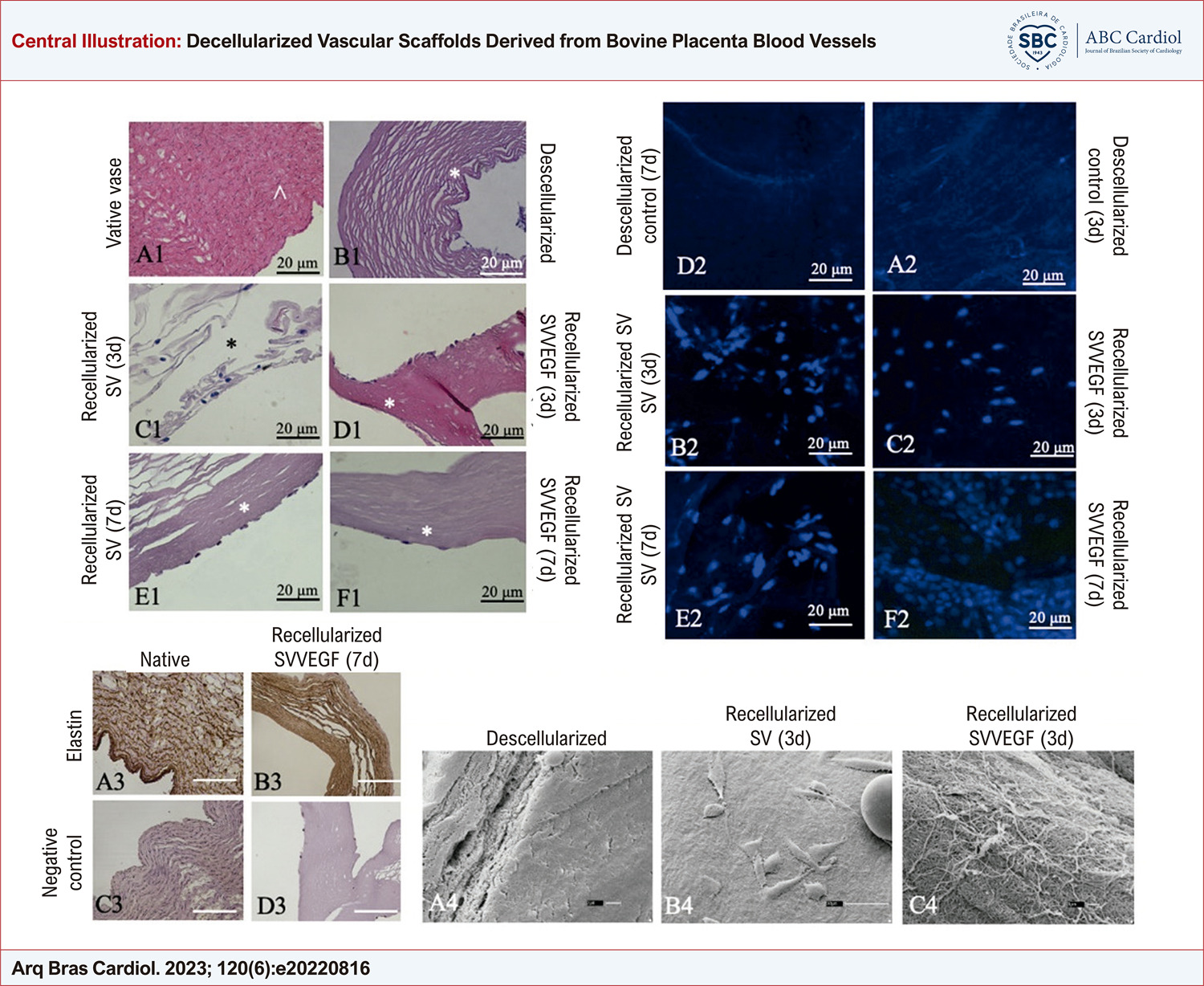
Decellularized Vascular Scaffolds Derived from Bovine Placenta Blood Vessels

Tarley Santos Oliveira et al. Igor Smirnow Kadija Mohamed Santee Maria Angelica Miglino Rodrigo da Silva Nunes Barreto

Background

Objectives

The present project aims to achieve the artificial development of blood vessels through the recellularization of vascular scaffolds derived from bovine placental vessels.

Methods

The chorioallantoic surface of the bovine placenta was used to produce decellularized biomaterials. For recellularization, 2.5 x 10⁴ endothelial cells were seeded above each decellularized vessel fragment during three or seven days, when culture were interrupted, and the fragments were fixed for cell attachment analysis. Decellularized and recellularized biomaterials were evaluated by basic histology, scanning electron microscopy, and immunohistochemistry.

Results

The decellularization process produced vessels that maintained natural structure and elastin content, and no cells or gDNA remains were observed. Endothelial precursor cells were also attached to lumen and external surface of the decellularized vessel.Conclusion: Our results show a possibility of future uses of this biomaterial in cardiovascular medicine, as in the development of engineered vessels.

  • Bioengineering
  • Blood Vessels
  • Decellularized Extracellular Matrix
Read Full Article
Creative Commons Attribution (CC BY) Creative Commons license
09/06/2023 DOI: 10.36660/abc.20220816 Views 1
Figure 1
ABCHF
Viewpoint

Is There Room for New Drugs in the Treatment of Advanced Heart Failure: SGLT2i?

Victor Sarli Issa

Over the last years, we have witnessed the inclusion of the use of sodium-glucose cotransporter 2 inhibitors (SGLT2i) for the treatment of patients with heart failure. Drugs in this group share the fact that they are able to inhibit glucose transport in the proximal tubule and thus promote glycosuria and blood glucose reduction in patients with diabetes. Other effects of these medications include increasing diuresis and natriuresis, lowering blood pressure, stimulating erythropoiesis, improving cardiac energy metabolism, reducing inflammation, inhibiting the sympathetic nervous system, preventing cardiac remodeling, preventing ischemia-reperfusion injury, inhibiting the Na+/H+ exchanger, reducing hyperuricemia, increasing autophagy and lysosomal degradation, decreasing epicardial fat, increasing erythropoietin levels, increasing circulating vascular progenitor cells, decreasing oxidative stress, and improving vascular function.

SGLT2i were initially tested for glycemic control in patients with diabetes mellitus,– and it was quickly noted that, in addition to their antidiabetic effect, these drugs were able to significantly reduce cardiovascular events, especially episodes of decompensated heart failure. Based on these results, the natural sequence was to evaluate SGLT2i in patients with heart failure. The initial results obtained were among patients with heart failure with reduced ejection fraction, with the DAPA-HF (evaluating dapagliflozin) and EMPEROR-Reduced (evaluating empagliflozin) studies, which showed that inhibition of sodium-glucose cotransporter 2 (SGLT2) reduced the combined risk of cardiovascular death or hospitalization due to heart failure in patients with heart failure with reduced ejection fraction, with or without diabetes. More recently, we have seen positive results in the context of heart failure with preserved ejection fraction, although the effects of medication have mainly focused on the group of patients with slightly reduced ejection fraction.

[…]

  • Blood Vessels
  • Heart Failure
  • Prognosis
Read Full Article
Creative Commons Attribution (CC BY) Creative Commons license
29/06/2022 DOI: 10.36660/abchf.20220030 Views 1

How to cite this article

EndNote RIS

Electronic Document Format (Vancouver)

Garcia LR, Garzesi AM, Brito FS, Felicio ML, Bertanha M. Scaffolds for Use in Blood Vessel Bioengineering: What are the Prospects?. Arquivos Brasileiros de Cardiologia 2023;120(6):e20230341.

Electronic Document Format (ABNT)

Garcia, Leonardo Rufino; Garzesi, André Monti; Brito, Flávio de Souza; Felicio, Marcello Laneza; Bertanha, Matheus. Scaffolds for Use in Blood Vessel Bioengineering: What are the Prospects?. Arquivos Brasileiros de Cardiologia, v. 120, n. 6, e20230341, Jun. 2023.

Electronic Document Format (APA)

Garcia, L. R., Garzesi, A. M., Brito, F. S., Felicio, M. L., & Bertanha, M. (2023). Scaffolds for Use in Blood Vessel Bioengineering: What are the Prospects?. Arquivos Brasileiros de Cardiologia, 120(6), e20230341.

Electronic Document Format (ISO)

Garcia, Leonardo Rufino and Garzesi, André Monti and Brito, Flávio de Souza and Felicio, Marcello Laneza and Bertanha, Matheus. Scaffolds for Use in Blood Vessel Bioengineering: What are the Prospects?. Arquivos Brasileiros de Cardiologia [online]. 2023, vol. 120, n. 6, [cited 2026-10-14], e20230341. Available from: <https://journals.cardiol.br/en/article/scaffolds-for-use-in-blood-vessel-bioengineering-what-are-the-prospects/>. ISSN 0066-782X

EndNote RIS

Electronic Document Format (Vancouver)

Oliveira TS, Smirnow I, Santee KM, Miglino MA, Barreto RSN. Decellularized Vascular Scaffolds Derived from Bovine Placenta Blood Vessels. Arquivos Brasileiros de Cardiologia 2023;120(6):e20220816.

Electronic Document Format (ABNT)

Oliveira, Tarley Santos; Smirnow, Igor; Santee, Kadija Mohamed; Miglino, Maria Angelica; Barreto, Rodrigo da Silva Nunes. Decellularized Vascular Scaffolds Derived from Bovine Placenta Blood Vessels. Arquivos Brasileiros de Cardiologia, v. 120, n. 6, e20220816, Jun. 2023.

Electronic Document Format (APA)

Oliveira, T. S., Smirnow, I., Santee, K. M., Miglino, M. A., & Barreto, R. S. N. (2023). Decellularized Vascular Scaffolds Derived from Bovine Placenta Blood Vessels. Arquivos Brasileiros de Cardiologia, 120(6), e20220816.

Electronic Document Format (ISO)

Oliveira, Tarley Santos and Smirnow, Igor and Santee, Kadija Mohamed and Miglino, Maria Angelica and Barreto, Rodrigo da Silva Nunes. Decellularized Vascular Scaffolds Derived from Bovine Placenta Blood Vessels. Arquivos Brasileiros de Cardiologia [online]. 2023, vol. 120, n. 6, [cited 2026-10-14], e20220816. Available from: <https://journals.cardiol.br/en/article/decellularized-vascular-scaffolds-derived-from-bovine-placenta-blood-vessels/>. ISSN 0066-782X

EndNote RIS

Electronic Document Format (Vancouver)

Issa VS. Is There Room for New Drugs in the Treatment of Advanced Heart Failure: SGLT2i?. ABC: Heart Failure & Cardiomyopathy 2022;2(2):195-7.

Electronic Document Format (ABNT)

Issa, Victor Sarli. Is There Room for New Drugs in the Treatment of Advanced Heart Failure: SGLT2i?. ABC: Heart Failure & Cardiomyopathy, v. 2, n. 2, p. 195-197, Jun. 2022.

Electronic Document Format (APA)

Issa, V. S. (2022). Is There Room for New Drugs in the Treatment of Advanced Heart Failure: SGLT2i?. ABC: Heart Failure & Cardiomyopathy, 2(2), 195-197.

Electronic Document Format (ISO)

Issa, Victor Sarli. Is There Room for New Drugs in the Treatment of Advanced Heart Failure: SGLT2i?. ABC: Heart Failure & Cardiomyopathy [online]. 2022, vol. 2, n. 2, [cited 2026-10-14], pp. 195-197. Available from: <https://journals.cardiol.br/en/article/is-there-room-for-new-drugs-in-the-treatment-of-advanced-heart-failure-sglt2i/>

  • About ABC Family
  • Internal Regulation
  • Editorial Board
  • Brazilian Society of Cardiology (SBC)

Issues

SBC Guidelines

  • Videos
  • Podcasts
  • News