ABC Family Arquivos Brasileiros de Cardiologia International Journal of Cardiovascular Sciences ABC Heart Failure & Cardiomyopathy ABC Imagem Cardiovascular
Português English
ABC Family
Português English
  • About
    • About ABC Family
    • Internal Regulation
    • Editorial Board
    • Brazilian Society of Cardiology (SBC)
  • Issues
  • SBC Guidelines
  • Content
    • Videos
    • Podcasts
    • News
  • About
    • About ABC Family
    • Internal Regulation
    • Editorial Board
    • Brazilian Society of Cardiology (SBC)
  • Issues
  • SBC Guidelines
  • Content
    • Videos
    • Podcasts
    • News

ABC Family

  • ABC Family
  • Arquivos Brasileiros de Cardiologia
  • International Journal of Cardiovascular Sciences
  • ABC Heart Failure & Cardiomyopathy
  • ABC Imagem Cardiovascular
Search in

No content found.

Journals
Ordering
Article types
Others

  1. Home
  2. Keyword: adherence
ABC
Editorial

Adherence, Compliance and Persistency in High Cholesterol Treatment

Tania L. R. Martinez

Lack of adherence to cholesterol-lowering medications remains a critical issue in managing cardiovascular risk. Despite advancements in treatment, many patients fail to follow their prescribed regimens, leading to increased risks of heart attack, stroke, and other cardiovascular events. As described in the study, adherence challenges in the Brazilian population illustrate a global problem. However, there are several promising strategies for increasing adherence, including the active involvement of pharmacists and the distribution of medications in larger volumes through public or private healthcare systems.

Medication adherence, or the degree to which patients follow their prescribed regimens, is fundamental to achieving optimal health outcomes in chronic conditions like high cholesterol. Compliance is the consistency with which patients take their medication over time, while persistence refers to how long they continue treatment without interruption. Cholesterol-lowering drugs, particularly statins, are widely used to reduce cardiovascular risk, but non-adherence remains a barrier to their full effectiveness.

[…]

  • adherence
  • Cholesterol
  • compliance
  • Persistence
  • Treatment
Read Full Article
Creative Commons Attribution (CC BY) Creative Commons license
20/01/2025 DOI: 10.36660/abc.20240652i
ABC
Original Article

The influence of patient's consciousness regarding high blood pressure and patient's attitude in face of disease controlling medicine intake

Maria Aparecida A Moura Strelec et al. Angela M. G. Pierin Décio Mion Jr.

OBJECTIVE: To assess the relation between blood pressure control and the following: the Morisky-Green test, the patient’s consciousness regarding high blood pressure, the patient’s attitude in face of medicine intake, the patient’s attendance at medical consultations, and the subjective physician’s judgment. METHODS: We studied 130 hypertensive patients with the following characteristics: 73% females, 60±11 years, 58% married, 70% white, 45% retired, 45% with incomplete elementary schooling, 64% had a familial income of 1 to 3 minimum wages, body mass index of 30±7 kg/m², consciousness regarding the disease for a mean period of 11±9.5 years, and mean treatment duration of 8 ±7 years. RESULTS: Only 35% of the hypertensive individuals had blood pressure under control and a longer duration of treatment (10±7 vs 7±6.5 years; P<0.05). The retiree predominated. The result of the Morisky-Green test did not relate to blood pressure control. In evaluating the attitude in face of medicine intake, the controlled patients achieved significantly higher scores than did the noncontrolled patients (8±1.9 vs 7 ±2, P<0.05). The hypertensive patients had higher levels of consciousness regarding their disease and its treatment, and most (70%) patients attended 3 or 4 medical consultations, which did not influence blood pressure control. The physicians attributed significantly higher scores regarding adherence to treatment to controlled patients (6±0.8 vs 5±1.2; P<0.05). CONCLUSION: Consciousness regarding the disease, the Morisky-Green test, and attendance to medical consultations did not influence blood pressure control.

  • adherence
  • Control
  • Hypertension
  • Treatment
Read Full Article
Creative Commons Attribution (CC BY) Creative Commons license
05/11/2003 DOI: 10.1590/S0066-782X2003001200002
Epidemiological aspects of adherence to the treatment of hypertension
ABC
Original Article

Epidemiological aspects of adherence to the treatment of hypertension

Jadelson P. Andrade et al. Fábio Vilas-Boas Hildenizia Chagas Marianna Andrade

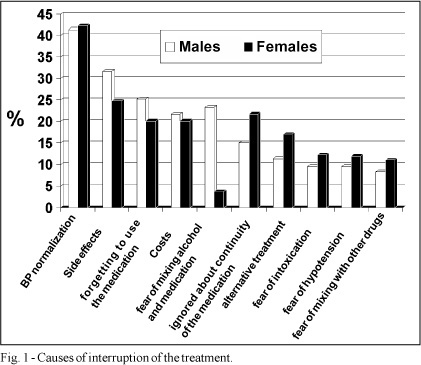
OBJECTIVE: To analyze the reasons given by patients for interrupting their pharmacological treatment of hypertension. METHODS: We carried out an observational cross-sectional study, in which a questionnaire was applied and blood pressure was measured in 401 patients in different centers of the state of Bahia. The patients selected had been diagnosed with hypertension and were not on antihypertensive treatment for at least 60 days. Clinical and epidemiological characteristics of the groups were analyzed. RESULTS: Of the 401 patients, 58.4% were females, 55.6% of whom white; 60.5% of the males were white. The major reasons alleged for not adhering to treatment were as follows (for males and females respectively): normalization of blood pressure (41.3% and 42.3%); side effects of the medications (31.7% and 24.8%); forgetting to use the medication (25.2% and 20.1%); cost of medication (21.6% and 20.1%); fear of mixing alcohol and medication (23.4% and 3.8%); ignoring the need for continuing the treatment (15% and 21.8%); use of an alternative treatment (11.4% and 17.1%); fear of intoxication (9.6% and 12.4%); fear of hypotension (9.6% and 12%); and fear of mixing the medication with other drugs (8.4% and 6.1%). CONCLUSION: Our data suggest that most factors concerning the abandonment of the treatment of hypertension are related to lack of information, and that, despite the advancement in antihypertensive drugs, side effects still account for most abandonments of treatment.

  • adherence
  • systemic arterial hypertension
  • Treatment
Read Full Article
Creative Commons Attribution (CC BY) Creative Commons license
06/11/2002 DOI: 10.1590/S0066-782X2002001300005
Prescription and adherence to statins of patients with coronary artery disease and hypercholesterolemia
ABC
Original Article

Prescription and adherence to statins of patients with coronary artery disease and hypercholesterolemia

Antonio P. Mansur et al. André P. L. Mattar Cristiane E. Tsubo Danielle T. Simão … Fábio R. Yoshi Kuang Daci

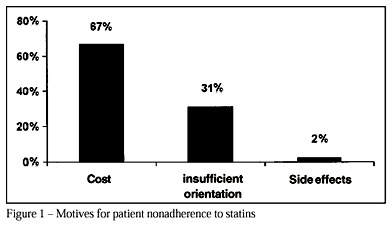
OBJECTIVE: Statins have proved to be safe and effective in the secondary prevention of coronary artery disease, but the level of prescription and the reasons for nonadherence to treatment in many coronariopathy treatment centers has not been determined. The purpose of this study was to identify reasons for nonadherence to statin therapy. METHODS: We analyzed 207 consecutive patients with coronary artery disease and hypercholesterolemia (total cholesterol > or = 200mg/dL or LDL – cholesterol > or = 130mg/dL). Patients’ average age was 61.7±10 year; 111 (53.6%) male were and 94 (46.6%) were female. We analyzed the level of prescription and adherence to treatment with statins. RESULTS: Statins were prescribed for 139 (67%) patients, but only 85 (41%) used the drug. In spite of being indicated, statins were not prescribed in 68 (33%) patients. Of 54 (26%) patients, nonadherent to statins, 67% did not use the drug due to its high cost, 31% due to the lack of instruction, and only 2% due to side effects. Total cholesterol (260.3±42.2 vs 226.4±51.9; p<0.0001) and LDL cholesterol (174.6±38.1 vs 149.6±36.1; p<0.0001) were lower in patients on medication. HDL-cholesterol increased from 37.6±9.6 to 41.5±12.9mg/dL (p=0.02), and triglycerides were not modified in patients using statins. CONCLUSION: The prescription of statins in patients with coronary artery disease and dyslipidemia is high; however, its adherence is far from satisfactory, due to the high cost of the medication. Reduction in total cholesterol and LDL cholesterol levels did not reach the targets recommended by the Brazilian Consensus on Dyslipidemia.

  • adherence
  • Coronary Artery Disease
  • Hypercholesterolemia
  • Statins
Read Full Article
Creative Commons Attribution (CC BY) Creative Commons license
08/01/2002 DOI: 10.1590/S0066-782X2001000200002 Views 1

How to cite this article

EndNote RIS

Electronic Document Format (Vancouver)

Martinez TLR. Adherence, Compliance and Persistency in High Cholesterol Treatment. Arquivos Brasileiros de Cardiologia 2025;121(11):e20240652.

Electronic Document Format (ABNT)

Martinez, Tania L. R.. Adherence, Compliance and Persistency in High Cholesterol Treatment. Arquivos Brasileiros de Cardiologia, v. 121, n. 11, e20240652, Jan. 2025.

Electronic Document Format (APA)

Martinez, T. L. R. (2025). Adherence, Compliance and Persistency in High Cholesterol Treatment. Arquivos Brasileiros de Cardiologia, 121(11), e20240652.

Electronic Document Format (ISO)

Martinez, Tania L. R.. Adherence, Compliance and Persistency in High Cholesterol Treatment. Arquivos Brasileiros de Cardiologia [online]. 2025, vol. 121, n. 11, [cited 2026-10-14], e20240652. Available from: <https://journals.cardiol.br/en/article/adherence-compliance-and-persistency-in-high-cholesterol-treatment/>. ISSN 0066-782X

EndNote RIS

Electronic Document Format (Vancouver)

Strelec MAAM, Pierin AMG, Mion Jr. D. The influence of patient’s consciousness regarding high blood pressure and patient’s attitude in face of disease controlling medicine intake. Arquivos Brasileiros de Cardiologia 2003;81(4):349-54.

Electronic Document Format (ABNT)

Strelec, Maria Aparecida A Moura; Pierin, Angela M. G.; Mion Jr., Décio. The influence of patient’s consciousness regarding high blood pressure and patient’s attitude in face of disease controlling medicine intake. Arquivos Brasileiros de Cardiologia, v. 81, n. 4, p. 349-354, Nov. 2003.

Electronic Document Format (APA)

Strelec, M. A. A. M., Pierin, A. M. G., & Mion Jr., D. (2003). The influence of patient’s consciousness regarding high blood pressure and patient’s attitude in face of disease controlling medicine intake. Arquivos Brasileiros de Cardiologia, 81(4), 349-354.

Electronic Document Format (ISO)

Strelec, Maria Aparecida A Moura and Pierin, Angela M. G. and Mion Jr., Décio. The influence of patient’s consciousness regarding high blood pressure and patient’s attitude in face of disease controlling medicine intake. Arquivos Brasileiros de Cardiologia [online]. 2003, vol. 81, n. 4, [cited 2026-10-14], pp. 349-354. Available from: <https://journals.cardiol.br/en/article/the-influence-of-patients-consciousness-regarding-high-blood-pressure-and-patients-attitude-in-face-of-disease-controlling-medicine-intake/>. ISSN 0066-782X

EndNote RIS

Electronic Document Format (Vancouver)

Andrade JP, Vilas-Boas F, Chagas H, Andrade M. Epidemiological aspects of adherence to the treatment of hypertension. Arquivos Brasileiros de Cardiologia 2002;79(4):380-4.

Electronic Document Format (ABNT)

Andrade, Jadelson P.; Vilas-Boas, Fábio; Chagas, Hildenizia; Andrade, Marianna. Epidemiological aspects of adherence to the treatment of hypertension. Arquivos Brasileiros de Cardiologia, v. 79, n. 4, p. 380-384, Nov. 2002.

Electronic Document Format (APA)

Andrade, J. P., Vilas-Boas, F., Chagas, H., & Andrade, M. (2002). Epidemiological aspects of adherence to the treatment of hypertension. Arquivos Brasileiros de Cardiologia, 79(4), 380-384.

Electronic Document Format (ISO)

Andrade, Jadelson P. and Vilas-Boas, Fábio and Chagas, Hildenizia and Andrade, Marianna. Epidemiological aspects of adherence to the treatment of hypertension. Arquivos Brasileiros de Cardiologia [online]. 2002, vol. 79, n. 4, [cited 2026-10-14], pp. 380-384. Available from: <https://journals.cardiol.br/en/article/epidemiological-aspects-of-adherence-to-the-treatment-of-hypertension/>. ISSN 0066-782X

EndNote RIS

Electronic Document Format (Vancouver)

Mansur AP, Mattar APL, Tsubo CE, Simão DT, Yoshi FR, Daci K. Prescription and adherence to statins of patients with coronary artery disease and hypercholesterolemia. Arquivos Brasileiros de Cardiologia 2002;76(2):115-8.

Electronic Document Format (ABNT)

Mansur, Antonio P.; Mattar, André P. L.; Tsubo, Cristiane E.; Simão, Danielle T.; Yoshi, Fábio R.; Daci, Kuang. Prescription and adherence to statins of patients with coronary artery disease and hypercholesterolemia. Arquivos Brasileiros de Cardiologia, v. 76, n. 2, p. 115-118, Jan. 2002.

Electronic Document Format (APA)

Mansur, A. P., Mattar, A. P. L., Tsubo, C. E., Simão, D. T., Yoshi, F. R., & Daci, K. (2002). Prescription and adherence to statins of patients with coronary artery disease and hypercholesterolemia. Arquivos Brasileiros de Cardiologia, 76(2), 115-118.

Electronic Document Format (ISO)

Mansur, Antonio P. and Mattar, André P. L. and Tsubo, Cristiane E. and Simão, Danielle T. and Yoshi, Fábio R. and Daci, Kuang. Prescription and adherence to statins of patients with coronary artery disease and hypercholesterolemia. Arquivos Brasileiros de Cardiologia [online]. 2002, vol. 76, n. 2, [cited 2026-10-14], pp. 115-118. Available from: <https://journals.cardiol.br/en/article/prescription-and-adherence-to-statins-of-patients-with-coronary-artery-disease-and-hypercholesterolemia/>. ISSN 0066-782X

  • About ABC Family
  • Internal Regulation
  • Editorial Board
  • Brazilian Society of Cardiology (SBC)

Issues

SBC Guidelines

  • Videos
  • Podcasts
  • News