ABC Family Arquivos Brasileiros de Cardiologia International Journal of Cardiovascular Sciences ABC Heart Failure & Cardiomyopathy ABC Imagem Cardiovascular
Português English
ABC Family
Português English
  • About
    • About ABC Family
    • Internal Regulation
    • Editorial Board
    • Brazilian Society of Cardiology (SBC)
  • Issues
  • SBC Guidelines
  • Content
    • Videos
    • Podcasts
    • News
  • About
    • About ABC Family
    • Internal Regulation
    • Editorial Board
    • Brazilian Society of Cardiology (SBC)
  • Issues
  • SBC Guidelines
  • Content
    • Videos
    • Podcasts
    • News

ABC Family

  • ABC Family
  • Arquivos Brasileiros de Cardiologia
  • International Journal of Cardiovascular Sciences
  • ABC Heart Failure & Cardiomyopathy
  • ABC Imagem Cardiovascular
Search in

No content found.

Journals
Ordering
Article types
Others

  1. Home
  2. Keyword: abdominal
Figure 1
ABCIC
Case Report

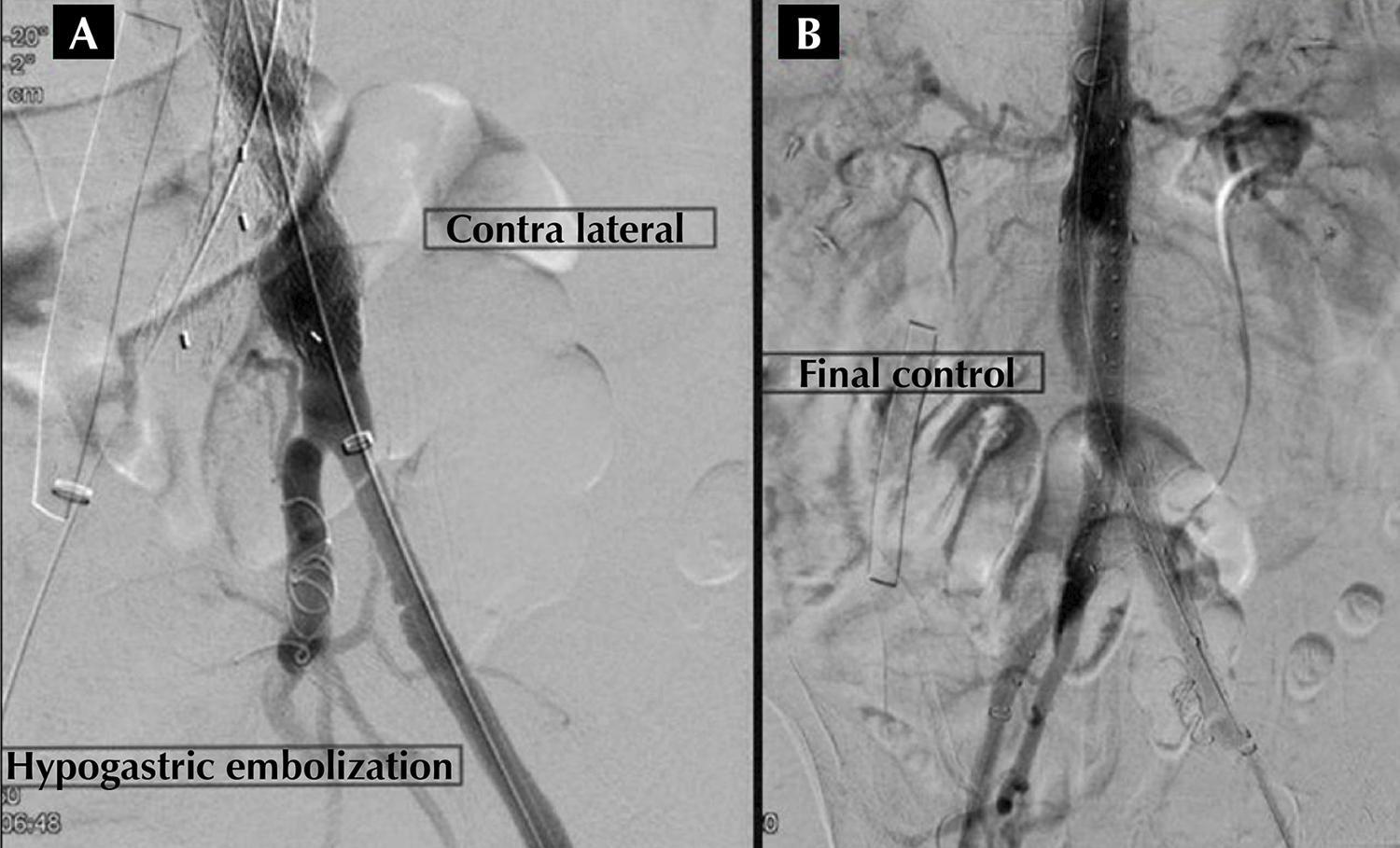
Use of Contrast-Enhanced Ultrasound for the Diagnosis of Endoleak After EVAR: A Case Report

Ana Carolina N. Netto Djaló et al. Glauber Lutterbach de Oliveira Pires Adriana Ferraz Carlos Gustavo Abath … Idalécio Souto Fonseca Filho Milena O. Marques

Introduction

Abdominal aortic aneurysm (AAA), with an estimated prevalence of 4–8% and a higher incidence in men, older people, hypertensive patients, and smokers, can be treated with surgical or endovascular aneurysm repair (EVAR). When well-indicated, EVAR is primarily used since it is less invasive and has lower morbidity and mortality rates. However, due to possible complications, routine clinical and imaging surveillance is necessary to identify or prevent periprosthetic leaks (endoleaks) associated with aneurysmal disease progression.

Accordingly, computed tomography angiography (CTA) has always been considered the gold standard for endoleak surveillance due to its high image quality and usefulness for two- and three-dimensional reconstruction; however, its use of iodinated contrast and exposure to ionizing radiation are disadvantages. Therefore, other post-EVAR control imaging methods such as contrast-enhanced ultrasound (CEUS) have been studied as an endoleak dynamic and high-quality assessment method.,

[…]
  • abdominal
  • Aortic Aneurysm
  • Endoleak
Read Full Article
Creative Commons Attribution (CC BY) Creative Commons license
17/08/2022 DOI: 10.47593/2675-312X/20223503eabc315
ABC
Artigo Original

Features of the onset of Takayasu's arteritis acccording to gender

Andrea Rocha de Saboia Mont'Alverne et al. Luiz Eduardo de Paula Samuel Katsuyuki Shinjo

BACKGROUND: Although there are various published epidemiological studies regarding Takayasu’s arteritis (TA), none have analyzed the influence of gender on the clinical and laboratory manifestations or vascular alterations at disease onset. OBJECTIVES: To analyze the influence of gender on clinical and laboratory manifestations and variations in vascular imaging at TA onset. METHODS: A retrospective, unicentric cohort study that evaluated 55 consecutive TA patients between 1982 and 2012. All available clinical data and laboratory test results related to the onset of the disease were analyzed. We included only patients aged 12-35 years at diagnosis to exclude age-related factors. RESULTS: We analyzed 17 men and 38 women, mostly Caucasian, with a comparable mean age between genders. There was no gender difference regarding the clinical or laboratory characteristics, comorbidities, or smoking habit, except for abdominal pain, which was more common in men. Regarding vascular lesions, the presence of ascending aortic aneurysms was significantly more frequent in males. Male gender represented an independent risk factor for the occurrence of abdominal pain and ascending aortic aneurysms in TA patients. CONCLUSION: Abdominal pain and ascending aortic aneurysms occurred more frequently in men with TA, suggesting a more severe disease profile in males.

  • abdominal
  • Abdominal Pain
  • Aortic Aneurysm
  • Cohort Studies
  • Female
  • Male
  • Takayasu Arteritis
Read Full Article
Creative Commons Attribution (CC BY) Creative Commons license
27/08/2013 DOI: 10.5935/abc.20130180
Combination of risk factors for metabolic syndrome in the military personnel of the Brazilian Navy
ABC
Artigo Original

Combination of risk factors for metabolic syndrome in the military personnel of the Brazilian Navy

Filipe Ferreira da Costa et al. Vila Bayma Montenegro Thiago Jambo Alves Lopes Eduardo Caldas Costa

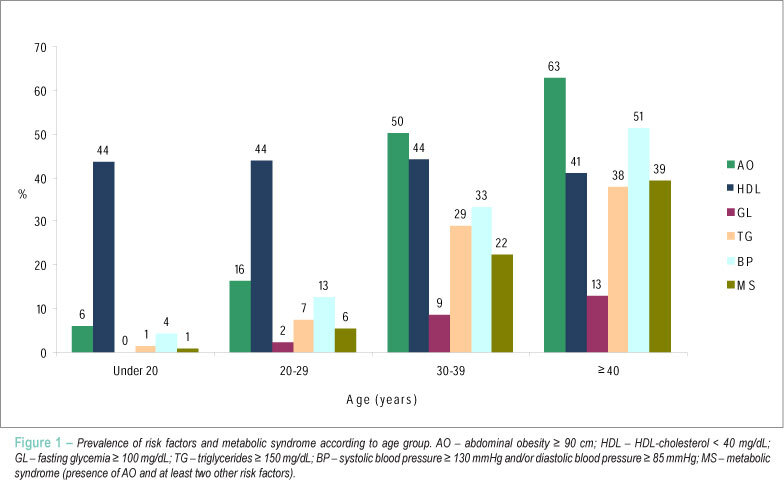
BACKGROUND: Cardiovascular diseases are the major cause of death in the population, and metabolic syndrome (MS) is a clinical condition significantly associated with the increase in morbidity and mortality. OBJECTIVE: To describe the pattern of combination of the risk factors related to the diagnosis of MS in the military personnel of the Brazilian Navy and to identify variables associated with the presence of MS in that population. METHODS: Cross-sectional study involving 1,383 men (18-62 years) assigned to military organizations in the city of Natal, state of Rio Grande do Norte. The criterion proposed by the International Diabetes Association was used for the diagnosis of MS. The ratio between observed and expected prevalence and the respective confidence intervals were used to identify the combinations of risk factors that exceeded that expected for the population. Logistic regression was used to identify variables associated with MS. RESULTS: The prevalence of MS was 17.6%. Approximately one third of the military personnel studied had two or more risk factors for MS. All specific combinations of risk factors for MS that exceeded the expected prevalence had abdominal obesity as one of its components. In the adjusted analyses, age, smoking and physical activity level remained associated with MS. CONCLUSION: Our findings reinforce the constant presence of abdominal obesity in the phenotype of MS. In addition, our data also support the idea that age, smoking and low level of physical activity are independent variables for the occurrence of MS.

  • abdominal
  • Brazil
  • Metabolic Syndrome
  • military personnel
  • Obesity
  • Risk Factors
Read Full Article
Creative Commons Attribution (CC BY) Creative Commons license
27/10/2011 DOI: 10.1590/S0066-782X2011005000113 Views 1
Comparison of the different definition criteria for the diagnosis of the metabolic syndrome in elderly women
ABC
Artigo Original

Comparison of the different definition criteria for the diagnosis of the metabolic syndrome in elderly women

Hudsara Aparecida de Almeida Paula et al. Rita de Cássia Lanes Ribeiro Lina Enriqueta Frandsen Paez de Lima Rosado Renan Salazar Ferreira Pereira Sylvia do Carmo Castro Franceschini

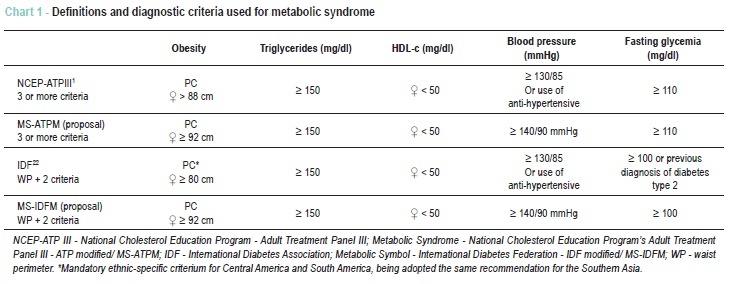
BACKGROUND: The criteria for best defining the metabolic syndrome (MS), especially in the elderly population, are still little known, and the understanding is increasingly necessary. OBJECTIVE: Compare the four MS definition proposals, two official ones (National Cholesterol Education Program’s Adult Treatment Panel III/NCEP-ATPIII and International Diabetes Federation/IDF) and two proposed definitions (Metabolic Syndrome – National Cholesterol Education Program’s Adult Treatment Panel III – modified/MS-ATPM and Metabolic Syndrome – International Diabetes Federation – modified/MS-IDFM), derived from the changes in the official criteria. METHODS: A total of 113 women (60-83 years old) participated in this study; they were submitted to anthropometric, blood pressure, lipid profile, fasting glycemia tests and answered questions related to life style habits and health conditions. Statistical analyses were performed using the chi-square test and Kappa coefficient determination. RESULTS: The frequency of the high pressure levels was similar in the two official definitions (54.8%), with a reduction in the two proposed definitions (33.6%). The homeostasis change of the glucose was higher as per the IDF and MS-IDFM (30.1%). The hypertriglyceridemia and the low levels of HDL-c were similar in all the definitions (35.4%). In relation to the abdominal obesity, the higher occurrence was registered by the IDF criteria (88.5%). The presence of the metabolic syndrome presented higher and lower frequencies as per the IDF proposal (45.1%) and MS-IDFM (22.1%), respectively. Higher agreement was found between the modified definition MS-ATPM with NCEP-ATPIII and MS-IDFM (Kappa: 0.79 and 0.77; p < 0.00001). CONCLUSION: The MS-ATPM proposal was found more adequate for the MS detection in the evaluated elderly women.

  • abdominal
  • Aged
  • Metabolic Syndrome
  • Obesity
  • Risk Factors
Read Full Article
Creative Commons Attribution (CC BY) Creative Commons license
30/07/2010 DOI: 10.1590/S0066-782X2010005000100

How to cite this article

EndNote RIS

Electronic Document Format (Vancouver)

Djaló ACNN, Pires GLO, Ferraz A, Abath CG, Fonseca Filho IS, Marques MO. Use of Contrast-Enhanced Ultrasound for the Diagnosis of Endoleak After EVAR: A Case Report. ABC Imagem Cardiovascular 2022;35(3):eabc315.

Electronic Document Format (ABNT)

Djaló, Ana Carolina N. Netto; Pires, Glauber Lutterbach de Oliveira; Ferraz, Adriana; Abath, Carlos Gustavo; Fonseca Filho, Idalécio Souto; Marques, Milena O.. Use of Contrast-Enhanced Ultrasound for the Diagnosis of Endoleak After EVAR: A Case Report. ABC Imagem Cardiovascular, v. 35, n. 3, eabc315, Aug. 2022.

Electronic Document Format (APA)

Djaló, A. C. N. N., Pires, G. L. O., Ferraz, A., Abath, C. G., Fonseca Filho, I. S., & Marques, M. O. (2022). Use of Contrast-Enhanced Ultrasound for the Diagnosis of Endoleak After EVAR: A Case Report. ABC Imagem Cardiovascular, 35(3), eabc315.

Electronic Document Format (ISO)

Djaló, Ana Carolina N. Netto and Pires, Glauber Lutterbach de Oliveira and Ferraz, Adriana and Abath, Carlos Gustavo and Fonseca Filho, Idalécio Souto and Marques, Milena O.. Use of Contrast-Enhanced Ultrasound for the Diagnosis of Endoleak After EVAR: A Case Report. ABC Imagem Cardiovascular [online]. 2022, vol. 35, n. 3, [cited 2026-10-14], eabc315. Available from: <https://journals.cardiol.br/en/article/use-of-contrast-enhanced-ultrasound-for-the-diagnosis-of-endoleak-after-evar-a-case-report/>. ISSN 2318-8219

EndNote RIS

Electronic Document Format (Vancouver)

Mont’Alverne ARS, Paula LE, Shinjo SK. Features of the onset of Takayasu’s arteritis acccording to gender. Arquivos Brasileiros de Cardiologia 2013;101(4):359-63.

Electronic Document Format (ABNT)

Mont’Alverne, Andrea Rocha de Saboia; Paula, Luiz Eduardo de; Shinjo, Samuel Katsuyuki. Features of the onset of Takayasu’s arteritis acccording to gender. Arquivos Brasileiros de Cardiologia, v. 101, n. 4, p. 359-363, Aug. 2013.

Electronic Document Format (APA)

Mont’Alverne, A. R. S., Paula, L. E. , & Shinjo, S. K. (2013). Features of the onset of Takayasu’s arteritis acccording to gender. Arquivos Brasileiros de Cardiologia, 101(4), 359-363.

Electronic Document Format (ISO)

Mont’Alverne, Andrea Rocha de Saboia and Paula, Luiz Eduardo de and Shinjo, Samuel Katsuyuki. Features of the onset of Takayasu’s arteritis acccording to gender. Arquivos Brasileiros de Cardiologia [online]. 2013, vol. 101, n. 4, [cited 2026-10-14], pp. 359-363. Available from: <https://journals.cardiol.br/en/article/features-of-the-onset-of-takayasus-arteritis-acccording-to-gender/>. ISSN 0066-782X

EndNote RIS

Electronic Document Format (Vancouver)

Costa FF, Montenegro VB, Lopes TJA, Costa EC. Combination of risk factors for metabolic syndrome in the military personnel of the Brazilian Navy. Arquivos Brasileiros de Cardiologia 2011;97(6):485-92.

Electronic Document Format (ABNT)

Costa, Filipe Ferreira da; Montenegro, Vila Bayma; Lopes, Thiago Jambo Alves; Costa, Eduardo Caldas. Combination of risk factors for metabolic syndrome in the military personnel of the Brazilian Navy. Arquivos Brasileiros de Cardiologia, v. 97, n. 6, p. 485-492, Oct. 2011.

Electronic Document Format (APA)

Costa, F. F. , Montenegro, V. B., Lopes, T. J. A., & Costa, E. C. (2011). Combination of risk factors for metabolic syndrome in the military personnel of the Brazilian Navy. Arquivos Brasileiros de Cardiologia, 97(6), 485-492.

Electronic Document Format (ISO)

Costa, Filipe Ferreira da and Montenegro, Vila Bayma and Lopes, Thiago Jambo Alves and Costa, Eduardo Caldas. Combination of risk factors for metabolic syndrome in the military personnel of the Brazilian Navy. Arquivos Brasileiros de Cardiologia [online]. 2011, vol. 97, n. 6, [cited 2026-10-14], pp. 485-492. Available from: <https://journals.cardiol.br/en/article/combination-of-risk-factors-for-metabolic-syndrome-in-the-military-personnel-of-the-brazilian-navy/>. ISSN 0066-782X

EndNote RIS

Electronic Document Format (Vancouver)

Paula HAA, Ribeiro RCL, Rosado LEFPL, Pereira RSF, Franceschini SCC. Comparison of the different definition criteria for the diagnosis of the metabolic syndrome in elderly women. Arquivos Brasileiros de Cardiologia 2010;95(3):346-53.

Electronic Document Format (ABNT)

Paula, Hudsara Aparecida de Almeida; Ribeiro, Rita de Cássia Lanes; Rosado, Lina Enriqueta Frandsen Paez de Lima; Pereira, Renan Salazar Ferreira; Franceschini, Sylvia do Carmo Castro. Comparison of the different definition criteria for the diagnosis of the metabolic syndrome in elderly women. Arquivos Brasileiros de Cardiologia, v. 95, n. 3, p. 346-353, Jul. 2010.

Electronic Document Format (APA)

Paula, H. A. A., Ribeiro, R. C. L., Rosado, L. E. F. P. L., Pereira, R. S. F., & Franceschini, S. C. C. (2010). Comparison of the different definition criteria for the diagnosis of the metabolic syndrome in elderly women. Arquivos Brasileiros de Cardiologia, 95(3), 346-353.

Electronic Document Format (ISO)

Paula, Hudsara Aparecida de Almeida and Ribeiro, Rita de Cássia Lanes and Rosado, Lina Enriqueta Frandsen Paez de Lima and Pereira, Renan Salazar Ferreira and Franceschini, Sylvia do Carmo Castro. Comparison of the different definition criteria for the diagnosis of the metabolic syndrome in elderly women. Arquivos Brasileiros de Cardiologia [online]. 2010, vol. 95, n. 3, [cited 2026-10-14], pp. 346-353. Available from: <https://journals.cardiol.br/en/article/comparison-of-the-different-definition-criteria-for-the-diagnosis-of-the-metabolic-syndrome-in-elderly-women/>. ISSN 0066-782X

  • About ABC Family
  • Internal Regulation
  • Editorial Board
  • Brazilian Society of Cardiology (SBC)

Issues

SBC Guidelines

  • Videos
  • Podcasts
  • News