| ABC
ABC Family Arquivos Brasileiros de Cardiologia International Journal of Cardiovascular Sciences ABC Heart Failure & Cardiomyopathy ABC Imagem Cardiovascular
Português English
ABC Family | ABC
Português English
  • About
    • About the Journal
    • Internal Regulation
    • Editors Section
    • Editorial Board
    • History
    • SBC Award
  • Instructions to Authors
    • Guidelines for Publication
    • Editorial Policy
    • Ethics Policy
    • Policy on the Use of Artificial Intelligence
    • Mandatory Publication Form
    • Publication Fee
  • Issues
  • SBC Guidelines
  • Abstracts
    • How to Publish an Abstract Supplement?
    • Supplements from the Brazilian Congress of Cardiology
  • About
    • About the Journal
    • Internal Regulation
    • Editors Section
    • Editorial Board
    • History
    • SBC Award
  • Instructions to Authors
    • Guidelines for Publication
    • Editorial Policy
    • Ethics Policy
    • Policy on the Use of Artificial Intelligence
    • Mandatory Publication Form
    • Publication Fee
  • Issues
  • SBC Guidelines
  • Abstracts
    • How to Publish an Abstract Supplement?
    • Supplements from the Brazilian Congress of Cardiology

ABC Family

  • ABC Family
  • Arquivos Brasileiros de Cardiologia
  • International Journal of Cardiovascular Sciences
  • ABC Heart Failure & Cardiomyopathy
  • ABC Imagem Cardiovascular
Search in

No content found.

Journals
Ordering
Article types
Others

  1. Home
  2. ABC
  3. Issues
  4. 2002, Volume 79, Number 6
Original Article

Devices and Techniques for Blood Pressure Measurement and Criteria for Hypertension Adopted by Brazilian Physicians: Exploratory Study

Décio Mion Júnior et al. Angela Maria Geraldo Pierin Ines Lessa Fernando Nobre

OBJECTIVE: To determine technical procedures and criteria used by Brazilian physicians for measuring blood pressure and diagnosing hypertension. METHODS: A questionnaire with 5 questions about practices and behaviors regarding blood pressure measurement and the diagnosis of hypertension was sent to 25,606 physicians in all Brazilian regions through a mailing list. The responses were compared with the recommendations of a specific consensus and descriptive analysis. RESULTS: Of the 3,621 (14.1%) responses obtained, 57% were from the southeastern region of Brazil. The following items were reported: use of an aneroid device by 67.8%; use of a mercury column device by 14.6%; 11.9% of the participants never calibrated the devices; 35.7% calibrated the devices at intervals < 1 year; 85.8% measured blood pressure in 100% of the medical visits; 86.9% measured blood pressure more than once and on more than one occasion. For hypertension diagnosis, 55.7% considered the patient's age, and only 1/3 relied on consensus statements. CONCLUSION: Despite the adequate frequency of both practices, it was far from that expected, and some contradictions between the diagnostic criterion for hypertension and the number of blood pressure measurements were found. The results suggest that, to include the great majority of the medical professionals, disclosure of consensus statements and techniques for blood pressure measurement should go beyond the boundaries of medical events and specialized journals.
  • blood pressure measurement
  • calibration
  • Hypertension
Read Full Article
Creative Commons Attribution (CC BY) Creative Commons license
09/01/2003 DOI: 10.1590/S0066-782X2002001500005 Views 3
Stress During ACLS Courses: Is it Important for Learning Skills?
Original Article

Stress During ACLS Courses: Is it Important for Learning Skills?

Emilton Lima Júnior et al. José Knopfholz Carla M. Menini

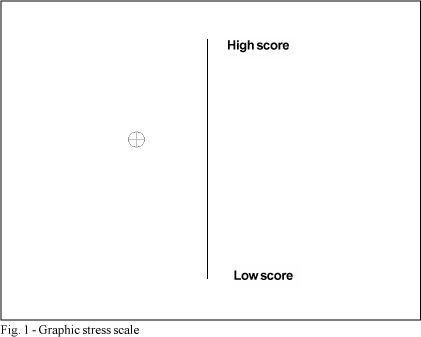
OBJECTIVE: To determine the influence of stress on teaching medical emergencies in an Advanced Cardiac Life Support (ACLS) course and to verify this influence on learning, and the efficiency of emergency care training. METHODS: Seventeen physicians signed up for an ACLS course. Their pulses were taken and blood pressure (BP) verified on the first day, before the beginning of the course, and on the second day, during the theoretical and practical test (TPT). Variations in pulse rates and BP were compared with students’ test grades. Then, students answered a questionnaire of variables (QV) about the amount of sleep they had during the course, the quantity of study material and the time spent studying for the course, and a stress scale graphic. RESULTS: Seven students had a pulse variation less than 10% between the 2 periods and 10 had a 10% or more variation. Grades on TPT were, respectively, 91.4±2.4 and 87.3±5.2 (p<0.05). Six students had a BP variation less than 20 mmHg, and in 11 it varied more than 21 mmHg. Grades on the TPT were 92.3±3.3 and 86.2± 8.1, respectively (p<0.05). The QV dates did not significantly influence grades. CONCLUSION: Stress, as an isolated variable, had a negative influence on the learning process and on the efficiency of emergency training in this situation.

  • ACLS
  • Cardiology
  • Medical Education
  • Stress
Read Full Article
Creative Commons Attribution (CC BY) Creative Commons license
09/01/2003 DOI: 10.1590/S0066-782X2002001500004 Views 2
The Role of B-Type Natriuretic Peptide in the Diagnosis of Congestive Heart Failure in Patients Presenting to an Emergency Department with Dyspnea
Original Article

The Role of B-Type Natriuretic Peptide in the Diagnosis of Congestive Heart Failure in Patients Presenting to an Emergency Department with Dyspnea

Humberto Villacorta et al. Adriana Duarte Neison Marques Duarte Ângela Carrano … Evandro Tinoco Mesquita Hans J. F. Dohmann Francisco Eduardo G. Ferreira

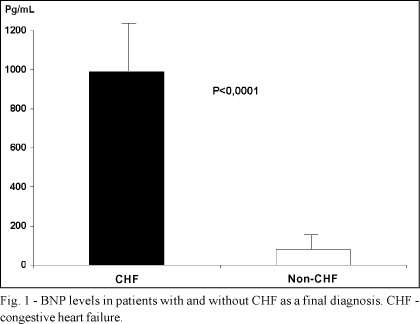
OBJECTIVE: To determine the utility of B-type natriuretic peptide (BNP) in the diagnosis of congestive heart failure (CHF) in patients presenting with dyspnea to an emergency department (ED). METHODS: Seventy patients presenting with dyspnea to an ED from April to July 2001 were included in the study. Mean age was 72±16 years and 33 (47%) were male. BNP was measured in all patients at the moment of admission to the ED. Emergency-care physicians, blinded to BNP values, were required to assign a probable initial diagnosis. A cardiologist retrospectively reviewed the data (blinded to BNP measurements) and assigned a definite diagnosis, which was considered the gold standard for assessing the diagnostic performance of BNP. RESULTS: The mean BNP concentration was higher in patients with CHF (n=36) than in those with other diagnoses (990±550 vs 80±67 pg/mL, p<0.0001). Patients with systolic dysfunction had higher BNP levels than those with preserved systolic function (1,180±641 vs 753±437 pg/mL, p=0.03). At a blood concentration of 200 pg/mL, BNP showed a sensitivity of 100%, specificity of 97.1%, positive predictive value of 97.3%, and negative predictive value of 100%. The application of BNP could have potentially corrected all 16 cases in which the diagnosis was missed by the emergency department physician. CONCLUSION: BNP measurement is a useful tool in the diagnosis of CHF in patients presenting to the ED with dyspnea.

  • emergency medicine
  • Heart Failure
  • Natriuretic Peptides
Read Full Article
Creative Commons Attribution (CC BY) Creative Commons license
09/01/2003 DOI: 10.1590/S0066-782X2002001500002 Views 2
Doppler Echocardiographic Assessment of Pregnant Women with Chronic Arterial Hypertension
Original Article

Doppler Echocardiographic Assessment of Pregnant Women with Chronic Arterial Hypertension

Nádia Cristiane de Mattia et al. Regina Lúcia Barbin Vera Therezinha M. Borges José Carlos Peraçoli Beatriz B. Matsubara

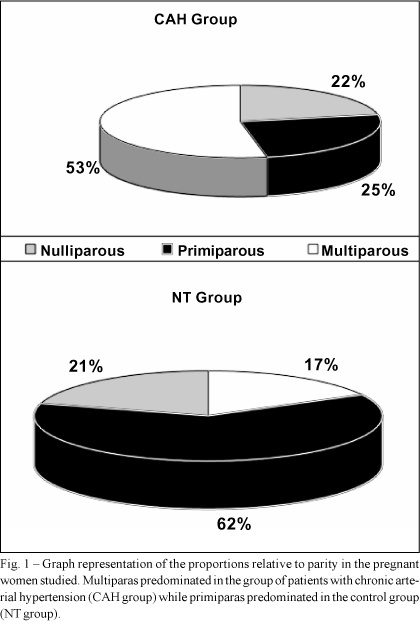
OBJECTIVE: To assess structural and functional cardiac changes in asymptomatic pregnant women with chronic arterial hypertension (CAH). METHODS: One hundred pregnant women with CAH underwent conventional Doppler echocardiography. The Student t test was used to compare them with 29 normotensive pregnant women (NT) in their third gestational trimester. RESULTS: Systolic (SBP; mmHg) and diastolic (DBP; mmHg) blood pressure values were higher (p<0.001) in the CAH pregnant women (SBP: 139±19 and DBP: 92± 18) as compared with those of the NT group (SBP: 112±10 and DBP: 74±9). A significant enlargement of the left atrium (4.10±0.48 cm vs 3.6±0.3 cm; p<0.001) and of the left ventricular normalized mass (59.6±19.7 g/cm2,7 vs 41.9±3.4 g/cm2,7; p<0.001) was observed. Cardiac output (CO, L/min) and systolic volume (SV, mL) were significantly higher in the CAH group (CO: 6.0±1.54 vs 4.9±2.1, p<0.01; SV: 77.3±19.8 vs 56.5±25.8, p<0.001). CONCLUSION: Chronic hypertensive pregnant women have structural and functional cardiac changes that justify routine cardiologic assessment, even in the absence of cardiopulmonary symptoms.

  • myocardial hypertrophy
  • Ventricular Function
  • volume overload
Read Full Article
Creative Commons Attribution (CC BY) Creative Commons license
09/01/2003 DOI: 10.1590/S0066-782X2002001500003 Views 1
Trends in Productive Years of Life Lost to Premature Mortality Due to Coronary Heart Disease
Original Article

Trends in Productive Years of Life Lost to Premature Mortality Due to Coronary Heart Disease

Ines Lessa

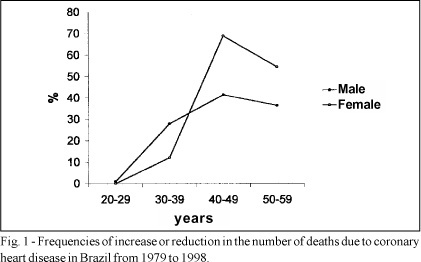
OBJECTIVE: To estimate the number of productive years of life lost to premature death due to coronary heart disease in Brazil and to report their trends over a 20-year period. METHODS: The Brazilian Ministry of Health raw database on death due to coronary heart disease from 1979-1998 was used. The productive years of life lost to premature death were estimated using 20 and 59 years of age as the cut points for the productive years, replacing the potential years of 1 and 70 of the original formula. A descriptive analysis was provided with adjustments, means, proportions, ratios, percentages of increase or reduction, and mobile means. RESULTS: A 35.8% increase in death for males and 51.3% for females was observed, +43.3% being the relative difference for females. The annual means of the productive years of life prematurely lost were analyzed in 140,865 males and 58,559 females, with the differential ratio between the age groups ranging from 2.3 to 2.5. The annual means were less favorable for males. Within each group (intragroup), the ratios decreased with the increase in age, and the age means at the time of death remained constant. The raw tendencies decreased in the 20- to 29-year age group and increased in the 40- to 59-year age group for females and the 40- to 49-year age group for males. When adjusted, the raw tendencies decreased. CONCLUSION: The 43.3% increase in the number of female deaths as compared with that of males and the ascending tendency in the productive years of life lost in the 40- to 59-year age group point to the influence of unfavorable changes in female lifestyles and suggest a deficiency in programs for prevention and control of risk factors and in their treatment in both sexes.

  • age
  • coronary heart disease
  • premature mortality
  • productive years of life
Read Full Article
Creative Commons Attribution (CC BY) Creative Commons license
09/01/2003 DOI: 10.1590/S0066-782X2002001500007 Views 1
Assessment of the DIXTAL DX-2710 Automated Oscillometric Device for Blood Pressure Measurement with the Validation Protocols of the British Hypertension Society (BHS) and the Association for the Advancement of Medical Instrumentation (AAMI)
Original Article

Assessment of the DIXTAL DX-2710 Automated Oscillometric Device for Blood Pressure Measurement with the Validation Protocols of the British Hypertension Society (BHS) and the Association for the Advancement of Medical Instrumentation (AAMI)

Gisele M. P. Mano et al. Viviane F. Souza Angela M. G. Pierin Josiane C. Lima … Edna C. Ignes Kátia C. Ortega Décio Mion Jr.

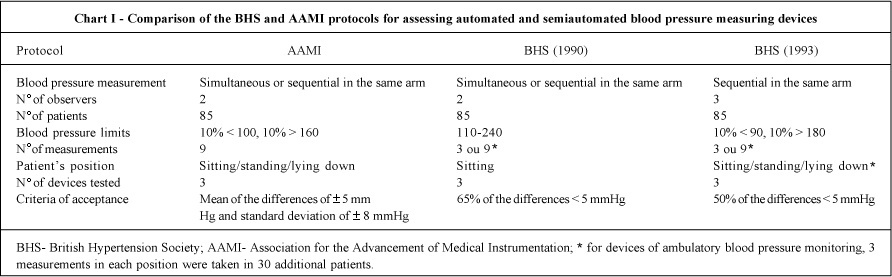
OBJECTIVE: To assess the Dixtal DX2710 automated oscillometric device used for blood pressure measurement according to the protocols of the BHS and the AAMI. METHODS: Three blood pressure measurements were taken in 94 patients (53 females 15 to 80 years). The measurements were taken randomly by 2 observers trained to measure blood pressure with a mercury column device connected with an automated device. The device was classified according to the protocols of the BHS and AAMI. RESULT: The mean of blood pressure levels obtained by the observers was 148±38/93±25 mmHg and that obtained with the device was 148±37/89±26 mmHg. Considering the differences between the measurements obtained by the observer and those obtained with the automated device according to the criteria of the BHS, the following classification was adopted: “A” for systolic pressure (69% of the differences < 5; 90% < 10; and 97% < 15 mmHg); and "B" for diastolic pressure (63% of the differences < 5; 83% < 10; and 93% < 15 mmHg). The mean and standard deviation of the differences were 0±6.27 mmHg for systolic pressure and 3.82±6.21 mmHg for diastolic pressure. CONCLUSION: The Dixtal DX2710 device was approved according to the international recommendations.

  • automated
  • oscillometric blood pressure measuring device
  • validation
Read Full Article
Creative Commons Attribution (CC BY) Creative Commons license
09/01/2003 DOI: 10.1590/S0066-782X2002001500006

How to cite this article

EndNote RIS

Electronic Document Format (Vancouver)

Mion Júnior D, Pierin AMG, Lessa I, Nobre F. Devices and Techniques for Blood Pressure Measurement and Criteria for Hypertension Adopted by Brazilian Physicians: Exploratory Study. Arquivos Brasileiros de Cardiologia 2003;79(6):597-600.

Electronic Document Format (ABNT)

Mion Júnior, Décio; Pierin, Angela Maria Geraldo; Lessa, Ines; Nobre, Fernando. Devices and Techniques for Blood Pressure Measurement and Criteria for Hypertension Adopted by Brazilian Physicians: Exploratory Study. Arquivos Brasileiros de Cardiologia, v. 79, n. 6, p. 597-600, Jan. 2003.

Electronic Document Format (APA)

Mion Júnior, D., Pierin, A. M. G., Lessa, I., & Nobre, F. (2003). Devices and Techniques for Blood Pressure Measurement and Criteria for Hypertension Adopted by Brazilian Physicians: Exploratory Study. Arquivos Brasileiros de Cardiologia, 79(6), 597-600.

Electronic Document Format (ISO)

Mion Júnior, Décio and Pierin, Angela Maria Geraldo and Lessa, Ines and Nobre, Fernando. Devices and Techniques for Blood Pressure Measurement and Criteria for Hypertension Adopted by Brazilian Physicians: Exploratory Study. Arquivos Brasileiros de Cardiologia [online]. 2003, vol. 79, n. 6, [cited 2026-10-14], pp. 597-600. Available from: <https://journals.cardiol.br/en/article/devices-and-techniques-for-blood-pressure-measurement-and-criteria-for-hypertension-adopted-by-brazilian-physicians-exploratory-study/>. ISSN 0066-782X

EndNote RIS

Electronic Document Format (Vancouver)

Lima Júnior E, Knopfholz J, Menini CM. Stress During ACLS Courses: Is it Important for Learning Skills?. Arquivos Brasileiros de Cardiologia 2003;79(6):589-92.

Electronic Document Format (ABNT)

Lima Júnior, Emilton; Knopfholz, José; Menini, Carla M.. Stress During ACLS Courses: Is it Important for Learning Skills?. Arquivos Brasileiros de Cardiologia, v. 79, n. 6, p. 589-592, Jan. 2003.

Electronic Document Format (APA)

Lima Júnior, E., Knopfholz, J., & Menini, C. M. (2003). Stress During ACLS Courses: Is it Important for Learning Skills?. Arquivos Brasileiros de Cardiologia, 79(6), 589-592.

Electronic Document Format (ISO)

Lima Júnior, Emilton and Knopfholz, José and Menini, Carla M.. Stress During ACLS Courses: Is it Important for Learning Skills?. Arquivos Brasileiros de Cardiologia [online]. 2003, vol. 79, n. 6, [cited 2026-10-14], pp. 589-592. Available from: <https://journals.cardiol.br/en/article/stress-during-acls-courses-is-it-important-for-learning-skills/>. ISSN 0066-782X

EndNote RIS

Electronic Document Format (Vancouver)

Villacorta H, Duarte A, Duarte NM, Carrano , Mesquita ET, Dohmann HJF, Ferreira FEG, et al. The Role of B-Type Natriuretic Peptide in the Diagnosis of Congestive Heart Failure in Patients Presenting to an Emergency Department with Dyspnea. Arquivos Brasileiros de Cardiologia 2003;79(6):569-72.

Electronic Document Format (ABNT)

Villacorta, Humberto; Duarte, Adriana; Duarte, Neison Marques; Carrano, Ângela; Mesquita, Evandro Tinoco; Dohmann, Hans J. F.; Ferreira, Francisco Eduardo G.. The Role of B-Type Natriuretic Peptide in the Diagnosis of Congestive Heart Failure in Patients Presenting to an Emergency Department with Dyspnea. Arquivos Brasileiros de Cardiologia, v. 79, n. 6, p. 569-572, Jan. 2003.

Electronic Document Format (APA)

Villacorta, H., Duarte, A., Duarte, N. M., Carrano, , Mesquita, E. T., Dohmann, H. J. F., & Ferreira, F. E. G. (2003). The Role of B-Type Natriuretic Peptide in the Diagnosis of Congestive Heart Failure in Patients Presenting to an Emergency Department with Dyspnea. Arquivos Brasileiros de Cardiologia, 79(6), 569-572.

Electronic Document Format (ISO)

Villacorta, Humberto and Duarte, Adriana and Duarte, Neison Marques and Carrano, Ângela and Mesquita, Evandro Tinoco and Dohmann, Hans J. F. and Ferreira, Francisco Eduardo G.. The Role of B-Type Natriuretic Peptide in the Diagnosis of Congestive Heart Failure in Patients Presenting to an Emergency Department with Dyspnea. Arquivos Brasileiros de Cardiologia [online]. 2003, vol. 79, n. 6, [cited 2026-10-14], pp. 569-572. Available from: <https://journals.cardiol.br/en/article/the-role-of-b-type-natriuretic-peptide-in-the-diagnosis-of-congestive-heart-failure-in-patients-presenting-to-an-emergency-department-with-dyspnea/>. ISSN 0066-782X

EndNote RIS

Electronic Document Format (Vancouver)

Mattia NC, Barbin RL, Borges VTM, Peraçoli JC, Matsubara BB. Doppler Echocardiographic Assessment of Pregnant Women with Chronic Arterial Hypertension. Arquivos Brasileiros de Cardiologia 2003;79(6):579-84.

Electronic Document Format (ABNT)

Mattia, Nádia Cristiane de; Barbin, Regina Lúcia; Borges, Vera Therezinha M.; Peraçoli, José Carlos; Matsubara, Beatriz B.. Doppler Echocardiographic Assessment of Pregnant Women with Chronic Arterial Hypertension. Arquivos Brasileiros de Cardiologia, v. 79, n. 6, p. 579-584, Jan. 2003.

Electronic Document Format (APA)

Mattia, N. C. , Barbin, R. L., Borges, V. T. M., Peraçoli, J. C., & Matsubara, B. B. (2003). Doppler Echocardiographic Assessment of Pregnant Women with Chronic Arterial Hypertension. Arquivos Brasileiros de Cardiologia, 79(6), 579-584.

Electronic Document Format (ISO)

Mattia, Nádia Cristiane de and Barbin, Regina Lúcia and Borges, Vera Therezinha M. and Peraçoli, José Carlos and Matsubara, Beatriz B.. Doppler Echocardiographic Assessment of Pregnant Women with Chronic Arterial Hypertension. Arquivos Brasileiros de Cardiologia [online]. 2003, vol. 79, n. 6, [cited 2026-10-14], pp. 579-584. Available from: <https://journals.cardiol.br/en/article/doppler-echocardiographic-assessment-of-pregnant-women-with-chronic-arterial-hypertension/>. ISSN 0066-782X

EndNote RIS

Electronic Document Format (Vancouver)

Lessa I. Trends in Productive Years of Life Lost to Premature Mortality Due to Coronary Heart Disease. Arquivos Brasileiros de Cardiologia 2003;79(6):617-22.

Electronic Document Format (ABNT)

Lessa, Ines. Trends in Productive Years of Life Lost to Premature Mortality Due to Coronary Heart Disease. Arquivos Brasileiros de Cardiologia, v. 79, n. 6, p. 617-622, Jan. 2003.

Electronic Document Format (APA)

Lessa, I. (2003). Trends in Productive Years of Life Lost to Premature Mortality Due to Coronary Heart Disease. Arquivos Brasileiros de Cardiologia, 79(6), 617-622.

Electronic Document Format (ISO)

Lessa, Ines. Trends in Productive Years of Life Lost to Premature Mortality Due to Coronary Heart Disease. Arquivos Brasileiros de Cardiologia [online]. 2003, vol. 79, n. 6, [cited 2026-10-14], pp. 617-622. Available from: <https://journals.cardiol.br/en/article/trends-in-productive-years-of-life-lost-to-premature-mortality-due-to-coronary-heart-disease/>. ISSN 0066-782X

EndNote RIS

Electronic Document Format (Vancouver)

Mano GMP, Souza VF, Pierin AMG, Lima JC, Ignes EC, Ortega KC, Mion Jr. D, et al. Assessment of the DIXTAL DX-2710 Automated Oscillometric Device for Blood Pressure Measurement with the Validation Protocols of the British Hypertension Society (BHS) and the Association for the Advancement of Medical Instrumentation (AAMI). Arquivos Brasileiros de Cardiologia 2003;79(6):606-10.

Electronic Document Format (ABNT)

Mano, Gisele M. P.; Souza, Viviane F.; Pierin, Angela M. G.; Lima, Josiane C.; Ignes, Edna C.; Ortega, Kátia C.; Mion Jr., Décio. Assessment of the DIXTAL DX-2710 Automated Oscillometric Device for Blood Pressure Measurement with the Validation Protocols of the British Hypertension Society (BHS) and the Association for the Advancement of Medical Instrumentation (AAMI). Arquivos Brasileiros de Cardiologia, v. 79, n. 6, p. 606-610, Jan. 2003.

Electronic Document Format (APA)

Mano, G. M. P., Souza, V. F., Pierin, A. M. G., Lima, J. C., Ignes, E. C., Ortega, K. C., & Mion Jr., D. (2003). Assessment of the DIXTAL DX-2710 Automated Oscillometric Device for Blood Pressure Measurement with the Validation Protocols of the British Hypertension Society (BHS) and the Association for the Advancement of Medical Instrumentation (AAMI). Arquivos Brasileiros de Cardiologia, 79(6), 606-610.

Electronic Document Format (ISO)

Mano, Gisele M. P. and Souza, Viviane F. and Pierin, Angela M. G. and Lima, Josiane C. and Ignes, Edna C. and Ortega, Kátia C. and Mion Jr., Décio. Assessment of the DIXTAL DX-2710 Automated Oscillometric Device for Blood Pressure Measurement with the Validation Protocols of the British Hypertension Society (BHS) and the Association for the Advancement of Medical Instrumentation (AAMI). Arquivos Brasileiros de Cardiologia [online]. 2003, vol. 79, n. 6, [cited 2026-10-14], pp. 606-610. Available from: <https://journals.cardiol.br/en/article/assessment-of-the-dixtal-dx-2710-automated-oscillometric-device-for-blood-pressure-measurement-with-the-validation-protocols-of-the-british-hypertension-society-bhs-and-the-association-for-the-advan/>. ISSN 0066-782X

Sede – Rio de Janeiro
Av. Marechal Câmara, 160
3º andar – Sala: 330 – Centro
Rio de Janeiro – CEP: 20020-907
Tel.: (55 +21) 3478-2700
ou (21) 99386-3961
E-mail: revista@cardiol.br

Sede – São Paulo
Alameda Santos, 705 – 11º andar
Cerqueira César | São Paulo
CEP: 01419-001
Tel.: (55 +11) 3411-5500
E-mail: revista@cardiol.br

  • About the Journal
  • Internal Regulation
  • Editors Section
  • Editorial Board
  • History
  • SBC Award

  • Guidelines for Publication
  • Editorial Policy
  • Ethics Policy
  • Policy on the Use of Artificial Intelligence
  • Mandatory Publication Form
  • Publication Fee

Issues

SBC Guidelines

  • How to Publish an Abstract Supplement?
  • Supplements from the Brazilian Congress of Cardiology