Comparable Ventilatory Inefficiency at Maximal and Submaximal Performance in COPD vs. CHF subjects: An Innovative Approach
Abstract
Background:
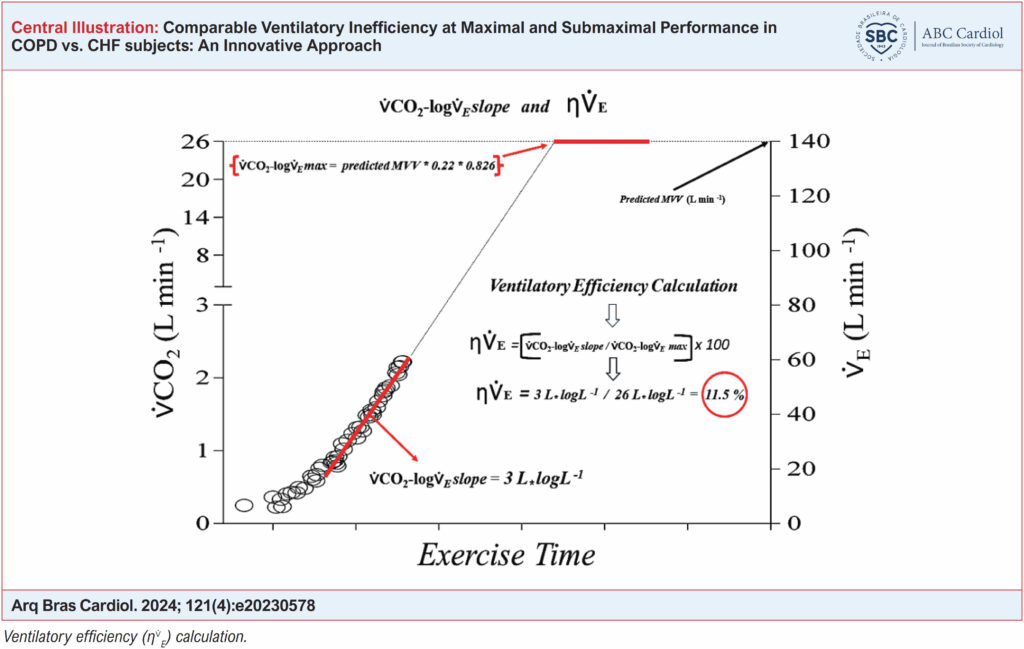
Currently, excess ventilation has been grounded under the relationship between minute-ventilation/carbon dioxide output (). Alternatively, a new approach for ventilatory efficiency () has been published.
Objective:
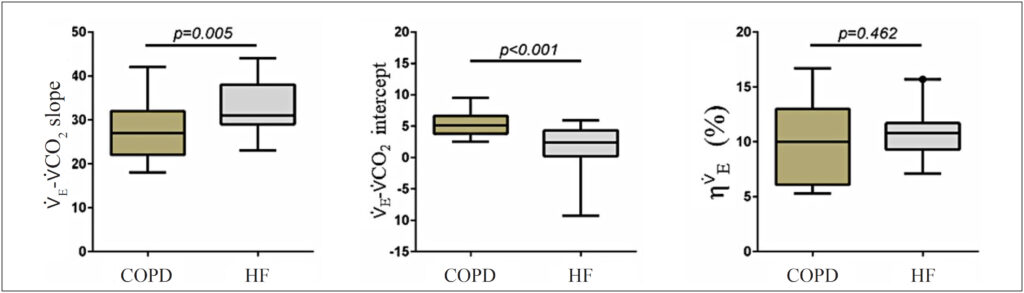
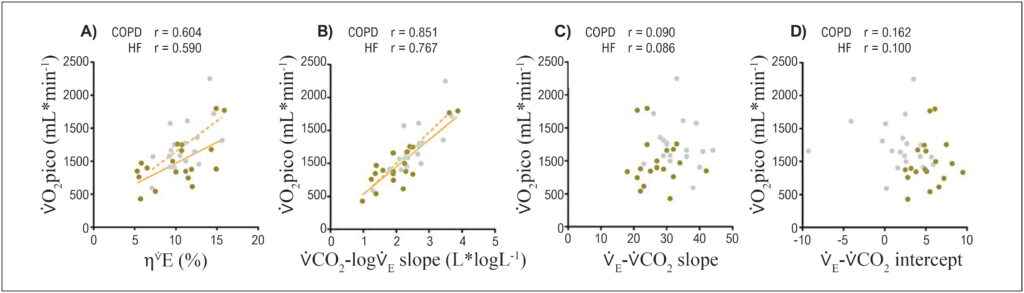
Our main hypothesis is that comparatively low levels of between chronic heart failure (CHF) and chronic obstructive pulmonary disease (COPD) are attainable for a similar level of maximum and submaximal aerobic performance, conversely to long-established methods ( slope and intercept).
Methods:
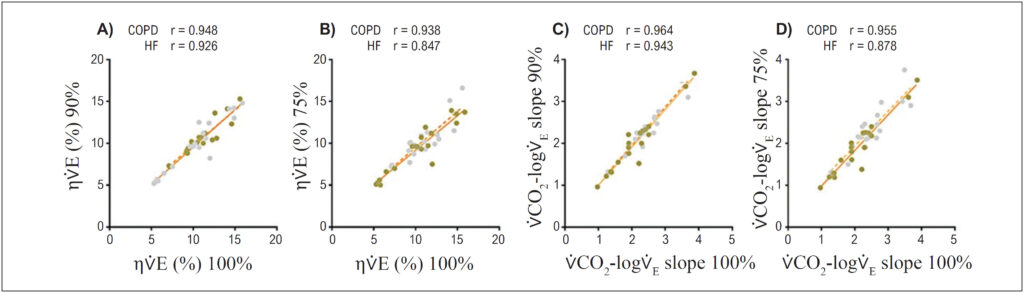
Both groups performed lung function tests, echocardiography, and cardiopulmonary exercise testing. The significance level adopted in the statistical analysis was 5%. Thus, nineteen COPD and nineteen CHF-eligible subjects completed the study. With the aim of contrasting full values of and for the exercise period (100%), correlations were made with smaller fractions, such as 90% and 75% of the maximum values.
Results:
The two groups attained matched characteristics for age (62±6 vs. 59±9 yrs, p>.05), sex (10/9 vs. 14/5, p>0.05), BMI (26±4 vs. 27±3 Kg m2, p>0.05), and peak (72±19 vs. 74±20 %pred, p>0.05), respectively. The slope and intercept were significantly different for COPD and CHF (27.2±1.4 vs. 33.1±5.7 and 5.3±1.9 vs. 1.7±3.6, p0.850 for both).
Conclusion:
The is a valuable method for comparison between cardiopulmonary diseases, with so far distinct physiopathological mechanisms, including ventilatory constraints in COPD.
Images
Image gallery fullscreen viewer
Comments are moderated by the editorial team before publication. Discussions should be evidence-based and use scientific language. Conflicts of interest should be declared.