ABC Family Arquivos Brasileiros de Cardiologia International Journal of Cardiovascular Sciences ABC Heart Failure & Cardiomyopathy ABC Imagem Cardiovascular
Português English
ABC Family
Português English
  • About
    • About ABC Family
    • Internal Regulation
    • Editorial Board
    • Brazilian Society of Cardiology (SBC)
  • Issues
  • SBC Guidelines
  • Content
    • Videos
    • Podcasts
    • News
  • About
    • About ABC Family
    • Internal Regulation
    • Editorial Board
    • Brazilian Society of Cardiology (SBC)
  • Issues
  • SBC Guidelines
  • Content
    • Videos
    • Podcasts
    • News

ABC Family

  • ABC Family
  • Arquivos Brasileiros de Cardiologia
  • International Journal of Cardiovascular Sciences
  • ABC Heart Failure & Cardiomyopathy
  • ABC Imagem Cardiovascular
Search in

No content found.

Journals
Ordering
Article types
Others

  1. Home
  2. Keyword: Virtual reality
Virtual Reality and Physical Activity in Patients with Heart Failure: Technology Validation and User Satisfaction – Pilot Study
IJCS
Original Article

Virtual Reality and Physical Activity in Patients with Heart Failure: Technology Validation and User Satisfaction – Pilot Study

Ariele dos Santos Costa et al. Caroline Bublitz Barbosa Solange Guizilini Vagner Rogério dos Santos … Carla Roberta Miura Múcio Tavares de Oliveira Junior Anabela Gonçalves da Silva Rita Simone Lopes Moreira

Abstract

Background

Digital health uses innovative information technology for healthcare needs. Virtual reality (VR) is increasingly adopted in healthcare, including cardiovascular rehabilitation (CVR), to improve performance and adherence. However, digital interventions must consider users’ perspectives to prevent VR from becoming a barrier.

Objective

This study aimed to assess the usability and enjoyment of physical activity associated with VR among inpatients with heart failure (HF).

Method

A prospective pilot study was conducted with ten patients diagnosed with HF. Participants completed an exercise program on a cycle ergometer with immersive VR for lower limb training. Anxiety and depression symptoms, physical activity enjoyment, and system usability were evaluated. Statistical analysis included descriptive and inferential analyses with a 5% significance level (p<0.05). Pearson's test was used for correlation analysis.

Results

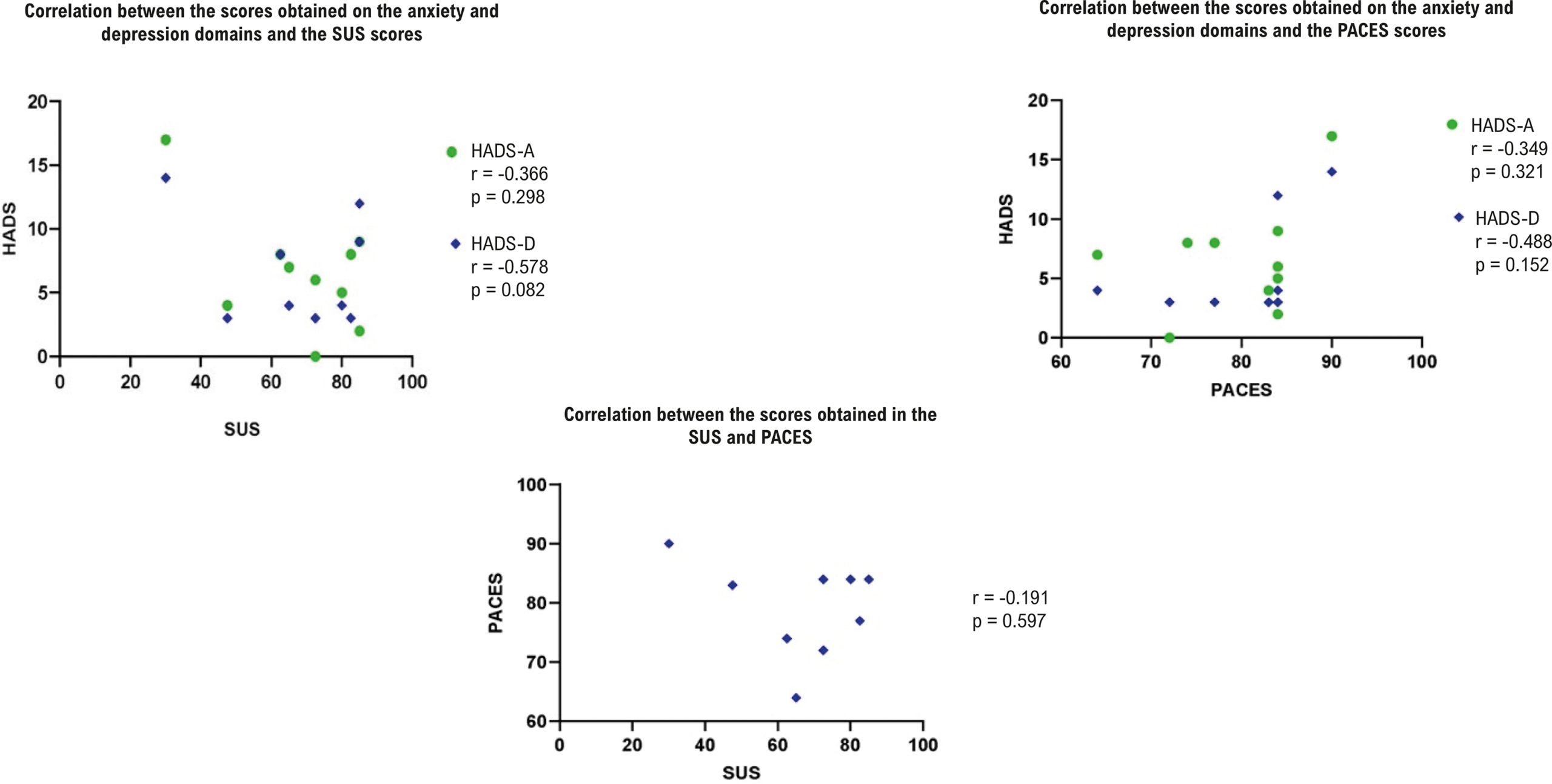
The population’s tendency to experience anxiety and depression was evaluated, and the sample favorably assessed the system’s usability, with a mean score of 68.2 (standard deviation ±17.8); exercise enjoyment scored 79.6 (±7.7). No significant correlations were found between anxiety and depression profiles and usability or exercise enjoyment, suggesting further study phases.

Conclusions

VR can complement rehabilitation programs for HF patients, potentially improving performance and adherence. Additional research is required to evaluate the effectiveness of VR-associated physical activity on clinical outcomes in HF patients.

  • digital health
  • Heart Failure
  • Rehabilitation
  • Virtual reality
Read Full Article
Creative Commons Attribution (CC BY) Creative Commons license
28/02/2025 DOI: 10.36660/ijcs.20240067 Views 2
IJCS
Editorial

Digital Tools and Cardiovascular Rehabilitation

Ricardo Stein et al. Leandro Tolfo Franzoni

Cardiovascular diseases are the leading cause of death worldwide. The inclusion of patients with such diseases in cardiovascular rehabilitation (CR) programs is an evidence-based conduct, since it has the potential to improve the individual’s clinical condition and manage several risk factors associated with these diseases. The association of aerobic and resistance exercises is a recommended combination in many CR programs. However, technological tools have been studied and used in order to increase the range of methods to optimize the results in the scenario of secondary prevention of cardiac diseases. In addition, combining modern strategies and conventional models can be a form of motivation for the patient by making CR interactive and funnier. In this case, virtual reality (VR) has also been used, including in our country.,

A study published by Silva et al. in this issue of the International Journal of Cardiovascular Sciences compares the effects of conventional rehabilitation with VR on body composition and functional capacity of patients with cardiac diseases. It is a randomized controlled trial (RCT) in which 27 patients with cardiac diseases were enrolled to participate in an eight-week CR program. The sample was divided into two groups: a) conventional rehabilitation; b) rehabilitation with VR. The sessions lasted 60 minutes for both groups and the weekly frequency was twice a week. Conventional rehabilitation consisted of two parts: 25 minutes of aerobic exercise followed by 25 minutes of exercises with weights (upper and lower limbs). The intensity control during aerobic exercise was performed by monitoring the heart rate reserve determined by the Karvonen equation (50% and 80%). For resistance exercises, intensity was controlled by rating of perceived exertion (up to 13 on the Borg scale). Rehabilitation with VR was performed using Microsoft’s Xbox 360 with Kinect. The twenty-five minutes of games consisted of exercises for the upper and lower limbs and 25 minutes of dancing with the Dance Central 3 game. In the first part, velcro weights were used in the ankle and dumbbells in the hands for the resistance exercises. The intensity was only controlled in the first part of the activity. Functional capacity was measured through a 6-minute walk test, which significantly increased in both groups. Similarly, both groups had the capillary blood glucose reduced. However, as opposed to what was expected, none of the two strategies significantly reduced fat percentage and body weight. In fact, the VR group presented a significant increase in these two variables compared to the conventional rehabilitation group.

[…]

  • Cardiac Rehabilitation
  • Cardiovascular Diseases/physiopathology
  • Exercise Movement Techniques/methods
  • Quality of life
  • Virtual reality
Read Full Article
Creative Commons Attribution (CC BY) Creative Commons license
01/01/2018 DOI: 10.5935/2359-4802.20180082 Views 1

How to cite this article

EndNote RIS

Electronic Document Format (Vancouver)

Costa AS, Barbosa CB, Guizilini S, Santos VR, Miura CR, Oliveira Junior MT, Silva AG, et al. Virtual Reality and Physical Activity in Patients with Heart Failure: Technology Validation and User Satisfaction – Pilot Study. International Journal of Cardiovascular Sciences 2025;38:e20240067.

Electronic Document Format (ABNT)

Costa, Ariele dos Santos; Barbosa, Caroline Bublitz; Guizilini, Solange; Santos, Vagner Rogério dos; Miura, Carla Roberta; Oliveira Junior, Múcio Tavares de; Silva, Anabela Gonçalves da; Moreira, Rita Simone Lopes. Virtual Reality and Physical Activity in Patients with Heart Failure: Technology Validation and User Satisfaction – Pilot Study. International Journal of Cardiovascular Sciences, v. 38, e20240067, Feb. 2025.

Electronic Document Format (APA)

Costa, A. S., Barbosa, C. B., Guizilini, S., Santos, V. R. , Miura, C. R., Oliveira Junior, M. T. , Silva, A. G. , & Moreira, R. S. L. (2025). Virtual Reality and Physical Activity in Patients with Heart Failure: Technology Validation and User Satisfaction – Pilot Study. International Journal of Cardiovascular Sciences, 38, e20240067.

Electronic Document Format (ISO)

Costa, Ariele dos Santos and Barbosa, Caroline Bublitz and Guizilini, Solange and Santos, Vagner Rogério dos and Miura, Carla Roberta and Oliveira Junior, Múcio Tavares de and Silva, Anabela Gonçalves da and Moreira, Rita Simone Lopes. Virtual Reality and Physical Activity in Patients with Heart Failure: Technology Validation and User Satisfaction – Pilot Study. International Journal of Cardiovascular Sciences [online]. 2025, vol. 38, [cited 2026-10-14], e20240067. Available from: <https://journals.cardiol.br/en/article/virtual-reality-and-physical-activity-in-patients-with-heart-failure-technology-validation-and-user-satisfaction-pilot-study/>. ISSN 2359-4802

EndNote RIS

Electronic Document Format (Vancouver)

Stein R, Franzoni LT. Digital Tools and Cardiovascular Rehabilitation. International Journal of Cardiovascular Sciences 2018;31(6):558-9.

Electronic Document Format (ABNT)

Stein, Ricardo; Franzoni, Leandro Tolfo. Digital Tools and Cardiovascular Rehabilitation. International Journal of Cardiovascular Sciences, v. 31, n. 6, p. 558-559, Dec. 2017.

Electronic Document Format (APA)

Stein, R., & Franzoni, L. T. (2018). Digital Tools and Cardiovascular Rehabilitation. International Journal of Cardiovascular Sciences, 31(6), 558-559.

Electronic Document Format (ISO)

Stein, Ricardo and Franzoni, Leandro Tolfo. Digital Tools and Cardiovascular Rehabilitation. International Journal of Cardiovascular Sciences [online]. 2018, vol. 31, n. 6, [cited 2026-10-14], pp. 558-559. Available from: <https://journals.cardiol.br/en/article/digital-tools-and-cardiovascular-rehabilitation/>. ISSN 2359-4802

  • About ABC Family
  • Internal Regulation
  • Editorial Board
  • Brazilian Society of Cardiology (SBC)

Issues

SBC Guidelines

  • Videos
  • Podcasts
  • News