ABC Family Arquivos Brasileiros de Cardiologia International Journal of Cardiovascular Sciences ABC Heart Failure & Cardiomyopathy ABC Imagem Cardiovascular
Português English
ABC Family
Português English
  • About
    • About ABC Family
    • Internal Regulation
    • Editorial Board
    • Brazilian Society of Cardiology (SBC)
  • Issues
  • SBC Guidelines
  • Content
    • Videos
    • Podcasts
    • News
  • About
    • About ABC Family
    • Internal Regulation
    • Editorial Board
    • Brazilian Society of Cardiology (SBC)
  • Issues
  • SBC Guidelines
  • Content
    • Videos
    • Podcasts
    • News

ABC Family

  • ABC Family
  • Arquivos Brasileiros de Cardiologia
  • International Journal of Cardiovascular Sciences
  • ABC Heart Failure & Cardiomyopathy
  • ABC Imagem Cardiovascular
Search in

No content found.

Journals
Ordering
Article types
Others

  1. Home
  2. Keyword: Ventilators Mechanical
Figure 1
ABC
Original Article

Use of a Portable Mechanical Ventilator during Cardiopulmonary Resuscitation is Feasible, Improves Respiratory Parameters, and Prevents the Decrease of Dynamic Lung Compliance

Manoel Ângelo Gomes Palácio et al. Edison Ferreira de Paiva Gustavo Bernardes de Figueiredo Oliveira Luciano César Pontes de Azevedo … Bruno Gregnanin Pedron Elizabete Silva dos Santos Ari Timerman

Abstract

Background

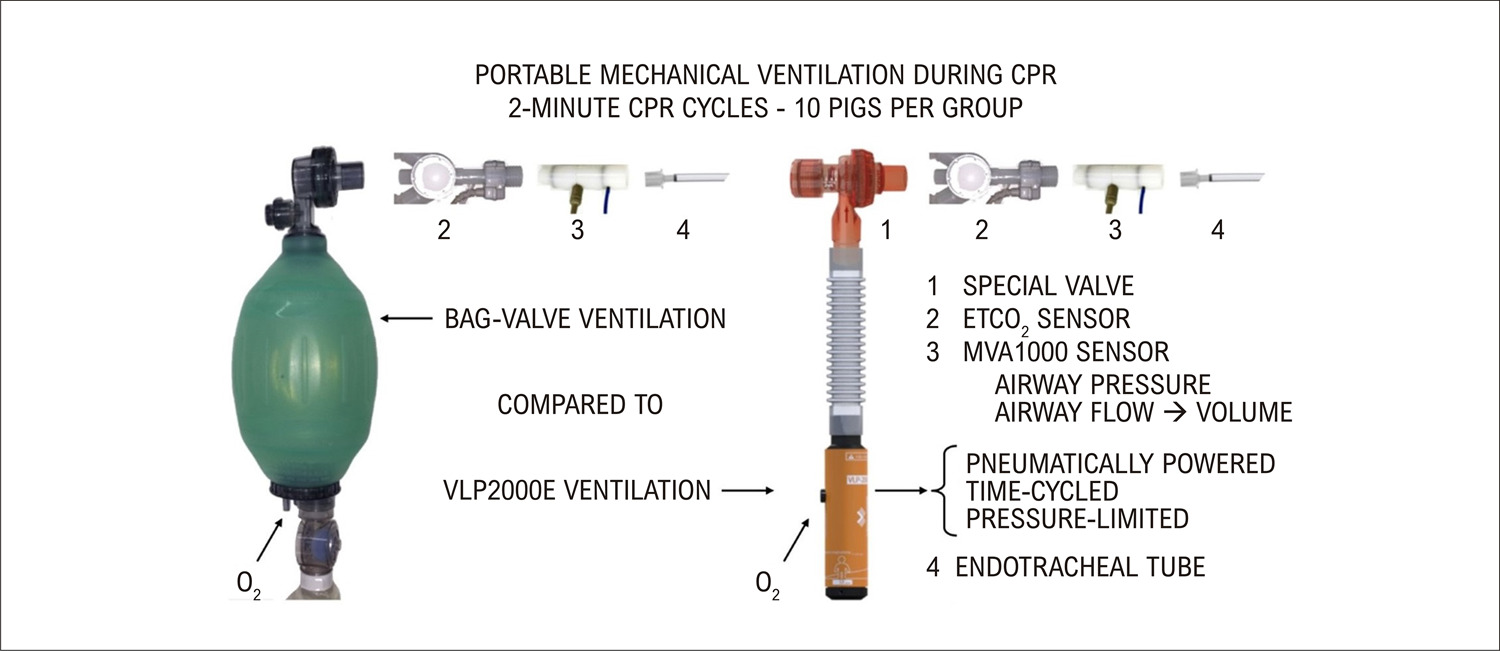
For practical and protective ventilation during cardiopulmonary resuscitation (CPR), a 150-grams mechanical ventilator (VLP2000E) that limits peak inspiratory pressure (PIP) during simultaneous ventilation with chest compressions was developed.

Objectives

To evaluate the feasibility of VLP2000E ventilation during CPR and to compare monitored parameters versus bag-valve ventilation.

Methods

A randomized experimental study with 10 intubated pigs per group. After seven minutes of ventricular fibrillation, 2-minute CPR cycles were delivered. All animals were placed on VLP2000E after achieving return of spontaneous circulation (ROSC).

Results

Bag-valve and VLP2000E groups had similar ROSC rate (60% vs. 50%, respectively) and arterial oxygen saturation in most CPR cycles, different baseline tidal volume [0.764 (0.068) vs. 0.591 (0.123) L, p = 0.0309, respectively] and, in 14 cycles, different PIP [52 (9) vs. 39 (5) cm H2O, respectively], tidal volume [0.635 (0.172) vs. 0.306 (0.129) L], ETCO2[14 (8) vs. 27 (9) mm Hg], and peak inspiratory flow [0.878 (0.234) vs. 0.533 (0.105) L/s], all p < 0.0001. Dynamic lung compliance (≥ 0.025 L/cm H2O) decreased after ROSC in bag-valve group but was maintained in VLP2000E group [0.019 (0.006) vs. 0.024 (0.008) L/cm H2O, p = 0.0003].

Conclusions

VLP2000E ventilation during CPR is feasible and equivalent to bag-valve ventilation in ROSC rate and arterial oxygen saturation. It produces better respiratory parameters, with lower airway pressure and tidal volume. VLP2000E ventilation also prevents the significant decrease of dynamic lung compliance observed after bag-valve ventilation. Further preclinical studies confirming these findings would be interesting.

  • Cardiopulmonary Resuscitation
  • Hyperventilation
  • Lung Compliance
  • Lung Injury
  • Ventilators Mechanical
Read Full Article
Creative Commons Attribution (CC BY) Creative Commons license
07/08/2023 DOI: 10.36660/abc.20220564
ABC
Editorial

Covid-19 in Brazil: Learning How to Walk in the Dark Without Leaving Anything Behind

Juliano Lara Fernandes

The SARS-CoV-2 pandemic had its first case in Brazil on February 4, 2020 in the state of São Paulo. Like a real meteor, it practically paralyzed the planet without a more effective therapeutic approach to fight the virus, in addition to practices adopted worldwide only decades or even hundreds of years ago, with a very low level of robust modern evidence. Brazil had the advantage of previewing the pandemic as it was a few weeks behind its Asian and European peers, so it was able to identify the hits and failures of these countries in their preparation to face the problem.

We have then found out by chance that we have the world’s third biggest number of ICU beds, second only to the USA and Germany, but we are also faced with an enormous heterogeneity between states, limitations and bureaucracy for the purchase of personal protective equipment and testing kits. This has prevented some pandemic approaches taken by other countries from being adopted here, either due to the impossibility of a lockdown in a continental country, or due to the speed and costs to identify the cases of transmission. Besides, limitations on the number of tests to be done has left us without a precise guide as to the spread of the pandemic, making it difficult to plan the timely, orderly and efficient allocation of scarce resources.

[…]

  • Catastrófica Illness/mortality
  • Coronavirus
  • COVID-19
  • Diagnostic Tests/methds
  • Equity in Access to Health Services
  • Hospitalization/economics
  • Masks
  • Pandemics
  • Personal Protective Equipment
  • Ventilators Mechanical
Read Full Article
Creative Commons Attribution (CC BY) Creative Commons license
03/07/2020 DOI: 10.36660/abc.20200445 Views 1

How to cite this article

EndNote RIS

Electronic Document Format (Vancouver)

Palácio MG, Paiva EF, Oliveira GBF, Azevedo LCP, Pedron BG, Santos ES, Timerman A, et al. Use of a Portable Mechanical Ventilator during Cardiopulmonary Resuscitation is Feasible, Improves Respiratory Parameters, and Prevents the Decrease of Dynamic Lung Compliance. Arquivos Brasileiros de Cardiologia 2023;120(7):e20220564.

Electronic Document Format (ABNT)

Palácio, Manoel Ângelo Gomes; Paiva, Edison Ferreira de; Oliveira, Gustavo Bernardes de Figueiredo; Azevedo, Luciano César Pontes de; Pedron, Bruno Gregnanin; Santos, Elizabete Silva dos; Timerman, Ari. Use of a Portable Mechanical Ventilator during Cardiopulmonary Resuscitation is Feasible, Improves Respiratory Parameters, and Prevents the Decrease of Dynamic Lung Compliance. Arquivos Brasileiros de Cardiologia, v. 120, n. 7, e20220564, Aug. 2023.

Electronic Document Format (APA)

Palácio, M. G., Paiva, E. F. , Oliveira, G. B. F., Azevedo, L. C. P. , Pedron, B. G., Santos, E. S. , & Timerman, A. (2023). Use of a Portable Mechanical Ventilator during Cardiopulmonary Resuscitation is Feasible, Improves Respiratory Parameters, and Prevents the Decrease of Dynamic Lung Compliance. Arquivos Brasileiros de Cardiologia, 120(7), e20220564.

Electronic Document Format (ISO)

Palácio, Manoel Ângelo Gomes and Paiva, Edison Ferreira de and Oliveira, Gustavo Bernardes de Figueiredo and Azevedo, Luciano César Pontes de and Pedron, Bruno Gregnanin and Santos, Elizabete Silva dos and Timerman, Ari. Use of a Portable Mechanical Ventilator during Cardiopulmonary Resuscitation is Feasible, Improves Respiratory Parameters, and Prevents the Decrease of Dynamic Lung Compliance. Arquivos Brasileiros de Cardiologia [online]. 2023, vol. 120, n. 7, [cited 2026-10-14], e20220564. Available from: <https://journals.cardiol.br/en/article/use-of-a-portable-mechanical-ventilator-during-cardiopulmonary-resuscitation-is-feasible-improves-respiratory-parameters-and-prevents-the-decrease-of-dynamic-lung-compliance/>. ISSN 0066-782X

EndNote RIS

Electronic Document Format (Vancouver)

Fernandes JL. Covid-19 in Brazil: Learning How to Walk in the Dark Without Leaving Anything Behind. Arquivos Brasileiros de Cardiologia 2020;114(6):988-91.

Electronic Document Format (ABNT)

Fernandes, Juliano Lara. Covid-19 in Brazil: Learning How to Walk in the Dark Without Leaving Anything Behind. Arquivos Brasileiros de Cardiologia, v. 114, n. 6, p. 988-991, Jul. 2020.

Electronic Document Format (APA)

Fernandes, J. L. (2020). Covid-19 in Brazil: Learning How to Walk in the Dark Without Leaving Anything Behind. Arquivos Brasileiros de Cardiologia, 114(6), 988-991.

Electronic Document Format (ISO)

Fernandes, Juliano Lara. Covid-19 in Brazil: Learning How to Walk in the Dark Without Leaving Anything Behind. Arquivos Brasileiros de Cardiologia [online]. 2020, vol. 114, n. 6, [cited 2026-10-14], pp. 988-991. Available from: <https://journals.cardiol.br/en/article/covid-19-in-brazil-learning-how-to-walk-in-the-dark-without-leaving-anything-behind/>. ISSN 0066-782X

  • About ABC Family
  • Internal Regulation
  • Editorial Board
  • Brazilian Society of Cardiology (SBC)

Issues

SBC Guidelines

  • Videos
  • Podcasts
  • News