ABC Family Arquivos Brasileiros de Cardiologia International Journal of Cardiovascular Sciences ABC Heart Failure & Cardiomyopathy ABC Imagem Cardiovascular
Português English
ABC Family
Português English
  • About
    • About ABC Family
    • Internal Regulation
    • Editorial Board
    • Brazilian Society of Cardiology (SBC)
  • Issues
  • SBC Guidelines
  • Content
    • Videos
    • Podcasts
    • News
  • About
    • About ABC Family
    • Internal Regulation
    • Editorial Board
    • Brazilian Society of Cardiology (SBC)
  • Issues
  • SBC Guidelines
  • Content
    • Videos
    • Podcasts
    • News

ABC Family

  • ABC Family
  • Arquivos Brasileiros de Cardiologia
  • International Journal of Cardiovascular Sciences
  • ABC Heart Failure & Cardiomyopathy
  • ABC Imagem Cardiovascular
Search in

No content found.

Journals
Ordering
Article types
Others

  1. Home
  2. Keyword: Standing Position
Figura 1
ABC
Original Article

Prevalence of Orthostatic Hypotension and the Distribution of Pressure Variation in the Longitudinal Study of Adult Health

Ana Paula Costa Velten et al. Isabela Bensenor Paulo Lotufo José Geraldo Mill

Abstract

Background

Orthostatic hypotension (OH) has been neglected in clinical practice, and there are no studies on its prevalence in the Brazilian population.

Objective

To determine the prevalence of OH and blood pressure (BP) changes after the postural change maneuver in participants of the Longitudinal Study of Adult Health.

Methods

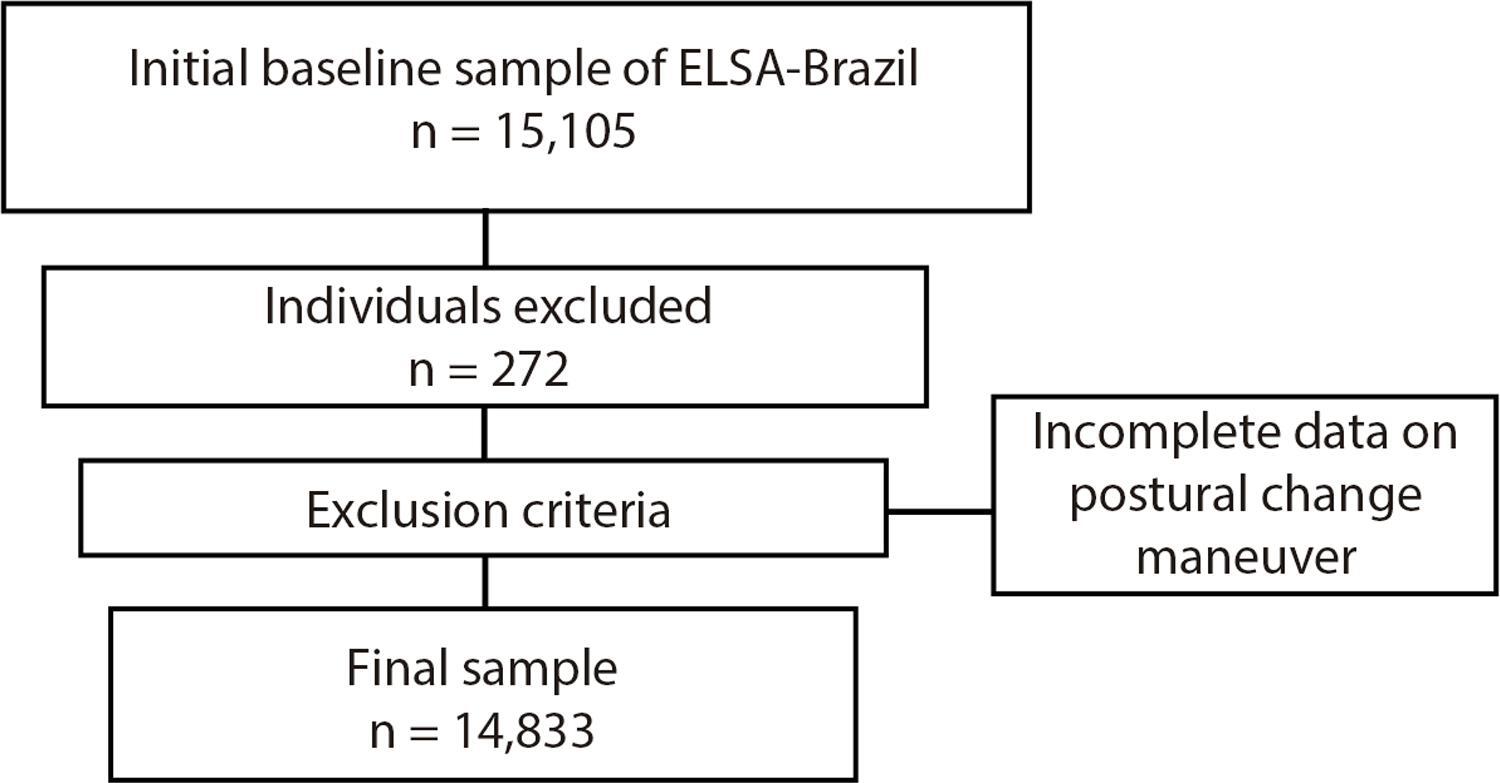
In this descriptive study of baseline data (N = 14,833 adults, ages 35 – 74 years), participants remained lying down for 20 minutes and subsequently stood up actively. BP measurements were taken while the participants were supine and at 2, 3, and 5 minutes after standing. OH was defined as a reduction of ≥ 20 mmHg in systolic BP and/or a reduction of ≥ 10 mmHg in diastolic BP at 3 minutes, and its prevalence was determined with a 95% confidence interval (CI). The distribution of BP variation after the postural change maneuver was determined in a subsample (N = 8,011) obtained by removing patients with cardiovascular morbidity and/or diabetes.

Results

The prevalence of OH was 2.0% (95% CI: 1.8 – 2.3), increasing with age. If the criterion applied were a BP reduction during any measurement, the prevalence would increase to 4.3% (95% CI: 4.0 – 4.7). Symptoms (dizziness, scotoma, nausea, etc.) were reported by 19.7% of participants (95% CI: 15.6 – 24.6) with OH and 1.4% (95% CI: 1.2 – 1.6) of participants without OH. The −2 Z-scores of BP variation before and after the postural change maneuver in the subsample were −14.1 mmHg for systolic BP and −5.4 mmHg for diastolic BP.

Conclusion

Prevalence of OH varies depending on when BP is measured. Current cutoff points may underestimate the actual occurrence of OH in the population. (Arq Bras Cardiol. 2020; 114(6):1040-1048)
  • Blood Pressure
  • Coronary Artery Disease
  • Hypotension, Orthostatic/epidemiology
  • Prevalence
  • Standing Position
Read Full Article
Creative Commons Attribution (CC BY) Creative Commons license
03/07/2020 DOI: 10.36660/abc.20180354 Views 2
Figure 1
ABC
Original Article

Influences on the Functional Behavior of Great Arteries during Orthostasis

Jorge Elias Neto et al. Albano Ferreira Guilherme Futuro Luiz Carlos dos Santos … Nevelton Heringer Filho Fernando Gomes Jose Geraldo Mill

Abstract

Background:

Arterial compliance reduction has been associated with aging and hypertension in supine position. However, the dynamic effects of orthostatism on aortic distensibility has not been defined.

Objective:

We sought to determine the orthostatic influence and the interference of age, blood pressure (BP) and heart rate (HR) on the great arteries during gravitational stress.

Methods:

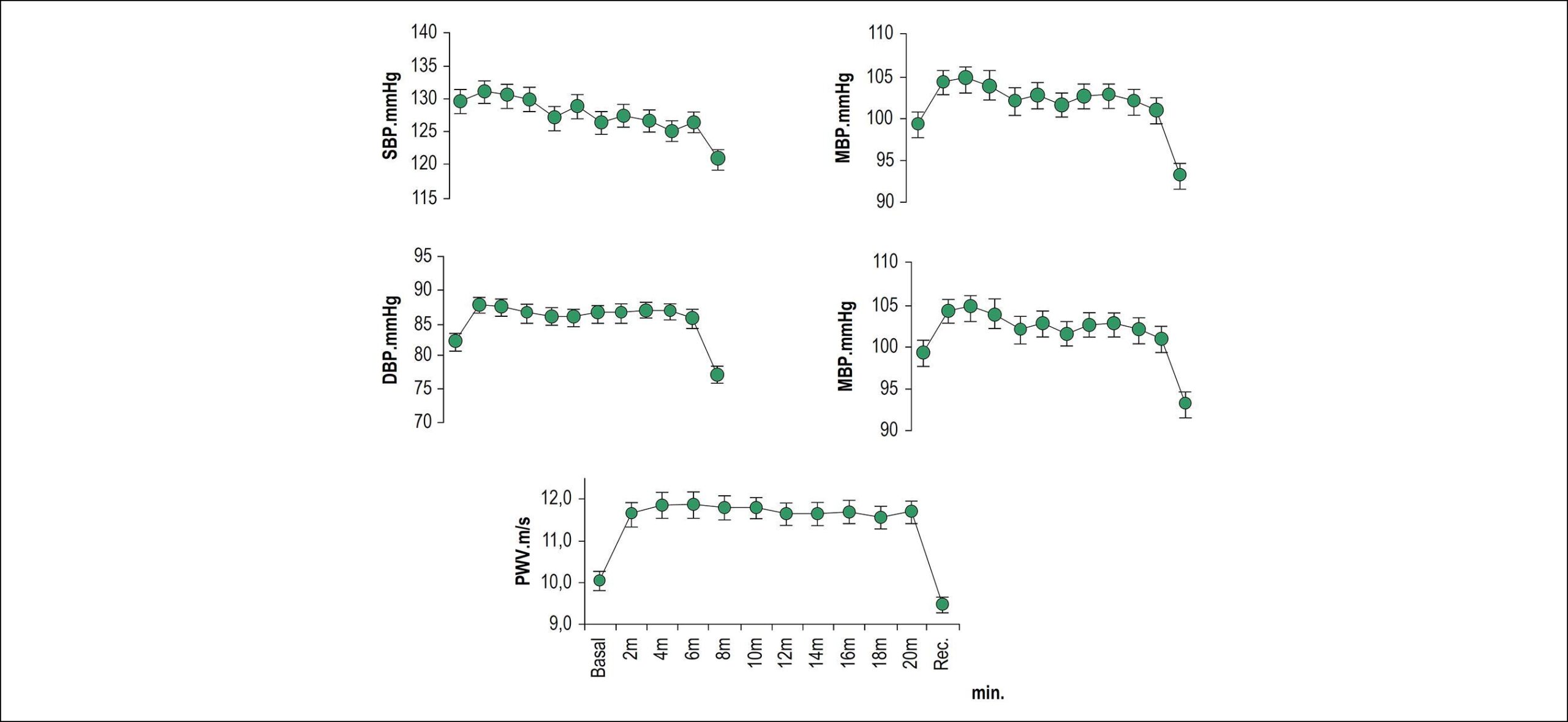
Ninety-three healthy volunteers (age 42 ± 16 years). Carotid-femoral pulse wave velocity (PWV) assumed as aortic stiffness was assessed in supine position (basal phase), during tilt test (TT) (orthostatic phase) and after return to supine position (recovery phase). Simultaneously with PWV acquisition, measures of BP and HR rate were recorded.

Results:

PWV during TT increased significantly compared to the basal and recovery phases (11.7 ± 2.5 m/s vs. 10.1 ± 2.3 m/s and 9.5 ± 2.0 m/s). Systolic BP (r = 0.55, r = 0.46 and r = 0.39) and age (r = 0.59, r = 0.63 and r = 0.39) correlated with PWV in all phases. The significance level for all tests was established as α = 0.05.

Conclusion:

We conclude that there is a permanent increase in PWV during orthostatic position that was returned to basal level at the recovery phase. This dynamic pattern of PWV response, during postural changes, can be explained by an increase in hydrostatic pressure at the level of abdominal aorta which with smaller radius and an increased elastic modulus, propagates the pulse in a faster way. Considering that it could increase central pulse reflection during the orthostatic position, we speculate that this mechanism may play a role in the overall adaptation of humans to gravitational stress.

  • aging
  • Gravitation
  • Hypertension
  • Pulse Wave Analysis
  • Standing Position
  • Switch Arterial
Read Full Article
Creative Commons Attribution (CC BY) Creative Commons license
09/09/2019 DOI: 10.5935/abc.20190182 Views 1

How to cite this article

EndNote RIS

Electronic Document Format (Vancouver)

Velten APC, Bensenor I, Lotufo P, Mill JG. Prevalence of Orthostatic Hypotension and the Distribution of Pressure Variation in the Longitudinal Study of Adult Health. Arquivos Brasileiros de Cardiologia 2020;114(6):1040-8.

Electronic Document Format (ABNT)

Velten, Ana Paula Costa; Bensenor, Isabela; Lotufo, Paulo; Mill, José Geraldo. Prevalence of Orthostatic Hypotension and the Distribution of Pressure Variation in the Longitudinal Study of Adult Health. Arquivos Brasileiros de Cardiologia, v. 114, n. 6, p. 1040-1048, Jul. 2020.

Electronic Document Format (APA)

Velten, A. P. C., Bensenor, I., Lotufo, P., & Mill, J. G. (2020). Prevalence of Orthostatic Hypotension and the Distribution of Pressure Variation in the Longitudinal Study of Adult Health. Arquivos Brasileiros de Cardiologia, 114(6), 1040-1048.

Electronic Document Format (ISO)

Velten, Ana Paula Costa and Bensenor, Isabela and Lotufo, Paulo and Mill, José Geraldo. Prevalence of Orthostatic Hypotension and the Distribution of Pressure Variation in the Longitudinal Study of Adult Health. Arquivos Brasileiros de Cardiologia [online]. 2020, vol. 114, n. 6, [cited 2026-10-14], pp. 1040-1048. Available from: <https://journals.cardiol.br/en/article/prevalence-of-orthostatic-hypotension-and-the-distribution-of-pressure-variation-in-the-longitudinal-study-of-adult-health/>. ISSN 0066-782X

EndNote RIS

Electronic Document Format (Vancouver)

Elias Neto J, Ferreira A, Futuro G, Santos LC, Heringer Filho N, Gomes F, Mill JG, et al. Influences on the Functional Behavior of Great Arteries during Orthostasis. Arquivos Brasileiros de Cardiologia 2019;113(6):1072-81.

Electronic Document Format (ABNT)

Elias Neto, Jorge; Ferreira, Albano; Futuro, Guilherme; Santos, Luiz Carlos dos; Heringer Filho, Nevelton; Gomes, Fernando; Mill, Jose Geraldo. Influences on the Functional Behavior of Great Arteries during Orthostasis. Arquivos Brasileiros de Cardiologia, v. 113, n. 6, p. 1072-1081, Sep. 2019.

Electronic Document Format (APA)

Elias Neto, J., Ferreira, A., Futuro, G., Santos, L. C. , Heringer Filho, N., Gomes, F., & Mill, J. G. (2019). Influences on the Functional Behavior of Great Arteries during Orthostasis. Arquivos Brasileiros de Cardiologia, 113(6), 1072-1081.

Electronic Document Format (ISO)

Elias Neto, Jorge and Ferreira, Albano and Futuro, Guilherme and Santos, Luiz Carlos dos and Heringer Filho, Nevelton and Gomes, Fernando and Mill, Jose Geraldo. Influences on the Functional Behavior of Great Arteries during Orthostasis. Arquivos Brasileiros de Cardiologia [online]. 2019, vol. 113, n. 6, [cited 2026-10-14], pp. 1072-1081. Available from: <https://journals.cardiol.br/en/article/influences-on-the-functional-behavior-of-great-arteries-during-orthostasis/>. ISSN 0066-782X

  • About ABC Family
  • Internal Regulation
  • Editorial Board
  • Brazilian Society of Cardiology (SBC)

Issues

SBC Guidelines

  • Videos
  • Podcasts
  • News