ABC Family Arquivos Brasileiros de Cardiologia International Journal of Cardiovascular Sciences ABC Heart Failure & Cardiomyopathy ABC Imagem Cardiovascular
Português English
ABC Family
Português English
  • About
    • About ABC Family
    • Internal Regulation
    • Editorial Board
    • Brazilian Society of Cardiology (SBC)
  • Issues
  • SBC Guidelines
  • Content
    • Videos
    • Podcasts
    • News
  • About
    • About ABC Family
    • Internal Regulation
    • Editorial Board
    • Brazilian Society of Cardiology (SBC)
  • Issues
  • SBC Guidelines
  • Content
    • Videos
    • Podcasts
    • News

ABC Family

  • ABC Family
  • Arquivos Brasileiros de Cardiologia
  • International Journal of Cardiovascular Sciences
  • ABC Heart Failure & Cardiomyopathy
  • ABC Imagem Cardiovascular
Search in

No content found.

Journals
Ordering
Article types
Others

  1. Home
  2. Keyword: Simulation Training
ABC
Research Letter

Simulation in Cardiovascular Medicine Education: Innovation, Safety, and Competency-Based Training

André Luiz Lisboa Cordeiro et al. Tiago Veltri Ormastroni da Trindade Rinaldo Antunes Barros

The incorporation of simulators into cardiovascular medicine education represents one of the most significant transformations in contemporary medical training. In a scenario marked by high clinical complexity, rapid technological evolution, and time-dependent decision-making, simulation emerges as a pedagogical strategy capable of integrating theoretical knowledge, technical skills, and non-technical competencies in a structured and safe manner., However, despite its growing adoption, simulation-based education should be interpreted within the context of its current evidence base, which still presents important limitations, particularly regarding its direct impact on patient-centered outcomes.

Contemporary cardiology, characterized by rapid advances in pharmacological therapies, complex interventional procedures, and sophisticated cardiac imaging, requires professionals not only to acquire new skills but also to maintain continuous proficiency. In this context of rapid evolution and increasing demands for safety and effectiveness, simulation positions itself as an important ally. Nevertheless, its role should be understood as complementary rather than substitutive to real clinical exposure. These needs are reinforced by the newly established National Curricular Guidelines for the Undergraduate Medical Course (DCNs 2025), which explicitly advocate the provision of “protected, controlled, and technically adequate learning environments, such as skills laboratories and clinical simulation,” aiming at patient safety and the analysis of error as a pedagogical tool, while also emphasizing that clinical training in real healthcare environments must remain predominant throughout medical education. This vision aligns with the already consolidated experience of programs that train simulation multipliers, which are essential for the continuing education of health professionals within the SUS and for the training of students and residents.

[…]
  • Cardiology
  • Medical Education
  • Patient Safety
  • Professional Competence
  • Simulation Training
Read Full Article
Creative Commons Attribution (CC BY) Creative Commons license
10/08/2026 DOI: 10.36660/abc.20260233i
The Use of Simulation-Based Learning in Cardiology Education: A Systematic Review
IJCS
Review Article

The Use of Simulation-Based Learning in Cardiology Education: A Systematic Review

André Luiz Lisboa Cordeiro et al. Washington Luiz Abreu de Jesus Tiago Veltri Osmastroni da Trindade Rodolfo Macedo Cruz Pimenta Rodolfo Prado da Silva

Abstract

The use of simulation in medical education is now a well-established practice. Many articles currently explore various simulation methods and the impacts reported by students. In cardiology, this is no exception; however, reviews on the topic do not focus on a specific area.

The objective of this study was to evaluate the existing evidence on the use of simulation in medical education, with a specific focus on cardiology.

This systematic review followed the Preferred Reporting Items for Systematic Reviews and Meta-Analyses (PRISMA) guidelines and searched the Ovid MEDLINE, Literatura Latino-Americana e do Caribe em Ciências da Saúde (LILACS), CINAHL, and CENTRAL databases. Clinical trials reporting the use of realistic simulation for teaching cardiology were included. Two independent reviewers assessed the studies for eligibility. The simulation methods and topics, along with their evaluations, were analyzed.

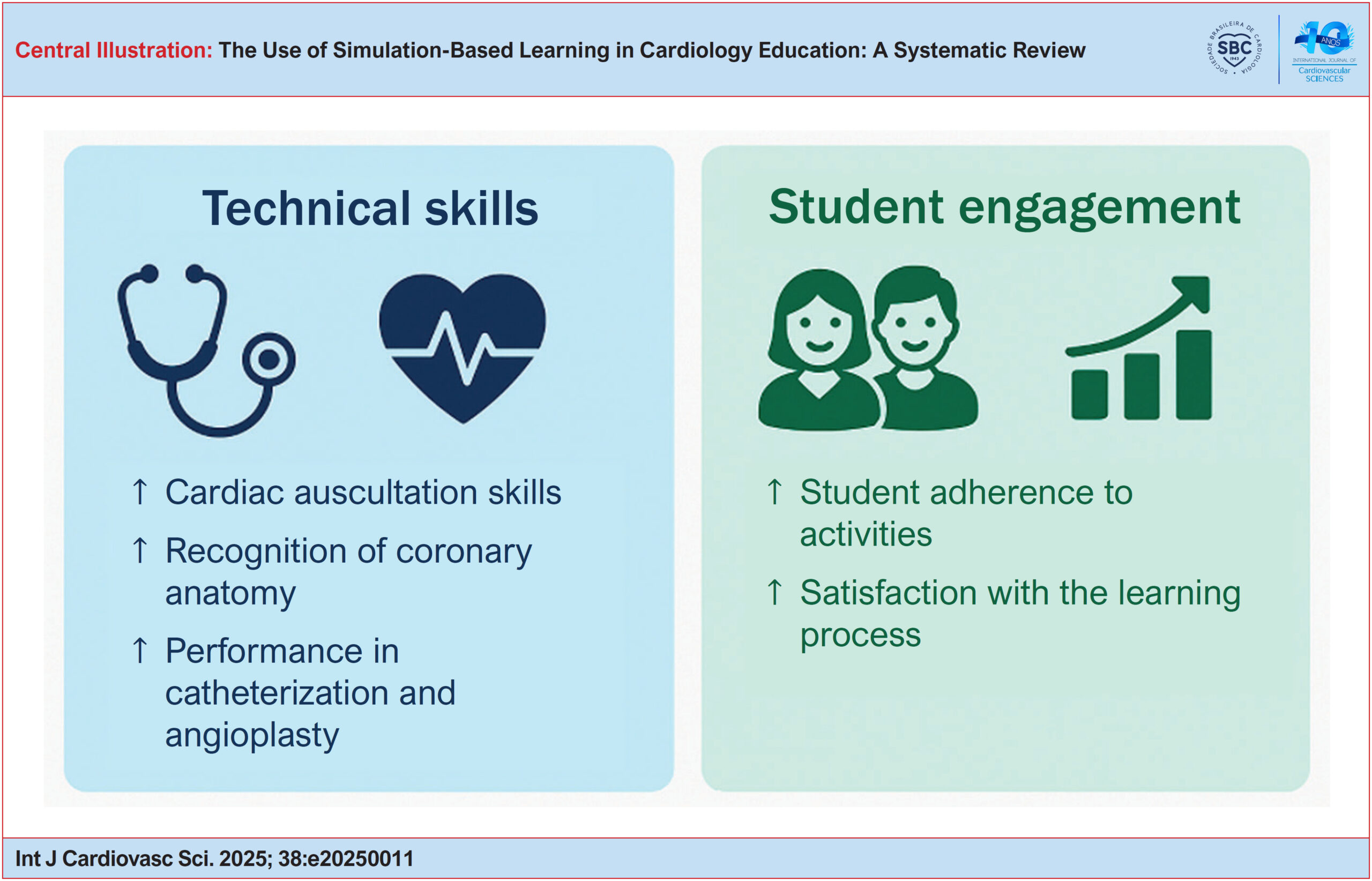
A total of 435 articles were initially identified based on the search criteria. Seven articles were selected for detailed analysis. Three of these studies reported an improvement in cardiac auscultation skills through simulation. One study showed improved ability to recognize coronary anatomy; another demonstrated enhanced performance during catheterization, and one highlighted better outcomes during angioplasty. Only one study showed a slight improvement in the diagnosis of acute myocardial infarction. In addition to these clinical improvements, there was also a noted increase in student engagement and satisfaction.

Realistic simulation, when integrated as a complement to existing curricula, enhances the performance of cardiology students.

  • Cardiology
  • Medical Education
  • Medicine
  • Simulation Training
Read Full Article
Creative Commons Attribution (CC BY) Creative Commons license
09/01/2026 DOI: 10.36660/ijcs.20250011 Views 4
Figure 1
IJCS
Original Article

First Evaluation of the Brazilian Advanced Life Support Training (TECA A)

Fabrício Nogueira Furtado et al. Antonio Carlos de Camargo Carvalho Iran Gonçalves Junior Manoel Fernandes Canesin … Sergio Timerman Rodrigo Marques Gonçalves Daniela Frizon Alfieri Dirceu Almeida

Abstract

Background

Cardiac arrest (CA) is a common condition associated with high mortality. The Brazilian advanced life support training TECA A (Treinamento em Emergências Cardiovasculares Avançado — Advanced Cardiovascular Emergency Training) was created to train healthcare professionals in the management of CA. However, there are no studies evaluating the effectiveness of TECA A.

Objective

To assess the impact of TECA A on the management of CA using a simulated CA situation.

Methods

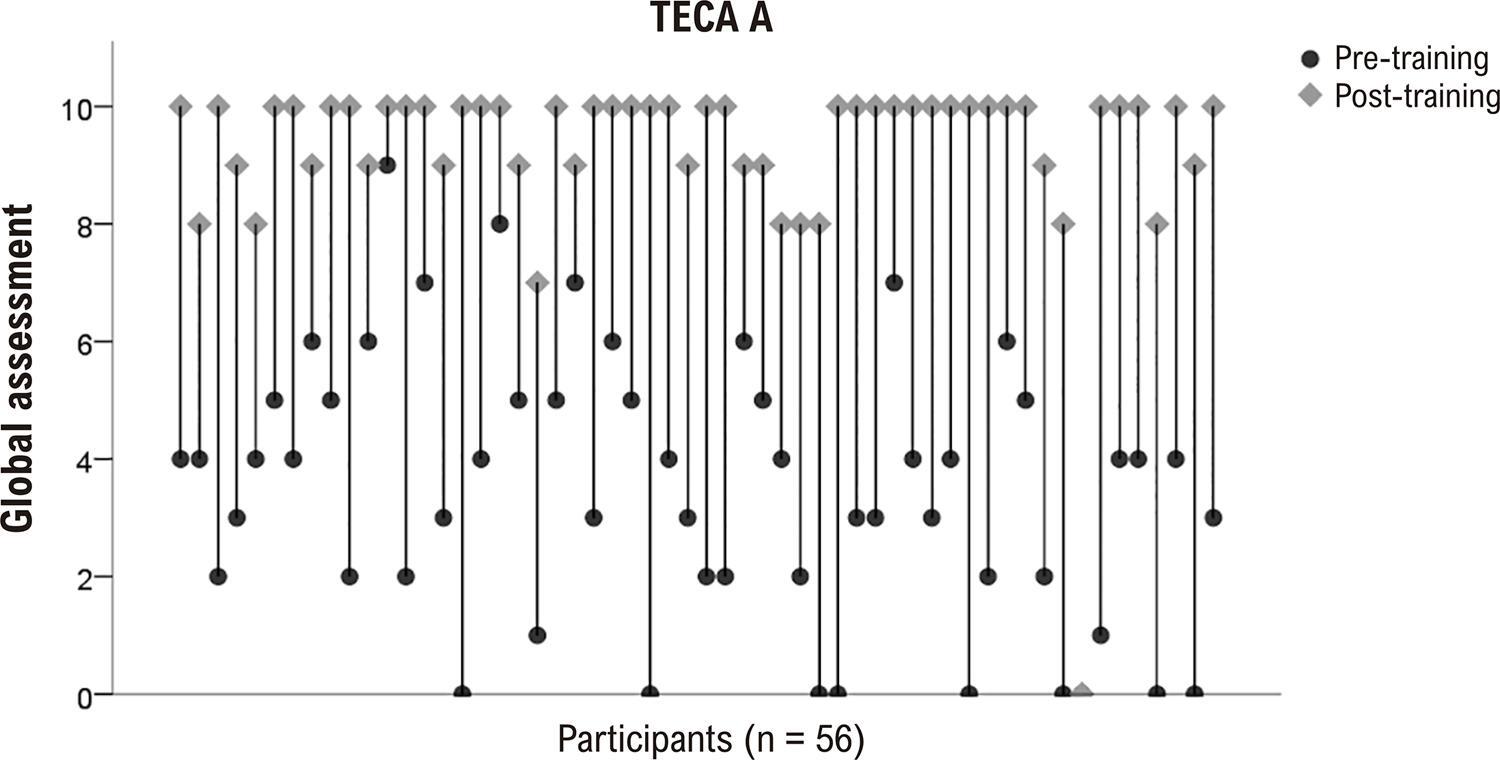
Fifty-six students underwent a simulated case of CA in a manikin. The students’ performance in the management of CA was assessed for the time to first chest compression and defibrillation and for a global assessment score using a structured tool. These items were assessed and compared before and after the TECA A. Exclusion criteria were previous participation in CA trainings and absence from class. Categorical variables were compared using the McNemar test and quantitative variables using the Wilcoxon test. All tests were two-tailed, and statistical significance was set at p < 0.05.

Results

Compared with before TECA A, median global assessment scores were higher after TECA A (pre-training: 4.0 points [2.0-5.0] vs. 10 points [9.0-10.0]; p<0.001), the time to start chest compressions was shorter (pre-training: 25 seconds [15-34] vs. 19 seconds [16.2-23.0]; p=0.002) and so was the time to defibrillation (pre-training: 82.5 seconds [65.0-108.0] vs. 48 seconds [39.0-53.0]; p<0.001).

Conclusions

The TECA A promoted a higher adherence to cardiopulmonary resuscitation (CPR) guidelines and a reduction in the time elapsed from CA to first chest compression and defibrillation.

  • Health Personnel
  • Heart Arrest
  • Simulation Training
  • Teaching
Read Full Article
Creative Commons Attribution (CC BY) Creative Commons license
09/10/2023 DOI: 10.36660/ijcs.20220199 Views 1

How to cite this article

EndNote RIS

Electronic Document Format (Vancouver)

Cordeiro ALL, Trindade TVO, Barros RA. Simulation in Cardiovascular Medicine Education: Innovation, Safety, and Competency-Based Training. Arquivos Brasileiros de Cardiologia 2026;123(6):e20260233.

Electronic Document Format (ABNT)

Cordeiro, André Luiz Lisboa; Trindade, Tiago Veltri Ormastroni da; Barros, Rinaldo Antunes. Simulation in Cardiovascular Medicine Education: Innovation, Safety, and Competency-Based Training. Arquivos Brasileiros de Cardiologia, v. 123, n. 6, e20260233, Aug. 2026.

Electronic Document Format (APA)

Cordeiro, A. L. L., Trindade, T. V. O. , & Barros, R. A. (2026). Simulation in Cardiovascular Medicine Education: Innovation, Safety, and Competency-Based Training. Arquivos Brasileiros de Cardiologia, 123(6), e20260233.

Electronic Document Format (ISO)

Cordeiro, André Luiz Lisboa and Trindade, Tiago Veltri Ormastroni da and Barros, Rinaldo Antunes. Simulation in Cardiovascular Medicine Education: Innovation, Safety, and Competency-Based Training. Arquivos Brasileiros de Cardiologia [online]. 2026, vol. 123, n. 6, [cited 2026-10-14], e20260233. Available from: <https://journals.cardiol.br/en/article/simulation-in-cardiovascular-medicine-education-innovation-safety-and-competency-based-training/>. ISSN 0066-782X

EndNote RIS

Electronic Document Format (Vancouver)

Cordeiro ALL, Jesus WLA, Trindade TVO, Pimenta RMC, Silva RP. The Use of Simulation-Based Learning in Cardiology Education: A Systematic Review. International Journal of Cardiovascular Sciences 2026;38:e20250011.

Electronic Document Format (ABNT)

Cordeiro, André Luiz Lisboa; Jesus, Washington Luiz Abreu de; Trindade, Tiago Veltri Osmastroni da; Pimenta, Rodolfo Macedo Cruz; Silva, Rodolfo Prado da. The Use of Simulation-Based Learning in Cardiology Education: A Systematic Review. International Journal of Cardiovascular Sciences, v. 38, e20250011, Jan. 2026.

Electronic Document Format (APA)

Cordeiro, A. L. L., Jesus, W. L. A. , Trindade, T. V. O. , Pimenta, R. M. C., & Silva, R. P. (2026). The Use of Simulation-Based Learning in Cardiology Education: A Systematic Review. International Journal of Cardiovascular Sciences, 38, e20250011.

Electronic Document Format (ISO)

Cordeiro, André Luiz Lisboa and Jesus, Washington Luiz Abreu de and Trindade, Tiago Veltri Osmastroni da and Pimenta, Rodolfo Macedo Cruz and Silva, Rodolfo Prado da. The Use of Simulation-Based Learning in Cardiology Education: A Systematic Review. International Journal of Cardiovascular Sciences [online]. 2026, vol. 38, [cited 2026-10-14], e20250011. Available from: <https://journals.cardiol.br/en/article/the-use-of-simulation-based-learning-in-cardiology-education-a-systematic-review/>. ISSN 2359-4802

EndNote RIS

Electronic Document Format (Vancouver)

Furtado FN, Carvalho ACC, Gonçalves Junior I, Canesin MF, Timerman S, Gonçalves RM, Alfieri DF, et al. First Evaluation of the Brazilian Advanced Life Support Training (TECA A). International Journal of Cardiovascular Sciences 2023;36:e20220199.

Electronic Document Format (ABNT)

Furtado, Fabrício Nogueira; Carvalho, Antonio Carlos de Camargo; Gonçalves Junior, Iran; Canesin, Manoel Fernandes; Timerman, Sergio; Gonçalves, Rodrigo Marques; Alfieri, Daniela Frizon; Almeida, Dirceu. First Evaluation of the Brazilian Advanced Life Support Training (TECA A). International Journal of Cardiovascular Sciences, v. 36, e20220199, Oct. 2023.

Electronic Document Format (APA)

Furtado, F. N., Carvalho, A. C. C., Gonçalves Junior, I., Canesin, M. F., Timerman, S., Gonçalves, R. M., Alfieri, D. F., & Almeida, D. (2023). First Evaluation of the Brazilian Advanced Life Support Training (TECA A). International Journal of Cardiovascular Sciences, 36, e20220199.

Electronic Document Format (ISO)

Furtado, Fabrício Nogueira and Carvalho, Antonio Carlos de Camargo and Gonçalves Junior, Iran and Canesin, Manoel Fernandes and Timerman, Sergio and Gonçalves, Rodrigo Marques and Alfieri, Daniela Frizon and Almeida, Dirceu. First Evaluation of the Brazilian Advanced Life Support Training (TECA A). International Journal of Cardiovascular Sciences [online]. 2023, vol. 36, [cited 2026-10-14], e20220199. Available from: <https://journals.cardiol.br/en/article/first-evaluation-of-the-brazilian-advanced-life-support-training-teca-a/>. ISSN 2359-4802

  • About ABC Family
  • Internal Regulation
  • Editorial Board
  • Brazilian Society of Cardiology (SBC)

Issues

SBC Guidelines

  • Videos
  • Podcasts
  • News