ABC Family Arquivos Brasileiros de Cardiologia International Journal of Cardiovascular Sciences ABC Heart Failure & Cardiomyopathy ABC Imagem Cardiovascular
Português English
ABC Family
Português English
  • About
    • About ABC Family
    • Internal Regulation
    • Editorial Board
    • Brazilian Society of Cardiology (SBC)
  • Issues
  • SBC Guidelines
  • Content
    • Videos
    • Podcasts
    • News
  • About
    • About ABC Family
    • Internal Regulation
    • Editorial Board
    • Brazilian Society of Cardiology (SBC)
  • Issues
  • SBC Guidelines
  • Content
    • Videos
    • Podcasts
    • News

ABC Family

  • ABC Family
  • Arquivos Brasileiros de Cardiologia
  • International Journal of Cardiovascular Sciences
  • ABC Heart Failure & Cardiomyopathy
  • ABC Imagem Cardiovascular
Search in

No content found.

Journals
Ordering
Article types
Others

  1. Home
  2. Keyword: Registries
ABC
Editorial

Southern Brazil Registry of Atrial Fibrillation (SBR-AF): Predictors of Atrial Arrhythmia Recurrence After First Catheter Ablation

Muhieddine Omar Chokr

Atrial fibrillation (AF) has established itself as a significant public health issue, affecting up to 4% of the population. Patients with AF experience increased mortality rates, stroke, and heart failure, as well as higher hospitalization rates and reduced quality of life.

Modern treatment of this arrhythmia involves managing cardiovascular risk factors, preventing cardioembolic events, and controlling heart rhythm. Among the therapeutic options, radiofrequency ablation has established itself as the therapy of choice, presenting the best results in the management of this clinical condition. In paroxysmal AF, triggers originating from the pulmonary veins are primarily responsible for initiating the arrhythmia. On the other hand, in the persistent form, different electrophysiological mechanisms are involved, making the invasive treatment strategy more complex as the disease progresses over time.

[…]

  • Atrial Fibrillation
  • Brazil
  • electrophysiology
  • Registries
Read Full Article
Creative Commons Attribution (CC BY) Creative Commons license
10/02/2025 DOI: 10.36660/abc.20240871i Views 1
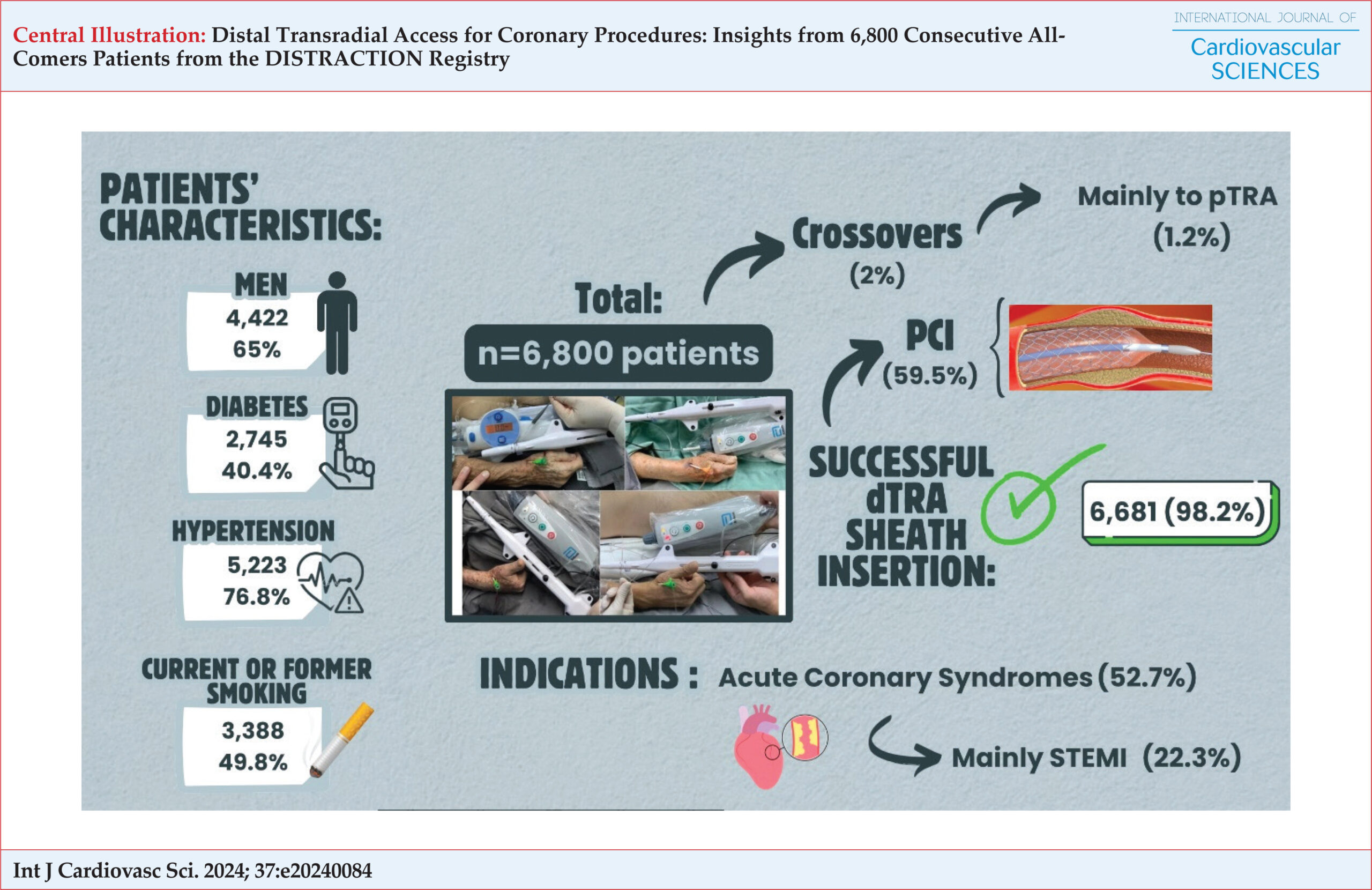
Distal Transradial Access for Coronary Procedures: Insights from 6,800 Consecutive All-Comers Patients from the DISTRACTION Registry
IJCS
Original Article

Distal Transradial Access for Coronary Procedures: Insights from 6,800 Consecutive All-Comers Patients from the DISTRACTION Registry

Marcos Danillo Oliveira et al. Ricardo Fonseca Oliveira Suruagy Motta Adriano Caixeta

Abstract

Background:

Distal transradial access (dTRA), an improvement of the conventional proximal transradial access (pTRA), has advantages in terms of faster hemostasis and lower rates of proximal radial artery occlusion (RAO).

Objectives:

We aim to describe our real-world experience with dTRA as the default approach for routine coronary angiography and percutaneous coronary interventions (PCI) in a large-scale sample of all-comers patients.

Methods:

From February 2019 to April 2024, 6,800 consecutive patients undergoing coronary procedures via dTRA were enrolled in the DISTRACTION (DIStal TRAnsradial access as default approach for Coronary angiography and intervenTIONs) Registry.

Results:

Mean patient age was 63.8 ± 15.7 years; 65% were male. Overall, 20.8% of patients had non-ST-elevation myocardial infarction (NSTEMI); 22.3% had ST-elevation myocardial infarction (STEMI), and 2.5% presented in cardiogenic shock. There were only 2% access site crossovers, mainly to ipsilateral pTRA. In only 119 patients dTRA sheath insertion could not be obtained. Right dTRA was the most frequent access, followed by redo ipsilateral dTRA, left dTRA, and simultaneous bilateral dTRA. PCI was performed in 59.5% of all cases, and the left anterior descending artery was the most treated vessel. No significant access site-related bleeding and no hand/thumb dysfunction after any procedure were documented. There were neither major complications nor major adverse cerebrovascular and cardiac events directly related to dTRA.

Conclusions:

In this real-world large-scale registry of all-comers patients, the adoption of dTRA by proficient operators as the default for routine coronary angiography and interventions was safe and feasible.

  • Coronary Angiography
  • Percutaneous Coronary Intervention
  • Registries
Read Full Article
Creative Commons Attribution (CC BY) Creative Commons license
04/11/2024 DOI: 10.36660/ijcs.20240084 Views 1
ABC
Review Article

Real-world use of drug-eluting stents: the importance of registries

Expedito E. Ribeiro et al. Henrique Barbosa Ribeiro

over the last decades the efficacy and safety of bare metal (BMS) and drug eluting stents (DES) have been demonstrated in many different clinical scenarios, leading to their use in more than 75% of the procedures worldwide. Compared to BMS, DES have shown lower rates of angiographic restenosis and target-vessel revascularization. This benefit was initially demonstrated in trials that excluded patients with more complex lesions, such as those with larger or smaller vessels, chronic total occlusions, bifurcation lesions, stent restenosis, long lesions and left main coronary artery disease. This real-world population has been recently evaluated in many registries and meta-analyses that are reviewed herein.

  • Drug-Eluting Stents
  • Meta-Analysis
  • Registries
Read Full Article
Creative Commons Attribution (CC BY) Creative Commons license
29/09/2010 DOI: 10.1590/S0066-782X2010001100019

How to cite this article

EndNote RIS

Electronic Document Format (Vancouver)

Chokr MO. Southern Brazil Registry of Atrial Fibrillation (SBR-AF): Predictors of Atrial Arrhythmia Recurrence After First Catheter Ablation. Arquivos Brasileiros de Cardiologia 2025;122(1):e20240871.

Electronic Document Format (ABNT)

Chokr, Muhieddine Omar. Southern Brazil Registry of Atrial Fibrillation (SBR-AF): Predictors of Atrial Arrhythmia Recurrence After First Catheter Ablation. Arquivos Brasileiros de Cardiologia, v. 122, n. 1, e20240871, Feb. 2025.

Electronic Document Format (APA)

Chokr, M. O. (2025). Southern Brazil Registry of Atrial Fibrillation (SBR-AF): Predictors of Atrial Arrhythmia Recurrence After First Catheter Ablation. Arquivos Brasileiros de Cardiologia, 122(1), e20240871.

Electronic Document Format (ISO)

Chokr, Muhieddine Omar. Southern Brazil Registry of Atrial Fibrillation (SBR-AF): Predictors of Atrial Arrhythmia Recurrence After First Catheter Ablation. Arquivos Brasileiros de Cardiologia [online]. 2025, vol. 122, n. 1, [cited 2026-10-14], e20240871. Available from: <https://journals.cardiol.br/en/article/southern-brazil-registry-of-atrial-fibrillation-sbr-af-predictors-of-atrial-arrhythmia-recurrence-after-first-catheter-ablation/>. ISSN 0066-782X

EndNote RIS

Electronic Document Format (Vancouver)

Oliveira MD, Motta RFOS, Caixeta A. Distal Transradial Access for Coronary Procedures: Insights from 6,800 Consecutive All-Comers Patients from the DISTRACTION Registry. International Journal of Cardiovascular Sciences 2024;37:e20240084.

Electronic Document Format (ABNT)

Oliveira, Marcos Danillo; Motta, Ricardo Fonseca Oliveira Suruagy; Caixeta, Adriano. Distal Transradial Access for Coronary Procedures: Insights from 6,800 Consecutive All-Comers Patients from the DISTRACTION Registry. International Journal of Cardiovascular Sciences, v. 37, e20240084, Nov. 2024.

Electronic Document Format (APA)

Oliveira, M. D., Motta, R. F. O. S., & Caixeta, A. (2024). Distal Transradial Access for Coronary Procedures: Insights from 6,800 Consecutive All-Comers Patients from the DISTRACTION Registry. International Journal of Cardiovascular Sciences, 37, e20240084.

Electronic Document Format (ISO)

Oliveira, Marcos Danillo and Motta, Ricardo Fonseca Oliveira Suruagy and Caixeta, Adriano. Distal Transradial Access for Coronary Procedures: Insights from 6,800 Consecutive All-Comers Patients from the DISTRACTION Registry. International Journal of Cardiovascular Sciences [online]. 2024, vol. 37, [cited 2026-10-14], e20240084. Available from: <https://journals.cardiol.br/en/article/distal-transradial-access-for-coronary-procedures-insights-from-6800-consecutive-all-comers-patients-from-the-distraction-registry/>. ISSN 2359-4802

EndNote RIS

Electronic Document Format (Vancouver)

Ribeiro EE, Ribeiro HB. Real-world use of drug-eluting stents: the importance of registries. Arquivos Brasileiros de Cardiologia 2010;95(1):131-4.

Electronic Document Format (ABNT)

Ribeiro, Expedito E.; Ribeiro, Henrique Barbosa. Real-world use of drug-eluting stents: the importance of registries. Arquivos Brasileiros de Cardiologia, v. 95, n. 1, p. 131-134, Sep. 2010.

Electronic Document Format (APA)

Ribeiro, E. E., & Ribeiro, H. B. (2010). Real-world use of drug-eluting stents: the importance of registries. Arquivos Brasileiros de Cardiologia, 95(1), 131-134.

Electronic Document Format (ISO)

Ribeiro, Expedito E. and Ribeiro, Henrique Barbosa. Real-world use of drug-eluting stents: the importance of registries. Arquivos Brasileiros de Cardiologia [online]. 2010, vol. 95, n. 1, [cited 2026-10-14], pp. 131-134. Available from: <https://journals.cardiol.br/en/article/real-world-use-of-drug-eluting-stents-the-importance-of-registries/>. ISSN 0066-782X

  • About ABC Family
  • Internal Regulation
  • Editorial Board
  • Brazilian Society of Cardiology (SBC)

Issues

SBC Guidelines

  • Videos
  • Podcasts
  • News