ABC Family Arquivos Brasileiros de Cardiologia International Journal of Cardiovascular Sciences ABC Heart Failure & Cardiomyopathy ABC Imagem Cardiovascular
Português English
ABC Family
Português English
  • About
    • About ABC Family
    • Internal Regulation
    • Editorial Board
    • Brazilian Society of Cardiology (SBC)
  • Issues
  • SBC Guidelines
  • Content
    • Videos
    • Podcasts
    • News
  • About
    • About ABC Family
    • Internal Regulation
    • Editorial Board
    • Brazilian Society of Cardiology (SBC)
  • Issues
  • SBC Guidelines
  • Content
    • Videos
    • Podcasts
    • News

ABC Family

  • ABC Family
  • Arquivos Brasileiros de Cardiologia
  • International Journal of Cardiovascular Sciences
  • ABC Heart Failure & Cardiomyopathy
  • ABC Imagem Cardiovascular
Search in

No content found.

Journals
Ordering
Article types
Others

  1. Home
  2. Keyword: Regional Blood Flow
Figure 1
ABCIC
Case Report

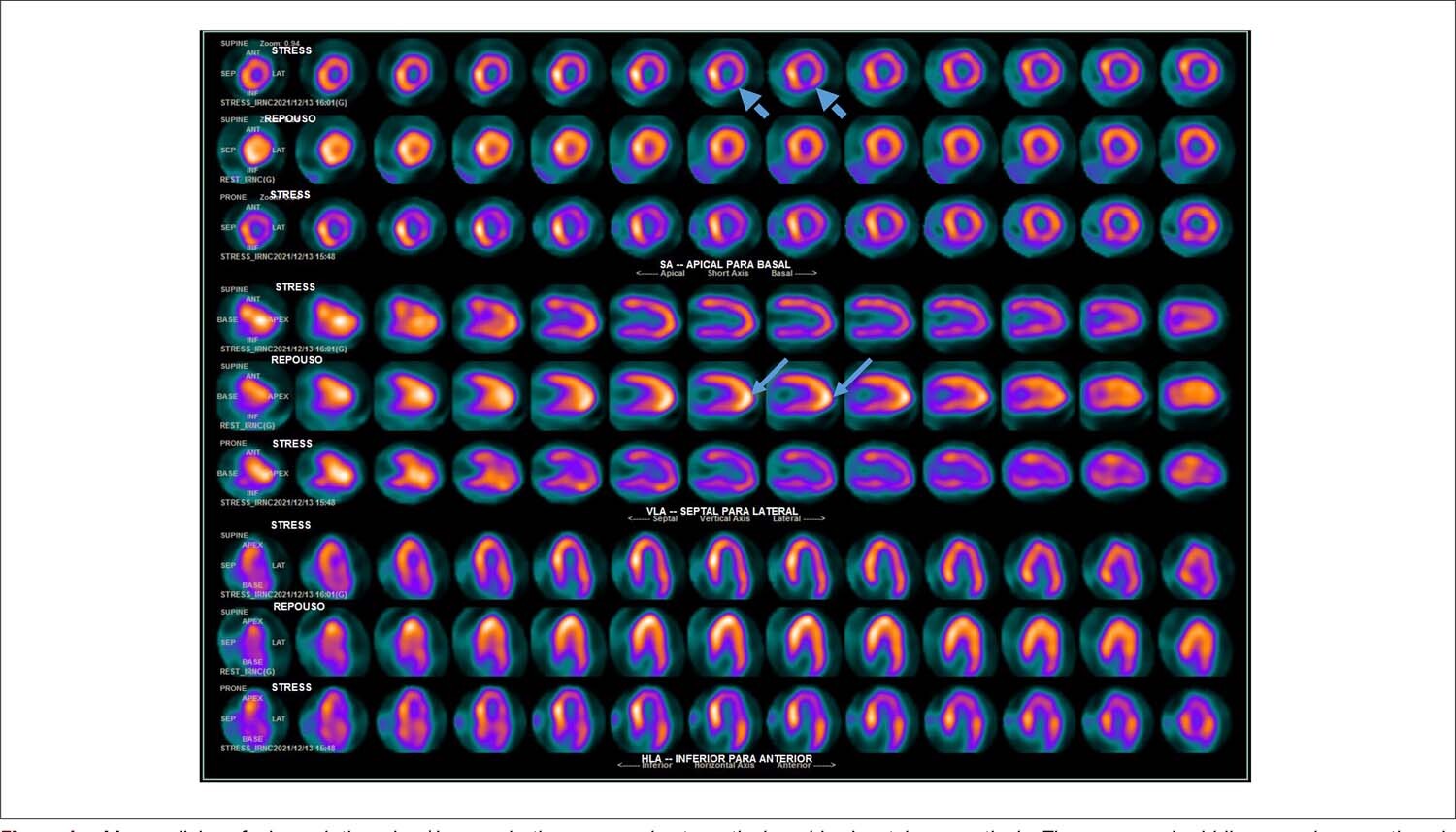
Evaluation of Coronary Flow Reserve by Myocardial Scintigraphy in Left Ventricular Hypertrophy

Renata Christian Martins Felix et al. Felipe Hermely Villela Pedras Odorico de Souza Lima Neto Leonardo Medeiros Vitório

Introduction

The microvascular integrity of the myocardial bed can be assessed by coronary flow reserve (CFR), which is a calculation of the ratio between the absolute coronary blood flow under vasodilator stress and under resting conditions. This measurement is capable of estimating vasomotor dysfunction, and it reflects the hemodynamic effect of focal, diffuse, or small-vessel coronary disease.

Currently, it is possible to measure CFR invasively using the techniques of thermodilution or intracoronary Doppler and through non-invasive methods, such as echocardiography, magnetic resonance imaging, computed tomography, or nuclear medicine.

[…]

  • Hypertrophy Left Ventricular
  • Microvascular Angina
  • Myocardial Perfusion Imaging
  • Regional Blood Flow
Read Full Article
Creative Commons Attribution (CC BY) Creative Commons license
26/09/2023 DOI: 10.36660/abcimg.20230053i Views 2
Figure 1
ABC
Original Article

Influence of the tilt angle of Percutaneous Aortic Prosthesis on Velocity and Shear Stress Fields

Bruno Alvares de Azevedo Gomes et al. Gabriel Cordeiro Camargo Jorge Roberto Lopes dos Santos Luis Fernando Alzuguir Azevedo … Ângela Ourivio Nieckele Aristarco Gonçalves Siqueira-Filho Glaucia Maria Moraes de Oliveira

Abstract

Background:

Due to the nature of the percutaneous prosthesis deployment process, a variation in its final position is expected. Prosthetic valve placement will define the spatial location of its effective orifice in relation to the aortic annulus. The blood flow pattern in the ascending aorta is related to the aortic remodeling process, and depends on the spatial location of the effective orifice. The hemodynamic effect of small variations in the angle of inclination of the effective orifice has not been studied in detail.

Objective:

To implement an in vitro simulation to characterize the hydrodynamic blood flow pattern associated with small variations in the effective orifice inclination.

Methods:

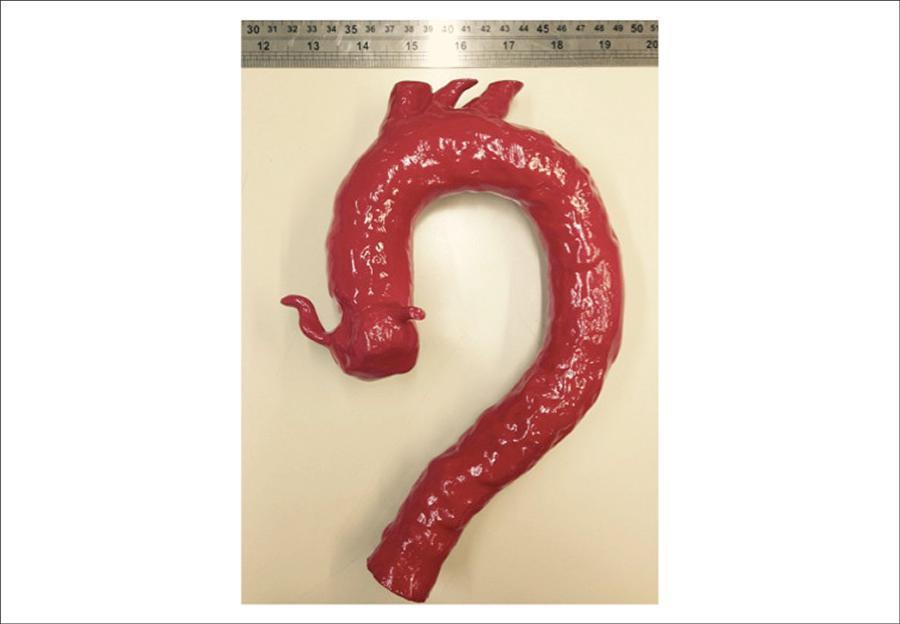
A three-dimensional aortic phantom was constructed, reproducing the anatomy of one patient submitted to percutaneous aortic valve implantation. Flow analysis was performed by use of the Particle Image Velocimetry technique. The flow pattern in the ascending aorta was characterized for six flow rate levels. In addition, six angles of inclination of the effective orifice were assessed.

Results:

The effective orifice at the -4° and -2° angles directed the main flow towards the anterior wall of the aortic model, inducing asymmetric and high shear stress in that region. However, the effective orifice at the +3° and +5° angles mimics the physiological pattern, centralizing the main flow and promoting a symmetric distribution of shear stress.

Conclusion:

The measurements performed suggest that small changes in the angle of inclination of the percutaneous prosthesis aid in the generation of a physiological hemodynamic pattern, and can contribute to reduce aortic remodeling.

  • Heart Valve Prosthesis Implantation
  • Hemodynamics
  • Regional Blood Flow
  • Shear Stress
Read Full Article
Creative Commons Attribution (CC BY) Creative Commons license
07/08/2017 DOI: 10.5935/abc.20170115 Views 1
Vascular endothelial function in patients with coronary slow flow and the effects of nebivolol
ABC
Artigo Original

Vascular endothelial function in patients with coronary slow flow and the effects of nebivolol

Yilmaz Gunes et al. Hasan Ali Gumrukcuoglu Serkan Akdag Hakki Simsek … Musa Sahin Mustafa Tuncer

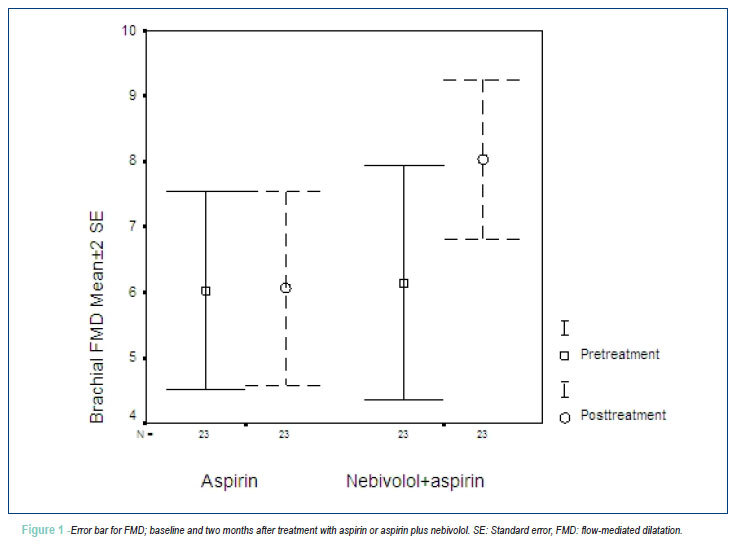
BACKGROUND: Brachial endothelial function has been associated with coronary slow flow (CSF). Increasing blood flow to brachial artery provokes endothelium to release nitric oxide (NO) with subsequent vasodilatation. Besides its β1-blocker activity, nebivolol causes vasodilatation by increasing endothelial NO release. OBJECTIVE: To assess the effects of nebivolol on vascular endothelial function in patients with CSF. METHODS: Forty-six patients with CSF and 23 individuals with normal epicardial coronary arteries were examined with transthoracic echocardiography and brachial artery ultrasonography. The patients were reevaluated two months after treatment with aspirin or aspirin plus nebivolol. RESULTS: Patients with CSF had higher body mass index (26.5 ± 3.3 vs. 23.8 ± 2.8, p < 0.001), mitral inflow isovolumetric relaxation time (IVRT) (114.9 ± 18.0 vs. 95.0 ± 22.0 msec, p < 0.001) and lower left ventricular ejection fraction (LVEF) (63.5 ± 3.1% vs. 65.4 ± 2.2, p = 0.009), HDL-cholesterol (39.4 ± 8.5 vs. 45.8 ± 7.7 mg/dL, p = 0.003) and brachial flow-mediated dilatation (FMD) (6.1 ± 3.9% vs. 17.6 ± 4.5%, p < 0.001). There were significant correlations between FMD and the presence of CSF (r = 0.800, p < 0.001) and HDL-cholesterol (r = 0.349, p = 0.003). Among Patients with CSF, although pretreatment mean FMD values were similar (6.1 ± 4.3% vs. 6.0 ± ,6%, p = 0.917) compared to aspirin alone group, posttreatment FMD was significantly higher in patients treated with aspirin plus nebivolol (6.0 ± 3.5% vs. 8.0 ± 2.9%, p = 0.047). Treatment with nebivolol was associated with a significant increase in FMD (6.0 ± 3.6 to 8.0 ± 2.9 %, p = 0.030) whereas treatment with aspirin alone was not. CONCLUSION: Endothelial function may be impaired in both coronary and brachial arteries in patients with CSF and nebivolol may be effective in the improvement of endothelial function in patients with CSF.

  • calcium channel blockers
  • Endothelium, Vascular
  • Regional Blood Flow
Read Full Article
Creative Commons Attribution (CC BY) Creative Commons license
21/10/2011 DOI: 10.1590/S0066-782X2011005000105

How to cite this article

EndNote RIS

Electronic Document Format (Vancouver)

Felix RCM, Pedras FHV, Lima Neto OS, Vitório LM. Evaluation of Coronary Flow Reserve by Myocardial Scintigraphy in Left Ventricular Hypertrophy. ABC Imagem Cardiovascular 2023;36(3):e20230053.

Electronic Document Format (ABNT)

Felix, Renata Christian Martins; Pedras, Felipe Hermely Villela; Lima Neto, Odorico de Souza; Vitório, Leonardo Medeiros. Evaluation of Coronary Flow Reserve by Myocardial Scintigraphy in Left Ventricular Hypertrophy. ABC Imagem Cardiovascular, v. 36, n. 3, e20230053, Sep. 2023.

Electronic Document Format (APA)

Felix, R. C. M., Pedras, F. H. V., Lima Neto, O. S., & Vitório, L. M. (2023). Evaluation of Coronary Flow Reserve by Myocardial Scintigraphy in Left Ventricular Hypertrophy. ABC Imagem Cardiovascular, 36(3), e20230053.

Electronic Document Format (ISO)

Felix, Renata Christian Martins and Pedras, Felipe Hermely Villela and Lima Neto, Odorico de Souza and Vitório, Leonardo Medeiros. Evaluation of Coronary Flow Reserve by Myocardial Scintigraphy in Left Ventricular Hypertrophy. ABC Imagem Cardiovascular [online]. 2023, vol. 36, n. 3, [cited 2026-10-14], e20230053. Available from: <https://journals.cardiol.br/en/article/evaluation-of-coronary-flow-reserve-by-myocardial-scintigraphy-in-left-ventricular-hypertrophy/>. ISSN 2318-8219

EndNote RIS

Electronic Document Format (Vancouver)

Gomes BAA, Camargo GC, Santos JRL, Azevedo LFA, Nieckele O, Siqueira-Filho AG, Oliveira GMM, et al. Influence of the tilt angle of Percutaneous Aortic Prosthesis on Velocity and Shear Stress Fields. Arquivos Brasileiros de Cardiologia 2017;109(3):231-40.

Electronic Document Format (ABNT)

Gomes, Bruno Alvares de Azevedo; Camargo, Gabriel Cordeiro; Santos, Jorge Roberto Lopes dos; Azevedo, Luis Fernando Alzuguir; Nieckele, Ângela Ourivio; Siqueira-Filho, Aristarco Gonçalves; Oliveira, Glaucia Maria Moraes de. Influence of the tilt angle of Percutaneous Aortic Prosthesis on Velocity and Shear Stress Fields. Arquivos Brasileiros de Cardiologia, v. 109, n. 3, p. 231-240, Aug. 2017.

Electronic Document Format (APA)

Gomes, B. A. A., Camargo, G. C., Santos, J. R. L. , Azevedo, L. F. A., Nieckele, O., Siqueira-Filho, A. G., & Oliveira, G. M. M. (2017). Influence of the tilt angle of Percutaneous Aortic Prosthesis on Velocity and Shear Stress Fields. Arquivos Brasileiros de Cardiologia, 109(3), 231-240.

Electronic Document Format (ISO)

Gomes, Bruno Alvares de Azevedo and Camargo, Gabriel Cordeiro and Santos, Jorge Roberto Lopes dos and Azevedo, Luis Fernando Alzuguir and Nieckele, Ângela Ourivio and Siqueira-Filho, Aristarco Gonçalves and Oliveira, Glaucia Maria Moraes de. Influence of the tilt angle of Percutaneous Aortic Prosthesis on Velocity and Shear Stress Fields. Arquivos Brasileiros de Cardiologia [online]. 2017, vol. 109, n. 3, [cited 2026-10-14], pp. 231-240. Available from: <https://journals.cardiol.br/en/article/influence-of-the-tilt-angle-of-percutaneous-aortic-prosthesis-on-velocity-and-shear-stress-fields/>. ISSN 0066-782X

EndNote RIS

Electronic Document Format (Vancouver)

Gunes Y, Gumrukcuoglu HA, Akdag S, Simsek H, Sahin M, Tuncer M. Vascular endothelial function in patients with coronary slow flow and the effects of nebivolol. Arquivos Brasileiros de Cardiologia 2011;97(4):275-80.

Electronic Document Format (ABNT)

Gunes, Yilmaz; Gumrukcuoglu, Hasan Ali; Akdag, Serkan; Simsek, Hakki; Sahin, Musa; Tuncer, Mustafa. Vascular endothelial function in patients with coronary slow flow and the effects of nebivolol. Arquivos Brasileiros de Cardiologia, v. 97, n. 4, p. 275-280, Oct. 2011.

Electronic Document Format (APA)

Gunes, Y., Gumrukcuoglu, H. A., Akdag, S., Simsek, H., Sahin, M., & Tuncer, M. (2011). Vascular endothelial function in patients with coronary slow flow and the effects of nebivolol. Arquivos Brasileiros de Cardiologia, 97(4), 275-280.

Electronic Document Format (ISO)

Gunes, Yilmaz and Gumrukcuoglu, Hasan Ali and Akdag, Serkan and Simsek, Hakki and Sahin, Musa and Tuncer, Mustafa. Vascular endothelial function in patients with coronary slow flow and the effects of nebivolol. Arquivos Brasileiros de Cardiologia [online]. 2011, vol. 97, n. 4, [cited 2026-10-14], pp. 275-280. Available from: <https://journals.cardiol.br/en/article/vascular-endothelial-function-in-patients-with-coronary-slow-flow-and-the-effects-of-nebivolol/>. ISSN 0066-782X

  • About ABC Family
  • Internal Regulation
  • Editorial Board
  • Brazilian Society of Cardiology (SBC)

Issues

SBC Guidelines

  • Videos
  • Podcasts
  • News