ABC Family Arquivos Brasileiros de Cardiologia International Journal of Cardiovascular Sciences ABC Heart Failure & Cardiomyopathy ABC Imagem Cardiovascular
Português English
ABC Family
Português English
  • About
    • About ABC Family
    • Internal Regulation
    • Editorial Board
    • Brazilian Society of Cardiology (SBC)
  • Issues
  • SBC Guidelines
  • Content
    • Videos
    • Podcasts
    • News
  • About
    • About ABC Family
    • Internal Regulation
    • Editorial Board
    • Brazilian Society of Cardiology (SBC)
  • Issues
  • SBC Guidelines
  • Content
    • Videos
    • Podcasts
    • News

ABC Family

  • ABC Family
  • Arquivos Brasileiros de Cardiologia
  • International Journal of Cardiovascular Sciences
  • ABC Heart Failure & Cardiomyopathy
  • ABC Imagem Cardiovascular
Search in

No content found.

Journals
Ordering
Article types
Others

  1. Home
  2. Keyword: predictors
Predictors of viability in patients with negative low-dose dobutamine stress echocardiograph
ABC
Artigo Original

Predictors of viability in patients with negative low-dose dobutamine stress echocardiograph

Zainab Abdel-Salam et al. Wail Nammas

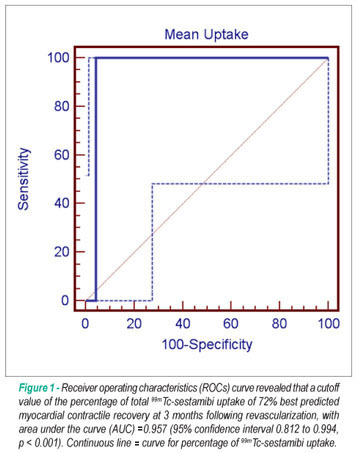
BACKGROUND: Low-dose dobutamine stress echocardiography is specific for predicting reversible contractility dysfunction, but its sensitivity is lower than ideal. OBJECTIVE: We sought to explore the predictors of myocardial contractile recovery following revascularization, in patients with no viability by low-dose dobutamine stress echocardiography. METHODS: We prospectively enrolled 30 consecutive patients with significant coronary stenosis/occlusion amenable for revascularization, regional wall motion abnormality in the distribution of the affected artery and absence of viability by low-dose dobutamine stress echocardiography. They underwent resting 99mTc-sestamibi imaging study, and then underwent successful coronary revascularization. Follow-up echocardiography was performed 3 months later. Patients were classified into 2 groups: group 1: with evidence of myocardial contractile recovery after revascularization at follow-up echocardiography and group 2: with no such evidence of recovery. The two groups were compared with respect to patients’ clinical, echocardiographic and scintigraphic data. RESULTS: The mean age was 52.3 ± 5.9 years, with 97% being males. The percentage of total 99mTc-sestamibi uptake was significantly higher in group 1 as compared to group 2 (p < 0.01), and it was the strongest independent predictor of myocardial contractile recovery at 3-month follow-up by multivariate regression analysis. Receiver operating characteristics curve revealed that a cutoff value of the percentage of total 99mTc-sestamibi uptake of 72% best predicted myocardial contractile recovery, with a sensitivity of 100% and specificity of 95.7%. CONCLUSION: In patients with no viability by low-dose dobutamine stress echocardiography, the percentage of total 99mTc-sestamibi uptake independently predicted myocardial contractile recovery following coronary revascularization.

  • dobutamine stress echocardiography
  • predictors
  • revascularization
  • viability
Read Full Article
Creative Commons Attribution (CC BY) Creative Commons license
21/01/2011 DOI: 10.1590/S0066-782X2011005000007 Views 1
Occurrence rate and clinical predictors of hypertensive pseudocrisis in emergency room care
ABC
Artigo Original

Occurrence rate and clinical predictors of hypertensive pseudocrisis in emergency room care

Silvestre Sobrinho et al. Luís C. L. Correia Constança Cruz Mila Santiago … Ana Catarina Paim Bruno Meireles Mariana Andrade Mariana Kerner Paula Amoedo Carlos Marcílio de Souza

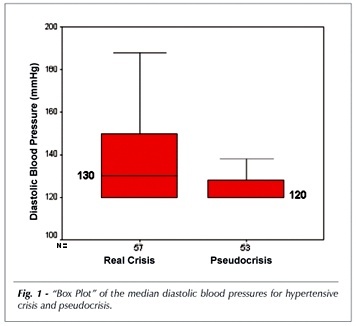
OBJECTIVES: To describe the prevalence of hypertensive pseudocrisis in patients treated in emergency rooms with substantially elevated blood pressure levels. To compare this prevalence in private and public hospitals. To describe the frequency of wrong treatment for this condition. To identify, during triage, independent predictors of pseudocrisis. To evaluate the prognosis of patients with pseudocrisis. METHODS: Patients above the age of 18, admitted to the Emergency Rooms of two hospitals (private and public) during a 6 month timeframe, with diastolic blood pressure > 120 mmHg were included in the study. Hypertensive pseudocrisis was determined when none of the criteria for hypertensive crisis were present (Guidelines of the Brazilian Society of Cardiology¹). RESULTS: In the 110 patients studied, the prevalence of hypertensive pseudocrisis was 48% (95% CI = 39%-58%) and prevailed in the private hospital (59% vs 37%, p=0.02). The frequency of wrong treatment was similar between the two hospitals (94% vs 95%, p=0.87). After multivariate analysis, the presence of headache upon admission (Odds Ratio=5.4; 95% CI = 5.1-13; p< 0.001) and diastolic BP levels (Odds Ratio=0.93; 95% CI = 0.89-0.97; p=0.002) were independent predictors of pseudocrisis. The 5 month mortality rate was lower in the pseudocrisis group than the hypertensive crisis group (0% vs 21%, p=0.0004). CONCLUSIONS: There is a high prevalence of hypertensive pseudocrisis in patients when hypertensive crisis is suspected, particularly in the private hospital. The frequency of wrong treatment was similar for both the private and public hospitals. Headaches and diastolic BP levels are independent predictors for this clinical condition. Hypertensive pseudocrisis has a low rate of lethality.

  • Emergency Medical Services
  • Hypertension
  • predictors
  • Prevalence
Read Full Article
Creative Commons Attribution (CC BY) Creative Commons license
15/06/2007 DOI: 10.1590/S0066-782X2007000500013
ABC
Artigo Original

Predictors of in-hospital lethality in patients with advanced heart failure

Adriana Lopes Latado et al. Luiz Carlos Santana Passos Julio C. V. Braga Alessandra Santos … Rodrigo Guedes Simone S. Moura Daniela Almeida

OBJECTIVE: Describe the clinical characteristics and identify potential risk factors for in-hospital lethality in patients with decompensated heart failure admitted to an intensive care unit. METHODS: Decompensated heart failure patients consecutively admitted to an intensive care unit between June 2001 and December 2003 were selected and followed during hospitalization until discharge or death. Clinical characteristics at admission were recorded and evaluated as independent risk predictors for in-hospital mortality by multiple logistic regression analysis. RESULTS: A total of 299 patients (69±13 years of age and 54% men) were enrolled. Coronary artery disease was the main cause of heart failure in 49% of the cases. Diabetes mellitus and systemic arterial hypertension occurred in 37.5% and 78% of the patients, respectively. At admission, 22% of them had atrial fibrillation, 21.5% had renal dysfunction, and 48% anemia (16.5% with severe anemia). Severe systolic dysfunction (left ventricular ejection fraction 70 years, and hyponatremia were independently associated with in-hospital mortality. CONCLUSION: Patients admitted to an intensive care unit due to decompensated heart failure have high in-hospital lethality. In this study, variables recorded at admission, such as previous stroke, atrial fibrillation, hyponatremia, renal failure, and age > 70 years were predictors of in-hospital lethality.

  • Epidemiology
  • Heart Failure
  • in-hospital lethality
  • predictors
Read Full Article
Creative Commons Attribution (CC BY) Creative Commons license
28/09/2006 DOI: 10.1590/S0066-782X2006001500018 Views 2

How to cite this article

EndNote RIS

Electronic Document Format (Vancouver)

Abdel-Salam Z, Nammas W. Predictors of viability in patients with negative low-dose dobutamine stress echocardiograph. Arquivos Brasileiros de Cardiologia 2011;96(3):188-95.

Electronic Document Format (ABNT)

Abdel-Salam, Zainab; Nammas, Wail. Predictors of viability in patients with negative low-dose dobutamine stress echocardiograph. Arquivos Brasileiros de Cardiologia, v. 96, n. 3, p. 188-195, Jan. 2011.

Electronic Document Format (APA)

Abdel-Salam, Z., & Nammas, W. (2011). Predictors of viability in patients with negative low-dose dobutamine stress echocardiograph. Arquivos Brasileiros de Cardiologia, 96(3), 188-195.

Electronic Document Format (ISO)

Abdel-Salam, Zainab and Nammas, Wail. Predictors of viability in patients with negative low-dose dobutamine stress echocardiograph. Arquivos Brasileiros de Cardiologia [online]. 2011, vol. 96, n. 3, [cited 2026-10-14], pp. 188-195. Available from: <https://journals.cardiol.br/en/article/predictors-of-viability-in-patients-with-negative-low-dose-dobutamine-stress-echocardiograph/>. ISSN 0066-782X

EndNote RIS

Electronic Document Format (Vancouver)

Sobrinho S, Correia LCL, Cruz C, Santiago M, Paim AC, Meireles B, Andrade M, et al. Occurrence rate and clinical predictors of hypertensive pseudocrisis in emergency room care. Arquivos Brasileiros de Cardiologia 2007;88(5):579-84.

Electronic Document Format (ABNT)

Sobrinho, Silvestre; Correia, Luís C. L.; Cruz, Constança; Santiago, Mila; Paim, Ana Catarina; Meireles, Bruno; Andrade, Mariana; Kerner, Mariana; Amoedo, Paula; Souza, Carlos Marcílio de. Occurrence rate and clinical predictors of hypertensive pseudocrisis in emergency room care. Arquivos Brasileiros de Cardiologia, v. 88, n. 5, p. 579-584, Jun. 2007.

Electronic Document Format (APA)

Sobrinho, S., Correia, L. C. L., Cruz, C., Santiago, M., Paim, A. C., Meireles, B., Andrade, M., Kerner, M., Amoedo, P., & Souza, C. M. (2007). Occurrence rate and clinical predictors of hypertensive pseudocrisis in emergency room care. Arquivos Brasileiros de Cardiologia, 88(5), 579-584.

Electronic Document Format (ISO)

Sobrinho, Silvestre and Correia, Luís C. L. and Cruz, Constança and Santiago, Mila and Paim, Ana Catarina and Meireles, Bruno and Andrade, Mariana and Kerner, Mariana and Amoedo, Paula and Souza, Carlos Marcílio de. Occurrence rate and clinical predictors of hypertensive pseudocrisis in emergency room care. Arquivos Brasileiros de Cardiologia [online]. 2007, vol. 88, n. 5, [cited 2026-10-14], pp. 579-584. Available from: <https://journals.cardiol.br/en/article/occurrence-rate-and-clinical-predictors-of-hypertensive-pseudocrisis-in-emergency-room-care/>. ISSN 0066-782X

EndNote RIS

Electronic Document Format (Vancouver)

Latado AL, Passos LCS, Braga JCV, Santos A, Guedes R, Moura SS, Almeida D, et al. Predictors of in-hospital lethality in patients with advanced heart failure. Arquivos Brasileiros de Cardiologia 2006;87(2):185-92.

Electronic Document Format (ABNT)

Latado, Adriana Lopes; Passos, Luiz Carlos Santana; Braga, Julio C. V.; Santos, Alessandra; Guedes, Rodrigo; Moura, Simone S.; Almeida, Daniela. Predictors of in-hospital lethality in patients with advanced heart failure. Arquivos Brasileiros de Cardiologia, v. 87, n. 2, p. 185-192, Sep. 2006.

Electronic Document Format (APA)

Latado, A. L., Passos, L. C. S., Braga, J. C. V., Santos, A., Guedes, R., Moura, S. S., & Almeida, D. (2006). Predictors of in-hospital lethality in patients with advanced heart failure. Arquivos Brasileiros de Cardiologia, 87(2), 185-192.

Electronic Document Format (ISO)

Latado, Adriana Lopes and Passos, Luiz Carlos Santana and Braga, Julio C. V. and Santos, Alessandra and Guedes, Rodrigo and Moura, Simone S. and Almeida, Daniela. Predictors of in-hospital lethality in patients with advanced heart failure. Arquivos Brasileiros de Cardiologia [online]. 2006, vol. 87, n. 2, [cited 2026-10-14], pp. 185-192. Available from: <https://journals.cardiol.br/en/article/predictors-of-in-hospital-lethality-in-patients-with-advanced-heart-failure/>. ISSN 0066-782X

  • About ABC Family
  • Internal Regulation
  • Editorial Board
  • Brazilian Society of Cardiology (SBC)

Issues

SBC Guidelines

  • Videos
  • Podcasts
  • News