Ling-Song Yao et al. Yu-Chen Dai Qing-Ren Liu Jie Sun Yunfei Bai
Abstract
Background
Blood pressure variability (BPV) has emerged as an important hemodynamic factor associated with adverse outcomes after cardiac surgery, including acute kidney injury (AKI). However, the prognostic value of postoperative BPV in patients undergoing coronary artery bypass grafting (CABG) remains insufficiently characterized.
Objective
To investigate the association between postoperative BPV and AKI after CABG and to evaluate the predictive value of early postoperative BPV for AKI.
Methods
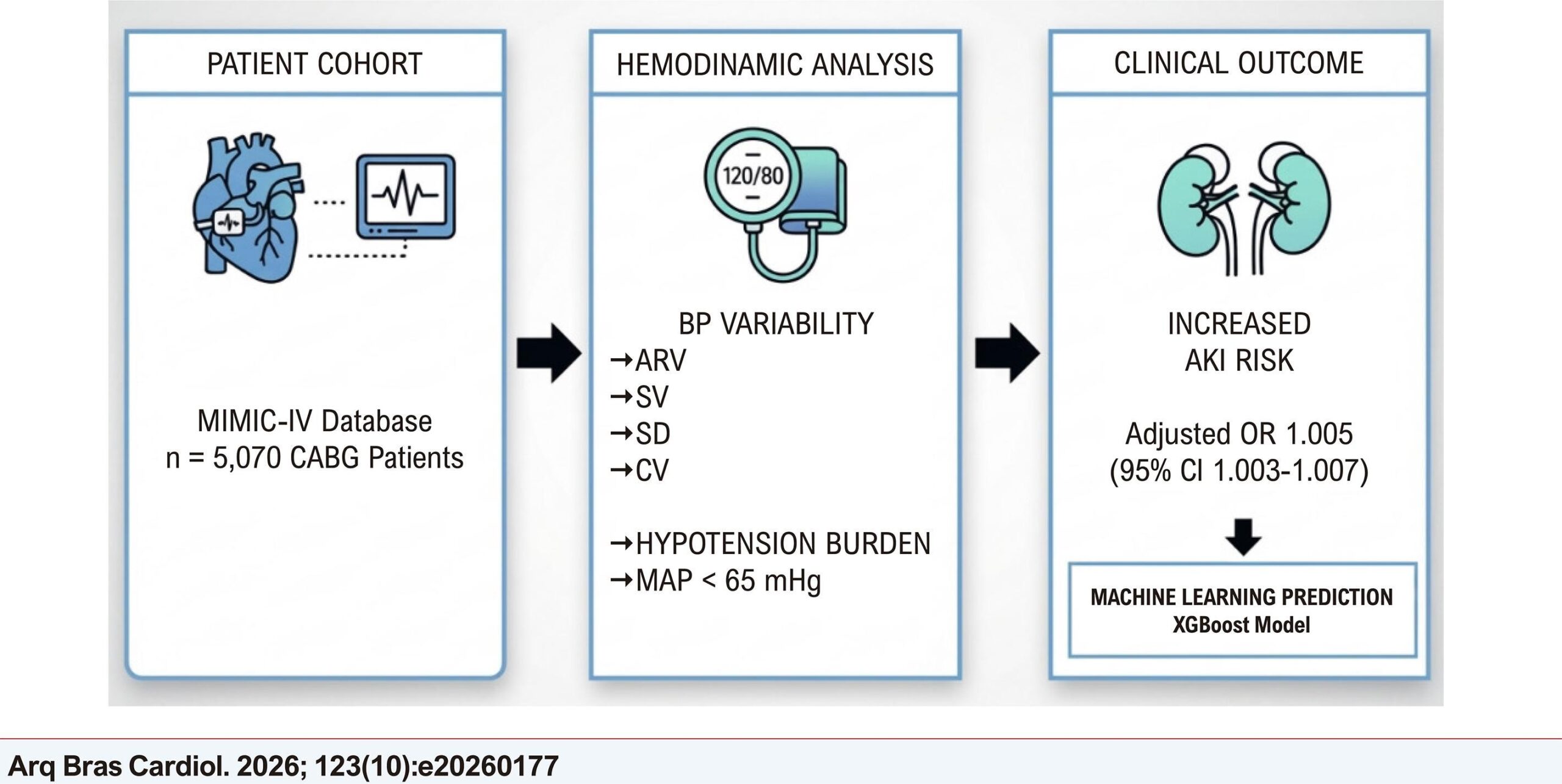
We conducted a retrospective cohort study using data from 5,070 adult patients who underwent CABG in the Medical Information Mart for Intensive Care IV (MIMIC-IV) database. Systolic blood pressure (SBP), diastolic blood pressure (DBP), and mean arterial pressure (MAP) variability during the first 24 hours after ICU admission were quantified using average real variability (ARV), successive variation (SV), standard deviation (SD), and coefficient of variation (CV). Multivariable logistic regression and machine learning models, including XGBoost, logistic regression, support vector machine, random forest, and K-nearest neighbor, were developed to predict postoperative AKI. All statistical tests were two-sided, and a P value < 0.05 was considered statistically significant.
Results
After adjustment for relevant confounders, increased BPV and cumulative hypotension were independently associated with AKI. Higher BPV was significantly associated with AKI (OR, 1.005; 95% CI, 1.002–1.008), as was greater hypotension burden defined by area under MAP <65 mmHg (OR, 1.307; 95% CI, 1.220–1.400). Among all models, XGBoost demonstrated the best predictive performance.
Conclusion
Postoperative BPV within the first 24 hours is a significant predictor of AKI after CABG. Integrating BPV into predictive models may improve early risk stratification and support clinical decision-making.