ABC Family Arquivos Brasileiros de Cardiologia International Journal of Cardiovascular Sciences ABC Heart Failure & Cardiomyopathy ABC Imagem Cardiovascular
Português English
ABC Family
Português English
  • About
    • About ABC Family
    • Internal Regulation
    • Editorial Board
    • Brazilian Society of Cardiology (SBC)
  • Issues
  • SBC Guidelines
  • Content
    • Videos
    • Podcasts
    • News
  • About
    • About ABC Family
    • Internal Regulation
    • Editorial Board
    • Brazilian Society of Cardiology (SBC)
  • Issues
  • SBC Guidelines
  • Content
    • Videos
    • Podcasts
    • News

ABC Family

  • ABC Family
  • Arquivos Brasileiros de Cardiologia
  • International Journal of Cardiovascular Sciences
  • ABC Heart Failure & Cardiomyopathy
  • ABC Imagem Cardiovascular
Search in

No content found.

Journals
Ordering
Article types
Others

  1. Home
  2. Keyword: polymorphism
Figure 1
ABC
Review Article

Serum Levels of BDNF in Cardiovascular Protection and in Response to Exercise

Ivani Credidio Trombetta et al. José Roberto DeMoura Cleber Rene Alves Renato Carbonari-Brito … Felipe Xerez Cepeda José Ribeiro Lemos Jr

Abstract

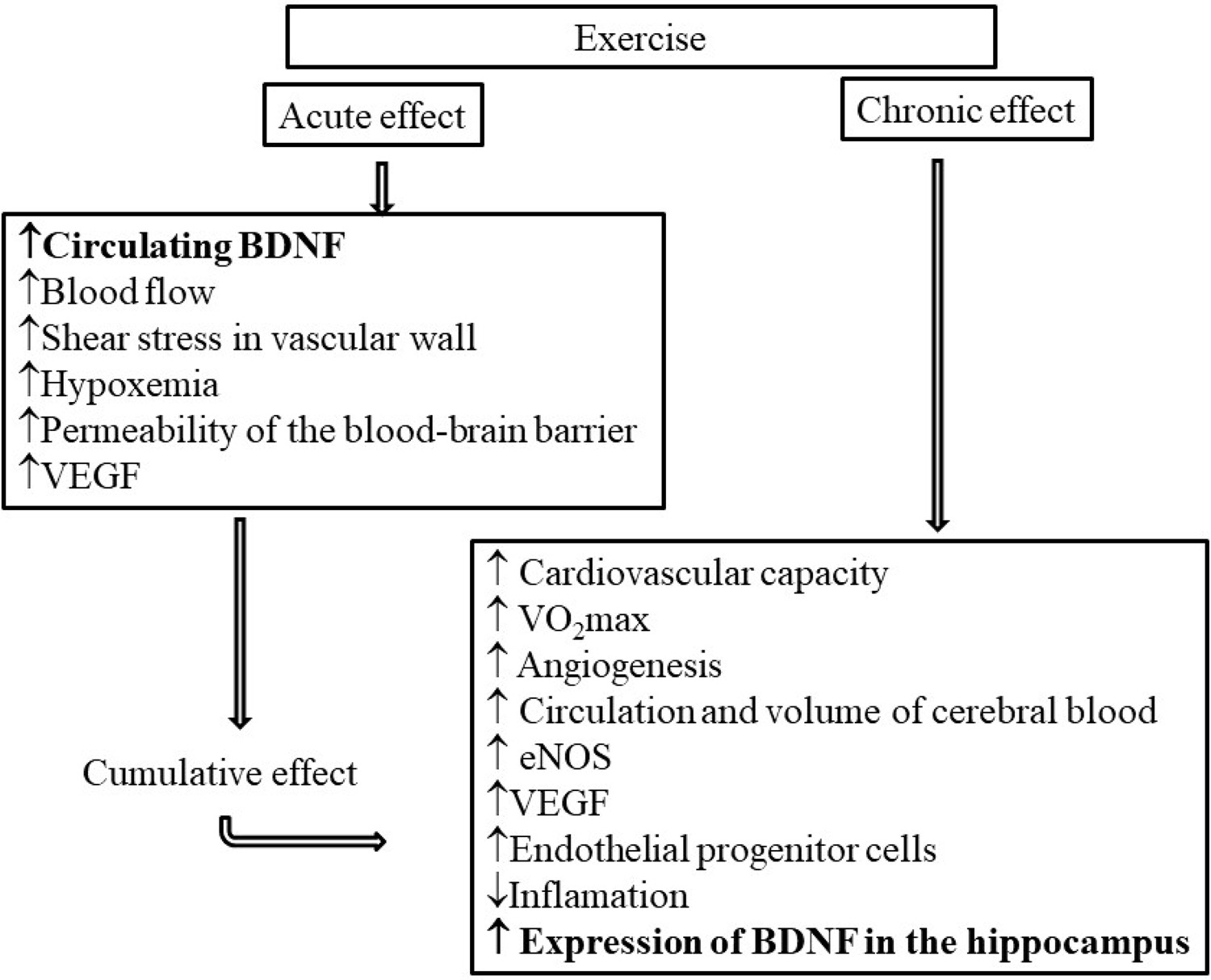
Cardiovascular disease (CVD) is currently the leading cause of death in Brazil and worldwide. In 2016, CVD accounted for more than 17 million deaths, representing 31% of all deaths globally. Molecular and genetic mechanisms may be involved in vascular protection and should be considered in new therapeutic approaches. In this sense, recent studies have reported that brain-derived neurotrophic factor (BDNF) is reduced in individuals predisposed to develop CVD, and that aerobic physical training increases the amounts of circulating BDNF. BDNF is a neurotrophin found at high concentrations in the hippocampus and cerebral cortex and is considered a key molecule for the maintenance of synaptic plasticity and survival of neuronal cells. In addition to neuronal plasticity, BDNF is also important in vascular function, promoting angiogenesis through the regulation of reactive oxygen species (ROS). However, a variant of the BDNF gene in humans, the Val66Met polymorphism (substitution of the amino acid valine for a methionine at position 66 of the codon), occurring in 20-30% of the Caucasian population, may affect plasma BDNF concentrations and its activity in all peripheral tissues containing tyrosine kinase B receptors (TrkB), such as the endothelium. Thus, we will present a discussion about the role of serum BDNF levels in cardiovascular protection, Val66Met genetic variant in vascular reactivity and the effect of physical exercise.
  • BDNF
  • Brain-Derived Neurotrophic Factor
  • Cardiovascular Diseases, mortality
  • Endothelium, Vascular
  • Exercise
  • Nerve Growth Factors
  • Neuronal Plasticity
  • polymorphism
Read Full Article
Creative Commons Attribution (CC BY) Creative Commons license
28/08/2020 DOI: 10.36660/abc.20190368 Views 2
IJCS
Review Article

Arterial Stiffness: Pathophysiological and Genetic Aspects

Rafael de Oliveira Alvim et al. Paulo Caleb Junior Lima Santos Luiz Aparecido Bortolotto José Geraldo Mill Alexandre da Costa Pereira

Abstract

Cardiovascular diseases (CVD) are the main cause of mortality and it represents a significant percentage of hospitalizations. In the scenario of minimization of costs of the health system, methods that identify subclinical CVD would be important. Some guidelines include the measures of aortic stiffness and intima-media thickness of the carotid artery as methods to identify subclinical CVD in hypertensive patients. The pulse wave velocity (PWV) is the gold standard for the evaluation of arterial stiffness. In this review, we report the pathophysiology, the determinants of arterial stiffness, and justify its inclusion in the assessment of hypertensive patient due its direct association with cardiovascular risk, as show in the I Diretriz Brasileira de Prevenção Cardiovascular. In addition, we raised the main genetic studies of this phenotype, due to its complexity, can be modulated by dozens of genes. However, a better understanding of the relationship genetic-arterial stiffness and, even an intervention based on genotypes, should be achieved in future studies.

  • heritability
  • pathophysiology
  • polymorphism
  • Vascular Stiffness
Read Full Article
Creative Commons Attribution (CC BY) Creative Commons license
01/01/2017 DOI: 10.5935/2359-4802.20170053 Views 3
Nitric oxide and the cardiovascular system: cell activation, vascular reactivity and genetic variant
ABC
Review Article

Nitric oxide and the cardiovascular system: cell activation, vascular reactivity and genetic variant

Rodrigo Gonçalves Dias et al. Carlos Eduardo Negrão Marta Helena Krieger

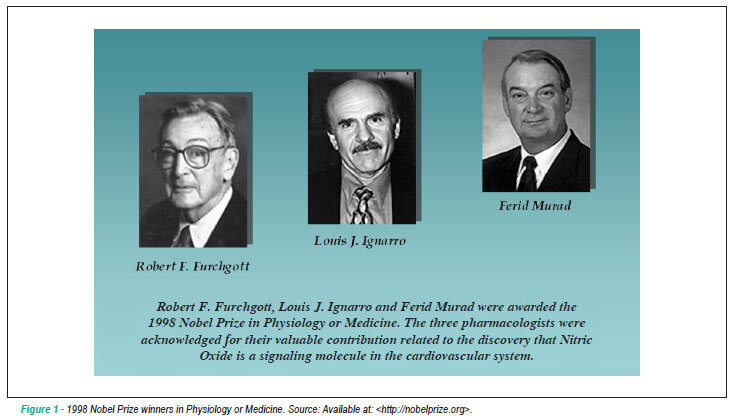
Nitric oxide (NO), primarily identified as an endothelium-derived relaxing factor, is a free radical that signals different biological processes. The identification of NO synthase (NOS) isoforms and the subsequent characterization of the mechanisms of cell activation of the enzymes permitted the partial understanding of both the physiological interactions and of the mechanisms of the diseases in which NO is involved. Mainly expressed in the vascular endothelium, the endothelial NOS isoform (eNOS) plays an important role in the regulation of vascular reactivity and in the development and progression of atherosclerosis. The purpose of this review is to contextualize the reader about the eNOS structure and its mechanisms of cell activation. In view of the advances in molecular biology, we will also address the known mechanisms of gene expression regulation and the role of variants on the genetic code of eNOS associated with cardiovascular phenotypes. Although the importance of NO as an atheroprotective molecule is recognized, our focus will be the review of the literature on NO and its participation in the modulation of the muscle vasodilatation phenotype.

  • Genetic
  • Nitric Oxide
  • nitric oxide synthase type III
  • polymorphism
Read Full Article
Creative Commons Attribution (CC BY) Creative Commons license
04/02/2011 DOI: 10.1590/S0066-782X2011000100012
Effect of physical activity and t-786C polymorphism in blood pressure and blood flow in the elderly
ABC
Artigo Original

Effect of physical activity and t-786C polymorphism in blood pressure and blood flow in the elderly

Anderson Saranz Zago et al. Eduardo Kokubun Nicola Fenty-Stewart Joon-Young Park … Selasi Attipoe James Hagberg Michael Brown

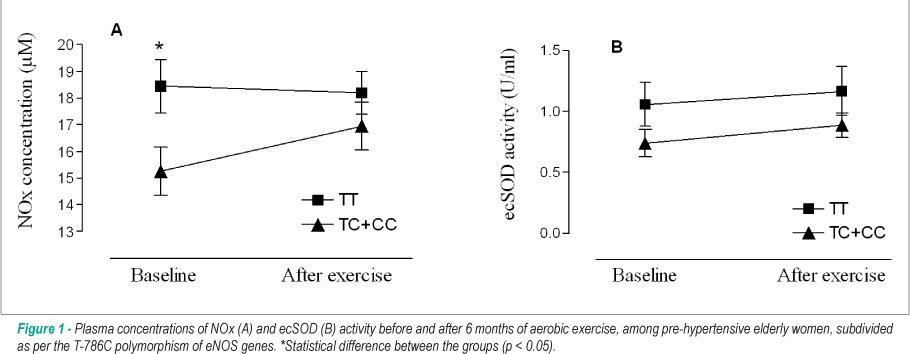
BACKGROUND: The T-786C polymorphism of the gene for endothelial nitric oxide synthase (eNOS) and superoxide anion production may reduce production and bioavailability of nitric oxide, affecting the degree of vasodilation. This effect can be reversed by exercise. OBJECTIVE: To investigate the influence of aerobic training and T-786C polymorphism in the concentrations of nitric oxide metabolites (NOx) in blood flow (BF) and blood pressure (BP). METHODS: Thirty-two elderly pre-hypertensive women (59 ± 6 years old) were divided into two groups according to the T-786C polymorphism (TT and TC + CC). We analyzed the concentrations of NOx (plasma) and blood flow by venous occlusion plethysmography at rest, 1, 2 and 3 minutes post-occlusion (BF-0, BF-1 BF-2 BF-3, respectively). Evaluations were performed before and after 6 months of a program of aerobic exercise. RESULTS: In the pre-training evaluations, NOx levels were lower in TC + CC group than in TT group. The TT group showed correlations between NOx and BF-0 (r = 0.6) and diastolic blood pressure (DBP) and BF-0 (r = -0.7), but no correlation was found in TC + CC group. In the post-training evaluations, there were correlations between NOx and BF-0 (r = 0.6) and the changes in NOx and DBP (r = -0.6) in TT group. There were also correlations between DBP and BF-1 (r = -0.8), DBP, and BF-2 (r = -0.6), DBP, and BF-3 (r = -0.6), in the changes between NOx and BF-1 (r = 0.8) and changes in NOx and DBP (r = -0.7) in TC + CC group. CONCLUSION: It was concluded that 6 months of aerobic exercise can increase the relationship between NO, BP and BF in elderly of allele C carriers.

  • Aged
  • Blood Pressure
  • Exercise
  • Genetic
  • Nitric Oxide
  • polymorphism
  • superoxide dismutase
Read Full Article
Creative Commons Attribution (CC BY) Creative Commons license
17/09/2010 DOI: 10.1590/S0066-782X2010005000126

How to cite this article

EndNote RIS

Electronic Document Format (Vancouver)

Trombetta IC, DeMoura JR, Alves CR, Carbonari-Brito R, Cepeda FX, Lemos Jr JR. Serum Levels of BDNF in Cardiovascular Protection and in Response to Exercise. Arquivos Brasileiros de Cardiologia 2020;115(2):263-9.

Electronic Document Format (ABNT)

Trombetta, Ivani Credidio; DeMoura, José Roberto; Alves, Cleber Rene; Carbonari-Brito, Renato; Cepeda, Felipe Xerez; Lemos Jr, José Ribeiro. Serum Levels of BDNF in Cardiovascular Protection and in Response to Exercise. Arquivos Brasileiros de Cardiologia, v. 115, n. 2, p. 263-269, Aug. 2020.

Electronic Document Format (APA)

Trombetta, I. C., DeMoura, J. R., Alves, C. R., Carbonari-Brito, R., Cepeda, F. X., & Lemos Jr, J. R. (2020). Serum Levels of BDNF in Cardiovascular Protection and in Response to Exercise. Arquivos Brasileiros de Cardiologia, 115(2), 263-269.

Electronic Document Format (ISO)

Trombetta, Ivani Credidio and DeMoura, José Roberto and Alves, Cleber Rene and Carbonari-Brito, Renato and Cepeda, Felipe Xerez and Lemos Jr, José Ribeiro. Serum Levels of BDNF in Cardiovascular Protection and in Response to Exercise. Arquivos Brasileiros de Cardiologia [online]. 2020, vol. 115, n. 2, [cited 2026-10-14], pp. 263-269. Available from: <https://journals.cardiol.br/en/article/serum-levels-of-bdnf-in-cardiovascular-protection-and-in-response-to-exercise/>. ISSN 0066-782X

EndNote RIS

Electronic Document Format (Vancouver)

Alvim RO, Santos PCJL, Bortolotto LA, Mill JG, Pereira AC. Arterial Stiffness: Pathophysiological and Genetic Aspects. International Journal of Cardiovascular Sciences 2017;30(5):433-41.

Electronic Document Format (ABNT)

Alvim, Rafael de Oliveira; Santos, Paulo Caleb Junior Lima; Bortolotto, Luiz Aparecido; Mill, José Geraldo; Pereira, Alexandre da Costa. Arterial Stiffness: Pathophysiological and Genetic Aspects. International Journal of Cardiovascular Sciences, v. 30, n. 5, p. 433-441, Dec. 2016.

Electronic Document Format (APA)

Alvim, R. O., Santos, P. C. J. L., Bortolotto, L. A., Mill, J. G., & Pereira, A. C. (2017). Arterial Stiffness: Pathophysiological and Genetic Aspects. International Journal of Cardiovascular Sciences, 30(5), 433-441.

Electronic Document Format (ISO)

Alvim, Rafael de Oliveira and Santos, Paulo Caleb Junior Lima and Bortolotto, Luiz Aparecido and Mill, José Geraldo and Pereira, Alexandre da Costa. Arterial Stiffness: Pathophysiological and Genetic Aspects. International Journal of Cardiovascular Sciences [online]. 2017, vol. 30, n. 5, [cited 2026-10-14], pp. 433-441. Available from: <https://journals.cardiol.br/en/article/arterial-stiffness-pathophysiological-and-genetic-aspects/>. ISSN 2359-4802

EndNote RIS

Electronic Document Format (Vancouver)

Dias RG, Negrão CE, Krieger MH. Nitric oxide and the cardiovascular system: cell activation, vascular reactivity and genetic variant. Arquivos Brasileiros de Cardiologia 2011;96(1):68-75.

Electronic Document Format (ABNT)

Dias, Rodrigo Gonçalves; Negrão, Carlos Eduardo; Krieger, Marta Helena. Nitric oxide and the cardiovascular system: cell activation, vascular reactivity and genetic variant. Arquivos Brasileiros de Cardiologia, v. 96, n. 1, p. 68-75, Feb. 2011.

Electronic Document Format (APA)

Dias, R. G., Negrão, C. E., & Krieger, M. H. (2011). Nitric oxide and the cardiovascular system: cell activation, vascular reactivity and genetic variant. Arquivos Brasileiros de Cardiologia, 96(1), 68-75.

Electronic Document Format (ISO)

Dias, Rodrigo Gonçalves and Negrão, Carlos Eduardo and Krieger, Marta Helena. Nitric oxide and the cardiovascular system: cell activation, vascular reactivity and genetic variant. Arquivos Brasileiros de Cardiologia [online]. 2011, vol. 96, n. 1, [cited 2026-10-14], pp. 68-75. Available from: <https://journals.cardiol.br/en/article/nitric-oxide-and-the-cardiovascular-system-cell-activation-vascular-reactivity-and-genetic-variant/>. ISSN 0066-782X

EndNote RIS

Electronic Document Format (Vancouver)

Zago AS, Kokubun E, Fenty-Stewart N, Park J, Attipoe S, Hagberg J, Brown M, et al. Effect of physical activity and t-786C polymorphism in blood pressure and blood flow in the elderly. Arquivos Brasileiros de Cardiologia 2010;95(4):510-8.

Electronic Document Format (ABNT)

Zago, Anderson Saranz; Kokubun, Eduardo; Fenty-Stewart, Nicola; Park, Joon-Young; Attipoe, Selasi; Hagberg, James; Brown, Michael. Effect of physical activity and t-786C polymorphism in blood pressure and blood flow in the elderly. Arquivos Brasileiros de Cardiologia, v. 95, n. 4, p. 510-518, Sep. 2010.

Electronic Document Format (APA)

Zago, A. S., Kokubun, E., Fenty-Stewart, N., Park, J., Attipoe, S., Hagberg, J., & Brown, M. (2010). Effect of physical activity and t-786C polymorphism in blood pressure and blood flow in the elderly. Arquivos Brasileiros de Cardiologia, 95(4), 510-518.

Electronic Document Format (ISO)

Zago, Anderson Saranz and Kokubun, Eduardo and Fenty-Stewart, Nicola and Park, Joon-Young and Attipoe, Selasi and Hagberg, James and Brown, Michael. Effect of physical activity and t-786C polymorphism in blood pressure and blood flow in the elderly. Arquivos Brasileiros de Cardiologia [online]. 2010, vol. 95, n. 4, [cited 2026-10-14], pp. 510-518. Available from: <https://journals.cardiol.br/en/article/effect-of-physical-activity-and-t-786c-polymorphism-in-blood-pressure-and-blood-flow-in-the-elderly/>. ISSN 0066-782X

  • About ABC Family
  • Internal Regulation
  • Editorial Board
  • Brazilian Society of Cardiology (SBC)

Issues

SBC Guidelines

  • Videos
  • Podcasts
  • News