ABC Family Arquivos Brasileiros de Cardiologia International Journal of Cardiovascular Sciences ABC Heart Failure & Cardiomyopathy ABC Imagem Cardiovascular
Português English
ABC Family
Português English
  • About
    • About ABC Family
    • Internal Regulation
    • Editorial Board
    • Brazilian Society of Cardiology (SBC)
  • Issues
  • SBC Guidelines
  • Content
    • Videos
    • Podcasts
    • News
  • About
    • About ABC Family
    • Internal Regulation
    • Editorial Board
    • Brazilian Society of Cardiology (SBC)
  • Issues
  • SBC Guidelines
  • Content
    • Videos
    • Podcasts
    • News

ABC Family

  • ABC Family
  • Arquivos Brasileiros de Cardiologia
  • International Journal of Cardiovascular Sciences
  • ABC Heart Failure & Cardiomyopathy
  • ABC Imagem Cardiovascular
Search in

No content found.

Journals
Ordering
Article types
Others

  1. Home
  2. Keyword: Percutaneous Coronary Interventon
Figure 1
ABC
Original Article

Comparison of the Outcomes between Coronary No-Reflow and Slow-Flow Phenomenon in Non-STEMI Patients

Mustafa Ahmet Huyut

Abstract

Background:

Coronary slow-flow phenomenon (CSFP) and coronary no-reflow phenomenon (CNP) are associated with increased risk of major cardiovascular adverse events (MACE).

Objectives:

This study aimed to evaluate and compare the one-year clinical follow-up outcomes among patients with CNP and CSFP who underwent percutaneous coronary interventions (PCI) in non-ST elevation myocardial infarction (NSTEMI).

Methods:

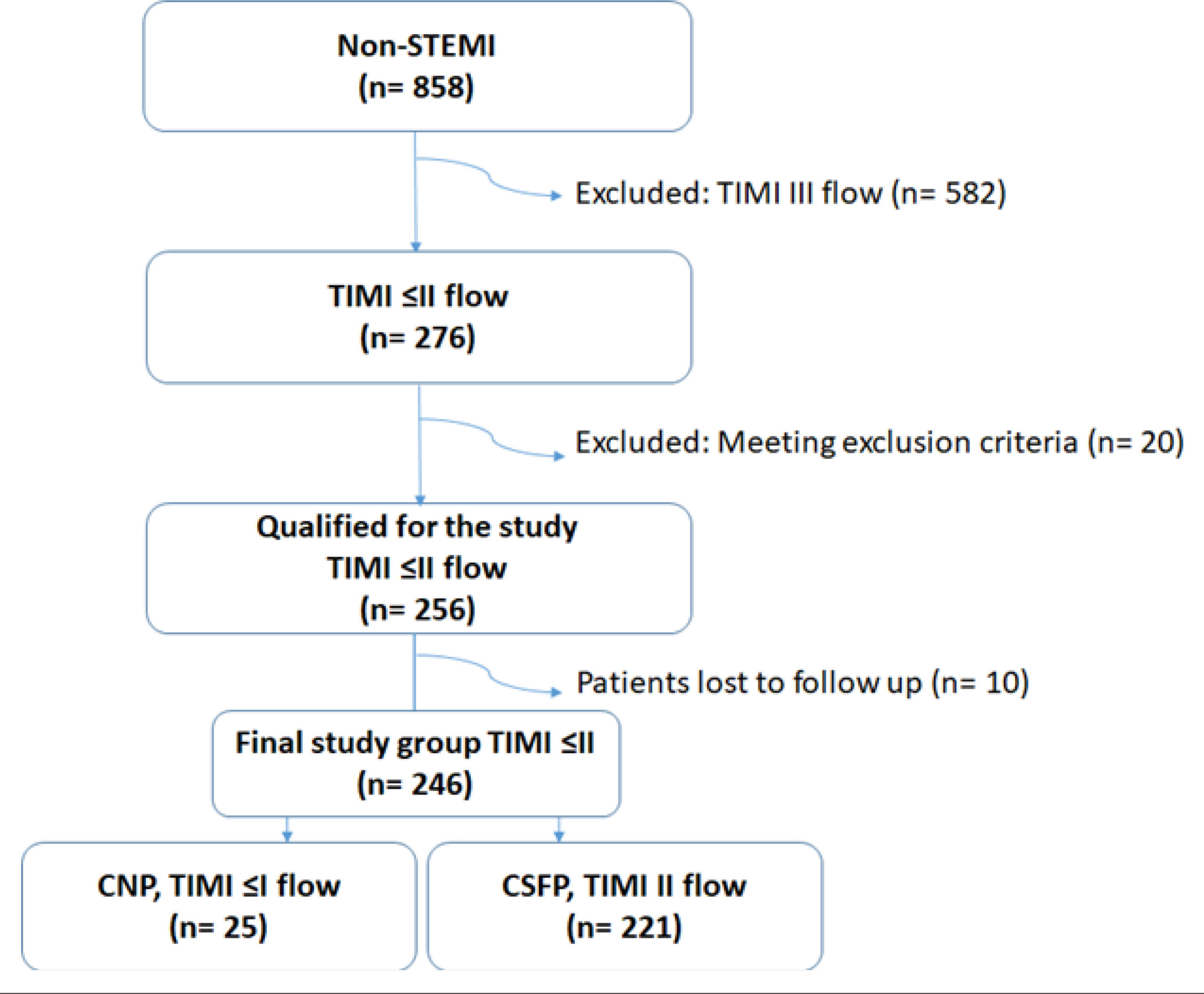
This study included a total of 858 patients who were diagnosed with NSTEMI and underwent PCI within 24 h of symptom onset. The patients were divided into two groups, the CSFP group (n=221) and the CNP group (n=25), regarding the angiographic characteristics of thrombolysis in myocardial infarction (TIMI) flow of the infarct-related artery. Patients were followed for one-year. A p-value of <0.05 was considered significant.

Results:

CNP was observed in 2.91%, and CSFP was observed in 25.75% of the patients. Clinical endpoints analyzed that stroke was significantly higher in the CNP group than in the CSFP group (6 (24%) vs. 6 (2.70%), p<0.001) and MACE was significantly higher in the CNP group than in the CSFP group (11 (44%) vs. 51 (23.10%), p=0.022). Forward conditional logistic regression analysis demonstrated that body mass index (BMI) (OR=1.11, 95%CI: 1.00-1.24, p=0.038) and baseline heart rate (HR) (OR=0.923, 95%CI: 0.88-0.96, p<0.001) were the independent predictors of CNP in NSTEMI.

Conclusion:

CNP patients have worse clinical outcomes and a higher risk of stroke compared with CSFP patients in NSTEMI. (Arq Bras Cardiol. 2021; 116(5):856-864)

  • Acute Coronary Syndrome / complications
  • Coronary Angiography
  • Myocardial Infarction
  • No-Reflow Phenomenon
  • Percutaneous Coronary Interventon
  • Risk Factors
  • Stroke
Read Full Article
Creative Commons Attribution (CC BY) Creative Commons license
17/05/2021 DOI: 10.36660/abc.20190905

How to cite this article

EndNote RIS

Electronic Document Format (Vancouver)

Huyut MA. Comparison of the Outcomes between Coronary No-Reflow and Slow-Flow Phenomenon in Non-STEMI Patients. Arquivos Brasileiros de Cardiologia 2021;116(5):856-64.

Electronic Document Format (ABNT)

Huyut, Mustafa Ahmet. Comparison of the Outcomes between Coronary No-Reflow and Slow-Flow Phenomenon in Non-STEMI Patients. Arquivos Brasileiros de Cardiologia, v. 116, n. 5, p. 856-864, May. 2021.

Electronic Document Format (APA)

Huyut, M. A. (2021). Comparison of the Outcomes between Coronary No-Reflow and Slow-Flow Phenomenon in Non-STEMI Patients. Arquivos Brasileiros de Cardiologia, 116(5), 856-864.

Electronic Document Format (ISO)

Huyut, Mustafa Ahmet. Comparison of the Outcomes between Coronary No-Reflow and Slow-Flow Phenomenon in Non-STEMI Patients. Arquivos Brasileiros de Cardiologia [online]. 2021, vol. 116, n. 5, [cited 2026-10-14], pp. 856-864. Available from: <https://journals.cardiol.br/en/article/comparison-of-the-outcomes-between-coronary-no-reflow-and-slow-flow-phenomenon-in-non-stemi-patients/>. ISSN 0066-782X
  • About ABC Family
  • Internal Regulation
  • Editorial Board
  • Brazilian Society of Cardiology (SBC)

Issues

SBC Guidelines

  • Videos
  • Podcasts
  • News