ABC Family Arquivos Brasileiros de Cardiologia International Journal of Cardiovascular Sciences ABC Heart Failure & Cardiomyopathy ABC Imagem Cardiovascular
Português English
ABC Family
Português English
  • About
    • About ABC Family
    • Internal Regulation
    • Editorial Board
    • Brazilian Society of Cardiology (SBC)
  • Issues
  • SBC Guidelines
  • Content
    • Videos
    • Podcasts
    • News
  • About
    • About ABC Family
    • Internal Regulation
    • Editorial Board
    • Brazilian Society of Cardiology (SBC)
  • Issues
  • SBC Guidelines
  • Content
    • Videos
    • Podcasts
    • News

ABC Family

  • ABC Family
  • Arquivos Brasileiros de Cardiologia
  • International Journal of Cardiovascular Sciences
  • ABC Heart Failure & Cardiomyopathy
  • ABC Imagem Cardiovascular
Search in

No content found.

Journals
Ordering
Article types
Others

  1. Home
  2. Keyword: Pacemaker,Artificial
Figure 2
ABC
Original Article

Long-Term Ventricular Pacing Dependency and Pacemaker Implantation Predictors after Transcatheter Aortic Valve Replacement – A 1-Year Follow-Up

Ricardo Alves Pinto et al. Tânia Proença Miguel Martins Carvalho Gonçalo Pestana … Ana Lebreiro Luis Adão Filipe Macedo

Abstract

Background

Conduction disturbances (CD) are the most frequent complication after transcatheter aortic valve replacement (TAVR), and there continues to be a lack of consensus on their management.

Objective

To assess new CD and permanent pacemaker (PPM) implantation after TAVR and to evaluate the ventricular pacing percentage (VP) up to 1 year of follow-up.

Methods

Patients who underwent TAVR from October 2014 to November 2019 were enrolled; patients with previous PPM were excluded. Clinical, procedure, ECG, and PPM data were collected up to 1 year after implantation. The significance level adopted in the statistical analysis was 0.05.

Results

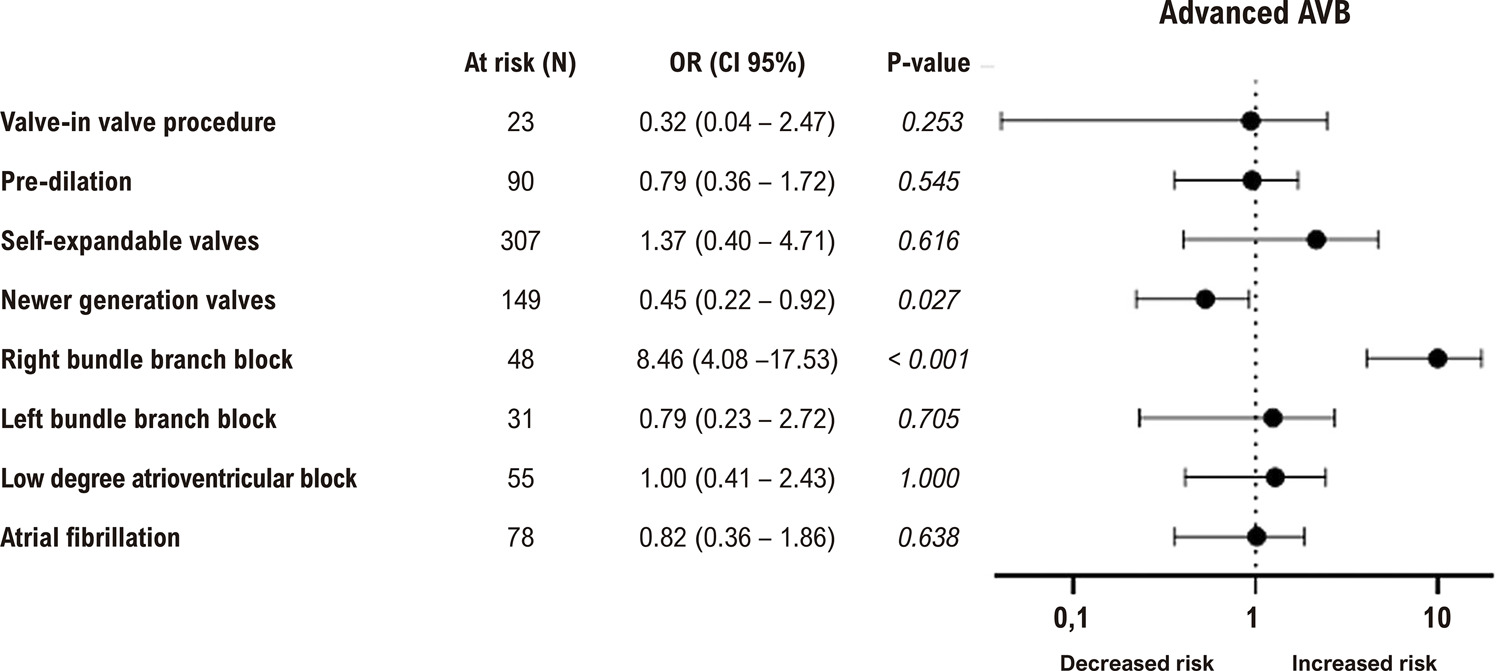
A total of 340 patients underwent TAVR. The most frequent CD was the new left bundle branch block (LBBB; 32.2%), which 56% resolved after 6 months. Right bundle branch block (RBBB) was the biggest risk factor for advanced atrioventricular block (AVB) [OR=8.46; p<0.001] and PPM implantation [OR=5.18, p<0.001], followed by previous low-grade AVB [OR=2.25; p=0.016 for PPM implantation]. Regarding procedure characteristics, newer generation valves and valve-in-valve procedures were associated with fewer CDs. Overall, 18.5% of patients had a PPM implanted post-TAVR. At first PPM evaluation, patients with advanced AVB had a median percentage of VP of 80% and 83% at one year. Regarding patients with LBBB plus low-grade AVB, median VP was lower (6% at first assessment, p=0.036; 2% at one year, p = 0.065).

Conclusion

LBBB was the most frequent CD after TAVR, with more than half being resolved in the first six months. RBBB was the major risk factor for advanced AVB and PPM implantation. Advanced AVB was associated with a higher percentage of VP at 1 year of follow-up.
  • Aortic Valve Stenosis
  • Atrioventriclar Block
  • Cardiac Conduction System Disease
  • Heart Valve Prosthesis Implantation
  • Pacemaker,Artificial
  • Transcatheter Aortic Valve Replacement
Read Full Article
Creative Commons Attribution (CC BY) Creative Commons license
18/07/2022 DOI: 10.36660/abc.20210613 Views 2
IJCS
Editorial

Conduction Abnormalities after Transcatheter Aortic Valve Replacement: Pretty Common, Fairly Predictable, Barely Avoidable

Mohammad Abdelghani

The cardiac conduction system is commonly diseased in patients with aortic valve disease, and the site of conduction defect in those with severe calcific aortic valve stenosis is most commonly the His bundle or infra-Hisian., The bundle of His traverses the membranous septum towards the left ventricular outflow tract (LVOT) running superficially over the crest of the ventricular septum, originating the left bundle branch. This anatomical course makes the His bundle and its left branch susceptible to mechanical injury during transcatheter aortic valve replacement (TAVR), which involves multiple mechanical manipulations with wires, catheters, balloons, and the transcatheter heart valve (THV) inflow within that vicinity. Atrioventricular and intra-ventricular conduction abnormalities are indeed a common finding in patients with severe aortic valve stenosis referred to TAVR and new onset persistent conduction abnormalities (NOPCAs) are a common complication arising during/after TAVR.

Unlike other periprocedural complications of TAVR, whose incidence has decreased over time, a regression in the incidence of NOPCAs after TAVR was neither seen with the introduction of new TAVR technologies/techniques nor it is foreseeable in the near future.

[…]

  • Aortic Valve Stenosis/complications
  • Aortic Valve Stenosis/physiopathology
  • Arrhythmias,Cardiac
  • Bundle-Branch Block/etiology
  • Pacemaker,Artificial
  • Transcatheter Aortic Valve Replacement/adverse effects
Read Full Article
Creative Commons Attribution (CC BY) Creative Commons license
03/10/2019 DOI: 10.5935/2359-4802.20190078
Figure 1
ABC
Original Article

Pacemaker Implants in Children and Adolescents with Chagas Disease in Brazil: 18-Year Incidence

Carolina Christianini Mizzaci et al. Thiago Gonçalves Schroder e Souza Gabriel Pelegrineti Targueta Ana Paula Frederico Tótora … Juan Carlos Pachón Mateos José Carlos Pachon Mateos

Abstract

Background:

Chagas disease continues to be a serious public health problem, and accounts for 25-30% of the indications for cardiac stimulation in Brazil.

Objective:

To assess clinical and epidemiological characteristics of patients with Chagas disease, younger than 18 years, who had undergone pacemaker implantation in Brazil between 1994 and 2011, and its temporal trend.

Methods:

This was a cross-sectional analysis of data from the Brazilian Pacemaker Registry database. The following variables were analyzed: year when pacemaker was implanted, location, age, sex, ethnic group, functional class and the main electrocardiographic findings at baseline.

Results:

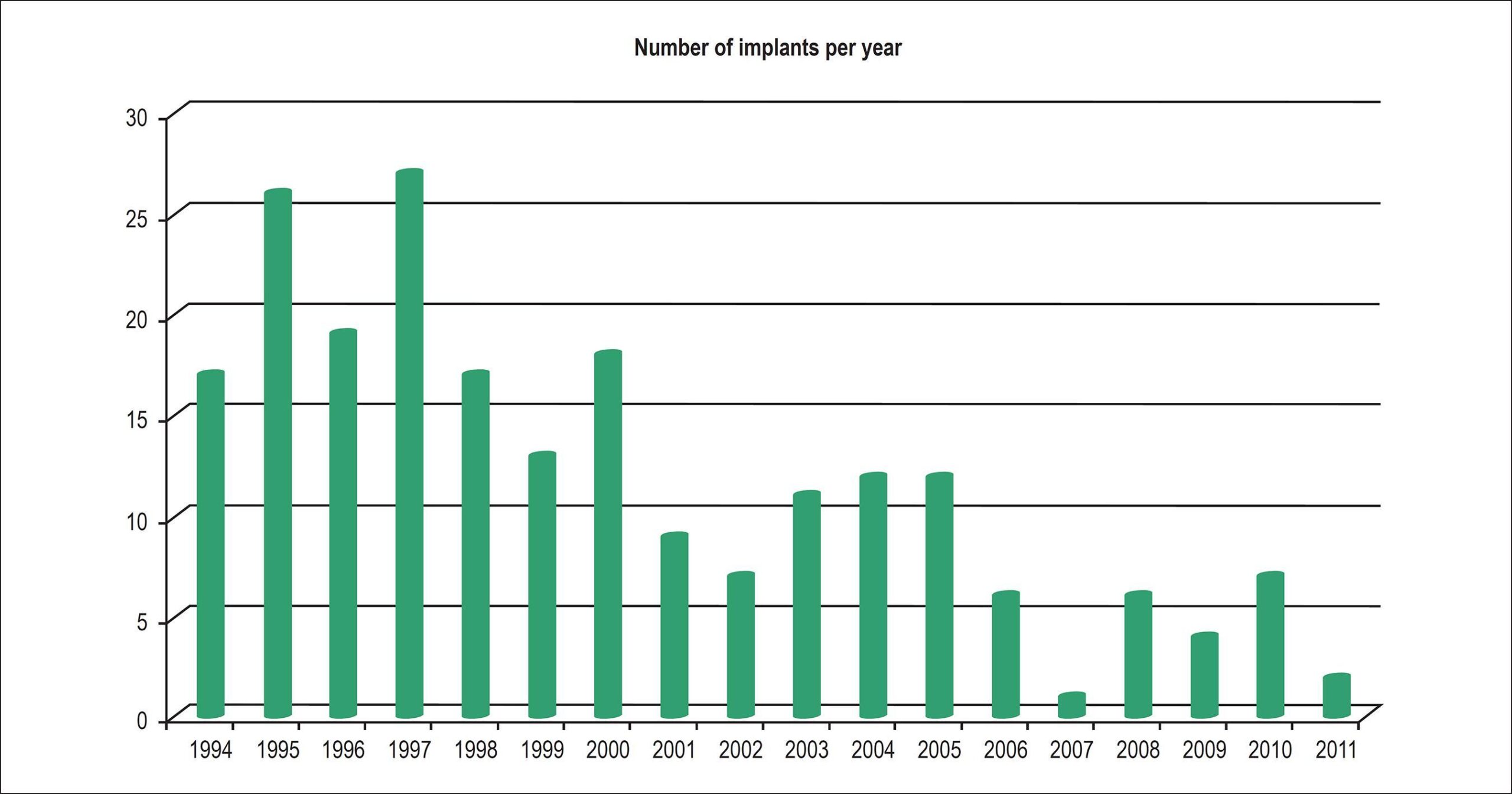
In a total of 183,123 implants performed between 1994 and 2011, 214 implants of cardiac stimulation device in Chagas disease patients aged younger than 18 years were identified. Mean age at implantation was 5.6 ± 6.2 years. Second- and third-degree atrioventricular blocks corresponded to 71% of indications for pacemaker implantation. Fifty-six percent of the procedures were performed in the southeast region. Regarding the total number of pacemaker implants per year, there was a remarkable increase in the implants for all causes. However, time series analysis of the implants in Chagas disease patients younger than 18 years revealed a significant reduction in the annual number of implants.

Conclusion:

There has been an important reduction in the number of pacemaker implantations among children and adolescents with Chagas disease, suggesting a reduction in the vertical transmission of the parasite.

  • Adolescents
  • Chagas Cardiomyopathy
  • Chagas disease
  • Child
  • Epidemiology
  • Pacemaker,Artificial
  • Retrospective Studies
Read Full Article
Creative Commons Attribution (CC BY) Creative Commons license
01/06/2017 DOI: 10.5935/abc.20170074

How to cite this article

EndNote RIS

Electronic Document Format (Vancouver)

Pinto RA, Proença T, Carvalho MM, Pestana G, Lebreiro A, Adão L, Macedo F, et al. Long-Term Ventricular Pacing Dependency and Pacemaker Implantation Predictors after Transcatheter Aortic Valve Replacement – A 1-Year Follow-Up. Arquivos Brasileiros de Cardiologia 2022;119(4):522-30.

Electronic Document Format (ABNT)

Pinto, Ricardo Alves; Proença, Tânia; Carvalho, Miguel Martins; Pestana, Gonçalo; Lebreiro, Ana; Adão, Luis; Macedo, Filipe. Long-Term Ventricular Pacing Dependency and Pacemaker Implantation Predictors after Transcatheter Aortic Valve Replacement – A 1-Year Follow-Up. Arquivos Brasileiros de Cardiologia, v. 119, n. 4, p. 522-530, Jul. 2022.

Electronic Document Format (APA)

Pinto, R. A., Proença, T., Carvalho, M. M., Pestana, G., Lebreiro, A., Adão, L., & Macedo, F. (2022). Long-Term Ventricular Pacing Dependency and Pacemaker Implantation Predictors after Transcatheter Aortic Valve Replacement – A 1-Year Follow-Up. Arquivos Brasileiros de Cardiologia, 119(4), 522-530.

Electronic Document Format (ISO)

Pinto, Ricardo Alves and Proença, Tânia and Carvalho, Miguel Martins and Pestana, Gonçalo and Lebreiro, Ana and Adão, Luis and Macedo, Filipe. Long-Term Ventricular Pacing Dependency and Pacemaker Implantation Predictors after Transcatheter Aortic Valve Replacement – A 1-Year Follow-Up. Arquivos Brasileiros de Cardiologia [online]. 2022, vol. 119, n. 4, [cited 2026-10-14], pp. 522-530. Available from: <https://journals.cardiol.br/en/article/long-term-ventricular-pacing-dependency-and-pacemaker-implantation-predictors-after-transcatheter-aortic-valve-replacement-a-1-year-follow-up/>. ISSN 0066-782X

EndNote RIS

Electronic Document Format (Vancouver)

Abdelghani M. Conduction Abnormalities after Transcatheter Aortic Valve Replacement: Pretty Common, Fairly Predictable, Barely Avoidable. International Journal of Cardiovascular Sciences 2019;32(5):505-7.

Electronic Document Format (ABNT)

Abdelghani, Mohammad. Conduction Abnormalities after Transcatheter Aortic Valve Replacement: Pretty Common, Fairly Predictable, Barely Avoidable. International Journal of Cardiovascular Sciences, v. 32, n. 5, p. 505-507, Oct. 2019.

Electronic Document Format (APA)

Abdelghani, M. (2019). Conduction Abnormalities after Transcatheter Aortic Valve Replacement: Pretty Common, Fairly Predictable, Barely Avoidable. International Journal of Cardiovascular Sciences, 32(5), 505-507.

Electronic Document Format (ISO)

Abdelghani, Mohammad. Conduction Abnormalities after Transcatheter Aortic Valve Replacement: Pretty Common, Fairly Predictable, Barely Avoidable. International Journal of Cardiovascular Sciences [online]. 2019, vol. 32, n. 5, [cited 2026-10-14], pp. 505-507. Available from: <https://journals.cardiol.br/en/article/conduction-abnormalities-after-transcatheter-aortic-valve-replacement-pretty-common-fairly-predictable-barely-avoidable/>. ISSN 2359-4802

EndNote RIS

Electronic Document Format (Vancouver)

Mizzaci CC, Souza TGS, Targueta GP, Tótora APF, Mateos JCP, Mateos JCP. Pacemaker Implants in Children and Adolescents with Chagas Disease in Brazil: 18-Year Incidence. Arquivos Brasileiros de Cardiologia 2017;108(6):546-51.

Electronic Document Format (ABNT)

Mizzaci, Carolina Christianini; Souza, Thiago Gonçalves Schroder e; Targueta, Gabriel Pelegrineti; Tótora, Ana Paula Frederico; Mateos, Juan Carlos Pachón; Mateos, José Carlos Pachon. Pacemaker Implants in Children and Adolescents with Chagas Disease in Brazil: 18-Year Incidence. Arquivos Brasileiros de Cardiologia, v. 108, n. 6, p. 546-551, May. 2017.

Electronic Document Format (APA)

Mizzaci, C. C., Souza, T. G. S. , Targueta, G. P., Tótora, A. P. F., Mateos, J. C. P., & Mateos, J. C. P. (2017). Pacemaker Implants in Children and Adolescents with Chagas Disease in Brazil: 18-Year Incidence. Arquivos Brasileiros de Cardiologia, 108(6), 546-551.

Electronic Document Format (ISO)

Mizzaci, Carolina Christianini and Souza, Thiago Gonçalves Schroder e and Targueta, Gabriel Pelegrineti and Tótora, Ana Paula Frederico and Mateos, Juan Carlos Pachón and Mateos, José Carlos Pachon. Pacemaker Implants in Children and Adolescents with Chagas Disease in Brazil: 18-Year Incidence. Arquivos Brasileiros de Cardiologia [online]. 2017, vol. 108, n. 6, [cited 2026-10-14], pp. 546-551. Available from: <https://journals.cardiol.br/en/article/pacemaker-implants-in-children-and-adolescents-with-chagas-disease-in-brazil-18-year-incidence/>. ISSN 0066-782X

  • About ABC Family
  • Internal Regulation
  • Editorial Board
  • Brazilian Society of Cardiology (SBC)

Issues

SBC Guidelines

  • Videos
  • Podcasts
  • News