ABC Family Arquivos Brasileiros de Cardiologia International Journal of Cardiovascular Sciences ABC Heart Failure & Cardiomyopathy ABC Imagem Cardiovascular
Português English
ABC Family
Português English
  • About
    • About ABC Family
    • Internal Regulation
    • Editorial Board
    • Brazilian Society of Cardiology (SBC)
  • Issues
  • SBC Guidelines
  • Content
    • Videos
    • Podcasts
    • News
  • About
    • About ABC Family
    • Internal Regulation
    • Editorial Board
    • Brazilian Society of Cardiology (SBC)
  • Issues
  • SBC Guidelines
  • Content
    • Videos
    • Podcasts
    • News

ABC Family

  • ABC Family
  • Arquivos Brasileiros de Cardiologia
  • International Journal of Cardiovascular Sciences
  • ABC Heart Failure & Cardiomyopathy
  • ABC Imagem Cardiovascular
Search in

No content found.

Journals
Ordering
Article types
Others

  1. Home
  2. Keyword: myotonic dystrophy
Heart rate variability in Myotonic Dystrophy type 1 patients
ABC
Artigo Original

Heart rate variability in Myotonic Dystrophy type 1 patients

Guilherme Fregonezi et al. Thaise Araújo Mario Emilio Dourado Junior Joceline Ferezini … Ester Silva Vanessa Resqueti

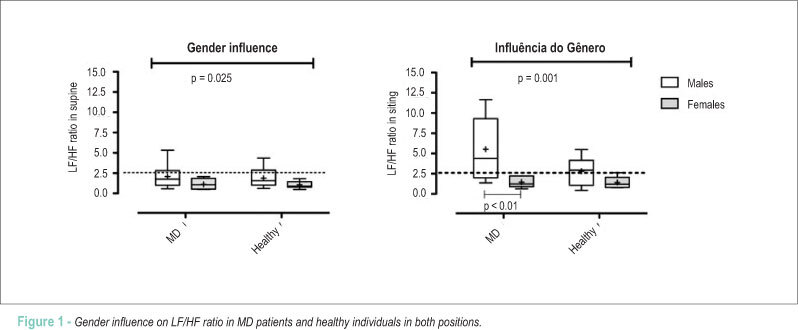
BACKGROUND: Cardiac involvement is common in myotonic dystrophy (MD) patients. Heart rate variability (HRV) is a simple and reliable technique that can be useful for studying the influence of the autonomic nervous system on the heart. OBJECTIVE: Study heart rate variability in patients with type 1 MD. METHODS: We studied HRV during 5-minute recordings in MD patients and in a healthy control group. We analyzed frequency domains (LF and HF) in normalized units (nu) and sympathovagal balance, in the sitting and supine position. RESULTS: Seventeen patients (10 men and 7 women) and seventeen matched healthy individuals (10 men and 7 women) were studied. Sympathetic and parasympathetic modulations of the heart increased in male MD patients from supine to sitting position in 19% of LFnu and the LF/HF ratio rose by 42.3%. In the sitting position, male MD patients exhibited significantly higher sympathovagal balances in 50.9% compared to healthy control individuals. HRV was influenced by both gender and disease. Gender influenced LFnu in the supine position while the LF/HF ratio and HFnu were affected in both positions. Post hoc analyses showed that gender significantly impacts MD patients and healthy individuals in different ways (p < 0.01). The low frequency domain in the sitting position (LFnu) was significantly influenced by the disease. CONCLUSION: The results of this study suggest that the sympathetic drive in middle-aged male MD patients who are not severely impaired and present moderate disease duration seems to be greater than in healthy matched individuals.
  • Autonomic Nervous System
  • Heart Rate
  • myotonic dystrophy
  • spectrum analysis
Read Full Article
Creative Commons Attribution (CC BY) Creative Commons license
08/03/2012 DOI: 10.1590/S0066-782X2012005000021 Views 1
Myotonic dystrophy and heart disease: behavior of arrhythmic events and conduction disturbances
ABC
Artigo Original

Myotonic dystrophy and heart disease: behavior of arrhythmic events and conduction disturbances

Silvana Angelina D'Orio Nishioka et al. Martino Martinelli Filho Suely Marie Mayana Zatz Roberto Costa

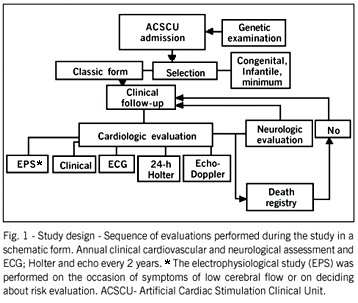
OBJECTIVE: To study the prevalence and natural evolution of arrhythmic events and conduction disturbances in myotonic dystrophy; to correlate the genetic defect with cardiovascular findings; to assess cardiac mortality, frequency, and predictive factors of sudden death; to correlate the severity of the neuromuscular and cardiac involvement; and to define the role of the electrophysiological study (EPS), in myotonic dystrophy. METHODS: Periodic clinical assessment and the following tests were performed in 83 consecutive patients with a mean follow-up of 42±30.63 months: complementary examinations, genetic tests, electrocardiography, echocardiography, and Holter; electrophysiological study was performed in 59 cases. RESULTS: Atrial tachyarrhythmia was observed in 10 (12%) patients, NSVT in 14 (17%), first-degree AVB in 24 (29%), LBBB in 19 (23%), and RBBB in 13 (16%). Symptoms, an increase in the PR interval, QRS enlargement, LVEF 70 ms in 34% and > 100 ms in 11% (postprocainamide). CONCLUSION: The prevalence of arrhythmic events and conduction disturbances ranged from 50% to 80% after 6 years, and did not correlate with the genetic defect. Atrial flutter was the most common sustained arrhythmia. Cardiac involvement increased as the neuromuscular disease became aggravated, but progression of the cardiac involvement was more rapid than that of the neuromuscular disease. Overall mortality was low (11%) and sudden death occurred in half of the cases. The EPS identified a group at risk for pacemaker implantation.

  • Arrhythmias
  • cardiac conduction system
  • Mortality
  • myotonic dystrophy
Read Full Article
Creative Commons Attribution (CC BY) Creative Commons license
03/05/2005 DOI: 10.1590/S0066-782X2005000400011 Views 1

How to cite this article

EndNote RIS

Electronic Document Format (Vancouver)

Fregonezi G, Araújo T, Dourado Junior ME, Ferezini J, Silva E, Resqueti V. Heart rate variability in Myotonic Dystrophy type 1 patients. Arquivos Brasileiros de Cardiologia 2012;98(4):353-61.

Electronic Document Format (ABNT)

Fregonezi, Guilherme; Araújo, Thaise; Dourado Junior, Mario Emilio; Ferezini, Joceline; Silva, Ester; Resqueti, Vanessa. Heart rate variability in Myotonic Dystrophy type 1 patients. Arquivos Brasileiros de Cardiologia, v. 98, n. 4, p. 353-361, Mar. 2012.

Electronic Document Format (APA)

Fregonezi, G., Araújo, T., Dourado Junior, M. E., Ferezini, J., Silva, E., & Resqueti, V. (2012). Heart rate variability in Myotonic Dystrophy type 1 patients. Arquivos Brasileiros de Cardiologia, 98(4), 353-361.

Electronic Document Format (ISO)

Fregonezi, Guilherme and Araújo, Thaise and Dourado Junior, Mario Emilio and Ferezini, Joceline and Silva, Ester and Resqueti, Vanessa. Heart rate variability in Myotonic Dystrophy type 1 patients. Arquivos Brasileiros de Cardiologia [online]. 2012, vol. 98, n. 4, [cited 2026-10-14], pp. 353-361. Available from: <https://journals.cardiol.br/en/article/heart-rate-variability-in-myotonic-dystrophy-type-1-patients/>. ISSN 0066-782X

EndNote RIS

Electronic Document Format (Vancouver)

Nishioka SAD, Martinelli Filho M, Marie S, Zatz M, Costa R. Myotonic dystrophy and heart disease: behavior of arrhythmic events and conduction disturbances. Arquivos Brasileiros de Cardiologia 2005;84(4):330-6.

Electronic Document Format (ABNT)

Nishioka, Silvana Angelina D’Orio; Martinelli Filho, Martino; Marie, Suely; Zatz, Mayana; Costa, Roberto. Myotonic dystrophy and heart disease: behavior of arrhythmic events and conduction disturbances. Arquivos Brasileiros de Cardiologia, v. 84, n. 4, p. 330-336, May. 2005.

Electronic Document Format (APA)

Nishioka, S. A. D., Martinelli Filho, M., Marie, S., Zatz, M., & Costa, R. (2005). Myotonic dystrophy and heart disease: behavior of arrhythmic events and conduction disturbances. Arquivos Brasileiros de Cardiologia, 84(4), 330-336.

Electronic Document Format (ISO)

Nishioka, Silvana Angelina D’Orio and Martinelli Filho, Martino and Marie, Suely and Zatz, Mayana and Costa, Roberto. Myotonic dystrophy and heart disease: behavior of arrhythmic events and conduction disturbances. Arquivos Brasileiros de Cardiologia [online]. 2005, vol. 84, n. 4, [cited 2026-10-14], pp. 330-336. Available from: <https://journals.cardiol.br/en/article/myotonic-dystrophy-and-heart-disease-behavior-of-arrhythmic-events-and-conduction-disturbances/>. ISSN 0066-782X

  • About ABC Family
  • Internal Regulation
  • Editorial Board
  • Brazilian Society of Cardiology (SBC)

Issues

SBC Guidelines

  • Videos
  • Podcasts
  • News