ABC Family Arquivos Brasileiros de Cardiologia International Journal of Cardiovascular Sciences ABC Heart Failure & Cardiomyopathy ABC Imagem Cardiovascular
Português English
ABC Family
Português English
  • About
    • About ABC Family
    • Internal Regulation
    • Editorial Board
    • Brazilian Society of Cardiology (SBC)
  • Issues
  • SBC Guidelines
  • Content
    • Videos
    • Podcasts
    • News
  • About
    • About ABC Family
    • Internal Regulation
    • Editorial Board
    • Brazilian Society of Cardiology (SBC)
  • Issues
  • SBC Guidelines
  • Content
    • Videos
    • Podcasts
    • News

ABC Family

  • ABC Family
  • Arquivos Brasileiros de Cardiologia
  • International Journal of Cardiovascular Sciences
  • ABC Heart Failure & Cardiomyopathy
  • ABC Imagem Cardiovascular
Search in

No content found.

Journals
Ordering
Article types
Others

  1. Home
  2. Keyword: Monoterpenes
Figure 1
ABC
Original Article

(-)-Carvone Modulates Intracellular Calcium Signaling with Antiarrhythmic Action in Rat Hearts

Gilmara Beatriz Andrade da Silva et al. Diego Santos Souza José Evaldo Rodrigues Menezes-Filho Júlio Alves da Silva-Neto … Jader dos Santos Cruz Danilo R. Roman-Campos Lucindo José Quintans-Júnior Carla Maria Lins de Vasconcelos

Abstract

Background:

(-)-Carvone is a monoterpene found in essential oils with antioxidant and anti-inflammatory activity.

Objective:

The aim of this paper was to analyze the antiarrhythmic property of (-)-carvone in the rat heart and its effects on the intracellular Ca2+ signaling.

Methods:

The effects of (-)-carvone were evaluated on the ventricular (0.5 mM) and atrial contractility (0.01 – 4 mM) and on electrocardiogram (0.5 mM). Fractional shortening, L-type calcium current (ICa,L) and Ca2+ signaling were measured in the isolated cardiomyocyte (0.5 mM). Antiarrhythmic effect was evaluated in arrhythmia model induced by calcium overload (0.5 mM) (n = 5). P < 0.05 was used as the significance level.

Results:

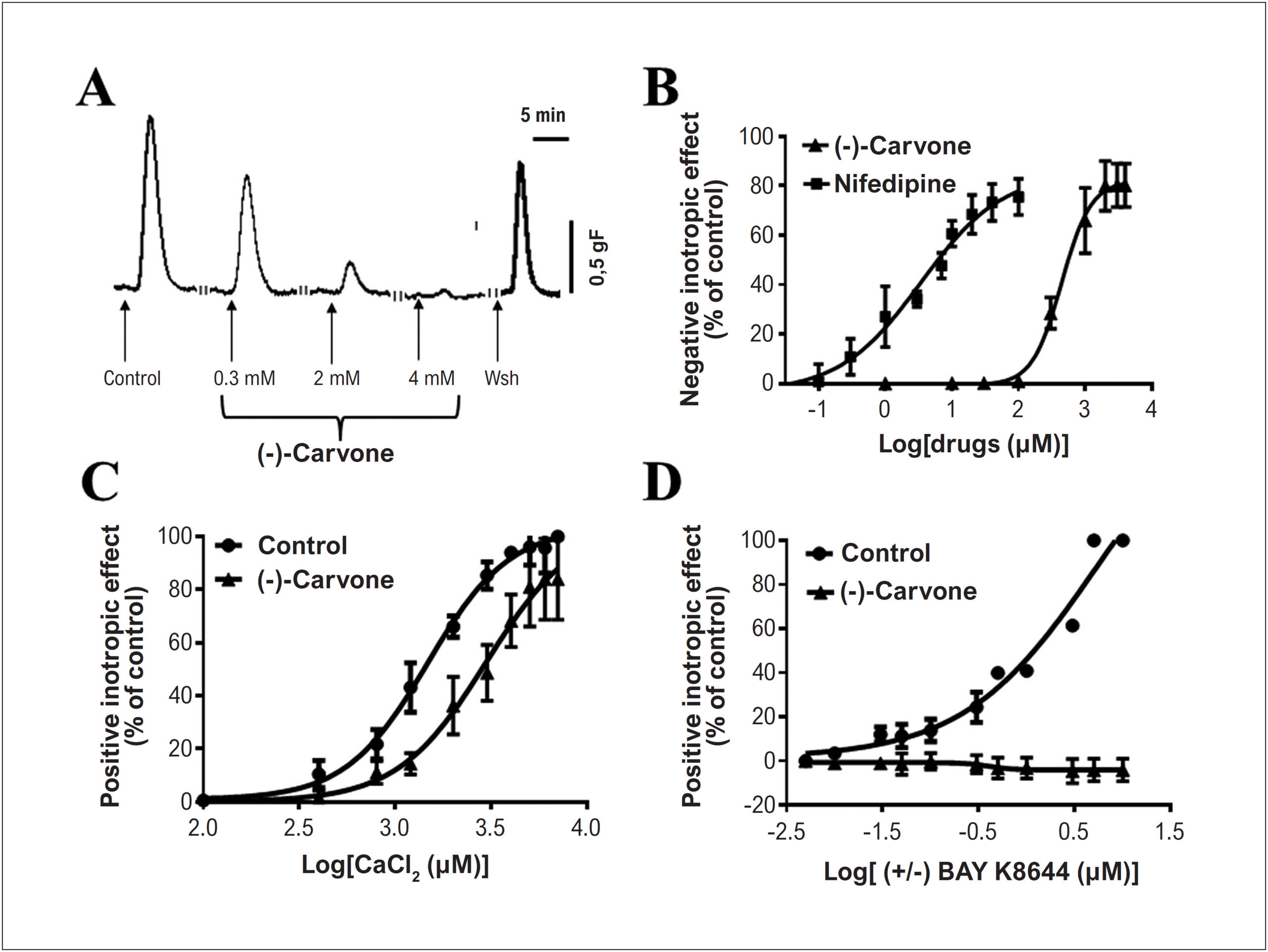
In the atrium, (-)-carvone evoked negative inotropism that was concentration-dependent (EC50 0.44 ± 0.11 mM) and decreased the positive inotropism evoked by CaCl2 (0.1 to 8.0 mM) or BAY K8644 (5 to 500 nM), an agonist of L-type Ca2+ channel. In isolated heart, (-)-carvone (0.5 mM) promoted reduction of ventricular contractility (73%) and heart rate (46%), increased PRi (30.7%, time from the onset of the P wave until the R wave) and QTc (9.2%, a measure of the depolarization and repolarization of the ventricles) without changing the QRS complex duration. (-)-Carvone decreased the fractional shortening (61%), ICa,L (79%) and Ca2+ intracellular transient (38%). Furthermore, (-)-carvone showed antiarrhythmic action, verified by decrease of the arrhythmia score (85%) and occurrence of ventricular fibrillation.

Conclusion:

(-)-Carvone decreases Ca2+ entry through L-type Ca2+ channels, reducing the cardiac contractility and intracellular Ca2+, and, therefore, presenting promising antiarrhythmic activity in the rat hearts.
  • Arrhythmias
  • cardiac
  • Monoterpenes
  • Rats
Read Full Article
Creative Commons Attribution (CC BY) Creative Commons license
05/08/2022 DOI: 10.36660/abc.20210499
ABC
Editorial

D-Limonene: A Promising Molecule with Bradycardic and Antiarrhythmic Potential

Quiara Lovatti Alves et al. Darizy Flávia Silva

It is unquestionable that cardiovascular disease (CVD) is and will continue to be one of the main health problems of modern society. A significant portion of cardiovascular disease-related deaths is a direct or indirect consequence of cardiac arrhythmias.Cardiac arrhythmias are abnormal conditions that refer to any alteration in the normal sequence of cardiac electrical impulses, which can be classified according to frequency, mechanism, duration, and place of origin, resulting in inefficient pumping. More specifically, cardiac arrhythmias indicate alterations in the rate or regularity of the heart rhythm, as well as changes in the conduction sequence of physiological electrical impulses, from their origin in the sinoatrial node to their end, in the His-Purkinje system, and the ventricles.The structural mechanisms that result in cardiac arrhythmias, as well as limitations regarding the safety and efficacy of “classic” antiarrhythmic drugs, make this disease difficult to treat.

The use of medicinal plants for the treatment, cure and prevention of diseases is one of the oldest forms of human medicinal practice. Natural medicinal plant-based products have shown to be an abundant source of biologically active compounds, many of which have been the basis for the development of new chemical products by the pharmaceutical industry.Essential oils, extracted from aromatic plants, are natural products with a variety of biological actions, including cardiovascular properties.Monoterpenes are the most representative molecules, which constitute 90% of essential oils, and also produce relevant effects on measurable cardiovascular parameters, including vasorelaxation and hypotension promotion in anesthetized and non-anesthetized rats., Additionally, monoterpenes may attenuate the development of hypertension in spontaneously hypertensive rats, by decreasing cardiac hypertrophy. Thus, it is evident that monoterpenes are molecules that could be further developed for the prevention and / or treatment of cardiovascular diseases. A study developed by our research group showed that the monoterpene carvacrol has negative chronotropic and inotropic effects on rats, whereas pulegone and geraniol have a negative inotropic effect on mammals.,

[…]

  • Arrhythmia, Agents
  • Bradycardia
  • Limoneno
  • Medicinal Plants
  • Monoterpenes
Read Full Article
Creative Commons Attribution (CC BY) Creative Commons license
02/12/2019 DOI: 10.5935/abc.20190233 Views 1
Figure 1
ABC
Original Article

Bradycardic and Antiarrhythmic Effects of the D-Limonene in Rats

Gildenisson Araújo do Nascimento et al. Diego Santos de Souza Bruno Santos Lima Carla Maria Lins de Vasconcelos … Adriano Antunes de Souza Araújo Aimée Obolari Durço Lucindo José Quintans-Junior Jackson Roberto Guedes da Silva Almeida Aldeída Pereira Oliveira Valter Joviniano de Santana-Filho André Sales Barreto Márcio Roberto Viana dos Santos

Abstract

Background:

D-limonene (DL) is a monoterpene and is the major component in the essential oil of citrus fruit. It presents antihyperglycemic and vasodilatation activities.

Objectives:

This study evaluated the cardiovascular effects and potential antiarrhythmic of DL in rats.

Methods:

Hemodynamic and electrocardiographic (ECG) parameters were measured in male Wistar rats, which under anesthesia had been cannulated in the abdominal aorta and lower vena cava and had electrodes subcutaneously implanted. In the in vitro approach, the heart was removed and perfused using the Langendorff technique. The significance level adopted was 5% (p < 0.05).

Results:

DL, in doses of 10, 20, and 40 mg/kg (i.v), produced intense and persistent bradycardia associated with hypotension. Bradycardia with prolonged QTc was observed in the ECG in vivo recording. In the in vivo model of arrhythmia induced by Bay K8644, DL (10 mg/kg) decreased the arrhythmia score from 15.33 ± 3.52 to 4.0 ± 2.64 u.a (p < 0.05, n = 4). In isolated perfused hearts, DL (10-3 M) promoted significant reductions in heart rate (from 228.6 ± 8.5 ms to 196.0 ± 9.3 bpm; p < 0.05) and left ventricular development pressure (from 25.2 ± 3.4 to 5.9 ± 1.8 mmHg; n = 5, p < 0.05).

Conclusions:

DL produces bradycardia and antiarrhythmic activity in rat heart.

  • Anti-Arrhythmia Agents
  • Antioxidants
  • Arrhythmias Cardiac
  • Bradycardia
  • Limonene
  • Monoterpenes
  • Rats
Read Full Article
Creative Commons Attribution (CC BY) Creative Commons license
02/09/2019 DOI: 10.5935/abc.20190173 Views 1

How to cite this article

EndNote RIS

Electronic Document Format (Vancouver)

Silva GBA, Souza DS, Menezes-Filho JER, Silva-Neto JA, Cruz JS, Roman-Campos DR, Quintans-Júnior LJ, et al. (-)-Carvone Modulates Intracellular Calcium Signaling with Antiarrhythmic Action in Rat Hearts. Arquivos Brasileiros de Cardiologia 2022;119(2):294-30.

Electronic Document Format (ABNT)

Silva, Gilmara Beatriz Andrade da; Souza, Diego Santos; Menezes-Filho, José Evaldo Rodrigues; Silva-Neto, Júlio Alves da; Cruz, Jader dos Santos; Roman-Campos, Danilo R.; Quintans-Júnior, Lucindo José; Vasconcelos, Carla Maria Lins de. (-)-Carvone Modulates Intracellular Calcium Signaling with Antiarrhythmic Action in Rat Hearts. Arquivos Brasileiros de Cardiologia, v. 119, n. 2, p. 294-304, Aug. 2022.

Electronic Document Format (APA)

Silva, G. B. A. , Souza, D. S., Menezes-Filho, J. E. R., Silva-Neto, J. A. , Cruz, J. S., Roman-Campos, D. R., Quintans-Júnior, L. J., & Vasconcelos, C. M. L. (2022). (-)-Carvone Modulates Intracellular Calcium Signaling with Antiarrhythmic Action in Rat Hearts. Arquivos Brasileiros de Cardiologia, 119(2), 294-304.

Electronic Document Format (ISO)

Silva, Gilmara Beatriz Andrade da and Souza, Diego Santos and Menezes-Filho, José Evaldo Rodrigues and Silva-Neto, Júlio Alves da and Cruz, Jader dos Santos and Roman-Campos, Danilo R. and Quintans-Júnior, Lucindo José and Vasconcelos, Carla Maria Lins de. (-)-Carvone Modulates Intracellular Calcium Signaling with Antiarrhythmic Action in Rat Hearts. Arquivos Brasileiros de Cardiologia [online]. 2022, vol. 119, n. 2, [cited 2026-10-14], pp. 294-304. Available from: <https://journals.cardiol.br/en/article/carvone-modulates-intracellular-calcium-signaling-with-antiarrhythmic-action-in-rat-hearts/>. ISSN 0066-782X

EndNote RIS

Electronic Document Format (Vancouver)

Alves QL, Silva DF. D-Limonene: A Promising Molecule with Bradycardic and Antiarrhythmic Potential. Arquivos Brasileiros de Cardiologia 2019;113(5):933-4.

Electronic Document Format (ABNT)

Alves, Quiara Lovatti; Silva, Darizy Flávia. D-Limonene: A Promising Molecule with Bradycardic and Antiarrhythmic Potential. Arquivos Brasileiros de Cardiologia, v. 113, n. 5, p. 933-934, Dec. 2019.

Electronic Document Format (APA)

Alves, Q. L., & Silva, D. F. (2019). D-Limonene: A Promising Molecule with Bradycardic and Antiarrhythmic Potential. Arquivos Brasileiros de Cardiologia, 113(5), 933-934.

Electronic Document Format (ISO)

Alves, Quiara Lovatti and Silva, Darizy Flávia. D-Limonene: A Promising Molecule with Bradycardic and Antiarrhythmic Potential. Arquivos Brasileiros de Cardiologia [online]. 2019, vol. 113, n. 5, [cited 2026-10-14], pp. 933-934. Available from: <https://journals.cardiol.br/en/article/d-limonene-a-promising-molecule-with-bradycardic-and-antiarrhythmic-potential/>. ISSN 0066-782X

EndNote RIS

Electronic Document Format (Vancouver)

Nascimento GA, Souza DS, Lima BS, Vasconcelos CML, Araújo AAS, Durço AO, Quintans-Junior LJ, et al. Bradycardic and Antiarrhythmic Effects of the D-Limonene in Rats. Arquivos Brasileiros de Cardiologia 2019;113(5):925-32.

Electronic Document Format (ABNT)

Nascimento, Gildenisson Araújo do; Souza, Diego Santos de; Lima, Bruno Santos; Vasconcelos, Carla Maria Lins de; Araújo, Adriano Antunes de Souza; Durço, Aimée Obolari; Quintans-Junior, Lucindo José; Almeida, Jackson Roberto Guedes da Silva; Oliveira, Aldeída Pereira; Santana-Filho, Valter Joviniano de; Barreto, André Sales; Santos, Márcio Roberto Viana dos. Bradycardic and Antiarrhythmic Effects of the D-Limonene in Rats. Arquivos Brasileiros de Cardiologia, v. 113, n. 5, p. 925-932, Sep. 2019.

Electronic Document Format (APA)

Nascimento, G. A. , Souza, D. S. , Lima, B. S., Vasconcelos, C. M. L. , Araújo, A. A. S., Durço, A. O., Quintans-Junior, L. J., Almeida, J. R. G. S., Oliveira, A. P., Santana-Filho, V. J. , Barreto, A. S., & Santos, M. R. V. (2019). Bradycardic and Antiarrhythmic Effects of the D-Limonene in Rats. Arquivos Brasileiros de Cardiologia, 113(5), 925-932.

Electronic Document Format (ISO)

Nascimento, Gildenisson Araújo do and Souza, Diego Santos de and Lima, Bruno Santos and Vasconcelos, Carla Maria Lins de and Araújo, Adriano Antunes de Souza and Durço, Aimée Obolari and Quintans-Junior, Lucindo José and Almeida, Jackson Roberto Guedes da Silva and Oliveira, Aldeída Pereira and Santana-Filho, Valter Joviniano de and Barreto, André Sales and Santos, Márcio Roberto Viana dos. Bradycardic and Antiarrhythmic Effects of the D-Limonene in Rats. Arquivos Brasileiros de Cardiologia [online]. 2019, vol. 113, n. 5, [cited 2026-10-14], pp. 925-932. Available from: <https://journals.cardiol.br/en/article/bradycardic-and-antiarrhythmic-effects-of-the-d-limonene-in-rats/>. ISSN 0066-782X

  • About ABC Family
  • Internal Regulation
  • Editorial Board
  • Brazilian Society of Cardiology (SBC)

Issues

SBC Guidelines

  • Videos
  • Podcasts
  • News