ABC Family Arquivos Brasileiros de Cardiologia International Journal of Cardiovascular Sciences ABC Heart Failure & Cardiomyopathy ABC Imagem Cardiovascular
Português English
ABC Family
Português English
  • About
    • About ABC Family
    • Internal Regulation
    • Editorial Board
    • Brazilian Society of Cardiology (SBC)
  • Issues
  • SBC Guidelines
  • Content
    • Videos
    • Podcasts
    • News
  • About
    • About ABC Family
    • Internal Regulation
    • Editorial Board
    • Brazilian Society of Cardiology (SBC)
  • Issues
  • SBC Guidelines
  • Content
    • Videos
    • Podcasts
    • News

ABC Family

  • ABC Family
  • Arquivos Brasileiros de Cardiologia
  • International Journal of Cardiovascular Sciences
  • ABC Heart Failure & Cardiomyopathy
  • ABC Imagem Cardiovascular
Search in

No content found.

Journals
Ordering
Article types
Others

  1. Home
  2. Keyword: Hospital Rapid Response Team
Prospective Longitudinal Study on Mortality and Quality of Care for Ward Patients Following Rapid Response Team Implementation in Brazil
IJCS
Original Article

Prospective Longitudinal Study on Mortality and Quality of Care for Ward Patients Following Rapid Response Team Implementation in Brazil

Fernanda Aburesi Salvadori et al. Renata Kobayasi Maria Beatriz Perondi Edison Ferreira de Paiva

Abstract

Background:

A Rapid Response Team (RRT) is a multidisciplinary team trained to assist hospitalized patients experiencing cardiac arrest (CA) or sudden clinical deterioration. Its effectiveness, however, remains debatable.

Objectives:

This study aimed to characterize the changes that occurred in a quaternary, highly complex hospital following the adoption of the RRT and to ascertain whether its implementation was associated with a decline in the mortality rates of patients admitted to wards.

Methods:

This was a prospective observational study conducted from April 1st, 2014, to December 31, 2019. The study compared patient mortality and clinical outcomes after the implementation of the RRT, focusing on the frequency and outcomes of “code blue” (CA) and “code yellow” (other types of clinical deterioration) calls. Pearson’s chi-squared test (χ²) was employed to compare categorical variables, while the Student’s t-test was utilized to compare continuous variables for independent samples. P-values < 0.05 were considered statistically significant.

Results:

The team responded to a total of 2,194 inpatient calls, 495 for code blue and 1,699 for code yellow. In the years following the team’s implementation, the number of deaths and code blue calls decreased, while the number of code yellow and total RRT calls increased. When comparing the first and second three-year terms, there were no significant differences regarding code blue mortality (276/293 [94.2%] vs. 184/200 [92%], p = 0.338). Still, survival rates for patients assisted during code yellow calls increased (348/609 [57.1%] vs. 648/1,005 [64.5%], p = 0.003). This improvement in code yellow outcomes was associated with a reduction in the overall ward mortality rate (1,078/96,866 [1.1%] vs. 788/85,019 [0.9%], p < 0.001).

Conclusion:

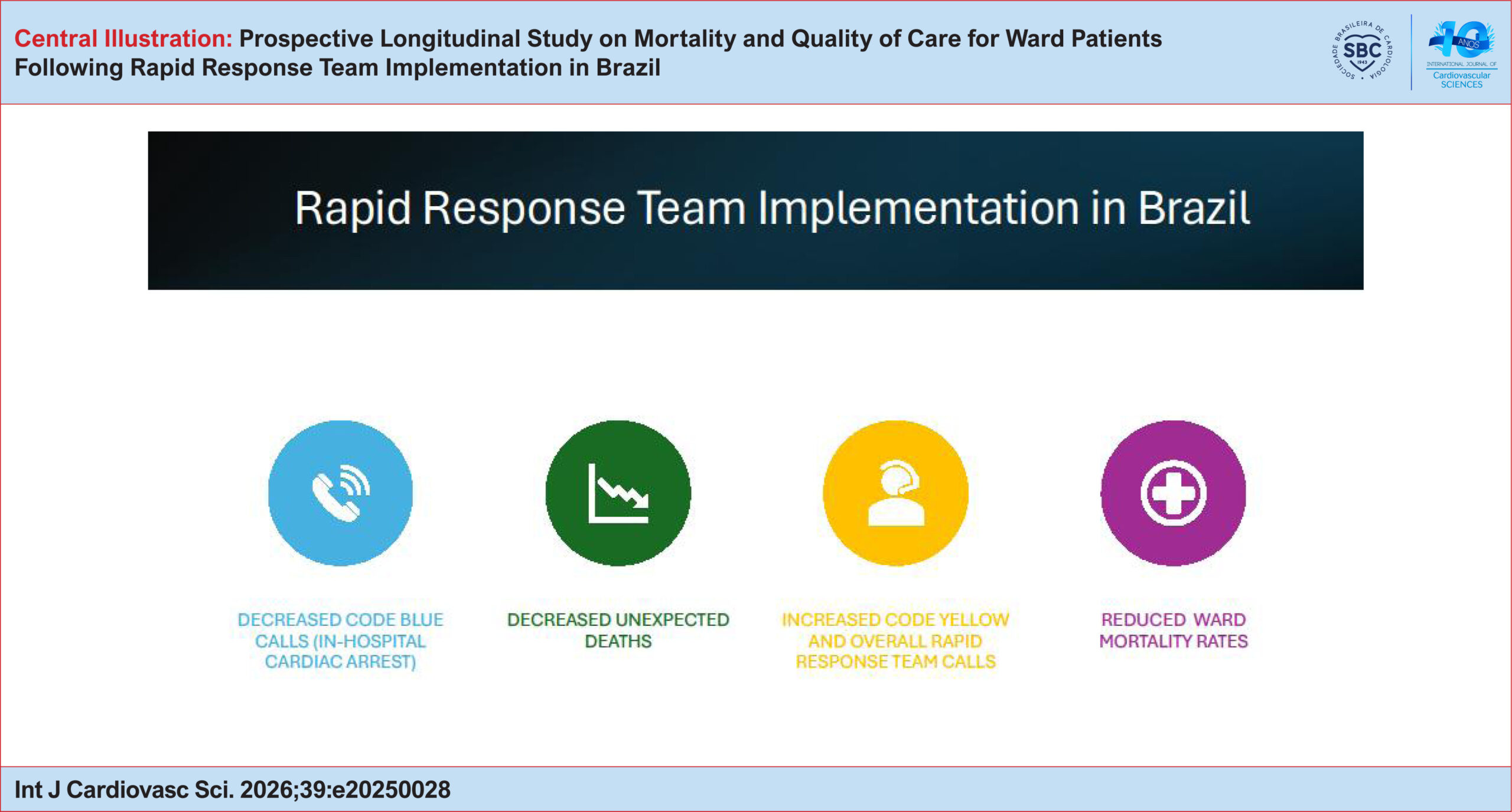
The implementation of the RRT was associated with a decrease in the number of in-hospital CA and unexpected deaths over six years, as well as an increase in the number of code yellow and overall RRT calls. Overall ward mortality also declined.

  • Cardiopulmonary Resuscitation
  • Heart Arrest
  • Hospital Care
  • Hospital Rapid Response Team
  • Quality of Health Care
Read Full Article
Creative Commons Attribution (CC BY) Creative Commons license
13/03/2026 DOI: 10.36660/ijcs.20250028 Views 2
IJCS
Letter to the Editor

Effectiveness of Rapid Response Teams and the Importance of Preprints

Hermano Alexandre Lima Rocha et al. Sabrina Gabriele Maia Oliveira Rocha Antônia Célia de Castro Alcântara

To the Editor of the International Journal of Cardiovascular Sciences,

We have read with interest the Point of View: “Performance of the Rapid Response Systems in Health Care Improvement: Benefits and Perspectives” by Viviane Cordeiro Veiga and Salomón Soriano Ordinola Rojas, published ahead of print in the International Journal of Cardiovascular Sciences on April 15, 2019. Rapid response teams to treat trauma patients in Australia 30 years ago, in 1989. From the outset, the aim was to early recognize signs of deterioration and provide a quick response, hence the name of the methodology. The discussion about the activation criteria is relevant and up to date and was treated in a solid manner by the authors in the introduction of the point of view. Indeed, it is known that this is the cause of part of the heterogeneity of results found in studies on the subject.

[…]

  • Hospital Mortality
  • Hospital Rapid Response Team
  • Patient Care Team
  • Patient Safety
Read Full Article
Creative Commons Attribution (CC BY) Creative Commons license
25/11/2020 DOI: 10.36660/ijcs.20190084
IJCS
Viewpoint

Performance of the Rapid Response Systems in Health Care Improvement: Benefits and Perspectives

Viviane Cordeiro Veiga et al. Salomón Soriano Ordinola Rojas

Introduction

In the last two decades, the rapid response systems (RRS) have been explored as initiatives to increase the safety of hospitalized patients. The main function is to identify and treat patients at risk, or who are presenting signs of clinical instability, and to prevent adverse events during hospital stay, with a consequent reduction in in-hospital mortality. Every year in the United States, more than 200,000 intrahospital cardiac arrests (CAs) occur, most of which could be avoided. RRS are formed by two health care components called the afferent limb and the efferent limb. The afferent limb is represented by the health care team in the admission units, responsible for the care of hospitalized patients and trained to activate the afferent limb, when physiological changes that predict adverse events are detected, especially cardiac arrests. The efferent limb is represented by a team of health care professionals, who respond to codes, and may be headed by a physician, a nurse or a physiotherapist. The efferent limb is better known as the rapid response team (RRT). In addition to these health care components, the rapid response systems must also have two other components, namely the administrative arm, which provides the necessary documentation and is responsible for the systems daily activities and the quality and governance arm, which contributes to continuous improvement and reassessment of the system. These systems have been implemented around the globe, but still in a non-uniform way in institutions and health systems with different characteristics. However, in Brazil, there are few reports on this issue.,

[…]

  • Hospital Mortality
  • Hospital Rapid Response Team
  • Patient Care Team
  • Patient Safety
Read Full Article
Creative Commons Attribution (CC BY) Creative Commons license
15/04/2019 DOI: 10.5935/2359-4802.20180101 Views 2

How to cite this article

EndNote RIS

Electronic Document Format (Vancouver)

Salvadori FA, Kobayasi R, Perondi MB, Paiva EF. Prospective Longitudinal Study on Mortality and Quality of Care for Ward Patients Following Rapid Response Team Implementation in Brazil. International Journal of Cardiovascular Sciences 2026;39:e20250028.

Electronic Document Format (ABNT)

Salvadori, Fernanda Aburesi; Kobayasi, Renata; Perondi, Maria Beatriz; Paiva, Edison Ferreira de. Prospective Longitudinal Study on Mortality and Quality of Care for Ward Patients Following Rapid Response Team Implementation in Brazil. International Journal of Cardiovascular Sciences, v. 39, e20250028, Mar. 2026.

Electronic Document Format (APA)

Salvadori, F. A., Kobayasi, R., Perondi, M. B., & Paiva, E. F. (2026). Prospective Longitudinal Study on Mortality and Quality of Care for Ward Patients Following Rapid Response Team Implementation in Brazil. International Journal of Cardiovascular Sciences, 39, e20250028.

Electronic Document Format (ISO)

Salvadori, Fernanda Aburesi and Kobayasi, Renata and Perondi, Maria Beatriz and Paiva, Edison Ferreira de. Prospective Longitudinal Study on Mortality and Quality of Care for Ward Patients Following Rapid Response Team Implementation in Brazil. International Journal of Cardiovascular Sciences [online]. 2026, vol. 39, [cited 2026-10-14], e20250028. Available from: <https://journals.cardiol.br/en/article/prospective-longitudinal-study-on-mortality-and-quality-of-care-for-ward-patients-following-rapid-response-team-implementation-in-brazil/>. ISSN 2359-4802

EndNote RIS

Electronic Document Format (Vancouver)

Rocha HAL, Rocha SGMO, Alcântara ACC. Effectiveness of Rapid Response Teams and the Importance of Preprints. International Journal of Cardiovascular Sciences 2020;33(6):721-2.

Electronic Document Format (ABNT)

Rocha, Hermano Alexandre Lima; Rocha, Sabrina Gabriele Maia Oliveira; Alcântara, Antônia Célia de Castro. Effectiveness of Rapid Response Teams and the Importance of Preprints. International Journal of Cardiovascular Sciences, v. 33, n. 6, p. 721-722, Nov. 2020.

Electronic Document Format (APA)

Rocha, H. A. L., Rocha, S. G. M. O., & Alcântara, A. C. C. (2020). Effectiveness of Rapid Response Teams and the Importance of Preprints. International Journal of Cardiovascular Sciences, 33(6), 721-722.

Electronic Document Format (ISO)

Rocha, Hermano Alexandre Lima and Rocha, Sabrina Gabriele Maia Oliveira and Alcântara, Antônia Célia de Castro. Effectiveness of Rapid Response Teams and the Importance of Preprints. International Journal of Cardiovascular Sciences [online]. 2020, vol. 33, n. 6, [cited 2026-10-14], pp. 721-722. Available from: <https://journals.cardiol.br/en/article/effectiveness-of-rapid-response-teams-and-the-importance-of-preprints/>. ISSN 2359-4802

EndNote RIS

Electronic Document Format (Vancouver)

Veiga VC, Rojas SSO. Performance of the Rapid Response Systems in Health Care Improvement: Benefits and Perspectives. International Journal of Cardiovascular Sciences 2019;32(5):536-9.

Electronic Document Format (ABNT)

Veiga, Viviane Cordeiro; Rojas, Salomón Soriano Ordinola. Performance of the Rapid Response Systems in Health Care Improvement: Benefits and Perspectives. International Journal of Cardiovascular Sciences, v. 32, n. 5, p. 536-539, Apr. 2019.

Electronic Document Format (APA)

Veiga, V. C., & Rojas, S. S. O. (2019). Performance of the Rapid Response Systems in Health Care Improvement: Benefits and Perspectives. International Journal of Cardiovascular Sciences, 32(5), 536-539.

Electronic Document Format (ISO)

Veiga, Viviane Cordeiro and Rojas, Salomón Soriano Ordinola. Performance of the Rapid Response Systems in Health Care Improvement: Benefits and Perspectives. International Journal of Cardiovascular Sciences [online]. 2019, vol. 32, n. 5, [cited 2026-10-14], pp. 536-539. Available from: <https://journals.cardiol.br/en/article/performance-of-the-rapid-response-systems-in-health-care-improvement-benefits-and-perspectives/>. ISSN 2359-4802

  • About ABC Family
  • Internal Regulation
  • Editorial Board
  • Brazilian Society of Cardiology (SBC)

Issues

SBC Guidelines

  • Videos
  • Podcasts
  • News