ABC Family Arquivos Brasileiros de Cardiologia International Journal of Cardiovascular Sciences ABC Heart Failure & Cardiomyopathy ABC Imagem Cardiovascular
Português English
ABC Family
Português English
  • About
    • About ABC Family
    • Internal Regulation
    • Editorial Board
    • Brazilian Society of Cardiology (SBC)
  • Issues
  • SBC Guidelines
  • Content
    • Videos
    • Podcasts
    • News
  • About
    • About ABC Family
    • Internal Regulation
    • Editorial Board
    • Brazilian Society of Cardiology (SBC)
  • Issues
  • SBC Guidelines
  • Content
    • Videos
    • Podcasts
    • News

ABC Family

  • ABC Family
  • Arquivos Brasileiros de Cardiologia
  • International Journal of Cardiovascular Sciences
  • ABC Heart Failure & Cardiomyopathy
  • ABC Imagem Cardiovascular
Search in

No content found.

Journals
Ordering
Article types
Others

  1. Home
  2. Keyword: Health Literacy
Association Between Functional Health Literacy and the Quality of Oral Anticogulation
IJCS
Original Article

Association Between Functional Health Literacy and the Quality of Oral Anticogulation

Gustavo Chaves de Souza et al. Josiane Moreira da Costa Mayara Cristina Oliveira Ortiz Philipe Dias de Avila Lima … Pollyanna Evelyn de Freitas Nogueira Carla Jorge Machado Maria Auxiliadora Parreiras Martins

Abstract

Background:

Low functional health literacy in anticoagulated patients using warfarin has been widely discussed in medical literature.

Objective:

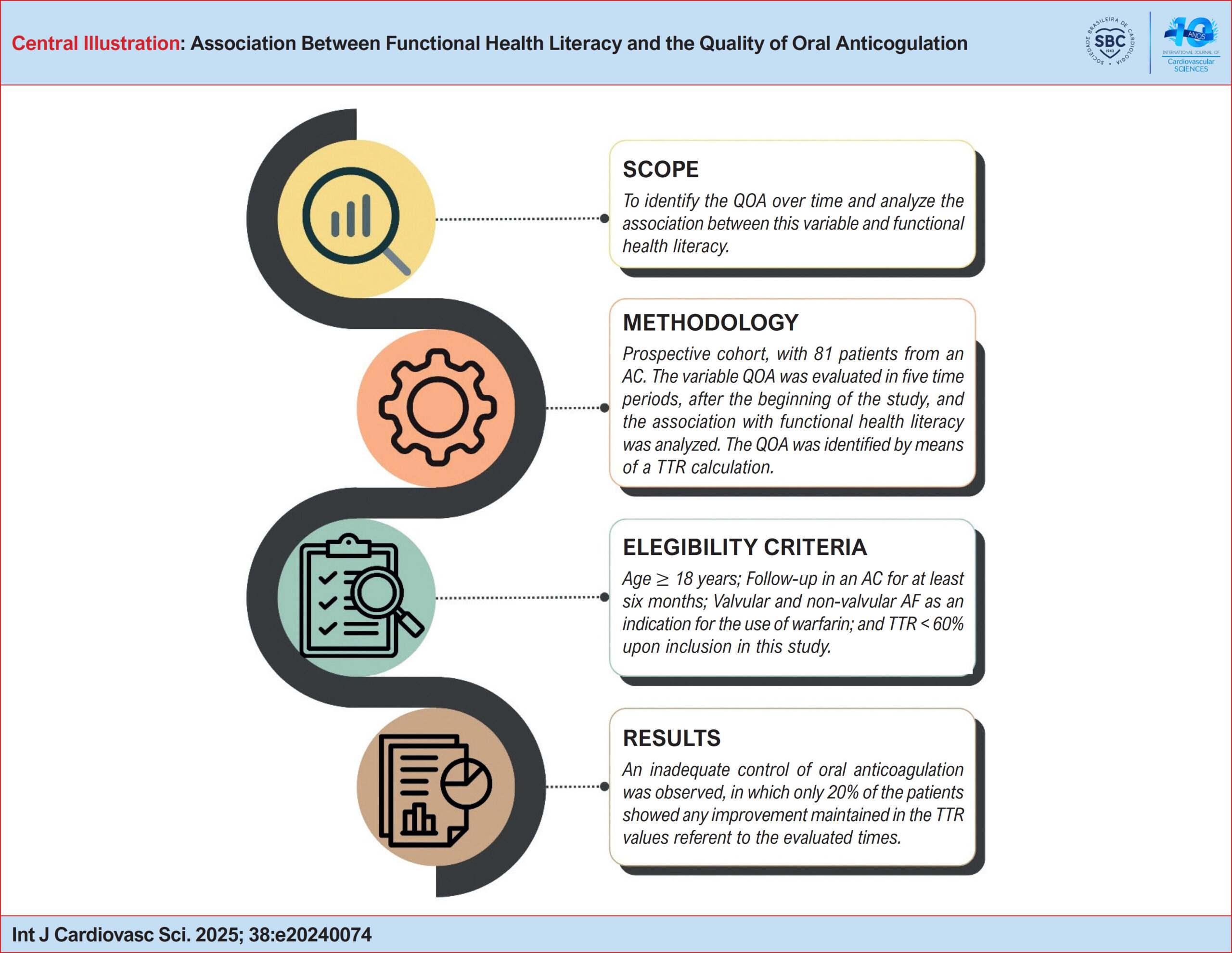
To identify the quality of oral anticoagulation (QOA) over time and to analyze the association between this variable and functional health literacy.

Methods:

Prospective cohort study conducted at an anticoagulation clinic (AC) in Minas Gerais, in a high-complexity hospital. The study included 81 patients, whose data were collected by direct consultation of medical records or by asking questions while patients were waiting for care. The QOA was assessed at 6, 9, 12, 15, and 18 months after the beginning of this study, and analyses of the association between this variable and functional health literacy were performed at the different time points. The QOA was identified by calculating the Therapeutic Time Range (TTR), with good quality being obtained with TTR values >59%. The incidence analysis of the TTR was performed for each of the five time points of the study through univariate Poisson regression. The significance level adopted in the statistical analysis was 5%.

Results:

Throughout the study, inadequate control of oral anticoagulation was observed, with only 20% of the patients showing persistent improvement in TTR values. No statistically significant association was identified at the different measurement times between TTR and functional health literacy.

Conclusion:

There was no direct association between the QOA and functional health literacy. However, the low incidence of persistent quality of anticoagulation in patients with low literacy suggests the development of specific educational actions for this subgroup of patients.
  • Anticoagulants
  • Health Care Evaluation Mechanisms
  • Health Literacy
  • Warfarin
Read Full Article
Creative Commons Attribution (CC BY) Creative Commons license
28/04/2025 DOI: 10.36660/ijcs.20240074 Views 1
IJCS
Original Article

Health Literacy, Patient Knowledge and Adherence to Oral Anticoagulation in Primary Care

Milena Soriano Marcolino et al. Thaís Lorenna Souza Sales João Antônio de Oliveira Danyelle Romana Alves Rios … Thaís Marques Pedroso Laura Caetano de Sá Maria Auxiliadora Martins Antonio Luiz Pinho Ribeiro

Abstract

Background

Warfarin is the only oral anticoagulant available in the Brazilian public health system. Health knowledge and treatment are essential to achieving the desirable therapeutic effect. However, data on these aspects among primary care patients are still lacking.

Objective

To assess health literacy, patient knowledge, and adherence to oral anticoagulation with warfarin, as well as the medication regimen complexity in primary health units in the municipality of Divinópolis, Minas Gerais, Brazil.

Methods

This cross-sectional study included patients using warfarin from primary care settings. Sociodemographic and clinical data were collected from medical records. Short Assessment of Health Literacy for Portuguese-Speaking Adults (SAHLPA-18), Oral Anticoagulation Knowledge (OAK), adaptation of the Measure of Adherence to Treatment (MAT-adapted) to oral anticoagulation, and Medication Regimen Complexity Index (MRCI) were applied, and the time in therapeutic range (TTR) was calculated. Patients were stratified in two groups (TTR < 60% and TTR ≥ 60%) and compared using Fisher's exact test at a significance level of p < 0.050.

Results

Analysis included 162 patients (64.8 ± 12.7 years old, 55.6% women). Nonvalvular atrial fibrillation (26.5%) and venous thromboembolism (24.1%) were the main indications for warfarin, and 67.9%, 88.3%, and 16.7% of the patients had inadequate health literacy, insufficient knowledge regarding anticoagulant therapy, and non-adherence to warfarin therapy, respectively. There was no significant association of these parameters in relation to TTR. MRCI showed high pharmacotherapy complexity between the drug prescriptions.

Conclusion

This study showed alarming insufficient knowledge about warfarin therapy and low health literacy in primary care patients.

  • Anticoagulants
  • Cardiovascular Diseases
  • Health Literacy
  • Primary Health Care
  • Warfarin
Read Full Article
Creative Commons Attribution (CC BY) Creative Commons license
25/08/2023 DOI: 10.36660/ijcs.20220158 Views 1
Figure 1
ABC
Original Article

Perceptions of Cardiac Rehabilitation Participants Regarding their Health Behaviors and Information Needs during the COVID-19 Pandemic in Brazil

Gabriela L.M Ghisi et al. Rafaella Z. Santos Andrea S. Korbes Cícero Augusto de Souza … Marlus Karsten Paul Oh Magnus Benetti

Abstract

Background

COVID-19 has impacted how people receive health care for many conditions, including cardiovascular diseases.

Objectives

To examine perceptions of cardiac rehabilitation (CR) participants regarding their health behaviors and information needs during the COVID-19 pandemic in Brazil.

Methods

In this cross-sectional study, a 27-item questionnaire, developed by the investigators, was administered online to participants from two CR programs. Questions included health literacy (HL; using the Brief Health Literacy Screening Tool), technology use, perceptions before and during the COVID-19 pandemic, and information needs. Pearson correlation coefficients, paired t-tests, and ANOVA were used as appropriate. P < 0.05 was considered statistically significant for all tests.

Results

Overall, 159 (25.5%) CR participants answered the questionnaire. Of these, 89.9% had limited or marginal HL and 96.2% reported having internet access at home. Patients are mainly concerned about their family’s health and their own, as well as how the coronavirus is dangerous to their health and how it has changed their lifestyle. Participants perceived that the quality of their health behaviors significantly decreased during the pandemic. The pandemic also changed information needs of CR participants as new needs emerged, such as the control of anxiety levels, staying motivated to live healthily during a pandemic, and how COVID-19 can impact their health condition. Participants with adequate HL significantly perceived the severity of the disease and having access to information significantly more than those with limited HL.

Conclusions

Our results highlighted the impact of the pandemic on CR participants’ perceptions regarding their health behaviors and information needs, which can be influenced by HL levels.

  • Cardiac Rehabilitation
  • COVID-19
  • Health Literacy
  • Needs Assessment
  • Surveys and Questionnaires
Read Full Article
Creative Commons Attribution (CC BY) Creative Commons license
04/04/2022 DOI: 10.36660/abc.20210447

How to cite this article

EndNote RIS

Electronic Document Format (Vancouver)

Souza GC, Costa JM, Ortiz MCO, Lima PDA, Nogueira PEF, Machado CJ, Martins MAP, et al. Association Between Functional Health Literacy and the Quality of Oral Anticogulation. International Journal of Cardiovascular Sciences 2025;38:e20240074.

Electronic Document Format (ABNT)

Souza, Gustavo Chaves de; Costa, Josiane Moreira da; Ortiz, Mayara Cristina Oliveira; Lima, Philipe Dias de Avila; Nogueira, Pollyanna Evelyn de Freitas; Machado, Carla Jorge; Martins, Maria Auxiliadora Parreiras. Association Between Functional Health Literacy and the Quality of Oral Anticogulation. International Journal of Cardiovascular Sciences, v. 38, e20240074, Apr. 2025.

Electronic Document Format (APA)

Souza, G. C. , Costa, J. M. , Ortiz, M. C. O., Lima, P. D. A., Nogueira, P. E. F., Machado, C. J., & Martins, M. A. P. (2025). Association Between Functional Health Literacy and the Quality of Oral Anticogulation. International Journal of Cardiovascular Sciences, 38, e20240074.

Electronic Document Format (ISO)

Souza, Gustavo Chaves de and Costa, Josiane Moreira da and Ortiz, Mayara Cristina Oliveira and Lima, Philipe Dias de Avila and Nogueira, Pollyanna Evelyn de Freitas and Machado, Carla Jorge and Martins, Maria Auxiliadora Parreiras. Association Between Functional Health Literacy and the Quality of Oral Anticogulation. International Journal of Cardiovascular Sciences [online]. 2025, vol. 38, [cited 2026-10-14], e20240074. Available from: <https://journals.cardiol.br/en/article/association-between-functional-health-literacy-and-the-quality-of-oral-anticogulation/>. ISSN 2359-4802

EndNote RIS

Electronic Document Format (Vancouver)

Marcolino MS, Sales TLS, Oliveira JA, Rios DRA, Pedroso TM, Sá LC, Martins MA, et al. Health Literacy, Patient Knowledge and Adherence to Oral Anticoagulation in Primary Care. International Journal of Cardiovascular Sciences 2023;36:e20220158.

Electronic Document Format (ABNT)

Marcolino, Milena Soriano; Sales, Thaís Lorenna Souza; Oliveira, João Antônio de; Rios, Danyelle Romana Alves; Pedroso, Thaís Marques; Sá, Laura Caetano de; Martins, Maria Auxiliadora; Ribeiro, Antonio Luiz Pinho. Health Literacy, Patient Knowledge and Adherence to Oral Anticoagulation in Primary Care. International Journal of Cardiovascular Sciences, v. 36, e20220158, Aug. 2023.

Electronic Document Format (APA)

Marcolino, M. S., Sales, T. L. S., Oliveira, J. A. , Rios, D. R. A., Pedroso, T. M., Sá, L. C. , Martins, M. A., & Ribeiro, A. L. P. (2023). Health Literacy, Patient Knowledge and Adherence to Oral Anticoagulation in Primary Care. International Journal of Cardiovascular Sciences, 36, e20220158.

Electronic Document Format (ISO)

Marcolino, Milena Soriano and Sales, Thaís Lorenna Souza and Oliveira, João Antônio de and Rios, Danyelle Romana Alves and Pedroso, Thaís Marques and Sá, Laura Caetano de and Martins, Maria Auxiliadora and Ribeiro, Antonio Luiz Pinho. Health Literacy, Patient Knowledge and Adherence to Oral Anticoagulation in Primary Care. International Journal of Cardiovascular Sciences [online]. 2023, vol. 36, [cited 2026-10-14], e20220158. Available from: <https://journals.cardiol.br/en/article/health-literacy-patient-knowledge-and-adherence-to-oral-anticoagulation-in-primary-care/>. ISSN 2359-4802

EndNote RIS

Electronic Document Format (Vancouver)

Ghisi GL, Santos RZ, Korbes AS, Souza CA, Karsten M, Oh P, Benetti M, et al. Perceptions of Cardiac Rehabilitation Participants Regarding their Health Behaviors and Information Needs during the COVID-19 Pandemic in Brazil. Arquivos Brasileiros de Cardiologia 2022;118(5):949-60.

Electronic Document Format (ABNT)

Ghisi, Gabriela L.M; Santos, Rafaella Z.; Korbes, Andrea S.; Souza, Cícero Augusto de; Karsten, Marlus; Oh, Paul; Benetti, Magnus. Perceptions of Cardiac Rehabilitation Participants Regarding their Health Behaviors and Information Needs during the COVID-19 Pandemic in Brazil. Arquivos Brasileiros de Cardiologia, v. 118, n. 5, p. 949-960, Apr. 2022.

Electronic Document Format (APA)

Ghisi, G. L., Santos, R. Z., Korbes, A. S., Souza, C. A. , Karsten, M., Oh, P., & Benetti, M. (2022). Perceptions of Cardiac Rehabilitation Participants Regarding their Health Behaviors and Information Needs during the COVID-19 Pandemic in Brazil. Arquivos Brasileiros de Cardiologia, 118(5), 949-960.

Electronic Document Format (ISO)

Ghisi, Gabriela L.M and Santos, Rafaella Z. and Korbes, Andrea S. and Souza, Cícero Augusto de and Karsten, Marlus and Oh, Paul and Benetti, Magnus. Perceptions of Cardiac Rehabilitation Participants Regarding their Health Behaviors and Information Needs during the COVID-19 Pandemic in Brazil. Arquivos Brasileiros de Cardiologia [online]. 2022, vol. 118, n. 5, [cited 2026-10-14], pp. 949-960. Available from: <https://journals.cardiol.br/en/article/perceptions-of-cardiac-rehabilitation-participants-regarding-their-health-behaviors-and-information-needs-during-the-covid-19-pandemic-in-brazil/>. ISSN 0066-782X

  • About ABC Family
  • Internal Regulation
  • Editorial Board
  • Brazilian Society of Cardiology (SBC)

Issues

SBC Guidelines

  • Videos
  • Podcasts
  • News