ABC Family Arquivos Brasileiros de Cardiologia International Journal of Cardiovascular Sciences ABC Heart Failure & Cardiomyopathy ABC Imagem Cardiovascular
Português English
ABC Family
Português English
  • About
    • About ABC Family
    • Internal Regulation
    • Editorial Board
    • Brazilian Society of Cardiology (SBC)
  • Issues
  • SBC Guidelines
  • Content
    • Videos
    • Podcasts
    • News
  • About
    • About ABC Family
    • Internal Regulation
    • Editorial Board
    • Brazilian Society of Cardiology (SBC)
  • Issues
  • SBC Guidelines
  • Content
    • Videos
    • Podcasts
    • News

ABC Family

  • ABC Family
  • Arquivos Brasileiros de Cardiologia
  • International Journal of Cardiovascular Sciences
  • ABC Heart Failure & Cardiomyopathy
  • ABC Imagem Cardiovascular
Search in

No content found.

Journals
Ordering
Article types
Others

  1. Home
  2. Keyword: Extracellular Matrix
ABC
Editorial

Challenges and Perspectives of Cardiac Fibrosis Biomarkers: From Diagnosis to Clinical Application

Priscila Portugal dos Santos et al. Ricardo Luiz Damatto

As reported by Cheng-Mei et al. myocardial fibrosis is present in various cardiac diseases and can negatively impact the heart. It plays a central role in cardiac dysfunction and failure across different pathologies, serving as a strong predictor of poor clinical outcomes and mortality. However, it is essential to recognize that fibrosis is a complex and heterogeneous process, which can sometimes play a beneficial role, such as after a myocardial infarction. In this context, fibrosis acts as a reparative mechanism, replacing dead cardiomyocytes with scar tissue. This initial fibrotic response is crucial to prevent cardiac rupture, a severe and often fatal complication and one of the leading causes of death in patients with acute myocardial infarction.

Cardiac fibrosis is characterized by the excessive accumulation of extracellular matrix (ECM) components, especially collagens, within the myocardium. Understanding this process involves more than just collagen quantity; the characterization of fibrosis also considers collagen quality, the ratio of different fiber types, and the degree of collagen cross-linking. Type I collagen, which predominates in cardiac and vascular ECM, contributes to tissue strength and stiffness due to its thick, dense structure. Type III collagen, being more flexible, aids in ECM compliance. Thus, myocardial elasticity is determined by the ratio of type I to type III collagen fibers., Moreover, the degree of covalent cross-linking among the constituent microfibrils is critical to collagen fiber rigidity, increasing their resistance to degradation and significantly contributing to tissue stiffening., Therefore, a comprehensive understanding of cardiac fibrosis, aimed at developing new therapies and diagnostic methods, requires evaluating collagen quantity, quality, and cross-linking levels.

[…]

  • Biomarkers
  • collagen
  • Endomyocardial Fibrosis
  • Extracellular Matrix
Read Full Article
Creative Commons Attribution (CC BY) Creative Commons license
10/02/2025 DOI: 10.36660/abc.20240735i Views 2
ABC
Letter to the Editor

Extracellular Matrix Turnover: a Balance between MMPs and their Inhibitors

Emre Yalcinkaya et al. Murat Celik Baris Bugan

To the Editor,

We read with great interest the article by Santos et al, entitled “Early Change of Extracellular Matrix and Diastolic Parameters in Metabolic Syndrome”, which was published in october of Arquivos Brasileiros de Cardiologia. The authors aimed to compare diastolic function, biomarkers representing extracellular matrix activity (MMP9 and TIMP1), inflammation and cardiac hemodynamic stress in patients with the metabolic syndrome and healthy controls. We thank authors for their excellent data and valuable study but some comments may be of beneficial.

[…]

  • Extracellular Matrix
  • matrix metalloproteinase 1
  • Matrix metalloproteinase inhibitors
  • Metabolic x Syndrome
Read Full Article
Creative Commons Attribution (CC BY) Creative Commons license
01/05/2014 DOI: 10.5935/abc.20140061 Views 1
Early change of extracellular matrix and diastolic parameters in metabolic syndrome
ABC
Artigo Original

Early change of extracellular matrix and diastolic parameters in metabolic syndrome

Angela B. S. Santos et al. Mauricio Junges Daiane Silvello Adriana Macari … Bruno S. de Araújo Beatriz G. Seligman Bruce B. Duncan Luis Eduardo P. Rohde Nadine Clausell Murilo Foppa

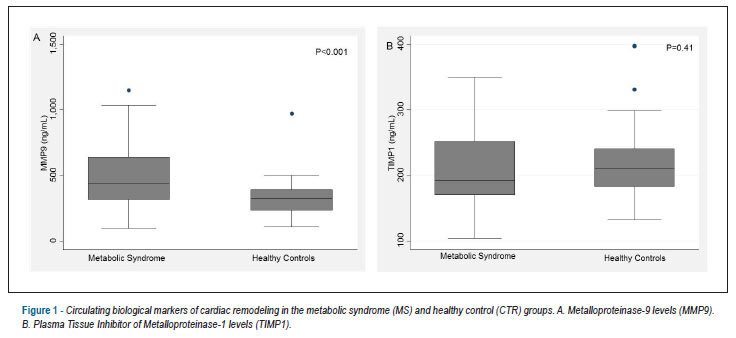
BACKGROUND: Metabolic syndrome (MS) is associated with increased cardiovascular risk. It is not clear whether myocardial changes showed in this syndrome, such as diastolic dysfunction, are due to the systemic effects of the syndrome, or to specific myocardial effects. OBJECTIVES: Compare diastolic function, biomarkers representing extracellular matrix activity (ECM), inflammation and cardiac hemodynamic stress in patients with the MS and healthy controls. METHODS: MS patients (n=76) and healthy controls (n=30) were submitted to a clinical assessment, echocardiographic study, and measurement of plasma levels of metalloproteinase-9 (MMP9), tissue inhibitor of metalloproteinase-1 (TIMP1), ultrasensitive-reactive-C-Protein (us-CRP), insulin resistance (HOMA-IR) and natriuretic peptide (NT-proBNP). RESULTS: MS group showed lower E’ wave (10.1 �± 3.0 cm/s vs 11.9 �± 2.6 cm/s, p = 0.005), increased A wave (63.4 �± 14.1 cm/s vs. 53.1 �± 8.9 cm/s; p < 0.001), E/E' ratio (8.0 �± 2.2 vs. 6.3 �± 1.2; p < 0.001), MMP9 (502.9 �± 237.1 ng/mL vs. 330.4�±162.7 ng/mL; p < 0.001), us-CRP (p = 0.001) and HOMA-IR (p < 0.001), but no difference for TIMP1 or NT-proBNP levels. In a multivariable analysis, only MMP9 was independently associated with MS. CONCLUSION: MS patients showed differences for echocardiographic measures of diastolic function, ECM activity, us-CRP and HOMA-IR when compared to controls. However, only MMP9 was independently associated with the MS. These findings suggest that there are early effects on ECM activity, which cannot be tracked by routine echocardiographic measures of diastolic function.

  • Diastole
  • Extracellular Matrix
  • Metabolic Syndrome
  • Risk Factors
Read Full Article
Creative Commons Attribution (CC BY) Creative Commons license
06/09/2013 DOI: 10.5935/abc.20130182 Views 2

How to cite this article

EndNote RIS

Electronic Document Format (Vancouver)

Santos PP, Damatto RL. Challenges and Perspectives of Cardiac Fibrosis Biomarkers: From Diagnosis to Clinical Application. Arquivos Brasileiros de Cardiologia 2025;121(12):e20240735.

Electronic Document Format (ABNT)

Santos, Priscila Portugal dos; Damatto, Ricardo Luiz. Challenges and Perspectives of Cardiac Fibrosis Biomarkers: From Diagnosis to Clinical Application. Arquivos Brasileiros de Cardiologia, v. 121, n. 12, e20240735, Feb. 2025.

Electronic Document Format (APA)

Santos, P. P. , & Damatto, R. L. (2025). Challenges and Perspectives of Cardiac Fibrosis Biomarkers: From Diagnosis to Clinical Application. Arquivos Brasileiros de Cardiologia, 121(12), e20240735.

Electronic Document Format (ISO)

Santos, Priscila Portugal dos and Damatto, Ricardo Luiz. Challenges and Perspectives of Cardiac Fibrosis Biomarkers: From Diagnosis to Clinical Application. Arquivos Brasileiros de Cardiologia [online]. 2025, vol. 121, n. 12, [cited 2026-10-14], e20240735. Available from: <https://journals.cardiol.br/en/article/challenges-and-perspectives-of-cardiac-fibrosis-biomarkers-from-diagnosis-to-clinical-application/>. ISSN 0066-782X

EndNote RIS

Electronic Document Format (Vancouver)

Yalcinkaya E, Celik M, Bugan B. Extracellular Matrix Turnover: a Balance between MMPs and their Inhibitors. Arquivos Brasileiros de Cardiologia 2014;102(5):519-20.

Electronic Document Format (ABNT)

Yalcinkaya, Emre; Celik, Murat; Bugan, Baris. Extracellular Matrix Turnover: a Balance between MMPs and their Inhibitors. Arquivos Brasileiros de Cardiologia, v. 102, n. 5, p. 519-520, Apr. 2014.

Electronic Document Format (APA)

Yalcinkaya, E., Celik, M., & Bugan, B. (2014). Extracellular Matrix Turnover: a Balance between MMPs and their Inhibitors. Arquivos Brasileiros de Cardiologia, 102(5), 519-520.

Electronic Document Format (ISO)

Yalcinkaya, Emre and Celik, Murat and Bugan, Baris. Extracellular Matrix Turnover: a Balance between MMPs and their Inhibitors. Arquivos Brasileiros de Cardiologia [online]. 2014, vol. 102, n. 5, [cited 2026-10-14], pp. 519-520. Available from: <https://journals.cardiol.br/en/article/extracellular-matrix-turnover-a-balance-between-mmps-and-their-inhibitors/>. ISSN 0066-782X

EndNote RIS

Electronic Document Format (Vancouver)

Santos ABS, Junges M, Silvello D, Macari A, Araújo BS, Seligman BG, Duncan BB, et al. Early change of extracellular matrix and diastolic parameters in metabolic syndrome. Arquivos Brasileiros de Cardiologia 2013;101(4):311-6.

Electronic Document Format (ABNT)

Santos, Angela B. S.; Junges, Mauricio; Silvello, Daiane; Macari, Adriana; Araújo, Bruno S. de; Seligman, Beatriz G.; Duncan, Bruce B.; Rohde, Luis Eduardo P.; Clausell, Nadine; Foppa, Murilo. Early change of extracellular matrix and diastolic parameters in metabolic syndrome. Arquivos Brasileiros de Cardiologia, v. 101, n. 4, p. 311-316, Sep. 2013.

Electronic Document Format (APA)

Santos, A. B. S., Junges, M., Silvello, D., Macari, A., Araújo, B. S. , Seligman, B. G., Duncan, B. B., Rohde, L. E. P., Clausell, N., & Foppa, M. (2013). Early change of extracellular matrix and diastolic parameters in metabolic syndrome. Arquivos Brasileiros de Cardiologia, 101(4), 311-316.

Electronic Document Format (ISO)

Santos, Angela B. S. and Junges, Mauricio and Silvello, Daiane and Macari, Adriana and Araújo, Bruno S. de and Seligman, Beatriz G. and Duncan, Bruce B. and Rohde, Luis Eduardo P. and Clausell, Nadine and Foppa, Murilo. Early change of extracellular matrix and diastolic parameters in metabolic syndrome. Arquivos Brasileiros de Cardiologia [online]. 2013, vol. 101, n. 4, [cited 2026-10-14], pp. 311-316. Available from: <https://journals.cardiol.br/en/article/early-change-of-extracellular-matrix-and-diastolic-parameters-in-metabolic-syndrome/>. ISSN 0066-782X

  • About ABC Family
  • Internal Regulation
  • Editorial Board
  • Brazilian Society of Cardiology (SBC)

Issues

SBC Guidelines

  • Videos
  • Podcasts
  • News