
ABC Family Arquivos Brasileiros de Cardiologia International Journal of Cardiovascular Sciences ABC Heart Failure & Cardiomyopathy ABC Imagem Cardiovascular
Português English
ABC Family
Português English
  • About
    • About ABC Family
    • Internal Regulation
    • Editorial Board
    • Brazilian Society of Cardiology (SBC)
  • Issues
  • SBC Guidelines
  • Content
    • Videos
    • Podcasts
    • News
  • About
    • About ABC Family
    • Internal Regulation
    • Editorial Board
    • Brazilian Society of Cardiology (SBC)
  • Issues
  • SBC Guidelines
  • Content
    • Videos
    • Podcasts
    • News

ABC Family

  • ABC Family
  • Arquivos Brasileiros de Cardiologia
  • International Journal of Cardiovascular Sciences
  • ABC Heart Failure & Cardiomyopathy
  • ABC Imagem Cardiovascular
Search in

No content found.

Journals
Ordering
Article types
Others

  1. Home
  2. Keyword: Coronary Reestenosis
Figure 1
ABC
Original Article

Cost-effectiveness of Drug-Eluting Stents in Percutaneous Coronary Intervention in Brazil’s Unified Public Health System (SUS)

João Addison Pessoa et al. Esmeralci Ferreira Denizar Viana Araújo Edirley Maia … Felipe Souza Maia da Silva Maurício Salles de Oliveira Denilson Campos de Albuquerque

Abstract

Background

The use of drug-eluting stents (DESs), compared with bare-metal stents (BMSs), in percutaneous coronary intervention (PCI) has reduced the rate of restenosis, without an impact on mortality but with an increase in costs. Medical literature lacks randomized studies that economically compare these 2 stent types within the reality of the Brazilian Unified Public Health System (SUS).

Objective

To estimate the incremental cost-effectiveness ratio (ICER) between DES and BMS in SUS patients with single-vessel coronary artery disease.

Methods

Over a 3-year period, patients with symptomatic single-vessel coronary artery disease were randomized in a 1:2 ratio to receive a DES or BMS during PCI, with a 1-year clinical follow-up. The evaluation included in-stent restenosis (ISR), target lesion revascularization (TLR), major adverse events, and cost-effectiveness for each group. P-values <0.05 were considered significant.

Results

In the DES group, of 74 patients (96.1%) who completed the follow-up, 1 developed ISR (1.4%), 1 had TLR (1.4%), and 1 died (1.4%), with no cases of thrombosis. In the BMS group, of 141 patients (91.5%), ISR occurred in 14 (10.1%), TLR in 10 (7.3%), death in 3 (2.1%), and thrombosis in 1 (0.74%). In the economic analysis, the cost of the procedure was R$ 5,722.21 in the DES group and R$ 4,085.21 in the BMS group. The effectiveness by ISR and TLR was 8.7% for DES and 5.9% for BMS, with an ICER of R$ 18,816.09 and R$ 27,745.76, respectively.

Conclusions

In the SUS, DESs were cost-effective in accordance with the cost-effectiveness threshold recommended by the World Health Organization (Arq Bras Cardiol. 2020; 115(1):80-89)
  • Coronary Reestenosis
  • Cost-Benefit Analysis
  • Drug-Eluting Stents
  • Myocardial Infarction
  • Percutaneous Coronary Intervention
  • Unified Health System (SUS
Read Full Article
Creative Commons Attribution (CC BY) Creative Commons license
07/08/2020 DOI: 10.36660/abc.20180292 Views 1
ABC
Editorial

Drug-Eluting Stents for Everyone: Is the Price Worth It?

Marcos Danillo P Oliveira et al. Vanessa Teich Adriano Caixeta

Despite their initial revolutionary role for the interventional cardiology development, bare-metal stents (BMS) have as main drawback in-stent restenosis (ISR), which occurs in a significant proportion (up to 44%) of patients undergoing to percutaneous coronary interventions (PCI).

Drug-eluting stents (DES) became first available in the year 2,000. By locally releasing antiproliferative and anti-inflammatory drugs, there is an inhibition to the proliferation of smooth muscle cells, thereby mitigating a key factor to ISR. The introduction of second-generation DES, including everolimus-eluting and zotarolimus-eluting stents, has led to claims of improved safety with non-inferior efficacy compared with first generation DES devices, supported by numerous clinical trials.

[…]

  • Coronary Reestenosis
  • Cost-Benefit Analysis
  • Drug-Eluting Stents
  • Myocardial Infarction
  • Percutaneous Coronary Intervention
  • Unified Health System (SUS
Read Full Article
Creative Commons Attribution (CC BY) Creative Commons license
07/08/2020 DOI: 10.36660/abc.20200530
Figure 1
ABC
Original Article

Effects of Rosuvastatin on Apolipoprotein J in Balloon-Injured Carotid Artery in Rats

Ning Yang et al. Bo Dong Jinyu Yang Yang Li … Lu Kou Yue Liu Qin Qin

Abstract

Background:

Restenosis after percutaneous coronary intervention in coronary heart disease remains an unsolved problem. Clusterin (CLU) (or Apolipoprotein [Apo] J) levels have been reported to be elevated during the progression of postangioplasty restenosis and atherosclerosis. However, its role in neointimal hyperplasia is still controversial.

Objective:

To elucidate the role Apo J in neointimal hyperplasia in a rat carotid artery model in vivo with or without rosuvastatin administration.

Methods:

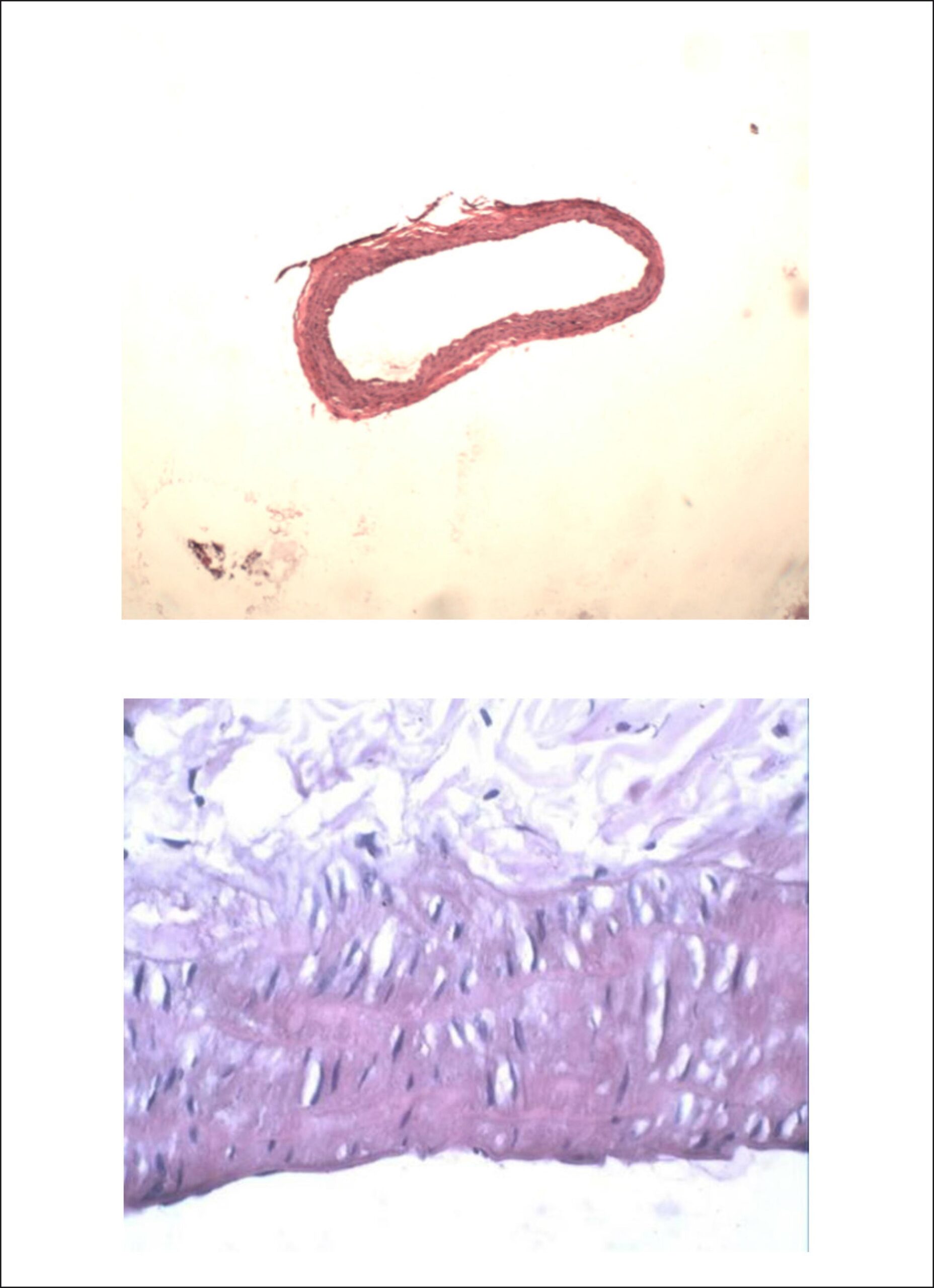
Male Wistar rats were randomly divided into three groups: the control group (n = 20), the model group (n = 20) and the statin intervention group (n = 32). The rats in the intervention group were given 10mg /kg dose of rosuvastatin. A 2F Fogarty catheter was introduced to induce vascular injury. Neointima formation was analyzed 1, 2, 3 and 4 weeks after balloon injury. The level of Apo J was measured by real-time PCR, immunohistochemistry and western blotting.

Results:

Intimal/medial area ratio (intimal/medial, I/M) was increased after balloon-injury and reached the maximum value at 4weeks in the model group; I/M was slightly increased at 2 weeks and stopped increasing after rosuvastatin administration. The mRNA and protein levels of Apo J in carotid arteries were significantly upregulated after rosuvastatin administration as compared with the model group, and reached maximum values at 2 weeks, which was earlier than in the model group (3 weeks).

Conclusion:

Apo J served as an acute phase reactant after balloon injury in rat carotid arteries. Rosuvastatin may reduce the neointima formation through up-regulation of Apo J. Our results suggest that Apo J exerts a protective role in the restenosis after balloon-injury in rats.

  • Apolipoprotein J
  • Coronary Artery Dsease
  • Coronary Reestenosis
  • Percutaneous Coronary Intervention
  • Rats
  • Rosuvastatin Calcium
Read Full Article
Creative Commons Attribution (CC BY) Creative Commons license
21/09/2018 DOI: 10.5935/abc.20180163
Late coronary thrombosis secondary to implantation of paclitaxel-eluting stent without restenosis of conventional stents
ABC
Case Report

Late coronary thrombosis secondary to implantation of paclitaxel-eluting stent without restenosis of conventional stents

Luciano Maurício de Abreu et al. George César Ximenes Meireles Marcos Kiyoshi Sumita Antonio Artur da Cruz Forte … Jose Del Carmen Solano Aliaga Jorge Hayashi

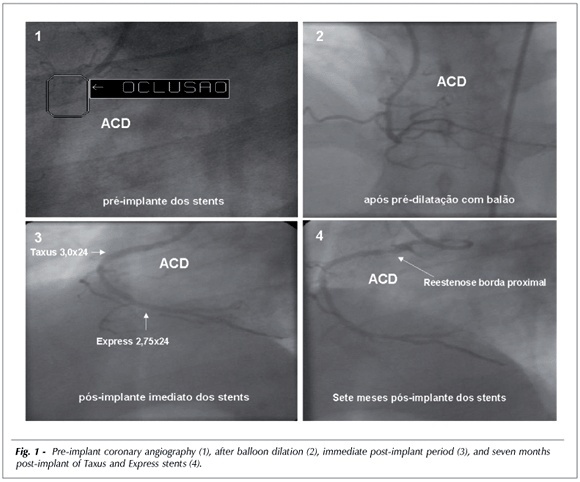
A male 39 year-old patient with post-infarction angina. The coronary angiography showed total proximal obstruction of right coronary artery (RCA), obstructive lesions of 95% of the anterior descending artery (ADA), 80% of the second left marginal branch (LM2), and 95% of the circumflex artery (CXA). The patient was successfully implanted with a Taxus 3.0 x 24 mm stent and an Express 2.75 x 24 mm stent in the proximal and distal thirds of the RCA, respectively, and with an Infinnium 3.0 x 24 mm stent in the ADA. After seven months, the patient had an anterior acute myocardial infarct (AMI) due to thrombosis of the Infinnium stent and restenosis of the Taxus stent, with no loss of results in the conventional stents.

  • Coronary Reestenosis
  • Coronary Thrombosis
  • Paclitaxel
  • Stents
Read Full Article
Creative Commons Attribution (CC BY) Creative Commons license
15/06/2007 DOI: 10.1590/S0066-782X2007000500023 Views 1

How to cite this article

EndNote RIS

Electronic Document Format (Vancouver)

Pessoa JA, Ferreira E, Araújo DV, Maia E, Silva FSM, Oliveira MS, Albuquerque DC, et al. Cost-effectiveness of Drug-Eluting Stents in Percutaneous Coronary Intervention in Brazil’s Unified Public Health System (SUS). Arquivos Brasileiros de Cardiologia 2020;115(1):80-9.

Electronic Document Format (ABNT)

Pessoa, João Addison; Ferreira, Esmeralci; Araújo, Denizar Viana; Maia, Edirley; Silva, Felipe Souza Maia da; Oliveira, Maurício Salles de; Albuquerque, Denilson Campos de. Cost-effectiveness of Drug-Eluting Stents in Percutaneous Coronary Intervention in Brazil’s Unified Public Health System (SUS). Arquivos Brasileiros de Cardiologia, v. 115, n. 1, p. 80-89, Aug. 2020.

Electronic Document Format (APA)

Pessoa, J. A., Ferreira, E., Araújo, D. V., Maia, E., Silva, F. S. M. , Oliveira, M. S. , & Albuquerque, D. C. (2020). Cost-effectiveness of Drug-Eluting Stents in Percutaneous Coronary Intervention in Brazil’s Unified Public Health System (SUS). Arquivos Brasileiros de Cardiologia, 115(1), 80-89.

Electronic Document Format (ISO)

Pessoa, João Addison and Ferreira, Esmeralci and Araújo, Denizar Viana and Maia, Edirley and Silva, Felipe Souza Maia da and Oliveira, Maurício Salles de and Albuquerque, Denilson Campos de. Cost-effectiveness of Drug-Eluting Stents in Percutaneous Coronary Intervention in Brazil’s Unified Public Health System (SUS). Arquivos Brasileiros de Cardiologia [online]. 2020, vol. 115, n. 1, [cited 2026-10-14], pp. 80-89. Available from: <https://journals.cardiol.br/en/article/cost-effectiveness-of-drug-eluting-stents-in-percutaneous-coronary-intervention-in-brazils-unified-public-health-system-sus/>. ISSN 0066-782X

EndNote RIS

Electronic Document Format (Vancouver)

Oliveira MDP, Teich V, Caixeta A. Drug-Eluting Stents for Everyone: Is the Price Worth It?. Arquivos Brasileiros de Cardiologia 2020;115(1):90-1.

Electronic Document Format (ABNT)

Oliveira, Marcos Danillo P; Teich, Vanessa; Caixeta, Adriano. Drug-Eluting Stents for Everyone: Is the Price Worth It?. Arquivos Brasileiros de Cardiologia, v. 115, n. 1, p. 90-91, Aug. 2020.

Electronic Document Format (APA)

Oliveira, M. D. P., Teich, V., & Caixeta, A. (2020). Drug-Eluting Stents for Everyone: Is the Price Worth It?. Arquivos Brasileiros de Cardiologia, 115(1), 90-91.

Electronic Document Format (ISO)

Oliveira, Marcos Danillo P and Teich, Vanessa and Caixeta, Adriano. Drug-Eluting Stents for Everyone: Is the Price Worth It?. Arquivos Brasileiros de Cardiologia [online]. 2020, vol. 115, n. 1, [cited 2026-10-14], pp. 90-91. Available from: <https://journals.cardiol.br/en/article/drug-eluting-stents-for-everyone-is-the-price-worth-it/>. ISSN 0066-782X

EndNote RIS

Electronic Document Format (Vancouver)

Yang N, Dong B, Yang J, Li Y, Kou L, Liu Y, Qin , et al. Effects of Rosuvastatin on Apolipoprotein J in Balloon-Injured Carotid Artery in Rats. Arquivos Brasileiros de Cardiologia 2018;111(4):562-8.

Electronic Document Format (ABNT)

Yang, Ning; Dong, Bo; Yang, Jinyu; Li, Yang; Kou, Lu; Liu, Yue; Qin, . Effects of Rosuvastatin on Apolipoprotein J in Balloon-Injured Carotid Artery in Rats. Arquivos Brasileiros de Cardiologia, v. 111, n. 4, p. 562-568, Sep. 2018.

Electronic Document Format (APA)

Yang, N., Dong, B., Yang, J., Li, Y., Kou, L., Liu, Y., & Qin, (2018). Effects of Rosuvastatin on Apolipoprotein J in Balloon-Injured Carotid Artery in Rats. Arquivos Brasileiros de Cardiologia, 111(4), 562-568.

Electronic Document Format (ISO)

Yang, Ning and Dong, Bo and Yang, Jinyu and Li, Yang and Kou, Lu and Liu, Yue and Qin. Effects of Rosuvastatin on Apolipoprotein J in Balloon-Injured Carotid Artery in Rats. Arquivos Brasileiros de Cardiologia [online]. 2018, vol. 111, n. 4, [cited 2026-10-14], pp. 562-568. Available from: <https://journals.cardiol.br/en/article/effects-of-rosuvastatin-on-apolipoprotein-j-in-balloon-injured-carotid-artery-in-rats/>. ISSN 0066-782X

EndNote RIS

Electronic Document Format (Vancouver)

Abreu LM, Meireles GCX, Sumita MK, Forte AAC, Aliaga JDCS, Hayashi J. Late coronary thrombosis secondary to implantation of paclitaxel-eluting stent without restenosis of conventional stents. Arquivos Brasileiros de Cardiologia 2007;88(5):e111-4.

Electronic Document Format (ABNT)

Abreu, Luciano Maurício de; Meireles, George César Ximenes; Sumita, Marcos Kiyoshi; Forte, Antonio Artur da Cruz; Aliaga, Jose Del Carmen Solano; Hayashi, Jorge. Late coronary thrombosis secondary to implantation of paclitaxel-eluting stent without restenosis of conventional stents. Arquivos Brasileiros de Cardiologia, v. 88, n. 5, p. e111-e114, Jun. 2007.

Electronic Document Format (APA)

Abreu, L. M. , Meireles, G. C. X., Sumita, M. K., Forte, A. A. C., Aliaga, J. D. C. S., & Hayashi, J. (2007). Late coronary thrombosis secondary to implantation of paclitaxel-eluting stent without restenosis of conventional stents. Arquivos Brasileiros de Cardiologia, 88(5), e111-e114.

Electronic Document Format (ISO)

Abreu, Luciano Maurício de and Meireles, George César Ximenes and Sumita, Marcos Kiyoshi and Forte, Antonio Artur da Cruz and Aliaga, Jose Del Carmen Solano and Hayashi, Jorge. Late coronary thrombosis secondary to implantation of paclitaxel-eluting stent without restenosis of conventional stents. Arquivos Brasileiros de Cardiologia [online]. 2007, vol. 88, n. 5, [cited 2026-10-14], pp. e111-e114. Available from: <https://journals.cardiol.br/en/article/late-coronary-thrombosis-secondary-to-implantation-of-paclitaxel-eluting-stent-without-restenosis-of-conventional-stents/>. ISSN 0066-782X

  • About ABC Family
  • Internal Regulation
  • Editorial Board
  • Brazilian Society of Cardiology (SBC)

Issues

SBC Guidelines

  • Videos
  • Podcasts
  • News