ABC Family Arquivos Brasileiros de Cardiologia International Journal of Cardiovascular Sciences ABC Heart Failure & Cardiomyopathy ABC Imagem Cardiovascular
Português English
ABC Family
Português English
  • About
    • About ABC Family
    • Internal Regulation
    • Editorial Board
    • Brazilian Society of Cardiology (SBC)
  • Issues
  • SBC Guidelines
  • Content
    • Videos
    • Podcasts
    • News
  • About
    • About ABC Family
    • Internal Regulation
    • Editorial Board
    • Brazilian Society of Cardiology (SBC)
  • Issues
  • SBC Guidelines
  • Content
    • Videos
    • Podcasts
    • News

ABC Family

  • ABC Family
  • Arquivos Brasileiros de Cardiologia
  • International Journal of Cardiovascular Sciences
  • ABC Heart Failure & Cardiomyopathy
  • ABC Imagem Cardiovascular
Search in

No content found.

Journals
Ordering
Article types
Others

  1. Home
  2. Keyword: Coronary Artery Disease / history
ABC
Editorial

Atherosclerosis, Inflammation, and Genetics – And you Thought it Was Just LDL-cholesterol

Luis Henrique Wolff Gowdak

As the twentieth century unfolded, based on numerous epidemiological observations and intervention trials, cardiovascular risk factors were identified and targeted with the aim of decreasing cardiovascular disease burden worldwide. Along the centuries, changes in human eating patterns, a progressive decrease in physical activity, and a higher prevalence of obesity, all of which are contributing factors to the alarming rates of diabetes, hypertension, and hypercholesterolemia we see in our daily practice, have led us to assume that atherosclerosis-related disorders (myocardial infarction, ischemic cardiomyopathy, stroke, and peripheral artery disease) are an inevitable consequence of the evolutionary process we have to face in present times. However, due to advances in noninvasive imaging of the vascular system, atherosclerotic lesions in the aorta and coronary and carotid arteries happen to be found in mummies from ancient Egypt, whose estimated mean age at the time of death was only 45 years.

If the so-called “classical risk factors” were less prevalent in ancient times, different, non-traditional factors must have played a significant role in the development and progression of atherosclerosis. Microbial and parasitic inflammatory burdens that were likely present in ancient cultures inherently lacking modern hygiene and antimicrobials could have evoked a chronic inflammatory status. Given that patients with today’s chronic systemic inflammatory diseases, including human immunodeficiency virus infection, systemic lupus erythematosus, and rheumatoid arthritis experience early-onset atherosclerosis and coronary events, is it possible that the chronic inflammatory load secondary to infection resulted in atherosclerosis in ancient times? Moreover, atherosclerosis is a complex, multifactorial biological process, and, as such, it is also subject to gene-environment interplay; therefore, although the contribution of today’s classical risk factors to the development of atherosclerosis is inquestionable, their role in the appearance of atherosclerotic lesions in the vascular tree involves not only inflammation and activation of the immune system but also genetic factors that facilitate or oppose the formation of lipid accumulation in the arterial wall.

[…]

  • Atherosclerosis / physiopathology
  • Coronary Artery Disease / history
  • Inflammation
  • Mortality and Morbidity
  • Polymorphism, Genetic
  • Risk Factors
Read Full Article
Creative Commons Attribution (CC BY) Creative Commons license
20/03/2020 DOI: 10.36660/abc.20200038 Views 1
Figure 1
ABC
Original Article

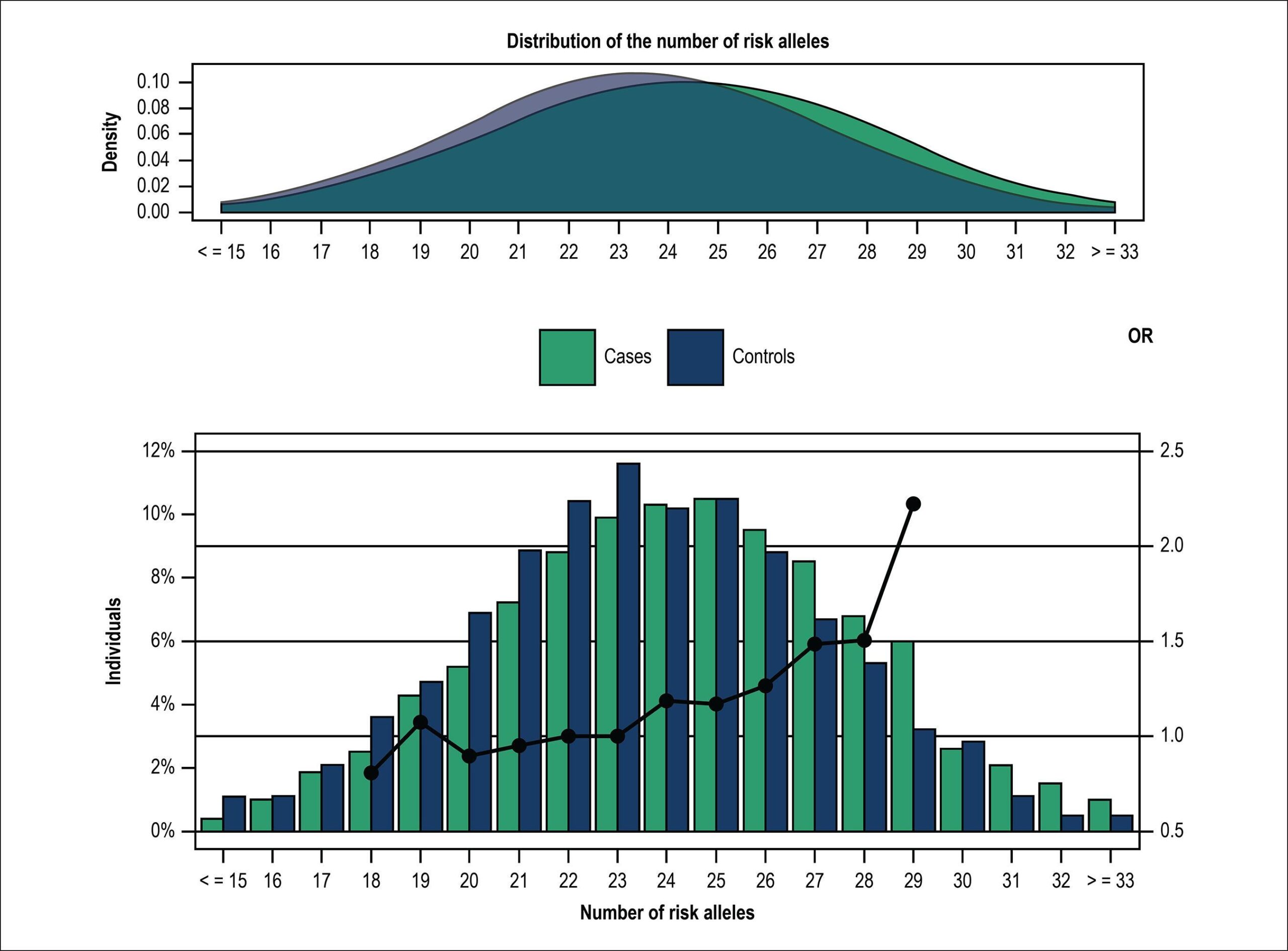
Genetic Risk Analysis of Coronary Artery Disease in a Population-based Study in Portugal, Using a Genetic Risk Score of 31 Variants

Andreia Pereira et al. Maria Isabel Mendonça Sofia Borges Sónia Freitas … Eva Henriques Mariana Rodrigues Ana Isabel Freitas Ana Célia Sousa António Brehm Roberto Palma dos Reis

Abstract

Background:

Genetic risk score can quantify individual’s predisposition to coronary artery disease; however, its usefulness as an independent risk predictor remains inconclusive.

Objective:

To evaluate the incremental predictive value of a genetic risk score to traditional risk factors associated with coronary disease.

Methods:

Thirty-three genetic variants previously associated with coronary disease were analyzed in a case-control population with 2,888 individuals. A multiplicative genetic risk score was calculated and then divided into quartiles, with the 1st quartile as the reference class. Coronary risk was determined by logistic regression analysis. Then, a second logistic regression was performed with traditional risk factors and the last quartile of the genetic risk score. Based on this model, two ROC curves were constructed with and without the genetic score and compared by the Delong test. Statistical significance was considered when p values were less than 0.05.

Results:

The last quartile of the multiplicative genetic risk score revealed a significant increase in coronary artery disease risk (OR = 2.588; 95% CI: 2.090-3.204; p < 0.0001). The ROC curve based on traditional risk factors estimated an AUC of 0.72, which increased to 0.74 when the genetic risk score was added, revealing a better fit of the model (p < 0.0001).

Conclusions:

In conclusion, a multilocus genetic risk score was associated with an increased risk for coronary disease in our population. The usual model of traditional risk factors can be improved by incorporating genetic data.

  • Coronary Artery Disease / history
  • Coronary Artery Disease / morbidity
  • Epidemiology
  • Mortality
  • Polymorphism, Genetic
  • Risk Factors
Read Full Article
Creative Commons Attribution (CC BY) Creative Commons license
02/07/2018 DOI: 10.5935/abc.20180107 Views 2

How to cite this article

EndNote RIS

Electronic Document Format (Vancouver)

Gowdak LHW. Atherosclerosis, Inflammation, and Genetics – And you Thought it Was Just LDL-cholesterol. Arquivos Brasileiros de Cardiologia 2020;114(2):273-4.

Electronic Document Format (ABNT)

Gowdak, Luis Henrique Wolff. Atherosclerosis, Inflammation, and Genetics – And you Thought it Was Just LDL-cholesterol. Arquivos Brasileiros de Cardiologia, v. 114, n. 2, p. 273-274, Mar. 2020.

Electronic Document Format (APA)

Gowdak, L. H. W. (2020). Atherosclerosis, Inflammation, and Genetics – And you Thought it Was Just LDL-cholesterol. Arquivos Brasileiros de Cardiologia, 114(2), 273-274.

Electronic Document Format (ISO)

Gowdak, Luis Henrique Wolff. Atherosclerosis, Inflammation, and Genetics – And you Thought it Was Just LDL-cholesterol. Arquivos Brasileiros de Cardiologia [online]. 2020, vol. 114, n. 2, [cited 2026-10-14], pp. 273-274. Available from: <https://journals.cardiol.br/en/article/atherosclerosis-inflammation-and-genetics-and-you-thought-it-was-just-ldl-cholesterol/>. ISSN 0066-782X

EndNote RIS

Electronic Document Format (Vancouver)

Pereira A, Mendonça MI, Borges S, Freitas S, Henriques E, Rodrigues M, Freitas AI, et al. Genetic Risk Analysis of Coronary Artery Disease in a Population-based Study in Portugal, Using a Genetic Risk Score of 31 Variants. Arquivos Brasileiros de Cardiologia 2018;111(1):50-61.

Electronic Document Format (ABNT)

Pereira, Andreia; Mendonça, Maria Isabel; Borges, Sofia; Freitas, Sónia; Henriques, Eva; Rodrigues, Mariana; Freitas, Ana Isabel; Sousa, Ana Célia; Brehm, António; Reis, Roberto Palma dos. Genetic Risk Analysis of Coronary Artery Disease in a Population-based Study in Portugal, Using a Genetic Risk Score of 31 Variants. Arquivos Brasileiros de Cardiologia, v. 111, n. 1, p. 50-61, Jul. 2018.

Electronic Document Format (APA)

Pereira, A., Mendonça, M. I., Borges, S., Freitas, S., Henriques, E., Rodrigues, M., Freitas, A. I., Sousa, A. C., Brehm, A., & Reis, R. P. (2018). Genetic Risk Analysis of Coronary Artery Disease in a Population-based Study in Portugal, Using a Genetic Risk Score of 31 Variants. Arquivos Brasileiros de Cardiologia, 111(1), 50-61.

Electronic Document Format (ISO)

Pereira, Andreia and Mendonça, Maria Isabel and Borges, Sofia and Freitas, Sónia and Henriques, Eva and Rodrigues, Mariana and Freitas, Ana Isabel and Sousa, Ana Célia and Brehm, António and Reis, Roberto Palma dos. Genetic Risk Analysis of Coronary Artery Disease in a Population-based Study in Portugal, Using a Genetic Risk Score of 31 Variants. Arquivos Brasileiros de Cardiologia [online]. 2018, vol. 111, n. 1, [cited 2026-10-14], pp. 50-61. Available from: <https://journals.cardiol.br/en/article/genetic-risk-analysis-of-coronary-artery-disease-in-a-population-based-study-in-portugal-using-a-genetic-risk-score-of-31-variants/>. ISSN 0066-782X

  • About ABC Family
  • Internal Regulation
  • Editorial Board
  • Brazilian Society of Cardiology (SBC)

Issues

SBC Guidelines

  • Videos
  • Podcasts
  • News