ABC Family Arquivos Brasileiros de Cardiologia International Journal of Cardiovascular Sciences ABC Heart Failure & Cardiomyopathy ABC Imagem Cardiovascular
Português English
ABC Family
Português English
  • About
    • About ABC Family
    • Internal Regulation
    • Editorial Board
    • Brazilian Society of Cardiology (SBC)
  • Issues
  • SBC Guidelines
  • Content
    • Videos
    • Podcasts
    • News
  • About
    • About ABC Family
    • Internal Regulation
    • Editorial Board
    • Brazilian Society of Cardiology (SBC)
  • Issues
  • SBC Guidelines
  • Content
    • Videos
    • Podcasts
    • News

ABC Family

  • ABC Family
  • Arquivos Brasileiros de Cardiologia
  • International Journal of Cardiovascular Sciences
  • ABC Heart Failure & Cardiomyopathy
  • ABC Imagem Cardiovascular
Search in

No content found.

Journals
Ordering
Article types
Others

  1. Home
  2. Keyword: Cholesterol, HDL/blood
Figure 1
ABC
Original Article

Assessment of the Relationship between Monocyte to High-Density Lipoprotein Ratio and Myocardial Bridge

Asim Enhos et al. Kahraman Cosansu Mustafa Ahmet Huyut Fahrettin Turna … Erdem Karacop Nijad Bakshaliyev Aydin Nadir Ramazan Ozdemir Mahmut Uluganyan

Abstract

Background:

Assessing the monocyte to high-density lipoprotein ratio (MHR) is a new tool for predicting inflamation, which plays a major role in atherosclerosis. Myocardial bridge (MB) is thought to be a benign condition with development of atherosclerosis, particularly at the proximal segment of the brigde.

Objective:

To evaluate the relationhip between MHR and the presence of MB.

Methods:

We consecutively scanned patients referred for coronary angiography between January 2013- December 2016, and a total of 160 patients who had a MB and normal coronary artery were enrolled in the study. The patients’ angiographic, demographic and clinic characteristics of the patients were reviewed from medical records. Monocytes and HDL-cholesterols were measured via complete blood count. MHR was calculated as the ratio of the absolute monocyte count to the HDL-cholesterol value. MHR values were divided into three tertiles as follows: lower (8.25 ± 1.61), moderate (13.11 ± 1.46), and higher (21.21 ± 4.30) tertile. A p-value of < 0.05 was considered significant.

Results:

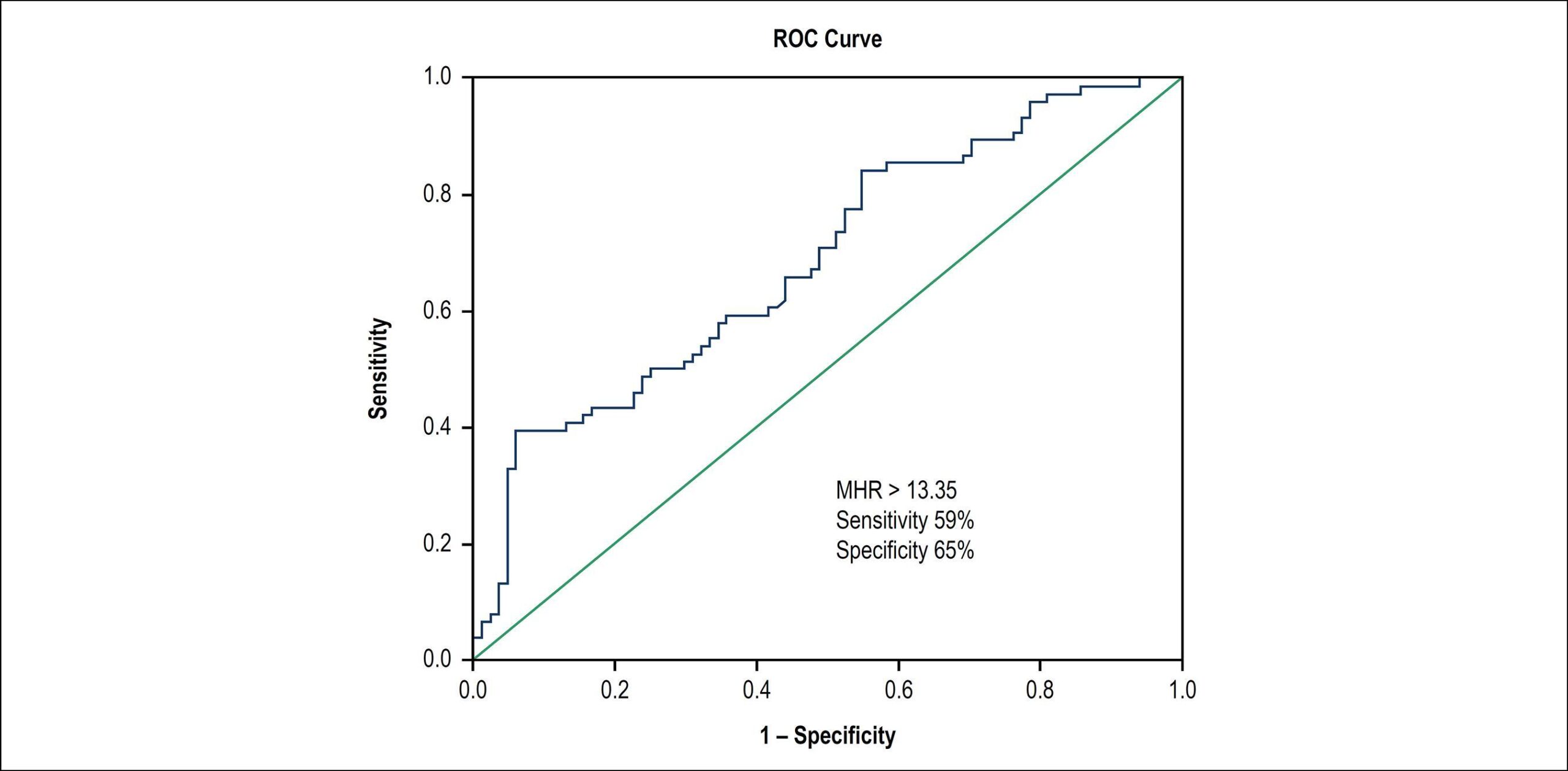
MHR was significantly higher in the MB group compared to the control group with normal coronary arteries. We found the frequency of MB (p = 0.002) to increase as the MHR tertiles rose. The Monocyte-HDL ratio with a cut-point of 13.35 had 59% sensitivity and 65.0% specificity (ROC area under curve: 0.687, 95% CI: 0.606-0.769, p < 0.001) in accurately predicting a MB diagnosis. In the multivariate analysis, MHR (p = 0.013) was found to be a significant independent predictor of the presence of MB, after adjusting for other risk factors.

Conclusion:

The present study revealed a significant correlation between MHR and MB.
  • Atherosclerosis
  • Biomarkers/blood
  • Cholesterol, HDL/blood
  • Inflammation
  • Monocytes/citology
  • Myocardial Bridging
Read Full Article
Creative Commons Attribution (CC BY) Creative Commons license
17/12/2018 DOI: 10.5935/abc.20180253
Figure 1
ABC
Original Article

The Expected Cardiovascular Benefit of Plasma Cholesterol Lowering with or Without LDL-C Targets in Healthy Individuals at Higher Cardiovascular Risk

Fernando Henpin Yue Cesena et al. Antonio Gabriele Laurinavicius Viviane A. Valente Raquel D. Conceição … Raul D. Santos Marcio S. Bittencourt

Abstract

Background:

There is controversy whether management of blood cholesterol should be based or not on LDL-cholesterol (LDL-c) target concentrations.

Objectives:

To compare the estimated impact of different lipid-lowering strategies, based or not on LDL-c targets, on the risk of major cardiovascular events in a population with higher cardiovascular risk.

Methods:

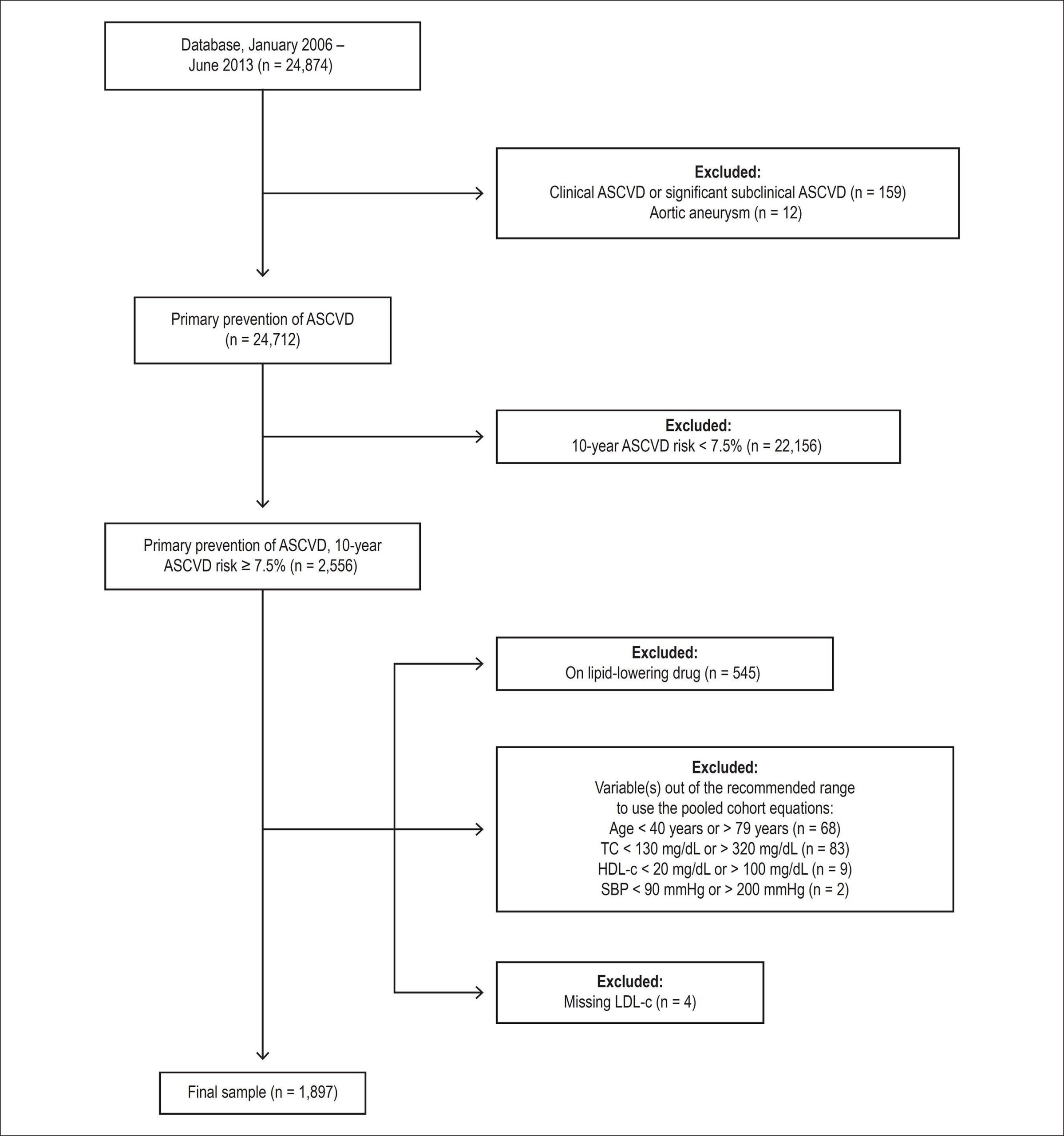
We included consecutive individuals undergoing a routine health screening in a single center who had a 10-year risk for atherosclerotic cardiovascular disease (ASCVD) ≥ 7.5% (pooled cohort equations, ACC/AHA, 2013). For each individual, we simulated two strategies based on LDL-c target (≤ 100 mg/dL [Starget-100] or ≤ 70 mg/dL [Starget-70]) and two strategies based on percent LDL-c reduction (30% [S30%] or 50% [S50%]).

Results:

In 1,897 subjects (57 ± 7 years, 96% men, 10-year ASCVD risk 13.7 ± 7.1%), LDL-c would be lowered from 141 ± 33 mg/dL to 99 ± 23 mg/dL in S30%, 71 ± 16 mg/dL in S50%, 98 ± 9 mg/dL in Starget-100, and 70 ± 2 mg/dL in Starget-70. Ten-year ASCVD risk would be reduced to 8.8 ± 4.8% in S50% and 8.9 ± 5.2 in Starget-70. The number of major cardiovascular events prevented in 10 years per 1,000 individuals would be 32 in S30%, 31 in Starget-100, 49 in S50%, and 48 in Starget-70. Compared with Starget-70, S50% would prevent more events in the lower LDL-c tertile and fewer events in the higher LDL-c tertile.

Conclusions:

The more aggressive lipid-lowering approaches simulated in this study, based on LDL-c target or percent reduction, may potentially prevent approximately 50% more hard cardiovascular events in the population compared with the less intensive treatments. Baseline LDL-c determines which strategy (based or not on LDL-c target) is more appropriate at the individual level.

  • Cholesterol, HDL/blood
  • Cholesterol, LDL / blood
  • Coronary Artery Disease
  • Hypercholesterolemia / blood
  • Risk Factors
Read Full Article
Creative Commons Attribution (CC BY) Creative Commons license
01/06/2017 DOI: 10.5935/abc.20170089 Views 1

How to cite this article

EndNote RIS

Electronic Document Format (Vancouver)

Enhos A, Cosansu K, Huyut MA, Turna F, Karacop E, Bakshaliyev N, Nadir A, et al. Assessment of the Relationship between Monocyte to High-Density Lipoprotein Ratio and Myocardial Bridge. Arquivos Brasileiros de Cardiologia 2018;112(1):12-7.

Electronic Document Format (ABNT)

Enhos, Asim; Cosansu, Kahraman; Huyut, Mustafa Ahmet; Turna, Fahrettin; Karacop, Erdem; Bakshaliyev, Nijad; Nadir, Aydin; Ozdemir, Ramazan; Uluganyan, Mahmut. Assessment of the Relationship between Monocyte to High-Density Lipoprotein Ratio and Myocardial Bridge. Arquivos Brasileiros de Cardiologia, v. 112, n. 1, p. 12-17, Dec. 2018.

Electronic Document Format (APA)

Enhos, A., Cosansu, K., Huyut, M. A., Turna, F., Karacop, E., Bakshaliyev, N., Nadir, A., Ozdemir, R., & Uluganyan, M. (2018). Assessment of the Relationship between Monocyte to High-Density Lipoprotein Ratio and Myocardial Bridge. Arquivos Brasileiros de Cardiologia, 112(1), 12-17.

Electronic Document Format (ISO)

Enhos, Asim and Cosansu, Kahraman and Huyut, Mustafa Ahmet and Turna, Fahrettin and Karacop, Erdem and Bakshaliyev, Nijad and Nadir, Aydin and Ozdemir, Ramazan and Uluganyan, Mahmut. Assessment of the Relationship between Monocyte to High-Density Lipoprotein Ratio and Myocardial Bridge. Arquivos Brasileiros de Cardiologia [online]. 2018, vol. 112, n. 1, [cited 2026-10-14], pp. 12-17. Available from: <https://journals.cardiol.br/en/article/assessment-of-the-relationship-between-monocyte-to-high-density-lipoprotein-ratio-and-myocardial-bridge/>. ISSN 0066-782X

EndNote RIS

Electronic Document Format (Vancouver)

Cesena FHY, Laurinavicius AG, Valente VA, Conceição RD, Santos RD, Bittencourt MS. The Expected Cardiovascular Benefit of Plasma Cholesterol Lowering with or Without LDL-C Targets in Healthy Individuals at Higher Cardiovascular Risk. Arquivos Brasileiros de Cardiologia 2017;108(6):518-25.

Electronic Document Format (ABNT)

Cesena, Fernando Henpin Yue; Laurinavicius, Antonio Gabriele; Valente, Viviane A.; Conceição, Raquel D.; Santos, Raul D.; Bittencourt, Marcio S.. The Expected Cardiovascular Benefit of Plasma Cholesterol Lowering with or Without LDL-C Targets in Healthy Individuals at Higher Cardiovascular Risk. Arquivos Brasileiros de Cardiologia, v. 108, n. 6, p. 518-525, May. 2017.

Electronic Document Format (APA)

Cesena, F. H. Y., Laurinavicius, A. G., Valente, V. A., Conceição, R. D., Santos, R. D., & Bittencourt, M. S. (2017). The Expected Cardiovascular Benefit of Plasma Cholesterol Lowering with or Without LDL-C Targets in Healthy Individuals at Higher Cardiovascular Risk. Arquivos Brasileiros de Cardiologia, 108(6), 518-525.

Electronic Document Format (ISO)

Cesena, Fernando Henpin Yue and Laurinavicius, Antonio Gabriele and Valente, Viviane A. and Conceição, Raquel D. and Santos, Raul D. and Bittencourt, Marcio S.. The Expected Cardiovascular Benefit of Plasma Cholesterol Lowering with or Without LDL-C Targets in Healthy Individuals at Higher Cardiovascular Risk. Arquivos Brasileiros de Cardiologia [online]. 2017, vol. 108, n. 6, [cited 2026-10-14], pp. 518-525. Available from: <https://journals.cardiol.br/en/article/the-expected-cardiovascular-benefit-of-plasma-cholesterol-lowering-with-or-without-ldl-c-targets-in-healthy-individuals-at-higher-cardiovascular-risk/>. ISSN 0066-782X

  • About ABC Family
  • Internal Regulation
  • Editorial Board
  • Brazilian Society of Cardiology (SBC)

Issues

SBC Guidelines

  • Videos
  • Podcasts
  • News