ABC Family Arquivos Brasileiros de Cardiologia International Journal of Cardiovascular Sciences ABC Heart Failure & Cardiomyopathy ABC Imagem Cardiovascular
Português English
ABC Family
Português English
  • About
    • About ABC Family
    • Internal Regulation
    • Editorial Board
    • Brazilian Society of Cardiology (SBC)
  • Issues
  • SBC Guidelines
  • Content
    • Videos
    • Podcasts
    • News
  • About
    • About ABC Family
    • Internal Regulation
    • Editorial Board
    • Brazilian Society of Cardiology (SBC)
  • Issues
  • SBC Guidelines
  • Content
    • Videos
    • Podcasts
    • News

ABC Family

  • ABC Family
  • Arquivos Brasileiros de Cardiologia
  • International Journal of Cardiovascular Sciences
  • ABC Heart Failure & Cardiomyopathy
  • ABC Imagem Cardiovascular
Search in

No content found.

Journals
Ordering
Article types
Others

  1. Home
  2. Keyword: Cardiorespiratory Arrest
Figure 1
ABCIC
Review Article

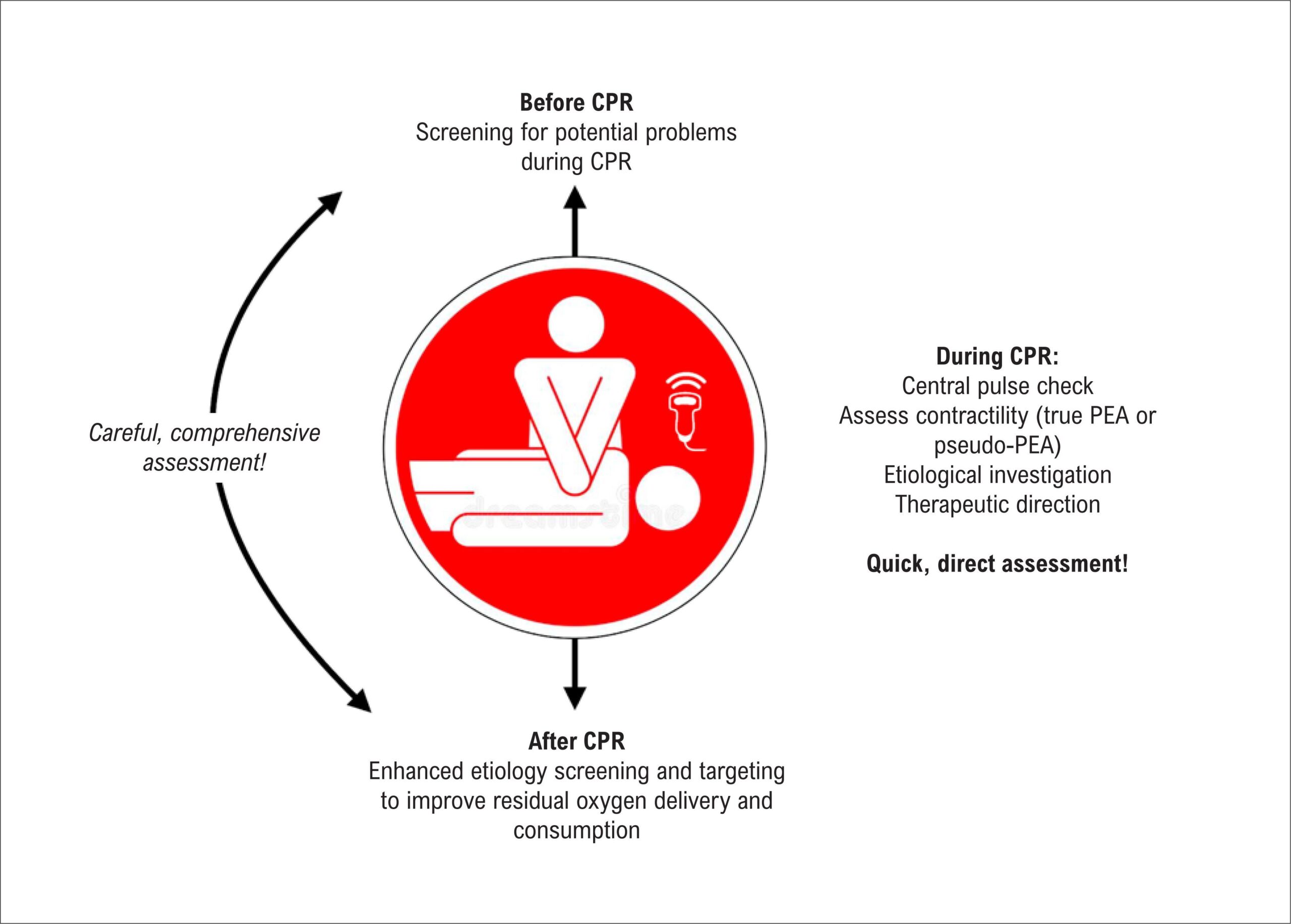
My Approach to Perform Echocardiographic Assessment during Cardiopulmonary Arrest

Fátima Elizabeth Fonseca de Oliveira Negri et al. Alexandre Jorge de Andrade Negri Alexandre Jorge de Andrade Negri Júnior Taciana Assis Bezerra Negri

Abstract

Cardiopulmonary arrest (CPA) is one of the most common events encountered by health care professionals. Attempts to reverse it by performing cardiopulmonary resuscitation (CPR) maneuvers still have very low success rates. Pulseless electrical activity (PEA) and asystole are associated with the worst outcomes. Major CPR guidelines emphasize the importance of identifying potentially treatable causes of CPA. Point-of-care ultrasound (PoCUS), when performed in a systematic, orderly fashion (i.e., without delaying or interfering with other CPR maneuvers), may be important in this change in outcome because it is a diagnostic and prognostic tool used in a scenario where the physical examination is not always conclusive. In this context, the main applications of PoCUS include diagnosis of CPA, differential diagnosis between PEA and pseudo-PEA, and etiologic diagnosis. Several protocols have been developed to optimize the performance of cardiac PoCUS simultaneously with each central pulse check. Pulmonary, abdominal and vascular PoCUS should be performed during resuscitation maneuvers, as they do not interfere with these maneuvers. In addition, PoCUS should preferably be performed by a trained physician who is not actively involved in the resuscitation maneuvers so that the dynamics of CPR are maintained. PoCUS contributes to the diagnosis, prognosis, and therapeutic care of patients suffering from CPA, especially in cases of PEA and asystole; however, there is still no robust evidence that the use of PoCUS reduces mortality among these patients.
  • Cardiorespiratory Arrest
  • Diagnosis
  • Echocardiography
Read Full Article
Creative Commons Attribution (CC BY) Creative Commons license
28/06/2024 DOI: 10.36660/abcimg.20240035i Views 1
Prognostic factors of the results of cardiopulmonary resuscitation in a cardiology hospital
ABC
Original Article

Prognostic factors of the results of cardiopulmonary resuscitation in a cardiology hospital

Ari Timerman et al. Naim Sauaia Leopoldo Soares Piegas Rui F. Ramos … Carlos Gun Elizabeth Silva Santos Antonio C. Mugayar Bianco J. Eduardo M. R. Sousa

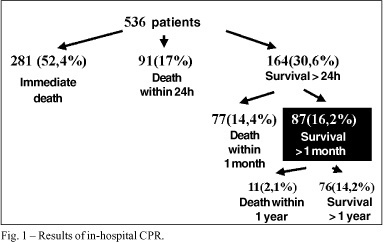
OBJECTIVE: To analyze the early and late results of cardiopulmonary resuscitation in a cardiology hospital and to try to detect prognostic determinants of both short- and long-term survival. METHODS: A series of 557 patients who suffered cardiorespiratory arrest (CRA) at the Dante Pazzanese Cardiology Institute over a period of 5 years was analyzed to examine factors predicting successful resuscitation and long-term survival. RESULTS: Ressuscitation maneuvers were tried in 536 patients; 281 patients (52.4%) died immediately, and 164 patients (30.6%) survived for than 24 hours. The 87 patients who survived for more than 1 month after CRA were compared with nonsurvivors. Coronary disease, cardiomyopathy, and valvular disease had a better prognosis. Primary arrhythmia occurred in 73.5% of the >1-month survivor group and heart failure occurred in 12.6% of this group. In those patients in whom the initial mechanism of CRA was ventricular fibrillation, 33.3% survived for more than 1 month, but of those with ventricular asystole only 4.3% survived. None of the 10 patients with electromechanical dissociation survived. There was worse prognosis in patients included in the extreme age groups (zero to 10 years and 70 years or more). The best results occurred when the cardiac arrest took place in the catheterization laboratories. The worst results occurred in the intensive care unit and the hemodialysis room. CONCLUSION: The results in our series may serve as a helpful guide to physicians with the difficult task of deciding when not to resuscitate or when to stop resuscitation efforts.

  • Acute Myocardial Infarction
  • Cardiorespiratory Arrest
Read Full Article
Creative Commons Attribution (CC BY) Creative Commons license
21/08/2001 DOI: 10.1590/S0066-782X2001000800006 Views 1

How to cite this article

EndNote RIS

Electronic Document Format (Vancouver)

Negri FEFO, Negri AJA, Negri Júnior AJA, Negri TAB. My Approach to Perform Echocardiographic Assessment during Cardiopulmonary Arrest. ABC Imagem Cardiovascular 2024;37(2):e20240035.

Electronic Document Format (ABNT)

Negri, Fátima Elizabeth Fonseca de Oliveira; Negri, Alexandre Jorge de Andrade; Negri Júnior, Alexandre Jorge de Andrade; Negri, Taciana Assis Bezerra. My Approach to Perform Echocardiographic Assessment during Cardiopulmonary Arrest. ABC Imagem Cardiovascular, v. 37, n. 2, e20240035, Jun. 2024.

Electronic Document Format (APA)

Negri, F. E. F. O., Negri, A. J. A., Negri Júnior, A. J. A., & Negri, T. A. B. (2024). My Approach to Perform Echocardiographic Assessment during Cardiopulmonary Arrest. ABC Imagem Cardiovascular, 37(2), e20240035.

Electronic Document Format (ISO)

Negri, Fátima Elizabeth Fonseca de Oliveira and Negri, Alexandre Jorge de Andrade and Negri Júnior, Alexandre Jorge de Andrade and Negri, Taciana Assis Bezerra. My Approach to Perform Echocardiographic Assessment during Cardiopulmonary Arrest. ABC Imagem Cardiovascular [online]. 2024, vol. 37, n. 2, [cited 2026-10-14], e20240035. Available from: <https://journals.cardiol.br/en/article/my-approach-to-perform-echocardiographic-assessment-during-cardiopulmonary-arrest/>. ISSN 2318-8219

EndNote RIS

Electronic Document Format (Vancouver)

Timerman A, Sauaia N, Piegas LS, Ramos RF, Gun C, Santos ES, Bianco ACM, et al. Prognostic factors of the results of cardiopulmonary resuscitation in a cardiology hospital. Arquivos Brasileiros de Cardiologia 2001;77(2):152-60.

Electronic Document Format (ABNT)

Timerman, Ari; Sauaia, Naim; Piegas, Leopoldo Soares; Ramos, Rui F.; Gun, Carlos; Santos, Elizabeth Silva; Bianco, Antonio C. Mugayar; Sousa, J. Eduardo M. R.. Prognostic factors of the results of cardiopulmonary resuscitation in a cardiology hospital. Arquivos Brasileiros de Cardiologia, v. 77, n. 2, p. 152-160, Aug. 2001.

Electronic Document Format (APA)

Timerman, A., Sauaia, N., Piegas, L. S., Ramos, R. F., Gun, C., Santos, E. S., Bianco, A. C. M., & Sousa, J. E. M. R. (2001). Prognostic factors of the results of cardiopulmonary resuscitation in a cardiology hospital. Arquivos Brasileiros de Cardiologia, 77(2), 152-160.

Electronic Document Format (ISO)

Timerman, Ari and Sauaia, Naim and Piegas, Leopoldo Soares and Ramos, Rui F. and Gun, Carlos and Santos, Elizabeth Silva and Bianco, Antonio C. Mugayar and Sousa, J. Eduardo M. R.. Prognostic factors of the results of cardiopulmonary resuscitation in a cardiology hospital. Arquivos Brasileiros de Cardiologia [online]. 2001, vol. 77, n. 2, [cited 2026-10-14], pp. 152-160. Available from: <https://journals.cardiol.br/en/article/prognostic-factors-of-the-results-of-cardiopulmonary-resuscitation-in-a-cardiology-hospital/>. ISSN 0066-782X

  • About ABC Family
  • Internal Regulation
  • Editorial Board
  • Brazilian Society of Cardiology (SBC)

Issues

SBC Guidelines

  • Videos
  • Podcasts
  • News