ABC Family Arquivos Brasileiros de Cardiologia International Journal of Cardiovascular Sciences ABC Heart Failure & Cardiomyopathy ABC Imagem Cardiovascular
Português English
ABC Family
Português English
  • About
    • About ABC Family
    • Internal Regulation
    • Editorial Board
    • Brazilian Society of Cardiology (SBC)
  • Issues
  • SBC Guidelines
  • Content
    • Videos
    • Podcasts
    • News
  • About
    • About ABC Family
    • Internal Regulation
    • Editorial Board
    • Brazilian Society of Cardiology (SBC)
  • Issues
  • SBC Guidelines
  • Content
    • Videos
    • Podcasts
    • News

ABC Family

  • ABC Family
  • Arquivos Brasileiros de Cardiologia
  • International Journal of Cardiovascular Sciences
  • ABC Heart Failure & Cardiomyopathy
  • ABC Imagem Cardiovascular
Search in

No content found.

Journals
Ordering
Article types
Others

  1. Home
  2. Keyword: Cardiopulmonary exercise test
IJCS
Editorial

Cardiorespiratory Optimal Point: A New Kid in the Block or an Established Star?

Miguel Mendes

Summary

COP researchers have already conducted very important research that must be expanded, including larger and more diverse and better defined populations, with patients around the world, different cardiovascular and non-cardiovascular diseases, tests using a treadmill (more experience with treadmill CPET is needed), and evaluation of the prognostic values of sub-maximal parameters, such as COP and eventually VO 2 at VT1, versus the maximal parameters, such as pVO 2 , VE/VCO 2 slope, and OUES.

A clear answer is needed: Is the information obtained from a submaximal CPET enough, or should it be considered only as an alternative when it is not possible to perform a maximal CPET or when peak VO 2 was not reached?

[…]

  • Cardiopulmonary exercise test
  • Cardiorespiratory Fitness
  • Oxygen Consumption
  • Survival
Read Full Article
Creative Commons Attribution (CC BY) Creative Commons license
20/10/2023 DOI: 10.36660/ijcs.20230124 Views 2
Figure 1
ABC
Original Article

Alternatives to Aerobic Exercise Prescription in Patients with Chronic Heart Failure

Mayron F Oliveira et al. Gabriela Zanussi Bianca Sprovieri Denise M. L. Lobo … Luiz E Mastrocolla Iracema I. K. Umeda Priscila A Sperandio

Background:

Exercise is essential for patients with heart failure as it leads to a reduction in morbidity and mortality as well as improved functional capacity and oxygen uptake (v̇O2). However, the need for an experienced physiologist and the cost of the exam may render the cardiopulmonary exercise test (CPET) unfeasible. Thus, the six-minute walk test (6MWT) and step test (ST) may be alternatives for exercise prescription.

Objective:

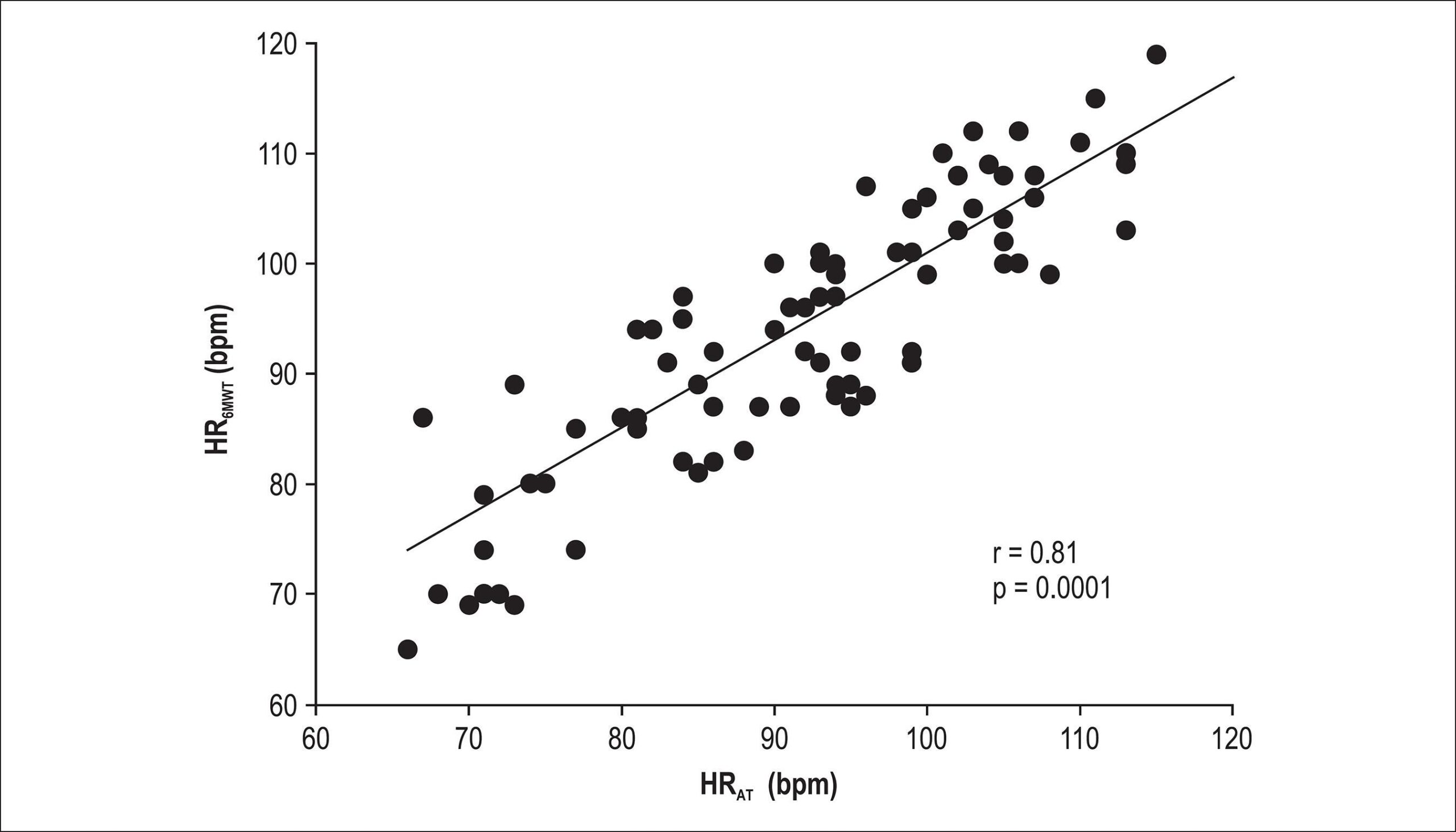
The aim was to correlate heart rate (HR) during the 6MWT and ST with HR at the anaerobic threshold (HRAT) and peak HR (HRP) obtained on the CPET.

Methods:

Eighty-three patients (58 ± 11 years) with heart failure (NYHA class II) were included and all subjects had optimized medication for at least 3 months. Evaluations involved CPET (v̇O2, HRAT, HRP), 6MWT (HR6MWT) and ST (HRST).

Results:

The participants exhibited severe ventricular dysfunction (ejection fraction: 31 ± 7%) and low peak v̇O2 (15.2 ± 3.1 mL.kg-1.min-1). HRP (113 ± 19 bpm) was higher than HRAT (92 ± 14 bpm; p < 0.05) and HR6MWT (94 ± 13 bpm; p < 0.05). No significant difference was found between HRP and HRST. Moreover, a strong correlation was found between HRAT and HR6MWT (r = 0.81; p < 0.0001), and between HRP and HRST (r = 0.89; p < 0.0001).

Conclusion:

These findings suggest that, in the absence of CPET, exercise prescription can be performed by use of 6MWT and ST, based on HR6MWT and HRST

  • Cardiopulmonary exercise test
  • chronic heart failure
  • exercise prescription
  • Rehabilitation
  • Six-minute walk test
Read Full Article
Creative Commons Attribution (CC BY) Creative Commons license
22/01/2016 DOI: 10.5935/abc.20160014
Influence of skeletal muscle mass on ventilatory and hemodynamic variables during exercise in patients with chronic heart failure
ABC
Original Article

Influence of skeletal muscle mass on ventilatory and hemodynamic variables during exercise in patients with chronic heart failure

Ricardo Vivacqua Cardoso Costa et al. Antonio Claudio Lucas da Nóbrega Salvador Manoel Serra Salete Rego Mauricio Wajngarten

OBJECTIVE: To assess the influence of skeletal muscle mass on ventilatory and hemodynamic variables during exercise in patients with chronic heart failure (CHF). METHODS: Twenty-five male patients underwent maximum cardiopulmonary exercise testing on a treadmill with a ramp protocol and measurement of the skeletal muscle mass of their thighs by using magnetic resonance imaging. The clinically stable, noncachectic patients were assessed and compared with 14 healthy individuals (S) paired by age and body mass index, who underwent the same examinations. RESULTS: Similar values of skeletal muscle mass were found in both groups (CHF group: 3863 ± 874 g; S group: 3743 ± 540 g; p = 0.32). Significant correlations of oxygen consumption in the anaerobic threshold (CHF: r = 0.39; P= 0.02 and S: r = 0.14; P = 0.31) and of oxygen pulse also in the anaerobic threshold (CHF: r = 0.49; P = 0.01 and S: r =0.12; P = 0.36) were found only in the group of patients with chronic heart failure. CONCLUSION: The results obtained indicate that skeletal muscle mass may influence the capacity of patients with CHF to withstand submaximal effort, due to limitations in their physical condition, even maintaining a value similar to that of healthy individuals. This suggests qualitative changes in the musculature.

  • Cardiopulmonary exercise test
  • chronic heart failure
  • skeletal muscle
Read Full Article
Creative Commons Attribution (CC BY) Creative Commons license
28/01/2004 DOI: 10.1590/S0066-782X2003001400004 Views 1
Gas exchange during exercise in different evolutional stages of chronic Chagas' heart disease
ABC
Original Article

Gas exchange during exercise in different evolutional stages of chronic Chagas' heart disease

Fátima Palha de Oliveira et al. Roberto Coury Pedrosa Antonio Giannella-Neto

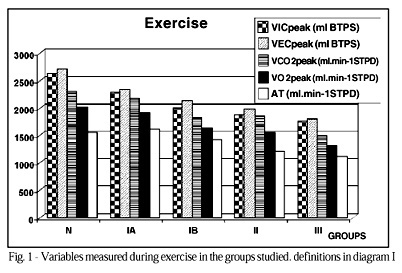
OBJECTIVE: To compare gas exchange at rest and during exercise in patients with chronic Chagas’ heart disease grouped according to the Los Andes clinical/hemodynamic classification. METHODS: We studied 15 healthy volunteers and 52 patients grouped according to the Los Andes clinical/hemodynamic classification as follows: 17 patients in group IA (normal electrocardiogram/echocardiogram), 9 patients in group IB (normal electrocardiogram and abnormal echocardiogram), 14 patients in group II (abnormal electrocardiogram/echocardiogram, without congestive heart failure), and 12 patients in group III (abnormal electrocardiogram/echocardiogram with congestive heart failure). The following variables were analyzed: oxygen consumption (V O2), carbon dioxide production (V CO2), gas exchange rate (R), inspiratory current volume (V IC), expiratory current volume (V EC), respiratory frequency, minute volume (V E), heart rate (HR), maximum load, O2 pulse, and ventilatory anaerobic threshold (AT). RESULTS: When compared with the healthy group, patients in groups II and III showed significant changes in the following variables: V O2peak, V CO2peak, V ICpeak, V ECpeak, E, HR, and maximum load. Group IA showed significantly better results for these same variables as compared with group III. CONCLUSION: The functional capacity of patients in the initial phase of chronic Chagas’ heart disease is higher than that of patients in an advanced phase and shows a decrease that follows the loss in cardiac-hemodynamic performance.

  • Cardiopulmonary exercise test
  • chronic Chagas' heart disease
  • Oxygen Consumption
Read Full Article
Creative Commons Attribution (CC BY) Creative Commons license
08/01/2002 DOI: 10.1590/S0066-782X2000001200003 Views 1

How to cite this article

EndNote RIS

Electronic Document Format (Vancouver)

Mendes M. Cardiorespiratory Optimal Point: A New Kid in the Block or an Established Star?. International Journal of Cardiovascular Sciences 2023;36:e20230124.

Electronic Document Format (ABNT)

Mendes, Miguel. Cardiorespiratory Optimal Point: A New Kid in the Block or an Established Star?. International Journal of Cardiovascular Sciences, v. 36, e20230124, Oct. 2023.

Electronic Document Format (APA)

Mendes, M. (2023). Cardiorespiratory Optimal Point: A New Kid in the Block or an Established Star?. International Journal of Cardiovascular Sciences, 36, e20230124.

Electronic Document Format (ISO)

Mendes, Miguel. Cardiorespiratory Optimal Point: A New Kid in the Block or an Established Star?. International Journal of Cardiovascular Sciences [online]. 2023, vol. 36, [cited 2026-10-14], e20230124. Available from: <https://journals.cardiol.br/en/article/cardiorespiratory-optimal-point-a-new-kid-in-the-block-or-an-established-star/>. ISSN 2359-4802

EndNote RIS

Electronic Document Format (Vancouver)

Oliveira MF, Zanussi G, Sprovieri B, Lobo DML, Mastrocolla LE, Umeda IIK, Sperandio PA, et al. Alternatives to Aerobic Exercise Prescription in Patients with Chronic Heart Failure. Arquivos Brasileiros de Cardiologia 2016;106(2):97-104.

Electronic Document Format (ABNT)

Oliveira, Mayron F; Zanussi, Gabriela; Sprovieri, Bianca; Lobo, Denise M. L.; Mastrocolla, Luiz E; Umeda, Iracema I. K.; Sperandio, Priscila A. Alternatives to Aerobic Exercise Prescription in Patients with Chronic Heart Failure. Arquivos Brasileiros de Cardiologia, v. 106, n. 2, p. 97-104, Jan. 2016.

Electronic Document Format (APA)

Oliveira, M. F., Zanussi, G., Sprovieri, B., Lobo, D. M. L., Mastrocolla, L. E., Umeda, I. I. K., & Sperandio, P. A. (2016). Alternatives to Aerobic Exercise Prescription in Patients with Chronic Heart Failure. Arquivos Brasileiros de Cardiologia, 106(2), 97-104.

Electronic Document Format (ISO)

Oliveira, Mayron F and Zanussi, Gabriela and Sprovieri, Bianca and Lobo, Denise M. L. and Mastrocolla, Luiz E and Umeda, Iracema I. K. and Sperandio, Priscila A. Alternatives to Aerobic Exercise Prescription in Patients with Chronic Heart Failure. Arquivos Brasileiros de Cardiologia [online]. 2016, vol. 106, n. 2, [cited 2026-10-14], pp. 97-104. Available from: <https://journals.cardiol.br/en/article/alternatives-to-aerobic-exercise-prescription-in-patients-with-chronic-heart-failure/>. ISSN 0066-782X

EndNote RIS

Electronic Document Format (Vancouver)

Costa RVC, Nóbrega ACL, Serra SM, Rego S, Wajngarten M. Influence of skeletal muscle mass on ventilatory and hemodynamic variables during exercise in patients with chronic heart failure. Arquivos Brasileiros de Cardiologia 2004;81(6):581-5.

Electronic Document Format (ABNT)

Costa, Ricardo Vivacqua Cardoso; Nóbrega, Antonio Claudio Lucas da; Serra, Salvador Manoel; Rego, Salete; Wajngarten, Mauricio. Influence of skeletal muscle mass on ventilatory and hemodynamic variables during exercise in patients with chronic heart failure. Arquivos Brasileiros de Cardiologia, v. 81, n. 6, p. 581-585, Jan. 2004.

Electronic Document Format (APA)

Costa, R. V. C., Nóbrega, A. C. L. , Serra, S. M., Rego, S., & Wajngarten, M. (2004). Influence of skeletal muscle mass on ventilatory and hemodynamic variables during exercise in patients with chronic heart failure. Arquivos Brasileiros de Cardiologia, 81(6), 581-585.

Electronic Document Format (ISO)

Costa, Ricardo Vivacqua Cardoso and Nóbrega, Antonio Claudio Lucas da and Serra, Salvador Manoel and Rego, Salete and Wajngarten, Mauricio. Influence of skeletal muscle mass on ventilatory and hemodynamic variables during exercise in patients with chronic heart failure. Arquivos Brasileiros de Cardiologia [online]. 2004, vol. 81, n. 6, [cited 2026-10-14], pp. 581-585. Available from: <https://journals.cardiol.br/article/influence-of-skeletal-muscle-mass-on-ventilatory-and-hemodynamic-variables-during-exercise-in-patients-with-chronic-heart-failure/>. ISSN 0066-782X

EndNote RIS

Electronic Document Format (Vancouver)

Oliveira FP, Pedrosa RC, Giannella-Neto A. Gas exchange during exercise in different evolutional stages of chronic Chagas’ heart disease. Arquivos Brasileiros de Cardiologia 2002;75(6):490-8.

Electronic Document Format (ABNT)

Oliveira, Fátima Palha de; Pedrosa, Roberto Coury; Giannella-Neto, Antonio. Gas exchange during exercise in different evolutional stages of chronic Chagas’ heart disease. Arquivos Brasileiros de Cardiologia, v. 75, n. 6, p. 490-498, Jan. 2002.

Electronic Document Format (APA)

Oliveira, F. P. , Pedrosa, R. C., & Giannella-Neto, A. (2002). Gas exchange during exercise in different evolutional stages of chronic Chagas’ heart disease. Arquivos Brasileiros de Cardiologia, 75(6), 490-498.

Electronic Document Format (ISO)

Oliveira, Fátima Palha de and Pedrosa, Roberto Coury and Giannella-Neto, Antonio. Gas exchange during exercise in different evolutional stages of chronic Chagas’ heart disease. Arquivos Brasileiros de Cardiologia [online]. 2002, vol. 75, n. 6, [cited 2026-10-14], pp. 490-498. Available from: <https://journals.cardiol.br/en/article/gas-exchange-during-exercise-in-different-evolutional-stages-of-chronic-chagas-heart-disease/>. ISSN 0066-782X

  • About ABC Family
  • Internal Regulation
  • Editorial Board
  • Brazilian Society of Cardiology (SBC)

Issues

SBC Guidelines

  • Videos
  • Podcasts
  • News