ABC Family Arquivos Brasileiros de Cardiologia International Journal of Cardiovascular Sciences ABC Heart Failure & Cardiomyopathy ABC Imagem Cardiovascular
Português English
ABC Family
Português English
  • About
    • About ABC Family
    • Internal Regulation
    • Editorial Board
    • Brazilian Society of Cardiology (SBC)
  • Issues
  • SBC Guidelines
  • Content
    • Videos
    • Podcasts
    • News
  • About
    • About ABC Family
    • Internal Regulation
    • Editorial Board
    • Brazilian Society of Cardiology (SBC)
  • Issues
  • SBC Guidelines
  • Content
    • Videos
    • Podcasts
    • News

ABC Family

  • ABC Family
  • Arquivos Brasileiros de Cardiologia
  • International Journal of Cardiovascular Sciences
  • ABC Heart Failure & Cardiomyopathy
  • ABC Imagem Cardiovascular
Search in

No content found.

Journals
Ordering
Article types
Others

  1. Home
  2. Keyword: Capillary Permeability
ABC
Editorial

Can We Pretreat Vein Grafts with Adiponectin to Improve Their Patency?

Maria Cristina de Oliveira Izar et al. Francisco A. H. Fonseca

Saphenous vein graft remains an option for patients with multivessel coronary artery disease,, mainly in individuals with type 2 diabetes. Although artery bypass should offer better patency rates than venous grafts, in many situations, complete revascularization cannot be achieved using solely arterial grafts. Venous graft failure has been associated with cardiovascular outcomes, including mortality., Therefore, there is a need to improve vein graft patency. The mechanisms involved in graft failure include intimal hyperplasia, smooth muscle cell proliferation, and endothelial dysfunction, among others., There have been some attempts to improve the preservation of saphenous vein grafts before implantation.

In the experimental study by Zhou et al. the authors used autologous jugular veins implanted as carotid interposition grafts in Sprague Dawley rats. Two groups received adiponectin (2.5 μg and 7.5 μg) applied externally to the vein bypass grafts, suspended in a 30% Pluronic-F127 gel. The other two groups (controls) received vehicle or no treatment (bypass only). At day 3, cell proliferation was significantly lower in adiponectin-treated versus control and vehicle-gel-treated grafts, both in intima and adventitia, whereas expression of VCAM-1 and ICAM-1 was significantly down-regulated in the adiponectin-treated vein grafts in week four. In addition, the treatment of vein grafts with adiponectin-loaded gels reduced intimal, media, and adventitia thickness when compared with the control and vehicle-gel-treated vein grafts at day 28.

[…]
  • Adiponectin/therapeutic use
  • Capillary Permeability
  • Coronary Artery Disease
  • Rats
  • Saphenous Vein
Read Full Article
Creative Commons Attribution (CC BY) Creative Commons license
03/12/2021 DOI: 10.36660/abc.20210902 Views 1
Figure 1
ABC
Original Article

Microvascular Reactivity in Hypertensive Patients with High Body Adiposity

Jenifer d'El-Rei et al. Michelle Rabello Cunha Samanta de Souza Mattos Bianca Cristina Marques … Viviane Prangiel de Menezes Ana Rosa Cunha Érica Monteiro França Wille Oigman Mario Fritsch Neves

Abstract

Background:

Several anthropometric indexes have been proposed to determine the association between overweight and cardiovascular risk factors.

Objective:

To evaluate the relationship between body adiposity and microvascular reactivity in hypertensive patients under antihypertensive therapy.

Methods:

Treated hypertensive patients aged 40 to 70 were submitted to evaluation of anthropometric indexes: conicity (CI), body adiposity (BAI), visceral adiposity (VAI) and waist-to-height ratio (WHtR). Participants were divided by the terciles of fat percentage (%F) obtained by bioelectrical impedance. The patients underwent microvascular reactivity test (Laser Speckle Contrast Image) and pulse wave velocity (PWV) measurement. The p value <0.05 was considered statistically significant.

Results:

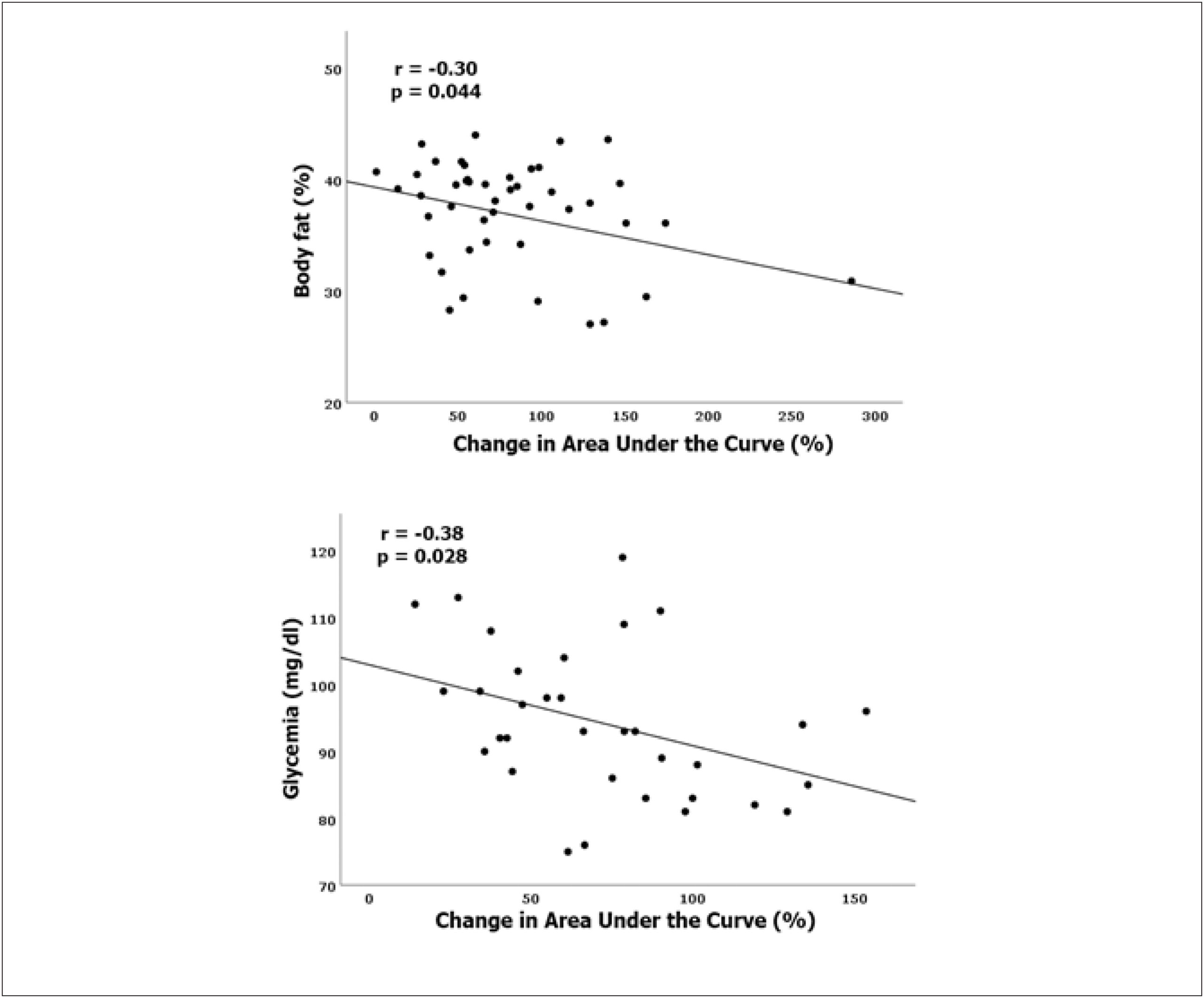
The variation of the area under the curve (AUC) of the skin perfusion was lower in the upper tercile (97±57% vs. 67±36%; p=0.027). %F showed significant correlation with WHtR (r=0.77; p<0.001), VAI (r=0.41; p=0.018), CI (r=0.60; p<0.001), BAI (r=0.65; p<0.001) in men and only with WHtR (r=0.55; p<0.001) and BAI (r=0.60; p<0.001) in women. In linear regression, AUC was independently associated with %F (β=−3.15; p=0.04) in women and with blood glucose (β=−1.15; p=0.02) in men. There was no difference in PWV measurements.

Conclusion:

Anthropometric indices were more associated with %F in men. Higher body adiposity was associated with lower microvascular reactivity, which was more evident in women. There was no difference in arterial stiffness, which may have been influenced by antihypertensive treatment.

  • Adiposity
  • Capillary Permeability
  • Endothelium
  • Hypertension/drug effects
Read Full Article
Creative Commons Attribution (CC BY) Creative Commons license
07/12/2020 DOI: 10.36660/abc.20190364
VEGF 165 gene therapy for patients with refractory angina: mobilization of endothelial progenitor cells
ABC
Artigo Original

VEGF 165 gene therapy for patients with refractory angina: mobilization of endothelial progenitor cells

Clarissa G. Rodrigues et al. Rodrigo D.M. Plentz Thiago Dipp Felipe B. Salles … Imarilde I. Giusti Roberto T. Sant'Anna Bruna Eibel Ivo A. Nesralla Melissa Markoski Nance N. Beyer Renato A. K. Kalil

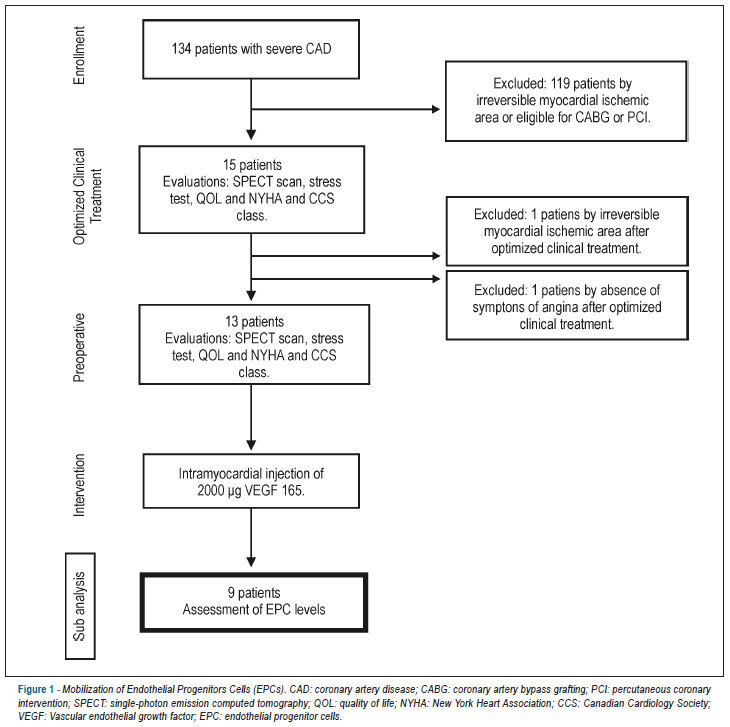
BACKGROUND: Vascular endothelial growth factor (VEGF) induces mobilization of endothelial progenitor cells (EPCs) with the capacity for proliferation and differentiation into mature endothelial cells, thus contributing to the angiogenic process. OBJECTIVE: We sought to assess the behavior of EPCs in patients with ischemic heart disease and refractory angina who received an intramyocardial injections of 2000 µg of VEGF 165 as the sole therapy. METHODS: The study was a subanalysis of a clinical trial. Patients with advanced ischemic heart disease and refractory angina were assessed for eligibility. Inclusion criteria were as follows: signs and symptoms of angina and/or heart failure despite maximum medical treatment and a myocardial ischemic area of at least 5% as assessed by single-photon emission computed tomography (SPECT). Exclusion criteria were as follows: age > 65 years, left ventricular ejection fraction < 25%, and a diagnosis of cancer. Patients whose EPC levels were assessed were included. The intervention was 2000 µg of VEGF 165 plasmid injected into the ischemic myocardium. The frequency of CD34+/KDR+ cells was analyzed by flow cytometry before and 3, 9, and 27 days after the intervention. RESULTS: A total of 9 patients were included, 8 males, mean age 59.4 years, mean left ventricular ejection fraction of 59.3% and predominant class III angina. The number of EPCs on day 3 was significantly higher than that at baseline (p = 0.03); however, that on days 9 and 27 was comparable to that at baseline. CONCLUSION: We identified a transient mobilization of EPCs, which peaked on the 3th day after VEGF 165 gene therapy in patients with refractory angina and returned to near baseline levels on days 9 and 27.

  • Capillary Permeability
  • Endothelial Cells
  • Genetic Therapy
  • Vascular Endothelial Growth Factor A
Read Full Article
Creative Commons Attribution (CC BY) Creative Commons license
09/07/2013 DOI: 10.5935/abc.20130128 Views 1

How to cite this article

EndNote RIS

Electronic Document Format (Vancouver)

Izar MCO, Fonseca FAH. Can We Pretreat Vein Grafts with Adiponectin to Improve Their Patency?. Arquivos Brasileiros de Cardiologia 2021;117(6):1189-90.

Electronic Document Format (ABNT)

Izar, Maria Cristina de Oliveira; Fonseca, Francisco A. H.. Can We Pretreat Vein Grafts with Adiponectin to Improve Their Patency?. Arquivos Brasileiros de Cardiologia, v. 117, n. 6, p. 1189-1190, Dec. 2021.

Electronic Document Format (APA)

Izar, M. C. O., & Fonseca, F. A. H. (2021). Can We Pretreat Vein Grafts with Adiponectin to Improve Their Patency?. Arquivos Brasileiros de Cardiologia, 117(6), 1189-1190.

Electronic Document Format (ISO)

Izar, Maria Cristina de Oliveira and Fonseca, Francisco A. H.. Can We Pretreat Vein Grafts with Adiponectin to Improve Their Patency?. Arquivos Brasileiros de Cardiologia [online]. 2021, vol. 117, n. 6, [cited 2026-10-14], pp. 1189-1190. Available from: <https://journals.cardiol.br/en/article/can-we-pretreat-vein-grafts-with-adiponectin-to-improve-their-patency/>. ISSN 0066-782X

EndNote RIS

Electronic Document Format (Vancouver)

d’El-Rei J, Cunha MR, Mattos SS, Marques BC, Menezes VP, Cunha AR, França M, et al. Microvascular Reactivity in Hypertensive Patients with High Body Adiposity. Arquivos Brasileiros de Cardiologia 2020;115(5):896-904.

Electronic Document Format (ABNT)

d’El-Rei, Jenifer; Cunha, Michelle Rabello; Mattos, Samanta de Souza; Marques, Bianca Cristina; Menezes, Viviane Prangiel de; Cunha, Ana Rosa; França, Érica Monteiro; Oigman, Wille; Neves, Mario Fritsch. Microvascular Reactivity in Hypertensive Patients with High Body Adiposity. Arquivos Brasileiros de Cardiologia, v. 115, n. 5, p. 896-904, Dec. 2020.

Electronic Document Format (APA)

d’El-Rei, J., Cunha, M. R., Mattos, S. S., Marques, B. C., Menezes, V. P. , Cunha, A. R., França, M., Oigman, W., & Neves, M. F. (2020). Microvascular Reactivity in Hypertensive Patients with High Body Adiposity. Arquivos Brasileiros de Cardiologia, 115(5), 896-904.

Electronic Document Format (ISO)

d’El-Rei, Jenifer and Cunha, Michelle Rabello and Mattos, Samanta de Souza and Marques, Bianca Cristina and Menezes, Viviane Prangiel de and Cunha, Ana Rosa and França, Érica Monteiro and Oigman, Wille and Neves, Mario Fritsch. Microvascular Reactivity in Hypertensive Patients with High Body Adiposity. Arquivos Brasileiros de Cardiologia [online]. 2020, vol. 115, n. 5, [cited 2026-10-14], pp. 896-904. Available from: <https://journals.cardiol.br/en/article/microvascular-reactivity-in-hypertensive-patients-with-high-body-adiposity/>. ISSN 0066-782X

EndNote RIS

Electronic Document Format (Vancouver)

Rodrigues CG, Plentz RD, Dipp T, Salles FB, Giusti II, Sant’Anna RT, Eibel B, et al. VEGF 165 gene therapy for patients with refractory angina: mobilization of endothelial progenitor cells. Arquivos Brasileiros de Cardiologia 2013;101(2):149-53.

Electronic Document Format (ABNT)

Rodrigues, Clarissa G.; Plentz, Rodrigo D.M.; Dipp, Thiago; Salles, Felipe B.; Giusti, Imarilde I.; Sant’Anna, Roberto T.; Eibel, Bruna; Nesralla, Ivo A.; Markoski, Melissa; Beyer, Nance N.; Kalil, Renato A. K.. VEGF 165 gene therapy for patients with refractory angina: mobilization of endothelial progenitor cells. Arquivos Brasileiros de Cardiologia, v. 101, n. 2, p. 149-153, Jul. 2013.

Electronic Document Format (APA)

Rodrigues, C. G., Plentz, R. D., Dipp, T., Salles, F. B., Giusti, I. I., Sant’Anna, R. T., Eibel, B., Nesralla, I. A., Markoski, M., Beyer, N. N., & Kalil, R. A. K. (2013). VEGF 165 gene therapy for patients with refractory angina: mobilization of endothelial progenitor cells. Arquivos Brasileiros de Cardiologia, 101(2), 149-153.

Electronic Document Format (ISO)

Rodrigues, Clarissa G. and Plentz, Rodrigo D.M. and Dipp, Thiago and Salles, Felipe B. and Giusti, Imarilde I. and Sant’Anna, Roberto T. and Eibel, Bruna and Nesralla, Ivo A. and Markoski, Melissa and Beyer, Nance N. and Kalil, Renato A. K.. VEGF 165 gene therapy for patients with refractory angina: mobilization of endothelial progenitor cells. Arquivos Brasileiros de Cardiologia [online]. 2013, vol. 101, n. 2, [cited 2026-10-14], pp. 149-153. Available from: <https://journals.cardiol.br/en/article/vegf-165-gene-therapy-for-patients-with-refractory-angina-mobilization-of-endothelial-progenitor-cells/>. ISSN 0066-782X

  • About ABC Family
  • Internal Regulation
  • Editorial Board
  • Brazilian Society of Cardiology (SBC)

Issues

SBC Guidelines

  • Videos
  • Podcasts
  • News