ABC Family Arquivos Brasileiros de Cardiologia International Journal of Cardiovascular Sciences ABC Heart Failure & Cardiomyopathy ABC Imagem Cardiovascular
Português English
ABC Family
Português English
  • About
    • About ABC Family
    • Internal Regulation
    • Editorial Board
    • Brazilian Society of Cardiology (SBC)
  • Issues
  • SBC Guidelines
  • Content
    • Videos
    • Podcasts
    • News
  • About
    • About ABC Family
    • Internal Regulation
    • Editorial Board
    • Brazilian Society of Cardiology (SBC)
  • Issues
  • SBC Guidelines
  • Content
    • Videos
    • Podcasts
    • News

ABC Family

  • ABC Family
  • Arquivos Brasileiros de Cardiologia
  • International Journal of Cardiovascular Sciences
  • ABC Heart Failure & Cardiomyopathy
  • ABC Imagem Cardiovascular
Search in

No content found.

Journals
Ordering
Article types
Others

  1. Home
  2. Keyword: Baroreflex
ABC
Editorial

Polycystic Ovary Syndrome and Cardiovascular Diseases: Still an Open Door

Marcus Vinicius Bolivar Malachias

This issue of the Brazilian Archives of Cardiology (ABC Cardiol) brings the article “Women with Polycystic Ovarian Syndrome Exhibit Reduced Baroreflex Sensitivity That May Be Associated with Increased Body Fat”, by Philbois, SV et al., which draws attention to this clinical condition that is so prevalent in our country and its many aspects related to cardiometabolism, neuroregulation and cardiovascular risk.

The Polycystic Ovary Syndrome (PCOS) is the most common endocrine disorder in women of reproductive age, with an estimated prevalence of 6 to 10% in this population. According to the Rotterdam criteria, PCOS is diagnosed in the presence of at least two of the three criteria: menstrual disorders or amenorrhea with chronic lack of ovulation, clinical and/or biochemical characteristics of hyperandrogenism and the presence of polycystic ovaries on ultrasonography after exclusion of other endocrine disorders. Overall, SOP has been considered a reproductive disorder; however, it also represents a significantly increased risk for cardiometabolic disorders. The impact on reproduction is predominant during the reproductive years, while cardiometabolic alterations become more important in the later stages of a woman’s life.

[…]

  • Autonomic Nervous System/abnormalities
  • Baroreflex
  • Cardiovascular Diseases/physiopatholog
  • Obesity/metabolism
  • Polycystic Ovary Syndrome
Read Full Article
Creative Commons Attribution (CC BY) Creative Commons license
15/04/2019 DOI: 10.5935/abc.20190062
Figure 1
ABC
Original Article

The Effect of Physical Resistance Training on Baroreflex Sensitivity of Hypertensive Rats

Moisés Felipe Pereira Gomes et al. Mariana Eiras Borges Vitor de Almeida Rossi Elizabeth de Orleans C. de Moura Alessandra Medeiros

Abstract

Background:

Baroreceptors act as regulators of blood pressure (BP); however, its sensitivity is impaired in hypertensive patients. Among the recommendations for BP reduction, exercise training has become an important adjuvant therapy in this population. However, there are many doubts about the effects of resistance exercise training in this population.

Objective:

To evaluate the effect of resistance exercise training on BP and baroreceptor sensitivity in spontaneously hypertensive rats (SHR).

Method:

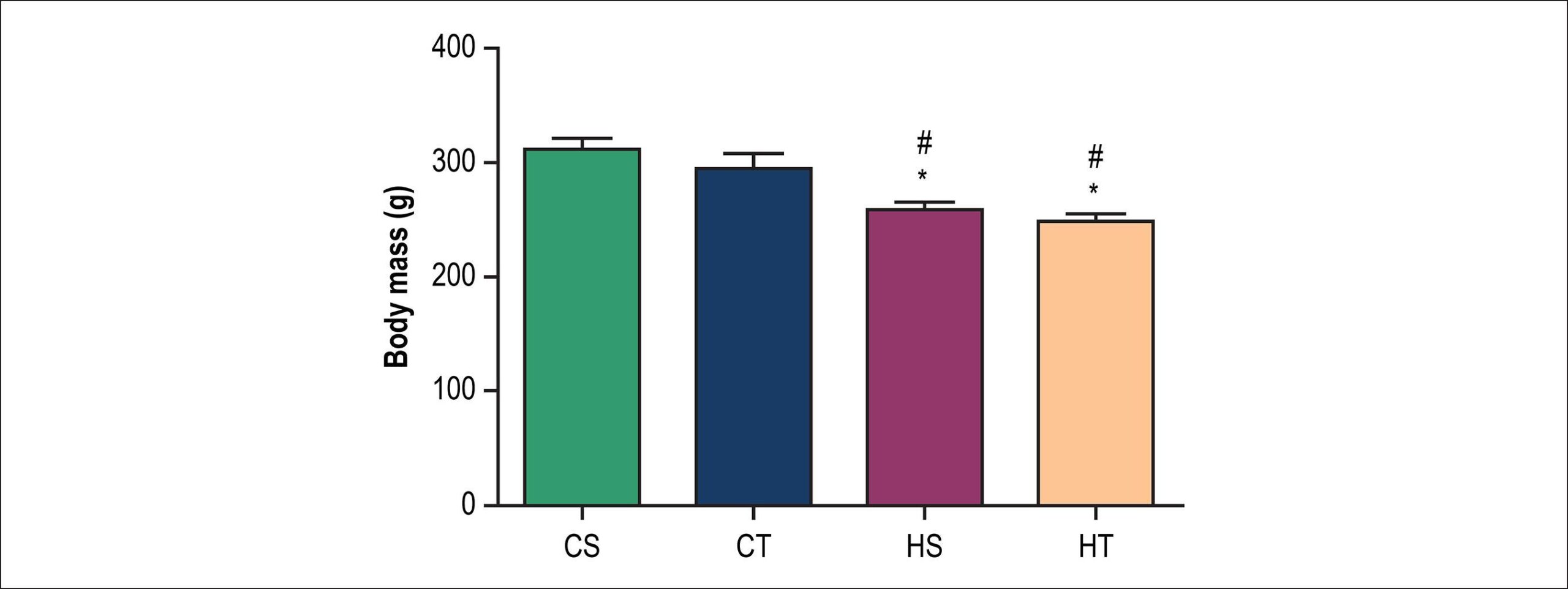
Rats SHR (n = 16) and Wistar (n = 16) at 8 weeks of age, at the beginning of the experiment, were randomly divided into 4 groups: sedentary control (CS, n = 8); trained control (CT, n = 8); sedentary SHR (HS, n = 8) and trained SHR (HT, n = 8). Resistance exercise training was performed in a stairmaster-type equipment (1.1 × 0.18 m, 2 cm between the steps, 80° incline) with weights attached to their tails, (5 days/week, 8 weeks). Baroreceptor reflex control of heart rate (HR) was tested by loading/unloading of baroreceptors with phenylephrine and sodium nitroprusside.

Results:

Resistance exercise training increased the soleus muscle mass in SHR when compared to HS (HS 0.027 ± 0.002 g/mm and HT 0.056 ± 0.003 g/mm). Resistance exercise training did not alter BP. On the other hand, in relation to baroreflex sensitivity, bradycardic response was improved in the TH group when compared to HS (HS -1.3 ± 0.1 bpm/mmHg and HT -2.6 ± 0.2 bpm/mmHg) although tachycardia response was not altered by resistance exercise (CS -3.3 ± 0.2 bpm/mmHg, CT -3.3 ± 0.1 bpm/mmHg, HS -1.47 ± 0.06 bpm/mmHg and HT -1.6 ± 0.1 bpm/mmHg).

Conclusion:

Resistance exercise training was able to promote improvements on baroreflex sensitivity of SHR rats, through the improvement of bradycardic response, despite not having reduced BP.

  • Baroreflex
  • Exercise
  • Heart Rate
  • Hypertension
  • Muscle Hypertrophy
Read Full Article
Creative Commons Attribution (CC BY) Creative Commons license
25/05/2017 DOI: 10.5935/abc.20170065 Views 1
Behavior of central and peripheral chemoreflexes in heart failure
ABC
Review Article

Behavior of central and peripheral chemoreflexes in heart failure

Guilherme Veiga Guimarães et al. Juliana Fernanda Canhadas Belli Fernando Bacal Edimar Alcides Bocchi

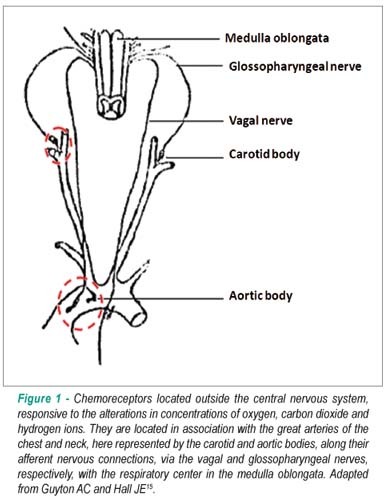
The heart failure (HF) syndrome can be defined as the final pathway of any type of heart disease. The sympatho-inhibitory cardiovascular reflexes, such as the arterial baroreceptor reflex, are significantly decreased in HF. Patients with HF present higher ventilation for a certain workload when compared with normal individuals. This fact generates low ventilatory efficiency and is related to higher ventilation associated with the carbon dioxide production, which is a predictor of bad prognosis, in addition to being a limiting factor for the practice of exercises. There is evidence that the autonomic imbalance contributes to the pathogenesis and the progression of heart failure. The chemoreflexes are the main mechanisms of control and regulation of the ventilatory responses to the changes in concentrations of arterial oxygen and carbon dioxide. The chemoreflex activation causes an increase in the sympathetic activity, heart rate, arterial pressure and minute volume. However, the increase in the minute volume and the arterial pressure, due to negative feedback, cause inhibition of the sympathetic response at the chemoreflex activation. In spite of the functional alterations of the reflexes, their behavior in normal and pathological conditions, especially their contribution to the sympathoexcitatory state observed in HF has not been broadly studied. Therefore, this review aims at integrating the knowledge on central and peripheral chemoreflexes in HF syndrome, as well as clarifying the influence of the heart failure drug therapy on the chemoreflexes.

  • Autonomic Nervous System
  • Baroreflex
  • Heart Failure
Read Full Article
Creative Commons Attribution (CC BY) Creative Commons license
07/01/2011 DOI: 10.1590/S0066-782X2011005000003
Sidestream cigarette smoke exposure effects on baroreflex in adult rats
ABC
Artigo Original

Sidestream cigarette smoke exposure effects on baroreflex in adult rats

Vitor E. Valenti et al. Luiz Carlos de Abreu Celso Ferreira

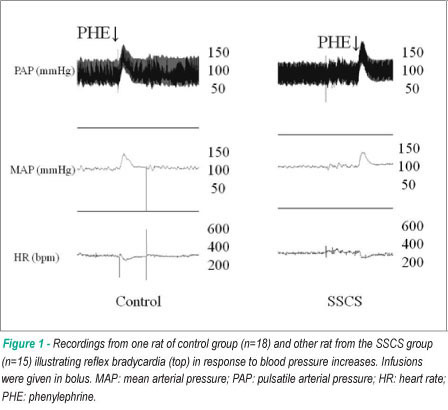
BACKGROUND: It has been evidenced in the literature that exposure to cigarette smoke causes hypertension in rats; however, it has not been demonstrated if the baroreflex function is impaired before the animal becomes hypertensive. OBJECTIVE: We evaluated short-term effects of sidestream cigarette smoke (SSCS) exposure on baroreflex function in Wistar normotensive rats. METHODS: Rats were exposed to SSCS during three weeks, 180 minutes, five days per week, at a concentration of monoxide carbon between 100-300 ppm. Mean arterial pressure (MAP) and heart rate (HR) were evaluated through cannulation of the femoral vein and artery. RESULTS: There was no significant difference between control and SSCS groups regarding basal mean arterial pressure and heart rate, sympathetic and parasympathetic components of the baroreflex function. CONCLUSION: Our data suggest that three weeks of exposure to SSCS is not enough to significantly impair cardiovascular parameters and baroreflex sensitivity in normotensive Wistar rats.

  • Baroreflex
  • Rats
  • Smoke
  • smoke inhalation injury
  • Tobacco
Read Full Article
Creative Commons Attribution (CC BY) Creative Commons license
22/12/2010 DOI: 10.1590/S0066-782X2010005000164 Views 1
Evaluation of baroreflex function in young spontaneously hypertensive rats
ABC
Artigo Original

Evaluation of baroreflex function in young spontaneously hypertensive rats

Vitor E. Valenti et al. Celso Ferreira Adriano Meneghini Marcelo Ferreira … Neif Murad Celso Ferreira Filho João Antônio Correa Luiz Carlos de Abreu Eduardo Colombari

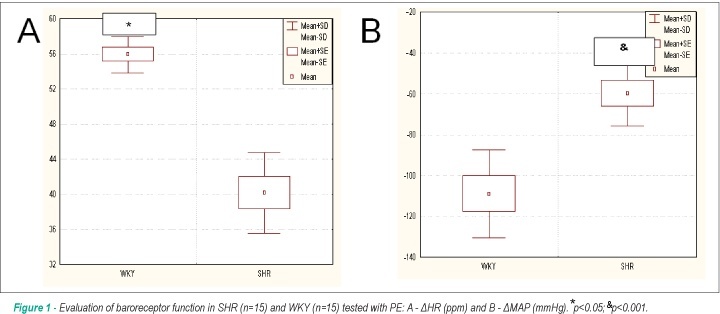
BACKGROUND: The literature describes contradictory data regarding the onset of the baroreflex reduction in spontaneously hypertensive rats. OBJECTIVE:This investigation was undertaken to evaluate the baroreflex function in 13-week-old spontaneously hypertensive rats. METHODS:Male Wistar Kyoto (n=15) and spontaneously hypertensive rats (n=15) aged 13 weeks were studied. Cannulas were inserted in the abdominal aortic artery through the right femoral artery to measure mean arterial pressure and heart rate. Baroreflex function was calculated as the derivative of the variation of HR in function of the MAP variation (Δheart rate/Δmean arterial pressure) tested with a depressor dose of sodium nitroprusside (50µg/kg) and with a pressor dose of phenylephrine (8µg/kg) in the right femoral venous approach through an inserted cannula in awake spontaneously hypertensive rats and Wistar-Kyoto. Differences with p values < 0.05 were considered statistically significant. RESULTS:Spontaneously hypertensive rats: Δmean arterial pressure=43.5mmHg±5.2, Δheart rate=-59.7ppm±17.9 and Δheart rate/Δmean arterial pressure=1.3ppm/mmHg±0.1 tested with phenylephrine; Wistar Kyoto: Δmean arterial pressure=&56mmHg±3, Δheart rate=*-114.9ppm±11.3 and Δheart rate/Δmean arterial pressure=#1.9ppm/mmHg±0.3 tested with phenylephrine; spontaneously hypertensive rats: Δmean arterial pressure=-45.6mmHg±8.1, Δheart rate=40.1ppm±11.6 and Δheart rate/Δmean arterial pressure=0.9ppm/mmHg±0.5 tested with sodium nitroprusside; Wistar Kyoto: Δmean arterial pressure=-39.8mmHg±6.2, Δheart rate=51.9ppm±21.8 and Δheart rate/Δmean arterial pressure=1.4ppm/mmHg±0.7 tested with sodium nitroprusside (*p<0.05; #p<0.01; &p<0.001). CONCLUSION: Our results showed that 13-week-old spontaneously hypertensive rats presented reduced baroreflex function when tested with phenylephrine.

  • Age of Onset
  • Baroreflex
  • central nervous system
  • Hypertension
Read Full Article
Creative Commons Attribution (CC BY) Creative Commons license
17/04/2009 DOI: 10.1590/S0066-782X2009000300009 Views 1

How to cite this article

EndNote RIS

Electronic Document Format (Vancouver)

Malachias MVB. Polycystic Ovary Syndrome and Cardiovascular Diseases: Still an Open Door. Arquivos Brasileiros de Cardiologia 2019;112(4):430-1.

Electronic Document Format (ABNT)

Malachias, Marcus Vinicius Bolivar. Polycystic Ovary Syndrome and Cardiovascular Diseases: Still an Open Door. Arquivos Brasileiros de Cardiologia, v. 112, n. 4, p. 430-431, Apr. 2019.

Electronic Document Format (APA)

Malachias, M. V. B. (2019). Polycystic Ovary Syndrome and Cardiovascular Diseases: Still an Open Door. Arquivos Brasileiros de Cardiologia, 112(4), 430-431.

Electronic Document Format (ISO)

Malachias, Marcus Vinicius Bolivar. Polycystic Ovary Syndrome and Cardiovascular Diseases: Still an Open Door. Arquivos Brasileiros de Cardiologia [online]. 2019, vol. 112, n. 4, [cited 2026-10-14], pp. 430-431. Available from: <https://journals.cardiol.br/en/article/polycystic-ovary-syndrome-and-cardiovascular-diseases-still-an-open-door/>. ISSN 0066-782X

EndNote RIS

Electronic Document Format (Vancouver)

Gomes MFP, Borges ME, Rossi VA, Moura EOC, Medeiros A. The Effect of Physical Resistance Training on Baroreflex Sensitivity of Hypertensive Rats. Arquivos Brasileiros de Cardiologia 2017;108(6):539-45.

Electronic Document Format (ABNT)

Gomes, Moisés Felipe Pereira; Borges, Mariana Eiras; Rossi, Vitor de Almeida; Moura, Elizabeth de Orleans C. de; Medeiros, Alessandra. The Effect of Physical Resistance Training on Baroreflex Sensitivity of Hypertensive Rats. Arquivos Brasileiros de Cardiologia, v. 108, n. 6, p. 539-545, May. 2017.

Electronic Document Format (APA)

Gomes, M. F. P., Borges, M. E., Rossi, V. A., Moura, E. O. C. , & Medeiros, A. (2017). The Effect of Physical Resistance Training on Baroreflex Sensitivity of Hypertensive Rats. Arquivos Brasileiros de Cardiologia, 108(6), 539-545.

Electronic Document Format (ISO)

Gomes, Moisés Felipe Pereira and Borges, Mariana Eiras and Rossi, Vitor de Almeida and Moura, Elizabeth de Orleans C. de and Medeiros, Alessandra. The Effect of Physical Resistance Training on Baroreflex Sensitivity of Hypertensive Rats. Arquivos Brasileiros de Cardiologia [online]. 2017, vol. 108, n. 6, [cited 2026-10-14], pp. 539-545. Available from: <https://journals.cardiol.br/en/article/the-effect-of-physical-resistance-training-on-baroreflex-sensitivity-of-hypertensive-rats/>. ISSN 0066-782X

EndNote RIS

Electronic Document Format (Vancouver)

Guimarães GV, Belli JFC, Bacal F, Bocchi EA. Behavior of central and peripheral chemoreflexes in heart failure. Arquivos Brasileiros de Cardiologia 2011;96(2):161-7.

Electronic Document Format (ABNT)

Guimarães, Guilherme Veiga; Belli, Juliana Fernanda Canhadas; Bacal, Fernando; Bocchi, Edimar Alcides. Behavior of central and peripheral chemoreflexes in heart failure. Arquivos Brasileiros de Cardiologia, v. 96, n. 2, p. 161-167, Jan. 2011.

Electronic Document Format (APA)

Guimarães, G. V., Belli, J. F. C., Bacal, F., & Bocchi, E. A. (2011). Behavior of central and peripheral chemoreflexes in heart failure. Arquivos Brasileiros de Cardiologia, 96(2), 161-167.

Electronic Document Format (ISO)

Guimarães, Guilherme Veiga and Belli, Juliana Fernanda Canhadas and Bacal, Fernando and Bocchi, Edimar Alcides. Behavior of central and peripheral chemoreflexes in heart failure. Arquivos Brasileiros de Cardiologia [online]. 2011, vol. 96, n. 2, [cited 2026-10-14], pp. 161-167. Available from: <https://journals.cardiol.br/en/article/behavior-of-central-and-peripheral-chemoreflexes-in-heart-failure/>. ISSN 0066-782X

EndNote RIS

Electronic Document Format (Vancouver)

Valenti VE, Abreu LC, Ferreira C. Sidestream cigarette smoke exposure effects on baroreflex in adult rats. Arquivos Brasileiros de Cardiologia 2010;96(2):148-53.

Electronic Document Format (ABNT)

Valenti, Vitor E.; Abreu, Luiz Carlos de; Ferreira, Celso. Sidestream cigarette smoke exposure effects on baroreflex in adult rats. Arquivos Brasileiros de Cardiologia, v. 96, n. 2, p. 148-153, Dec. 2010.

Electronic Document Format (APA)

Valenti, V. E., Abreu, L. C. , & Ferreira, C. (2010). Sidestream cigarette smoke exposure effects on baroreflex in adult rats. Arquivos Brasileiros de Cardiologia, 96(2), 148-153.

Electronic Document Format (ISO)

Valenti, Vitor E. and Abreu, Luiz Carlos de and Ferreira, Celso. Sidestream cigarette smoke exposure effects on baroreflex in adult rats. Arquivos Brasileiros de Cardiologia [online]. 2010, vol. 96, n. 2, [cited 2026-10-14], pp. 148-153. Available from: <https://journals.cardiol.br/en/article/sidestream-cigarette-smoke-exposure-effects-on-baroreflex-in-adult-rats/>. ISSN 0066-782X

EndNote RIS

Electronic Document Format (Vancouver)

Valenti VE, Ferreira C, Meneghini A, Ferreira M, Murad N, Ferreira Filho C, Correa JA, et al. Evaluation of baroreflex function in young spontaneously hypertensive rats. Arquivos Brasileiros de Cardiologia 2009;92(3):216-21.

Electronic Document Format (ABNT)

Valenti, Vitor E.; Ferreira, Celso; Meneghini, Adriano; Ferreira, Marcelo; Murad, Neif; Ferreira Filho, Celso; Correa, João Antônio; Abreu, Luiz Carlos de; Colombari, Eduardo. Evaluation of baroreflex function in young spontaneously hypertensive rats. Arquivos Brasileiros de Cardiologia, v. 92, n. 3, p. 216-221, Apr. 2009.

Electronic Document Format (APA)

Valenti, V. E., Ferreira, C., Meneghini, A., Ferreira, M., Murad, N., Ferreira Filho, C., Correa, J. A., Abreu, L. C. , & Colombari, E. (2009). Evaluation of baroreflex function in young spontaneously hypertensive rats. Arquivos Brasileiros de Cardiologia, 92(3), 216-221.

Electronic Document Format (ISO)

Valenti, Vitor E. and Ferreira, Celso and Meneghini, Adriano and Ferreira, Marcelo and Murad, Neif and Ferreira Filho, Celso and Correa, João Antônio and Abreu, Luiz Carlos de and Colombari, Eduardo. Evaluation of baroreflex function in young spontaneously hypertensive rats. Arquivos Brasileiros de Cardiologia [online]. 2009, vol. 92, n. 3, [cited 2026-10-14], pp. 216-221. Available from: <https://journals.cardiol.br/en/article/evaluation-of-baroreflex-function-in-young-spontaneously-hypertensive-rats/>. ISSN 0066-782X

  • About ABC Family
  • Internal Regulation
  • Editorial Board
  • Brazilian Society of Cardiology (SBC)

Issues

SBC Guidelines

  • Videos
  • Podcasts
  • News