ABC Family Arquivos Brasileiros de Cardiologia International Journal of Cardiovascular Sciences ABC Heart Failure & Cardiomyopathy ABC Imagem Cardiovascular
Português English
ABC Family
Português English
  • About
    • About ABC Family
    • Internal Regulation
    • Editorial Board
    • Brazilian Society of Cardiology (SBC)
  • Issues
  • SBC Guidelines
  • Content
    • Videos
    • Podcasts
    • News
  • About
    • About ABC Family
    • Internal Regulation
    • Editorial Board
    • Brazilian Society of Cardiology (SBC)
  • Issues
  • SBC Guidelines
  • Content
    • Videos
    • Podcasts
    • News

ABC Family

  • ABC Family
  • Arquivos Brasileiros de Cardiologia
  • International Journal of Cardiovascular Sciences
  • ABC Heart Failure & Cardiomyopathy
  • ABC Imagem Cardiovascular
Search in

No content found.

Journals
Ordering
Article types
Others

  1. Home
  2. Keyword: Angiotensin-converting Enzyme Inhibitor
Figure 1
ABCHF
Viewpoint

SGLT2 Inhibitors and Sacubitril-Valsartan: How Trial Results will Revolutionize the Treatment of Heart Failure with Mildly Reduced Ejection Fraction

Miguel Morita Fernandes-Silva

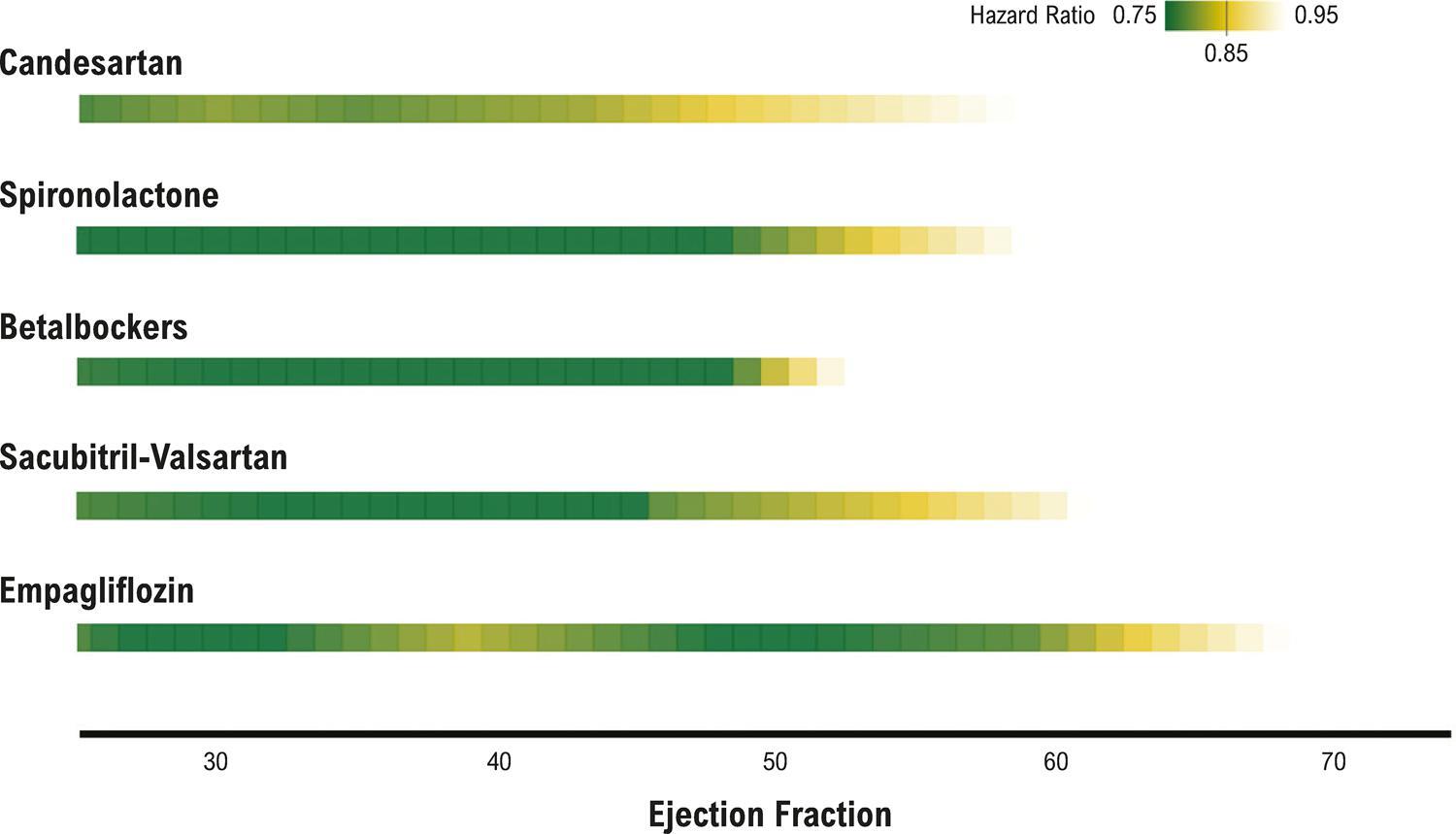
Left ventricular ejection fraction (EF) is a key parameter in the management of heart failure (HF) and a crucial biomarker for prognostic evaluation and therapeutic decision. Patients with HF are classified into different categories according to EF. Although the concept of “normal” EF was introduced four decades ago, the cutoff values for normal and abnormal EF have considerably varied over time. In 2016, the European Society of Cardiology HF guidelines defined HF with reduced EF (HFrEF) as patients with EF below 40%, while HF with preserved EF (HFpEF) was the category for patients with EF equal to 50% or above. To fill in the gap between the two categories, the term HF with mid-range EF was introduced. More recently, the guidelines considered more appropriate to rename this category to HF with mildly reduced EF (HFmrEF). , Why has the EF-based classification changed in recent years and how may this affect HF treatment?

In the 1980s, the first HF trials used in their design EF cutoffs to select patients with worse prognosis as an enrichment strategy, ie, they included patients based on a biomarker that improves design efficiency. Because patients with lower EF have worse prognosis and, therefore, higher rates of events, a relatively smaller sample size would be required to detect an effect. These trials used cutoff values for EF that ranged from < 45% to < 25% ( ) and were highly successful in finding effective therapies. In general, trials using a cutoff EF of < 40% consistently found drugs and devices for the treatment of HF that improved outcomes.

[…]

  • Angiotensin receptor-neprylisin Inhibitor
  • Angiotensin-converting Enzyme Inhibitor
  • Beta-blocker
  • Ejection Fraction
  • Heart Failure
  • Mineralocorticoid Receptor Antagonist
  • Sodium-glucose Cotransporter 2 Inhibitor
Read Full Article
Creative Commons Attribution (CC BY) Creative Commons license
12/04/2022 DOI: 10.36660/abchf.20220013 Views 1
Do cardiologists at a university hospital adopt the guidelines for the treatment of heart failure?
ABC
Original Article

Do cardiologists at a university hospital adopt the guidelines for the treatment of heart failure?

Antonio Carlos Pereira Barretto et al. Moacyr Roberto Cucê Nobre Inês Lancarotte Airton Roberto Scipioni José Antonio Franchini Ramires

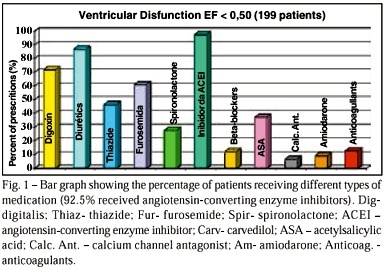
OBJECTIVE: To verify whether the guidelines for the treatment of heart failure have been adopted at a university hospital. The guidelines recommend the following: use of angiotensin-converting enzyme inhibitors for all patients with systolic ventricular dysfunction, use of digitalis and diuretics for symptomatic patients, use of beta-blockers for patients in functional classes II or III, use of spironolactone for patients in functional classes III or IV. METHODS: We analyzed the prescriptions of 199 patients. All these patients had ejection fraction (EF) <=0.50, their ages ranged from 25 to 86 years, and 142 were males. Cardiomyopathy was the most frequent diagnosis: 67 (33.6%) patients had dilated cardiomyopathy, 65 (32.6%) had ischemic cardiomyopathy. RESULTS: Angiotensin-converting enzyme inhibitors were prescribed for 93% of the patients. 71.8% also had a prescription for digitalis, 86.9% for diuretics, 27.6% for spironolactone, 12% for beta-blockers, 37.2% for acetylsalicylic acid, 6.5% for calcium channel antagonists, and 12.5% for anticoagulants. In regard to vasodilators, 71% of the patients were using captopril (85.2mg/day), 20% enalapril (21.4mg/day), 3% hydralazine and nitrates. In 71.8% of the cases, the dosages prescribed were in accordance with those recommended in the large studies. CONCLUSION: Most patients were prescribed the same doses as those recommended in the large studies. Brazilian patients tolerate well the doses recommended in the studies, and that not using these doses may be a consequence of the physician's fear of prescribing them and not of the patient's intolerance.

  • Angiotensin-converting Enzyme Inhibitor
  • Anticoagulation
  • beta-blockers
  • Heart Failure
Read Full Article
Creative Commons Attribution (CC BY) Creative Commons license
30/07/2001 DOI: 10.1590/S0066-782X2001000700003

How to cite this article

EndNote RIS

Electronic Document Format (Vancouver)

Fernandes-Silva MM. SGLT2 Inhibitors and Sacubitril-Valsartan: How Trial Results will Revolutionize the Treatment of Heart Failure with Mildly Reduced Ejection Fraction. ABC Heart Fail Cardiomyop 2022;2(1):67-71.

Electronic Document Format (ABNT)

Fernandes-Silva, Miguel Morita. SGLT2 Inhibitors and Sacubitril-Valsartan: How Trial Results will Revolutionize the Treatment of Heart Failure with Mildly Reduced Ejection Fraction. ABC Heart Fail Cardiomyop, v. 2, n. 1, p. 67-71, Apr. 2022.

Electronic Document Format (APA)

Fernandes-Silva, M. M. (2022). SGLT2 Inhibitors and Sacubitril-Valsartan: How Trial Results will Revolutionize the Treatment of Heart Failure with Mildly Reduced Ejection Fraction. ABC Heart Fail Cardiomyop, 2(1), 67-71.

Electronic Document Format (ISO)

Fernandes-Silva, Miguel Morita. SGLT2 Inhibitors and Sacubitril-Valsartan: How Trial Results will Revolutionize the Treatment of Heart Failure with Mildly Reduced Ejection Fraction. ABC Heart Fail Cardiomyop [online]. 2022, vol. 2, n. 1, [cited 2026-10-14], pp. 67-71. Available from: <https://journals.cardiol.br/en/article/sglt2-inhibitors-and-sacubitril-valsartan-how-trial-results-will-revolutionize-the-treatment-of-heart-failure-with-mildly-reduced-ejection-fraction/>

EndNote RIS

Electronic Document Format (Vancouver)

Barretto ACP, Nobre MRC, Lancarotte I, Scipioni AR, Ramires JAF. Do cardiologists at a university hospital adopt the guidelines for the treatment of heart failure?. Arquivos Brasileiros de Cardiologia 2001;77(1):30-6.

Electronic Document Format (ABNT)

Barretto, Antonio Carlos Pereira; Nobre, Moacyr Roberto Cucê; Lancarotte, Inês; Scipioni, Airton Roberto; Ramires, José Antonio Franchini. Do cardiologists at a university hospital adopt the guidelines for the treatment of heart failure?. Arquivos Brasileiros de Cardiologia, v. 77, n. 1, p. 30-36, Jul. 2001.

Electronic Document Format (APA)

Barretto, A. C. P., Nobre, M. R. C., Lancarotte, I., Scipioni, A. R., & Ramires, J. A. F. (2001). Do cardiologists at a university hospital adopt the guidelines for the treatment of heart failure?. Arquivos Brasileiros de Cardiologia, 77(1), 30-36.

Electronic Document Format (ISO)

Barretto, Antonio Carlos Pereira and Nobre, Moacyr Roberto Cucê and Lancarotte, Inês and Scipioni, Airton Roberto and Ramires, José Antonio Franchini. Do cardiologists at a university hospital adopt the guidelines for the treatment of heart failure?. Arquivos Brasileiros de Cardiologia [online]. 2001, vol. 77, n. 1, [cited 2026-10-14], pp. 30-36. Available from: <https://journals.cardiol.br/en/article/do-cardiologists-at-a-university-hospital-adopt-the-guidelines-for-the-treatment-of-heart-failure/>. ISSN 0066-782X

  • About ABC Family
  • Internal Regulation
  • Editorial Board
  • Brazilian Society of Cardiology (SBC)

Issues

SBC Guidelines

  • Videos
  • Podcasts
  • News