ABC Family Arquivos Brasileiros de Cardiologia International Journal of Cardiovascular Sciences ABC Heart Failure & Cardiomyopathy ABC Imagem Cardiovascular
Português English
ABC Family
Português English
  • About
    • About ABC Family
    • Internal Regulation
    • Editorial Board
    • Brazilian Society of Cardiology (SBC)
  • Issues
  • SBC Guidelines
  • Content
    • Videos
    • Podcasts
    • News
  • About
    • About ABC Family
    • Internal Regulation
    • Editorial Board
    • Brazilian Society of Cardiology (SBC)
  • Issues
  • SBC Guidelines
  • Content
    • Videos
    • Podcasts
    • News

ABC Family

  • ABC Family
  • Arquivos Brasileiros de Cardiologia
  • International Journal of Cardiovascular Sciences
  • ABC Heart Failure & Cardiomyopathy
  • ABC Imagem Cardiovascular
Search in

No content found.

Journals
Ordering
Article types
Others

  1. Home
  2. Keyword: Ambulatory Electrocardiography
Comparative Analysis of ECG and Holter Monitoring in the Assessment of Heart Rate in Heart Failure with Reduced Ejection Fraction and Sinus Rhythm
ABC
Original Article

Comparative Analysis of ECG and Holter Monitoring in the Assessment of Heart Rate in Heart Failure with Reduced Ejection Fraction and Sinus Rhythm

Fabio Eduardo Camazzola et al. Pedro Vellosa Schwartzmann Marcelo Sabedotti Rafael Massuti … Tulio Zortea Vitoria Chen Ana Carolina Guimarães Maggi Francine Fonseca de Souza Andressa da Silva Cardoso Luciano da Silva Selistre

Abstract

Background

Heart rate (HR) has shown prognostic value in patients with heart failure with reduced ejection fraction (HFrEF) and sinus rhythm. However, the method of measurement is debated in the literature.

Objectives

To compare HR on Holter with 3 resting electrocardiograms (ECG1, ECG2, and ECG3) in patients with HFrEF and sinus rhythm.

Methods

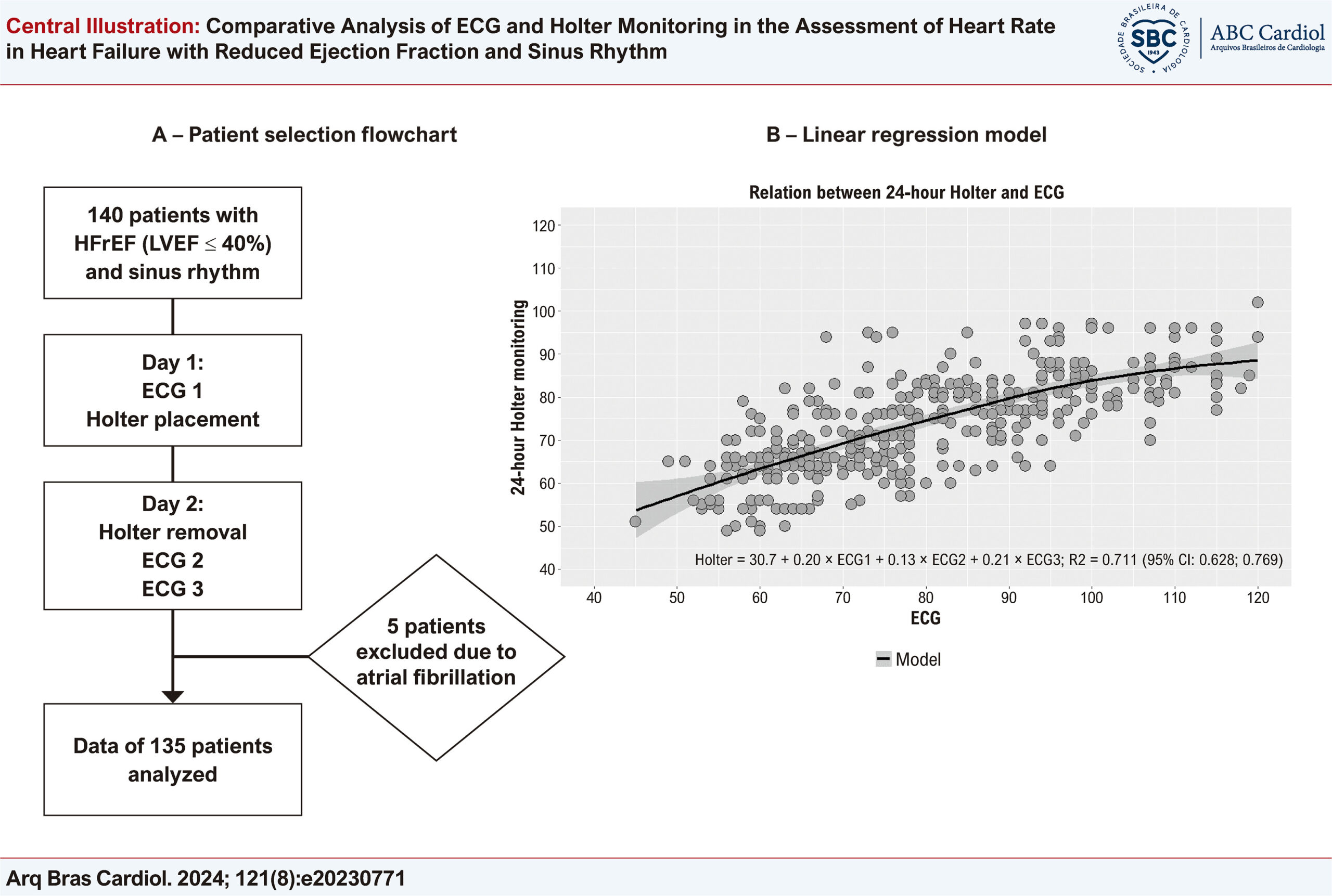
This was a cross-sectional study with 135 patients with heart failure with ejection fraction ≤ 40% and sinus rhythm. HR was assessed by ECG and Holter. Analyses included intraclass correlation coefficient (ICC), robust regression, root mean squared error, Bland-Altman, and area under the receiver operating characteristic (ROC) curve. A significance level of 0.05 and Bonferroni-Holm adjustment were adopted to minimize type I errors.

Results

The median [interquartile range] age and ejection fraction were 65 years [16] and 30% [11], respectively. The ICC of the 3 ECGs was 0.922 (95% confidence interval: 0.892; 0.942). The robust regression coefficients for ECG1 and ECG3 were 0.20 (95% confidence interval: 0.12; 0.29) and 0.21 (95% confidence interval: 0.06; 0.36). The robust R2 was 0.711 (95% confidence interval: 0.628; 0.76). In the Bland-Altman agreement analysis, the limits of agreement were −17.0 (95% confidence interval: −19.0; −15.0) and 32.0 (95% confidence interval: 30.0; 34.0). The area under the ROC curve was 0.896 (95% confidence interval: 0.865; 0.923).

Conclusion

The HR on ECG showed high agreement with the HR on Holter, validating its clinical use in patients with HFrEF and sinus rhythm. However, agreement was suboptimal in one third of patients with HR below 70 bpm on ECG; thus, 24-hour Holter monitoring should be considered in this context.
  • Ambulatory Electrocardiography
  • Electrocardiography
  • Heart Failure
  • Heart Rate
Read Full Article
Creative Commons Attribution (CC BY) Creative Commons license
26/08/2024 DOI: 10.36660/abc.20230771i Views 1
IJCS
Editorial

Venturing into Uncharted Territories: Unveiling Frontal QRS-T Angle in Patients with Coronary Artery Ectasia

Maqsood Alam et al. Eduardo Sanhueza Adrian Baranchuk

It is with profound interest that we read the manuscript by Karahan et al. titled “Evaluation of Frontal QRS-T Angle in Patients with Coronary Artery Ectasia” published in the recent volume of International Journal of Cardiovascular Sciences . Coronary artery ectasia (CAE), a condition marked by focal enlargement of coronary arteries, has long intrigued researchers and clinicians due to its enigmatic nature. Beyond its silence existence, CAE hides a spectrum of clinical ranges, from chest pain with coexisting coronary artery disease to life threatening arrhythmias and sudden cardiac death. , While previous research has delved into the multifaceted etiology of CAE, , this study took a unique path, exploring the electrocardiographic landscape to better understand ventricular heterogeneity in CAE.

The cornerstone of this study lies in the evaluation of frontal QRS-T angle, a marker of ventricular repolarization heterogeneity. Spatial QRS-T angles have received attention in previous research, often as an indicator of worse cardiovascular outcomes. This method is a little tiresome, as it requires a 3-dimensional computational model for interpretation, whereas the ease of measurement of the frontal QRS-T angle from routine 12-lead electrocardiograms makes it an attractive alternative candidate for exploring ventricular repolarization. The frontal QRS-T angle was calculated as the absolute value of difference between the QRS- and T-axis, yielding values between 0° and 180°, and it was categorized as normal (≤ 90° ) or abnormal (≥ 100°). However, its application in the context of CAE is a novel and compelling avenue of investigation.

[…]

  • Ambulatory Electrocardiography
  • Coronary Vessels
  • Pathologic Dilatation
Read Full Article
Creative Commons Attribution (CC BY) Creative Commons license
07/06/2024 DOI: 10.36660/ijcs.20240049
Evaluation of asymptomatic patients with chronic Chagas’ disease through ambulatory electrocardiogram, echocardiogram and B-Type natriuretic peptide analyses
ABC
Artigo Original

Evaluation of asymptomatic patients with chronic Chagas’ disease through ambulatory electrocardiogram, echocardiogram and B-Type natriuretic peptide analyses

Divina Seila de Oliveira Marques et al. Manoel Fernandes Canesin Flavio Barutta Júnior Claudio José Fuganti Antonio Carlos Pereira Barretto

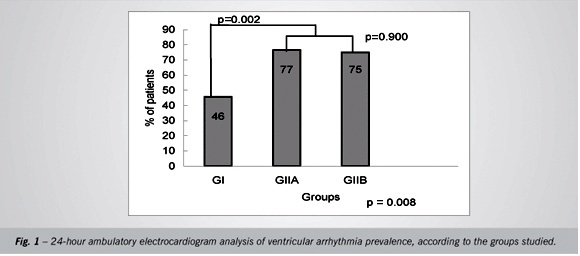
OBJECTIVE: To evaluate asymptomatic patients with chronic Chagas’ disease to determine prevalence of ventricular arrhythmias, left ventricular dysfunction, and B-type natriuretic peptide (BNP) plasma levels. METHODS: One hundred and six patients from the Chagas’ disease outpatient clinic underwent clinical evaluation, electrocardiogram (ECG), cardiothoracic index (CTI), ambulatory electrocardiogram (Holter monitoring), echocardiogram, and BNP measurement and then were distributed into three groups: GI, with normal ECG (n = 50); GIIA, with ECG changes characteristic of Chagas’ disease (n = 31); and GIIB, with other ECG changes (n = 25). RESULTS: The most common electrocardiographic changes were the following. GIIA: complete right bundle branch block (35%), left anterior hemiblock (35%), and electrically inactive areas (32%); GIIB: inferolateral repolarization change (28%), and left ventricular overload (24%). Mean CTI index values were similar (p = 0.383). Ventricular arrhythmia prevalence was higher in the GIIA (77%) and GIIB (75%) groups than in the GI group (46%) (p = 0.002). Ventricular dysfunction was more prevalent in the GIIA (52%) and GIIB (32%) groups than in the GI group (14%) (p = 0.001). Systolic dysfunction was more prevalent in the GIIA group (29%) than in the GIIB (20%) and GI groups (2%) (p < 0.001). Diastolic dysfunction was more prevalent in the GIIA (42%) and GIIB (28%) groups than in the GI group (12%) (p = 0.005). Mean B-type natriuretic peptide levels were 30 ± 88 pg/mL in the GI group, 66 ± 194 in the GIIA group and 24 ± 82 for the GIIB group (p = 0.121), respectively. CONCLUSION: Arrhythmias and left ventricular dysfunction are more prevalent in asymptomatic patients with chronic Chagas’ disease and abnormal ECG than in patients with normal ECG. Plasma BNP levels were similar among the groups.

  • Ambulatory Electrocardiography
  • Brain Natriuretic Peptide
  • Chagas disease
  • Doppler Echocardiography
Read Full Article
Creative Commons Attribution (CC BY) Creative Commons license
16/10/2006 DOI: 10.1590/S0066-782X2006001600017 Views 1

How to cite this article

EndNote RIS

Electronic Document Format (Vancouver)

Camazzola FE, Schwartzmann PV, Sabedotti M, Massuti R, Zortea T, Chen V, Maggi ACG, et al. Comparative Analysis of ECG and Holter Monitoring in the Assessment of Heart Rate in Heart Failure with Reduced Ejection Fraction and Sinus Rhythm. Arquivos Brasileiros de Cardiologia 2024;121(8):e20230771.

Electronic Document Format (ABNT)

Camazzola, Fabio Eduardo; Schwartzmann, Pedro Vellosa; Sabedotti, Marcelo; Massuti, Rafael; Zortea, Tulio; Chen, Vitoria; Maggi, Ana Carolina Guimarães; Souza, Francine Fonseca de; Cardoso, Andressa da Silva; Selistre, Luciano da Silva. Comparative Analysis of ECG and Holter Monitoring in the Assessment of Heart Rate in Heart Failure with Reduced Ejection Fraction and Sinus Rhythm. Arquivos Brasileiros de Cardiologia, v. 121, n. 8, e20230771, Aug. 2024.

Electronic Document Format (APA)

Camazzola, F. E., Schwartzmann, P. V., Sabedotti, M., Massuti, R., Zortea, T., Chen, V., Maggi, A. C. G., Souza, F. F. , Cardoso, A. S., & Selistre, L. S. (2024). Comparative Analysis of ECG and Holter Monitoring in the Assessment of Heart Rate in Heart Failure with Reduced Ejection Fraction and Sinus Rhythm. Arquivos Brasileiros de Cardiologia, 121(8), e20230771.

Electronic Document Format (ISO)

Camazzola, Fabio Eduardo and Schwartzmann, Pedro Vellosa and Sabedotti, Marcelo and Massuti, Rafael and Zortea, Tulio and Chen, Vitoria and Maggi, Ana Carolina Guimarães and Souza, Francine Fonseca de and Cardoso, Andressa da Silva and Selistre, Luciano da Silva. Comparative Analysis of ECG and Holter Monitoring in the Assessment of Heart Rate in Heart Failure with Reduced Ejection Fraction and Sinus Rhythm. Arquivos Brasileiros de Cardiologia [online]. 2024, vol. 121, n. 8, [cited 2026-10-14], e20230771. Available from: <https://journals.cardiol.br/en/article/comparative-analysis-of-ecg-and-holter-monitoring-in-the-assessment-of-heart-rate-in-heart-failure-with-reduced-ejection-fraction-and-sinus-rhythm/>. ISSN 0066-782X

EndNote RIS

Electronic Document Format (Vancouver)

Alam M, Sanhueza E, Baranchuk A. Venturing into Uncharted Territories: Unveiling Frontal QRS-T Angle in Patients with Coronary Artery Ectasia. International Journal of Cardiovascular Sciences 2024;37:e20240049.

Electronic Document Format (ABNT)

Alam, Maqsood; Sanhueza, Eduardo; Baranchuk, Adrian. Venturing into Uncharted Territories: Unveiling Frontal QRS-T Angle in Patients with Coronary Artery Ectasia. International Journal of Cardiovascular Sciences, v. 37, e20240049, Jun. 2024.

Electronic Document Format (APA)

Alam, M., Sanhueza, E., & Baranchuk, A. (2024). Venturing into Uncharted Territories: Unveiling Frontal QRS-T Angle in Patients with Coronary Artery Ectasia. International Journal of Cardiovascular Sciences, 37, e20240049.

Electronic Document Format (ISO)

Alam, Maqsood and Sanhueza, Eduardo and Baranchuk, Adrian. Venturing into Uncharted Territories: Unveiling Frontal QRS-T Angle in Patients with Coronary Artery Ectasia. International Journal of Cardiovascular Sciences [online]. 2024, vol. 37, [cited 2026-10-14], e20240049. Available from: <https://journals.cardiol.br/en/article/venturing-into-uncharted-territories-unveiling-frontal-qrs-t-angle-in-patients-with-coronary-artery-ectasia/>. ISSN 2359-4802

EndNote RIS

Electronic Document Format (Vancouver)

Marques DSO, Canesin MF, Barutta Júnior F, Fuganti CJ, Barretto ACP. Evaluation of asymptomatic patients with chronic Chagas’ disease through ambulatory electrocardiogram, echocardiogram and B-Type natriuretic peptide analyses. Arquivos Brasileiros de Cardiologia 2006;87(3):336-43.

Electronic Document Format (ABNT)

Marques, Divina Seila de Oliveira; Canesin, Manoel Fernandes; Barutta Júnior, Flavio; Fuganti, Claudio José; Barretto, Antonio Carlos Pereira. Evaluation of asymptomatic patients with chronic Chagas’ disease through ambulatory electrocardiogram, echocardiogram and B-Type natriuretic peptide analyses. Arquivos Brasileiros de Cardiologia, v. 87, n. 3, p. 336-343, Oct. 2006.

Electronic Document Format (APA)

Marques, D. S. O., Canesin, M. F., Barutta Júnior, F., Fuganti, C. J., & Barretto, A. C. P. (2006). Evaluation of asymptomatic patients with chronic Chagas’ disease through ambulatory electrocardiogram, echocardiogram and B-Type natriuretic peptide analyses. Arquivos Brasileiros de Cardiologia, 87(3), 336-343.

Electronic Document Format (ISO)

Marques, Divina Seila de Oliveira and Canesin, Manoel Fernandes and Barutta Júnior, Flavio and Fuganti, Claudio José and Barretto, Antonio Carlos Pereira. Evaluation of asymptomatic patients with chronic Chagas’ disease through ambulatory electrocardiogram, echocardiogram and B-Type natriuretic peptide analyses. Arquivos Brasileiros de Cardiologia [online]. 2006, vol. 87, n. 3, [cited 2026-10-14], pp. 336-343. Available from: <https://journals.cardiol.br/en/article/evaluation-of-asymptomatic-patients-with-chronic-chagas-disease-through-ambulatory-electrocardiogram-echocardiogram-and-b-type-natriuretic-peptide-analyses/>. ISSN 0066-782X

  • About ABC Family
  • Internal Regulation
  • Editorial Board
  • Brazilian Society of Cardiology (SBC)

Issues

SBC Guidelines

  • Videos
  • Podcasts
  • News