ABC Family Arquivos Brasileiros de Cardiologia International Journal of Cardiovascular Sciences ABC Heart Failure & Cardiomyopathy ABC Imagem Cardiovascular
Português English
ABC Family
Português English
  • About
    • About ABC Family
    • Internal Regulation
    • Editorial Board
    • Brazilian Society of Cardiology (SBC)
  • Issues
  • SBC Guidelines
  • Content
    • Videos
    • Podcasts
    • News
  • About
    • About ABC Family
    • Internal Regulation
    • Editorial Board
    • Brazilian Society of Cardiology (SBC)
  • Issues
  • SBC Guidelines
  • Content
    • Videos
    • Podcasts
    • News

ABC Family

  • ABC Family
  • Arquivos Brasileiros de Cardiologia
  • International Journal of Cardiovascular Sciences
  • ABC Heart Failure & Cardiomyopathy
  • ABC Imagem Cardiovascular
Search in

No content found.

Journals
Ordering
Article types
Others

  1. Home
  2. Keyword: Access to Essential Medicines and Health Technologies
Evidence-Based Pharmacological Treatment for Heart Failure in Brazil
IJCS
Original Article

Evidence-Based Pharmacological Treatment for Heart Failure in Brazil

Luísa Preiss Marques da Rocha et al. Kathleen Asturian Isabel Machado Canabarro Lidia Einsfeld Diogo Pilger

Abstract

Background:

Heart failure (HF) affects an estimated 64 million individuals globally. Current guideline-directed medical therapy (GDMT) comprises four cornerstone pharmacological medications proven to reduce hospitalization and/or mortality: renin-angiotensin system inhibitors, beta-blockers, mineralocorticoid receptor antagonists (MRA), and sodium-glucose cotransporter 2 inhibitors (SGLT2i).

Objective:

This study aimed to describe, through an exploratory analysis, access to HF drug therapy in Primary Health Care in Brazil, via the Brazilian Unified Health System (SUS).

Methods:

This was a descriptive, cross-sectional study based on data extracted from Municipal Lists of Essential Medicines (REMUMEs) published on official municipalities’ websites from Brazilian metropolitan regions in June 2024.

Results:

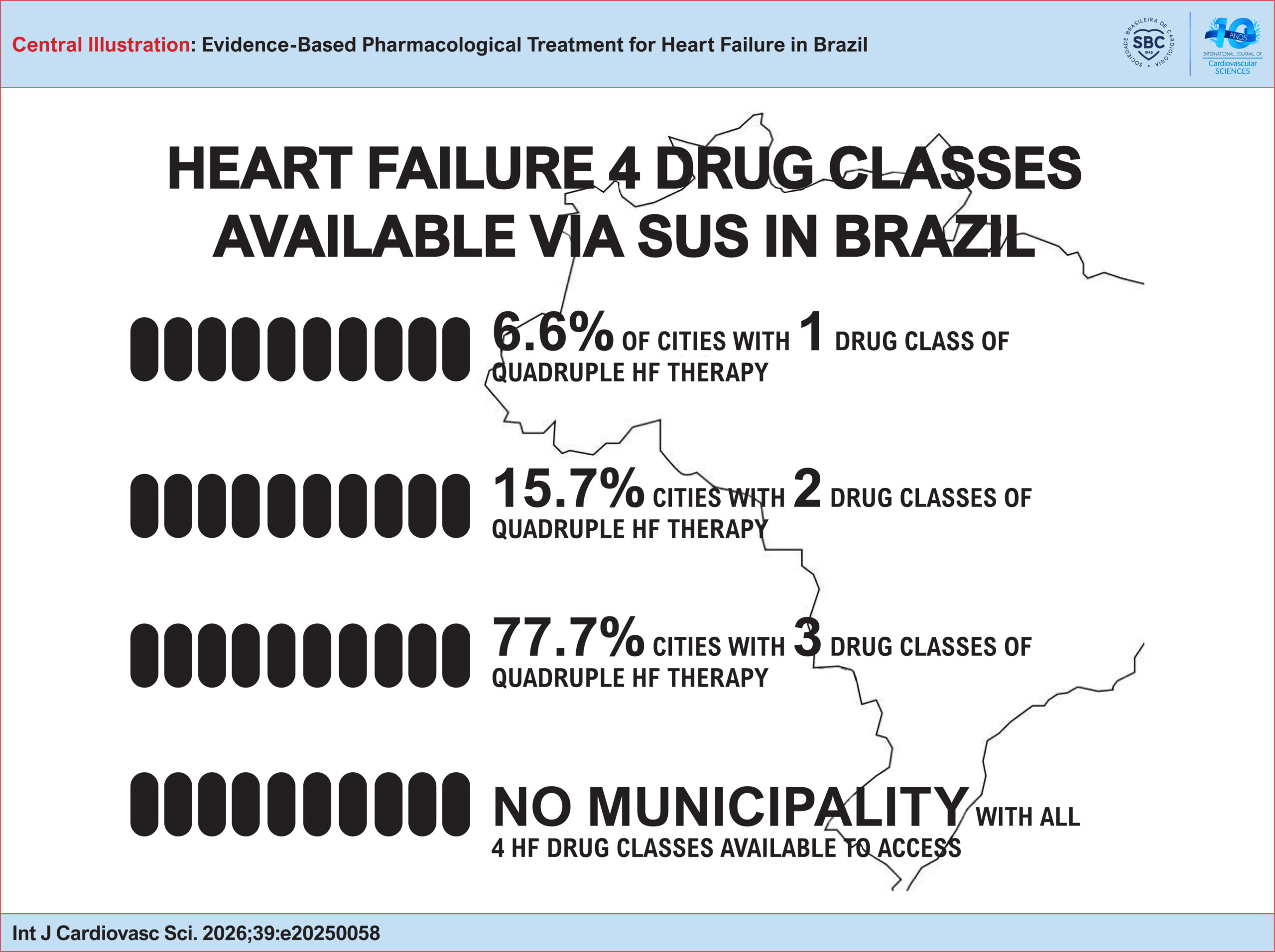
A total of 387 municipalities were included, of which only 50.9% had a REMUME publicly available. Among these, 61.4% had been published within the previous 2 years. The frequency of each drug class was as follows: angiotensin-converting enzyme inhibitors in 92.4% of municipalities, angiotensin II receptor blockers in 80.2%, cardioselective beta-blockers in 91.9%, and MRAs in 85.8%. No REMUME simultaneously included all four GDMT medications. In 22.3% of the metropolitan cities, only two or fewer drug classes were available to patients’ access.

Conclusion:

The remarkable variability in the composition of REMUMEs, along with the frequent omission of at least one of the four essential pharmacological pillars, indicates a potential suboptimal management of HF at the population level. Given the importance of comprehensive pharmacological treatment in HF, these findings highlight ongoing challenges in access to essential medicines within the SUS, even in metropolitan areas.
  • Access to Essential Medicines and Health Technologies
  • Drug Therapy
  • Health Services Accessibility
  • Heart Failure
Read Full Article
Creative Commons Attribution (CC BY) Creative Commons license
13/03/2026 DOI: 10.36660/ijcs.20250058
Central Illustration
ABCHF
Brief Communication

Evidence Based Treatment of Heart Failure: Challenges of Drug Access

Lidia Einsfeld et al. Diogo Pilger Cassiela Roman

Abstract

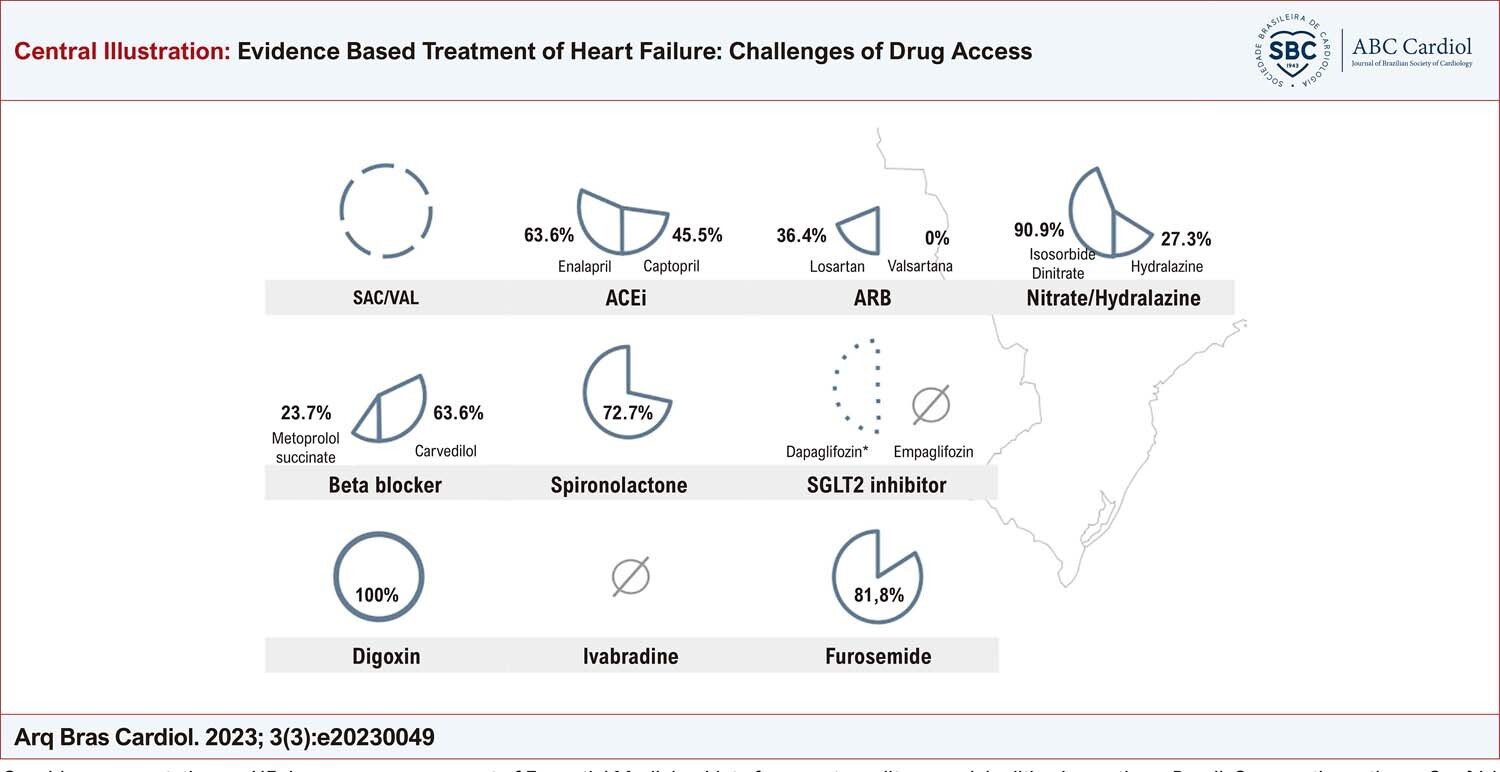
Heart failure (HF) is a complex clinical syndrome with high prevalence, significant morbi-mortality and is the leading cause of hospital admissions of Brazilian patients over 65 years of age. Drug therapy plays a key role in the care of HF patients, aimed to control symptoms, improve functional classification, reduce hospital readmissions and HF-related mortality rates. Despite the evidence of drug therapy proven benefits in HF, their access through the Unified Health System (Sistema Único de Saúde, SUS) remains unexplored. The present study aims to analyze the dynamics of access to HF therapy, based on the list of drugs made available by the SUS through a descriptive and documental methodology. Data were collected from the Municipal Lists of Essential Medicines in a metropolitan region in southern Brazil. Municipalities with a population over 80,000 inhabitants were included, and the respective lists of available drugs were reachable electronically by the health departments themselves. The results showed a partial access to HF treatment via the SUS, especially spironolactone and furosemide, present in 72.7% and 81.8% of the municipalities, respectively. Although drug treatment for HF has proven a high level of evidence, access via SUS represents a challenge to overcome in the continuum of care of patients with heart failure in Brazil

  • Access to Essential Medicines and Health Technologies
  • Drug Therapy
  • Health Services Accessibility
  • Heart Failure
Read Full Article
Creative Commons Attribution (CC BY) Creative Commons license
29/11/2023 DOI: 10.36660/abchf.20230049
IJCS
Original Article

Public Programs for Essential Medicine Access in a Small Municipality: A Cross-Sectional Analysis

Zeó Jaime Lacerda Chaves et al. Luiz Sérgio Silva Renata Cristina Rezende Macedo do Nascimento

Abstract

Background:

Public programs that provide access to essential medications have played an important role in the care of hypertensive and diabetic patients. However, access in small municipalities has been poorly studied.

Objectives:

To describe the sociodemographic profile and the medication and health service usage of patients with systemic arterial hypertension and/or diabetes mellitus in a small municipality who use the public medication access programs Health has no Price (Saúde Não Tem Preço – SNTP) and the Minas Pharmacy Network.

Methods:

This cross-sectional study with 341 participants was conducted in 2019. Home interviews were conducted using a standardized, semi-structured questionnaire. The data are expressed as absolute and relative frequencies, and Pearson’s chi-square test was used for comparisons between proportions (α = 5%).

Results:

Most of the participants (70.68%) had hypertension only, 11.14% had diabetes only, and 18.18% had both. Regarding the origin of the hypertension medications, 82.67% were provided by the Minas Pharmacy Network and/or SNTP programs. Regarding oral hypoglycemic agents and insulins, 88.61% were provided by the Minas Pharmacy Network and/or SNTP. Most participants were female (63.1%), at least 65 years of age (50.30%), non-White (66.96%), resided in an urban area (67.16%), were illiterate or had a low education level (89.94%), and had a maximum income ≤ 2 times the federal minimum salary (89.19%). Overall user perception was significantly better for SNTP (p=0.010).

Conclusion:

The results of this study indicate that programs which provide access to essential medications are important sources of hypertension and diabetes medications in the study area, especially for people with low incomes.

  • Access to Essential Medicines and Health Technologies
  • Diabetes Mellitus
  • Drugs
  • Essential
  • Hypertension
  • National Drug Policy
  • Pharmaceutical Services
Read Full Article
Creative Commons Attribution (CC BY) Creative Commons license
28/02/2022 DOI: 10.36660/ijcs.20200287

How to cite this article

EndNote RIS

Electronic Document Format (Vancouver)

Rocha LPM, Asturian K, Canabarro IM, Einsfeld L, Pilger D. Evidence-Based Pharmacological Treatment for Heart Failure in Brazil. International Journal of Cardiovascular Sciences 2026;39:e20250058.

Electronic Document Format (ABNT)

Rocha, Luísa Preiss Marques da; Asturian, Kathleen; Canabarro, Isabel Machado; Einsfeld, Lidia; Pilger, Diogo. Evidence-Based Pharmacological Treatment for Heart Failure in Brazil. International Journal of Cardiovascular Sciences, v. 39, e20250058, Mar. 2026.

Electronic Document Format (APA)

Rocha, L. P. M. , Asturian, K., Canabarro, I. M., Einsfeld, L., & Pilger, D. (2026). Evidence-Based Pharmacological Treatment for Heart Failure in Brazil. International Journal of Cardiovascular Sciences, 39, e20250058.

Electronic Document Format (ISO)

Rocha, Luísa Preiss Marques da and Asturian, Kathleen and Canabarro, Isabel Machado and Einsfeld, Lidia and Pilger, Diogo. Evidence-Based Pharmacological Treatment for Heart Failure in Brazil. International Journal of Cardiovascular Sciences [online]. 2026, vol. 39, [cited 2026-10-14], e20250058. Available from: <https://journals.cardiol.br/en/article/evidence-based-pharmacological-treatment-for-heart-failure-in-brazil/>. ISSN 2359-4802

EndNote RIS

Electronic Document Format (Vancouver)

Einsfeld L, Pilger D, Roman C. Evidence Based Treatment of Heart Failure: Challenges of Drug Access. ABC Heart Fail Cardiomyop 2023;3(3):e20230049.

Electronic Document Format (ABNT)

Einsfeld, Lidia; Pilger, Diogo; Roman, Cassiela. Evidence Based Treatment of Heart Failure: Challenges of Drug Access. ABC Heart Fail Cardiomyop, v. 3, n. 3, e20230049, Nov. 2023.

Electronic Document Format (APA)

Einsfeld, L., Pilger, D., & Roman, C. (2023). Evidence Based Treatment of Heart Failure: Challenges of Drug Access. ABC Heart Fail Cardiomyop, 3(3), e20230049.

Electronic Document Format (ISO)

Einsfeld, Lidia and Pilger, Diogo and Roman, Cassiela. Evidence Based Treatment of Heart Failure: Challenges of Drug Access. ABC Heart Fail Cardiomyop [online]. 2023, vol. 3, n. 3, [cited 2026-10-14], e20230049. Available from: <https://journals.cardiol.br/en/article/evidence-based-treatment-of-heart-failure-challenges-of-drug-access/>

EndNote RIS

Electronic Document Format (Vancouver)

Chaves ZJL, Silva LS, Nascimento RCRM. Public Programs for Essential Medicine Access in a Small Municipality: A Cross-Sectional Analysis. International Journal of Cardiovascular Sciences 2022;35(3):342-53.

Electronic Document Format (ABNT)

Chaves, Zeó Jaime Lacerda; Silva, Luiz Sérgio; Nascimento, Renata Cristina Rezende Macedo do. Public Programs for Essential Medicine Access in a Small Municipality: A Cross-Sectional Analysis. International Journal of Cardiovascular Sciences, v. 35, n. 3, p. 342-353, Feb. 2022.

Electronic Document Format (APA)

Chaves, Z. J. L., Silva, L. S., & Nascimento, R. C. R. M. (2022). Public Programs for Essential Medicine Access in a Small Municipality: A Cross-Sectional Analysis. International Journal of Cardiovascular Sciences, 35(3), 342-353.

Electronic Document Format (ISO)

Chaves, Zeó Jaime Lacerda and Silva, Luiz Sérgio and Nascimento, Renata Cristina Rezende Macedo do. Public Programs for Essential Medicine Access in a Small Municipality: A Cross-Sectional Analysis. International Journal of Cardiovascular Sciences [online]. 2022, vol. 35, n. 3, [cited 2026-10-14], pp. 342-353. Available from: <https://journals.cardiol.br/en/article/public-programs-for-essential-medicine-access-in-a-small-municipality-a-cross-sectional-analysis/>. ISSN 2359-4802

  • About ABC Family
  • Internal Regulation
  • Editorial Board
  • Brazilian Society of Cardiology (SBC)

Issues

SBC Guidelines

  • Videos
  • Podcasts
  • News