| ABC
ABC Family Arquivos Brasileiros de Cardiologia International Journal of Cardiovascular Sciences ABC Heart Failure & Cardiomyopathy ABC Imagem Cardiovascular
Português English
ABC Family | ABC
Português English
  • About
    • About the Journal
    • Internal Regulation
    • Editors Section
    • Editorial Board
    • History
    • SBC Award
  • Instructions to Authors
    • Guidelines for Publication
    • Editorial Policy
    • Ethics Policy
    • Policy on the Use of Artificial Intelligence
    • Mandatory Publication Form
    • Publication Fee
  • Issues
  • SBC Guidelines
  • Abstracts
    • How to Publish an Abstract Supplement?
    • Supplements from the Brazilian Congress of Cardiology
  • About
    • About the Journal
    • Internal Regulation
    • Editors Section
    • Editorial Board
    • History
    • SBC Award
  • Instructions to Authors
    • Guidelines for Publication
    • Editorial Policy
    • Ethics Policy
    • Policy on the Use of Artificial Intelligence
    • Mandatory Publication Form
    • Publication Fee
  • Issues
  • SBC Guidelines
  • Abstracts
    • How to Publish an Abstract Supplement?
    • Supplements from the Brazilian Congress of Cardiology

ABC Family

  • ABC Family
  • Arquivos Brasileiros de Cardiologia
  • International Journal of Cardiovascular Sciences
  • ABC Heart Failure & Cardiomyopathy
  • ABC Imagem Cardiovascular
Search in

No content found.

Journals
Ordering
Article types
Others

  1. Home
  2. ABC
  3. Issues
  4. 2001, Volume 76, Number 1
Original Article

Immunologic evaluation in infective endocarditis

Wilma C. Neves Forte et al. Aline C. Mario Adilson da Costa Luciana S. Henriques … Carla L. Gonzales Roberto A. Franken

OBJECTIVE: To analyze the immune response in peripheral blood of patients with infective endocarditis. METHODS: We studied 10 patients with infective endocarditis, age range from 20 to 50 years-old, males and females, and 20 healthy subjects in the same age range. The diagnosis of the disease was based on the clinical picture, echocardiogram, and hemoculture based upon samples drawn and tested before the treatment started. The were no history of atopy or malnutrition, no autoimmune disease, and they were not using any immunosuppressant or antibiotic medication. RESULTS: The patients with endocarditis had significantly higher T and B lymphocyte, CD4+ and CD8+ cell counts, IgM and IgG serum levels, and C4 component of the complement than the control group; no significant difference concerning serum IgA and neutrophil oxidative metabolism; a significant decrease in C3, chemotaxis, and monocyte phagocytosis;cryoglobulins were detected in 66.6% of patients and they were formed by IgG, IgM, IgA, C3, and C4. CONCLUSION: The patients with infective endocarditis were immunocompetent in most sectors of immune response and, at a certain moment, an autoimmune component may be present.
  • autoimmunity
  • cryoglobulin
  • Endocarditis
  • immune response
Read Full Article
Creative Commons Attribution (CC BY) Creative Commons license
02/02/2001 DOI: 10.1590/S0066-782X2001000100005
Atrioventricular pacemaker. Incidence and causes of reprogramming in long-term follow-up
Original Article

Atrioventricular pacemaker. Incidence and causes of reprogramming in long-term follow-up

Martino Martinelli Fº et al. Sylton de Arruda Melo Silvana A. D. Nishióka Anísio A. A. Pedrosa … Sérgio Freitas de Siqueira Roberto Costa Eduardo Sosa

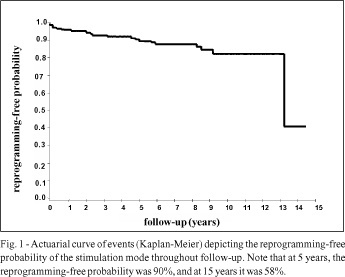
OBJECTIVE: To assess the incidence of problems requiring reprogramming of atrioventricular pacemakers in a long-term follow-up, and also the causes for this procedure. METHODS: During the period from May ’98 to December ’99, 657 patients were retrospectively studied, An actuarial curve for the event reprogramming of the stimulation mode was drawn. RESULTS: The follow-up period ranged from 12 to 178 months (mean = 81 months). Eighty-two (12.4%) patients underwent reprogramming of the stimulation mode as follows: 63 (9.5%) changed to VVI,(R/C); 10 (1.5%) changed to DVI,C; 6 (0.9%) changed to VDD,C; and 3 (0.5%) changed to DOO. The causes for the reprogramming were as follows: arrhythmia conducted by the pacemaker in 39 (37.6%) patients; loss of atrial sensitivity or capture, or both, in 39 (38.6%) patients; and microfracture of atrial electrode in 5 (4.9%) patients. The stimulation mode reprogramming free probability after 15 years was 58%. CONCLUSION: In a long-term follow-up, the atrioventricular pacemaker provided a low incidence of complications, a high probability of permanence in the DDD,C mode, and the most common cause of reprogramming was arrhythmia conducted by the pacemaker.

  • atrioventricular pacemaker
  • DDD,Cmode
  • reprogramming
Read Full Article
Creative Commons Attribution (CC BY) Creative Commons license
02/02/2001 DOI: 10.1590/S0066-782X2001000100002 Views 1
Editorial

Critical analysis of diagnostic methods in pediatric cardiology

Edmar Atik

Editorial

Critical Analysis of Diagnostic Methods in Pediatric Cardiology

[…]

Read Full Article
Creative Commons Attribution (CC BY) Creative Commons license
02/02/2001 DOI: 10.1590/S0066-782X2001000100001
Original Article

Acute myocardial infarction in progressively elderly patients. A comparative analysis of immediate results in patients who underwent primary percutaneous coronary intervention

Luiz Alberto Mattos et al. Alexandre Zago Áurea Chaves Ibraim Pinto … Luiz Tanajura Rodolfo Staico Marinella Centemero Fausto Feres Galo Maldonado Manoel Cano Andréa Abizaid Alexandre Abizaid Amanda G.M.R. Sousa J. Eduardo Sousa

OBJECTIVE: Analysis of the in-hospital results, in progressively elderly patients who undergo primary percutaneous coronary intervention (PCI) in the first 24 hours of AMI. METHODS: The patients were divided into three different age groups (60/69, 70/79, and > or = 80 years) and were treated from 7/95 until 12/99. The primary success rate and the occurrence of major clinical events were analyzed at the end of the in-hospital phase. Coronary stent implantation and abciximab use were employed at the intervencionist discretion. RESULTS: We analyzed 201 patients with age ranging from 60 to 93 years, who underwent primary PCI. Patients with ages above 70 were more often female (p=.015). Those with ages above 80 were treated later with PCI (p=.054), and all of them presented with total occlusion of the infarct-related artery. Coronary stents were implanted in 30% of the patients. Procedural success was lower in > or = 80 year old patients (p=.022), and the death rate was higher in > or = 70 years olds (p=.019). Reinfarction and coronary bypass surgery were uncommon events. A trend occurred toward a higher combined incidence of major in-hospital events according to increased age (p=.064). CONCLUSION: Elderly patients ( > or = 70 years) presented with adverse clinical and angiographic profiles and patients > or = 80 years of age obtained reduced TIMI 3 flow success rates after primary PTCA, and those > or = 70 years had a higher death rate.

  • Angioplasty
  • Elderly
  • Myocardial Infarction
Read Full Article
Creative Commons Attribution (CC BY) Creative Commons license
02/02/2001 DOI: 10.1590/S0066-782X2001000100006
Echocardiographic assessment of the different left ventricular geometric patterns in hypertensive patients
Original Article

Echocardiographic assessment of the different left ventricular geometric patterns in hypertensive patients

Delma Maria Cunha et al. Ademir Batista da Cunha Wolney de Andrade Martins Luís Augusto de Freitas Pinheiro … Luís José Martins Romêo Álvaro Vilela de Moraes Fernando Portugal Morcerf

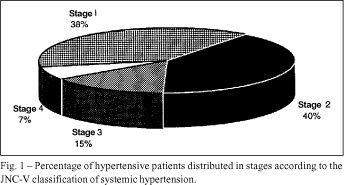
OBJECTIVE: To identiy left ventricular geometric patterns in hypertensive patients on echocardiography, and to correlate those patterns with casual blood pressure measurements and with the parameters obtained on a 24-hour ambulatory blood pressure monitoring. METHODS: We studied sixty hypertensive patients, grouped according to the Joint National Committee stages of hypertension.. Using the single- and two-dimensional Doppler Echocardiography, we analyzed the left ventricular mass and the geometric patterns through the correlation of left ventricular mass index and relative wall thickness. On ambulatory blood pressure monitoring we assessed the means and pressure loads in the different geometric patterns detected on echocardiography RESULTS: We identified three left ventricular geometric patterns: 1) concentric hypertrophy, in 25% of the patients; 2) concentric remodeling, in 25%; and 3) normal geometry, in 50%. Casual systolic blood pressure was higher in the group with concentric hypertrophy than in the other groups (p=0.001). Mean systolic pressure in the 24h, daytime and nighttime periods was also higher in patients with concentric hypertrophy, as compared to the other groups (p=0.003, p=0.004 and p=0.007). Daytime systolic load and nighttime diastolic load were higher in patients with concentric hypertrophy ( p=0.004 and p=0.01, respectively). CONCLUSIONS: Left ventricular geometric patterns show significant correlation with casual systolic blood pressure, and with means and pressure loads on ambulatory blood pressure monitoring.

  • Echocardiography
  • Hypertension
  • Left Ventricular Hypertrophy
Read Full Article
Creative Commons Attribution (CC BY) Creative Commons license
02/02/2001 DOI: 10.1590/S0066-782X2001000100003 Views 2
Noninvasive diagnosis of allograft vascular disease after heart transplantation
Original Article

Noninvasive diagnosis of allograft vascular disease after heart transplantation

Fernando Bacal et al. Noedir Antonio Groppo Stolf Viviane Cordeiro Veiga William A. Chalela … Cesar Grupi Ana Clara Rodrigues Eulógio E. Martinez Alfredo Inácio Fiorelli Luiz Felipe Pinho Moreira Edimar Alcides Bocchi Giovanni Bellotti José Antonio Franchini Ramires

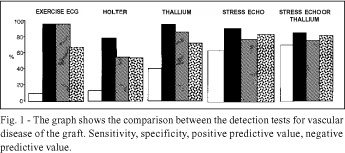
OBJECTIVE: To determine the predictive values of noninvasive tests for the detection of allograft vascular disease. METHODS: We studied 39 patients with mean ages of 48±13 years and a follow-up period of 86±13 months. The diagnosis of allograft vascular disease was made by cine-coronary arteriography, and it was considered as positive if lesions existed that caused > or = 50% obstruction of the lumen. Patients underwent 24h Holter monitoring, thallium scintigraphy, a treadmill stress test, and dobutamine stress echocardiography. Sensitivity, specificity, and positive and negative predictive values were determined in percentages for each method, as compared with the cine-coronary arteriography results. RESULTS: Allograft vascular disease was found in 15 (38%) patients. The Holter test showed 15.4% sensitivity, 95.5% specificity. For the treadmill stress test, sensitivity was 10%, specificity was 100%. When thallium scintigraphy was used, sensitivity was 40%, specificity 95.8%. On echocardiography with dobutamine, we found a 63.6% sensitivity, 91.3% specificity. When the dobutamine echocardiogram was associated with scintigraphy, sensitivity was 71.4%, specificity was 87%. CONCLUSION: In this group of patients, the combination of two noninvasive methods (dobutamine echocardiography and thallium scintigraphy) may be a good alternative for the detection of allograft vascular disease in asymptomatic patients with normal ventricular function.

  • allograft vascular disease
  • Diagnostic Methods
  • Heart Transplantation
Read Full Article
Creative Commons Attribution (CC BY) Creative Commons license
02/02/2001 DOI: 10.1590/S0066-782X2001000100004 Views 1
Catecholaminergic polymorphic ventricular tachycardia. An important diagnosis in children with syncope and normal heart
Brief Communication

Catecholaminergic polymorphic ventricular tachycardia. An important diagnosis in children with syncope and normal heart

Luiz Roberto Leite et al. Kleber R. Ponzi Pereira Sílvio R. B. Alessi Angelo A. V. de Paola

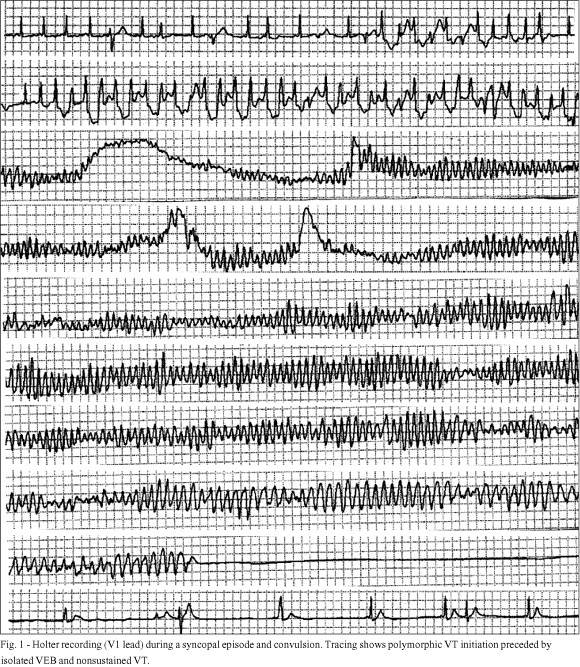
Syncope in children is primarily related to vagal hyperreactivity, but ventricular tachycardia (VT) way rarely be seen. Catecholaminergic polymorphic VT is a rare entity that can occur in children without heart disease and with a normal QT interval, which may cause syncope and sudden cardiac death. In this report, we describe the clinical features, treatment, and clinical follow-up of three children with syncope associated with physical effort or emotion and cathecolaminergic polymorphic VT. Symptoms were controlled with beta-blockers, but one patient died suddenly in the fourth year of follow-up. Despite the rare occurrence, catecholaminergic polymorphic VT is an important cause of syncope and sudden death in children with no identified heart disease and normal QT interval.

Read Full Article
Creative Commons Attribution (CC BY) Creative Commons license
02/02/2001 DOI: 10.1590/S0066-782X2001000100007
Atualização

Sudden death in Chagas' disease

Anis Rassi Jr et al. Sérgio Gabriel Rassi Anis Rassi

Read Full Article
Creative Commons Attribution (CC BY) Creative Commons license
02/02/2001 DOI: 10.1590/S0066-782X2001000100008 Views 1

How to cite this article

EndNote RIS

Electronic Document Format (Vancouver)

Forte WCN, Mario AC, Costa A, Henriques LS, Gonzales CL, Franken RA. Immunologic evaluation in infective endocarditis. Arquivos Brasileiros de Cardiologia 2001;76(1):48-52.

Electronic Document Format (ABNT)

Forte, Wilma C. Neves; Mario, Aline C.; Costa, Adilson da; Henriques, Luciana S.; Gonzales, Carla L.; Franken, Roberto A.. Immunologic evaluation in infective endocarditis. Arquivos Brasileiros de Cardiologia, v. 76, n. 1, p. 48-52, Feb. 2001.

Electronic Document Format (APA)

Forte, W. C. N., Mario, A. C., Costa, A. , Henriques, L. S., Gonzales, C. L., & Franken, R. A. (2001). Immunologic evaluation in infective endocarditis. Arquivos Brasileiros de Cardiologia, 76(1), 48-52.

Electronic Document Format (ISO)

Forte, Wilma C. Neves and Mario, Aline C. and Costa, Adilson da and Henriques, Luciana S. and Gonzales, Carla L. and Franken, Roberto A.. Immunologic evaluation in infective endocarditis. Arquivos Brasileiros de Cardiologia [online]. 2001, vol. 76, n. 1, [cited 2026-10-14], pp. 48-52. Available from: <https://journals.cardiol.br/en/article/immunologic-evaluation-in-infective-endocarditis/>. ISSN 0066-782X

EndNote RIS

Electronic Document Format (Vancouver)

Fº MM, Melo SA, Nishióka SAD, Pedrosa AAA, Siqueira SF, Costa R, Sosa E, et al. Atrioventricular pacemaker. Incidence and causes of reprogramming in long-term follow-up. Arquivos Brasileiros de Cardiologia 2001;76(1):11-4.

Electronic Document Format (ABNT)

Fº, Martino Martinelli; Melo, Sylton de Arruda; Nishióka, Silvana A. D.; Pedrosa, Anísio A. A.; Siqueira, Sérgio Freitas de; Costa, Roberto; Sosa, Eduardo. Atrioventricular pacemaker. Incidence and causes of reprogramming in long-term follow-up. Arquivos Brasileiros de Cardiologia, v. 76, n. 1, p. 11-14, Feb. 2001.

Electronic Document Format (APA)

Fº, M. M., Melo, S. A., Nishióka, S. A. D., Pedrosa, A. A. A., Siqueira, S. F. , Costa, R., & Sosa, E. (2001). Atrioventricular pacemaker. Incidence and causes of reprogramming in long-term follow-up. Arquivos Brasileiros de Cardiologia, 76(1), 11-14.

Electronic Document Format (ISO)

Fº, Martino Martinelli and Melo, Sylton de Arruda and Nishióka, Silvana A. D. and Pedrosa, Anísio A. A. and Siqueira, Sérgio Freitas de and Costa, Roberto and Sosa, Eduardo. Atrioventricular pacemaker. Incidence and causes of reprogramming in long-term follow-up. Arquivos Brasileiros de Cardiologia [online]. 2001, vol. 76, n. 1, [cited 2026-10-14], pp. 11-14. Available from: <https://journals.cardiol.br/en/article/atrioventricular-pacemaker-incidence-and-causes-of-reprogramming-in-long-term-follow-up/>. ISSN 0066-782X

EndNote RIS

Electronic Document Format (Vancouver)

Atik E. Critical analysis of diagnostic methods in pediatric cardiology. Arquivos Brasileiros de Cardiologia 2001;76(1):04-6.

Electronic Document Format (ABNT)

Atik, Edmar. Critical analysis of diagnostic methods in pediatric cardiology. Arquivos Brasileiros de Cardiologia, v. 76, n. 1, p. 04-06, Feb. 2001.

Electronic Document Format (APA)

Atik, E. (2001). Critical analysis of diagnostic methods in pediatric cardiology. Arquivos Brasileiros de Cardiologia, 76(1), 04-06.

Electronic Document Format (ISO)

Atik, Edmar. Critical analysis of diagnostic methods in pediatric cardiology. Arquivos Brasileiros de Cardiologia [online]. 2001, vol. 76, n. 1, [cited 2026-10-14], pp. 04-06. Available from: <https://journals.cardiol.br/en/article/critical-analysis-of-diagnostic-methods-in-pediatric-cardiology/>. ISSN 0066-782X

EndNote RIS

Electronic Document Format (Vancouver)

Mattos LA, Zago A, Chaves , Pinto I, Tanajura L, Staico R, Centemero M, et al. Acute myocardial infarction in progressively elderly patients. A comparative analysis of immediate results in patients who underwent primary percutaneous coronary intervention. Arquivos Brasileiros de Cardiologia 2001;76(1):58-62.

Electronic Document Format (ABNT)

Mattos, Luiz Alberto; Zago, Alexandre; Chaves, Áurea; Pinto, Ibraim; Tanajura, Luiz; Staico, Rodolfo; Centemero, Marinella; Feres, Fausto; Maldonado, Galo; Cano, Manoel; Abizaid, Andréa; Abizaid, Alexandre; Sousa, Amanda G.M.R.; Sousa, J. Eduardo. Acute myocardial infarction in progressively elderly patients. A comparative analysis of immediate results in patients who underwent primary percutaneous coronary intervention. Arquivos Brasileiros de Cardiologia, v. 76, n. 1, p. 58-62, Feb. 2001.

Electronic Document Format (APA)

Mattos, L. A., Zago, A., Chaves, , Pinto, I., Tanajura, L., Staico, R., Centemero, M., Feres, F., Maldonado, G., Cano, M., Abizaid, A., Abizaid, A., Sousa, A. G., & Sousa, J. E. (2001). Acute myocardial infarction in progressively elderly patients. A comparative analysis of immediate results in patients who underwent primary percutaneous coronary intervention. Arquivos Brasileiros de Cardiologia, 76(1), 58-62.

Electronic Document Format (ISO)

Mattos, Luiz Alberto and Zago, Alexandre and Chaves, Áurea and Pinto, Ibraim and Tanajura, Luiz and Staico, Rodolfo and Centemero, Marinella and Feres, Fausto and Maldonado, Galo and Cano, Manoel and Abizaid, Andréa and Abizaid, Alexandre and Sousa, Amanda G.M.R. and Sousa, J. Eduardo. Acute myocardial infarction in progressively elderly patients. A comparative analysis of immediate results in patients who underwent primary percutaneous coronary intervention. Arquivos Brasileiros de Cardiologia [online]. 2001, vol. 76, n. 1, [cited 2026-10-14], pp. 58-62. Available from: <https://journals.cardiol.br/en/article/acute-myocardial-infarction-in-progressively-elderly-patients-a-comparative-analysis-of-immediate-results-in-patients-who-underwent-primary-percutaneous-coronary-intervention/>. ISSN 0066-782X

EndNote RIS

Electronic Document Format (Vancouver)

Cunha DM, Cunha AB, Martins WA, Pinheiro LAF, Romêo LJM, Moraes V, Morcerf FP, et al. Echocardiographic assessment of the different left ventricular geometric patterns in hypertensive patients. Arquivos Brasileiros de Cardiologia 2001;76(1):22-8.

Electronic Document Format (ABNT)

Cunha, Delma Maria; Cunha, Ademir Batista da; Martins, Wolney de Andrade; Pinheiro, Luís Augusto de Freitas; Romêo, Luís José Martins; Moraes, Álvaro Vilela de; Morcerf, Fernando Portugal. Echocardiographic assessment of the different left ventricular geometric patterns in hypertensive patients. Arquivos Brasileiros de Cardiologia, v. 76, n. 1, p. 22-28, Feb. 2001.

Electronic Document Format (APA)

Cunha, D. M., Cunha, A. B. , Martins, W. A., Pinheiro, L. A. F., Romêo, L. J. M., Moraes, V. , & Morcerf, F. P. (2001). Echocardiographic assessment of the different left ventricular geometric patterns in hypertensive patients. Arquivos Brasileiros de Cardiologia, 76(1), 22-28.

Electronic Document Format (ISO)

Cunha, Delma Maria and Cunha, Ademir Batista da and Martins, Wolney de Andrade and Pinheiro, Luís Augusto de Freitas and Romêo, Luís José Martins and Moraes, Álvaro Vilela de and Morcerf, Fernando Portugal. Echocardiographic assessment of the different left ventricular geometric patterns in hypertensive patients. Arquivos Brasileiros de Cardiologia [online]. 2001, vol. 76, n. 1, [cited 2026-10-14], pp. 22-28. Available from: <https://journals.cardiol.br/en/article/echocardiographic-assessment-of-the-different-left-ventricular-geometric-patterns-in-hypertensive-patients/>. ISSN 0066-782X

EndNote RIS

Electronic Document Format (Vancouver)

Bacal F, Stolf NAG, Veiga VC, Chalela WA, Grupi C, Rodrigues AC, Martinez EE, et al. Noninvasive diagnosis of allograft vascular disease after heart transplantation. Arquivos Brasileiros de Cardiologia 2001;76(1):36-42.

Electronic Document Format (ABNT)

Bacal, Fernando; Stolf, Noedir Antonio Groppo; Veiga, Viviane Cordeiro; Chalela, William A.; Grupi, Cesar; Rodrigues, Ana Clara; Martinez, Eulógio E.; Fiorelli, Alfredo Inácio; Moreira, Luiz Felipe Pinho; Bocchi, Edimar Alcides; Bellotti, Giovanni; Ramires, José Antonio Franchini. Noninvasive diagnosis of allograft vascular disease after heart transplantation. Arquivos Brasileiros de Cardiologia, v. 76, n. 1, p. 36-42, Feb. 2001.

Electronic Document Format (APA)

Bacal, F., Stolf, N. A. G., Veiga, V. C., Chalela, W. A., Grupi, C., Rodrigues, A. C., Martinez, E. E., Fiorelli, A. I., Moreira, L. F. P., Bocchi, E. A., Bellotti, G., & Ramires, J. A. F. (2001). Noninvasive diagnosis of allograft vascular disease after heart transplantation. Arquivos Brasileiros de Cardiologia, 76(1), 36-42.

Electronic Document Format (ISO)

Bacal, Fernando and Stolf, Noedir Antonio Groppo and Veiga, Viviane Cordeiro and Chalela, William A. and Grupi, Cesar and Rodrigues, Ana Clara and Martinez, Eulógio E. and Fiorelli, Alfredo Inácio and Moreira, Luiz Felipe Pinho and Bocchi, Edimar Alcides and Bellotti, Giovanni and Ramires, José Antonio Franchini. Noninvasive diagnosis of allograft vascular disease after heart transplantation. Arquivos Brasileiros de Cardiologia [online]. 2001, vol. 76, n. 1, [cited 2026-10-14], pp. 36-42. Available from: <https://journals.cardiol.br/en/article/noninvasive-diagnosis-of-allograft-vascular-disease-after-heart-transplantation/>. ISSN 0066-782X

EndNote RIS

Electronic Document Format (Vancouver)

Leite LR, Pereira KRP, Alessi SRB, Paola AAV. Catecholaminergic polymorphic ventricular tachycardia. An important diagnosis in children with syncope and normal heart. Arquivos Brasileiros de Cardiologia 2001;76(1):69-74.

Electronic Document Format (ABNT)

Leite, Luiz Roberto; Pereira, Kleber R. Ponzi; Alessi, Sílvio R. B.; Paola, Angelo A. V. de. Catecholaminergic polymorphic ventricular tachycardia. An important diagnosis in children with syncope and normal heart. Arquivos Brasileiros de Cardiologia, v. 76, n. 1, p. 69-74, Feb. 2001.

Electronic Document Format (APA)

Leite, L. R., Pereira, K. R. P., Alessi, S. R. B., & Paola, A. A. V. (2001). Catecholaminergic polymorphic ventricular tachycardia. An important diagnosis in children with syncope and normal heart. Arquivos Brasileiros de Cardiologia, 76(1), 69-74.

Electronic Document Format (ISO)

Leite, Luiz Roberto and Pereira, Kleber R. Ponzi and Alessi, Sílvio R. B. and Paola, Angelo A. V. de. Catecholaminergic polymorphic ventricular tachycardia. An important diagnosis in children with syncope and normal heart. Arquivos Brasileiros de Cardiologia [online]. 2001, vol. 76, n. 1, [cited 2026-10-14], pp. 69-74. Available from: <https://journals.cardiol.br/en/article/catecholaminergic-polymorphic-ventricular-tachycardia-an-important-diagnosis-in-children-with-syncope-and-normal-heart/>. ISSN 0066-782X

EndNote RIS

Electronic Document Format (Vancouver)

Rassi Jr A, Rassi SG, Rassi A. Sudden death in Chagas’ disease. Arquivos Brasileiros de Cardiologia 2001;76(1):86-9.

Electronic Document Format (ABNT)

Rassi Jr, Anis; Rassi, Sérgio Gabriel; Rassi, Anis. Sudden death in Chagas’ disease. Arquivos Brasileiros de Cardiologia, v. 76, n. 1, p. 86-96, Feb. 2001.

Electronic Document Format (APA)

Rassi Jr, A., Rassi, S. G., & Rassi, A. (2001). Sudden death in Chagas’ disease. Arquivos Brasileiros de Cardiologia, 76(1), 86-96.

Electronic Document Format (ISO)

Rassi Jr, Anis and Rassi, Sérgio Gabriel and Rassi, Anis. Sudden death in Chagas’ disease. Arquivos Brasileiros de Cardiologia [online]. 2001, vol. 76, n. 1, [cited 2026-10-14], pp. 86-96. Available from: <https://journals.cardiol.br/en/article/sudden-death-in-chagas-disease/>. ISSN 0066-782X

Sede – Rio de Janeiro
Av. Marechal Câmara, 160
3º andar – Sala: 330 – Centro
Rio de Janeiro – CEP: 20020-907
Tel.: (55 +21) 3478-2700
ou (21) 99386-3961
E-mail: revista@cardiol.br

Sede – São Paulo
Alameda Santos, 705 – 11º andar
Cerqueira César | São Paulo
CEP: 01419-001
Tel.: (55 +11) 3411-5500
E-mail: revista@cardiol.br

  • About the Journal
  • Internal Regulation
  • Editors Section
  • Editorial Board
  • History
  • SBC Award

  • Guidelines for Publication
  • Editorial Policy
  • Ethics Policy
  • Policy on the Use of Artificial Intelligence
  • Mandatory Publication Form
  • Publication Fee

Issues

SBC Guidelines

  • How to Publish an Abstract Supplement?
  • Supplements from the Brazilian Congress of Cardiology