ABC Family Arquivos Brasileiros de Cardiologia International Journal of Cardiovascular Sciences ABC Heart Failure & Cardiomyopathy ABC Imagem Cardiovascular
Português English
ABC Family
Português English
  • About
    • About ABC Family
    • Internal Regulation
    • Editorial Board
    • Brazilian Society of Cardiology (SBC)
  • Issues
  • SBC Guidelines
  • Content
    • Videos
    • Podcasts
    • News
  • About
    • About ABC Family
    • Internal Regulation
    • Editorial Board
    • Brazilian Society of Cardiology (SBC)
  • Issues
  • SBC Guidelines
  • Content
    • Videos
    • Podcasts
    • News

ABC Family

  • ABC Family
  • Arquivos Brasileiros de Cardiologia
  • International Journal of Cardiovascular Sciences
  • ABC Heart Failure & Cardiomyopathy
  • ABC Imagem Cardiovascular
Search in

No content found.

Journals
Ordering
Article types
Others

  1. Home
  2. Keyword: Diagnostic Methods
Figure 1
ABCHF
Editorial

The Importance of the DEIC/GEMIC/SBC 2021 Position Statement on Diagnosis and Treatment of Cardiac Amyloidosis to Clinical Practice

Marcus Vinicius Simões et al. Fabio Fernandes

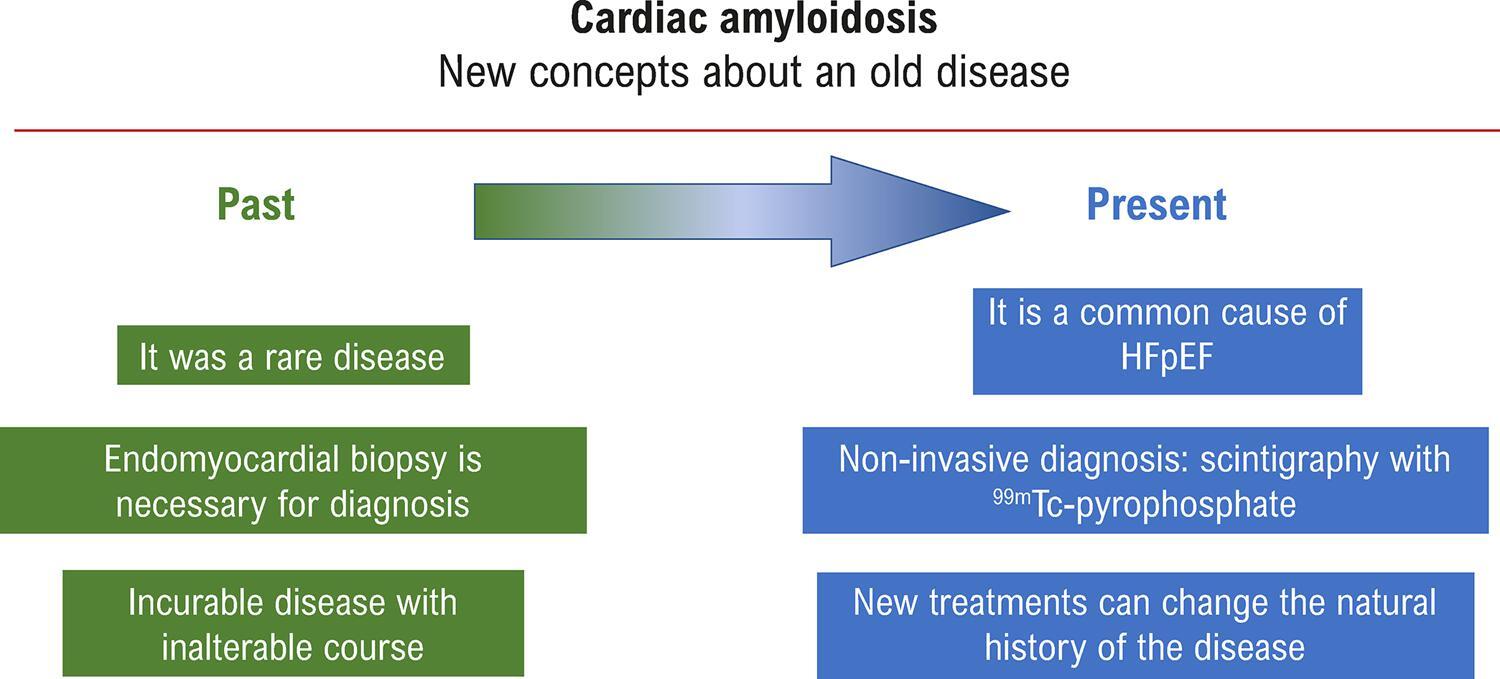
Cardiac amyloidosis is a frequent cause of heart failure with preserved ejection fraction

The main cardiological phenotype of CA is that of an infiltrative restrictive cardiomyopathy, whose more general aspects of symptoms, increased thickness of the ventricular walls, and concentric remodeling of the left ventricle, overlap with those of heart failure with preserved ejection fraction (HFpEF), produced by risk factors such as high blood pressure, obesity, diabetes, and aging. Thus, CA should be considered as a differential diagnosis in patients who exhibit HFpEF.

It is worth remembering that, among the different amyloidogenic proteins that can be deposited in the myocardium and cause CA, the wild type transthyretin form (ATTR-CAwt), which is closely linked to aging, is the most frequently reported in several series of specialized medical literature. This has been repeated both in large reference centers and in real world registers. Accordingly, a recent article has shown a very significant increase in CA as a cause of hospitalizations due to heart failure in several regions of the United States, between 2000 and 2012, exceeding the rate of 65 cases per 100,000 people/year, indicating that CA is not a rare disease according to the current criteria of the World Health Organization ( ).

[…]

  • Amyloidosis
  • cardiomyopathy
  • Diagnostic Methods
  • Treatment
Read Full Article
Creative Commons Attribution (CC BY) Creative Commons license
10/12/2021 DOI: 10.36660/abchf.20210021 Views 1
Figure 1
ABCHF
Viewpoint

Cardiac Scintigraphy with Bone Markers in Clinical Practice: When to Solicit the Exam? How to Interpret the Results?

Marcus Vinicius Simões

When to solicit cardiac scintigraphy with bone markers?

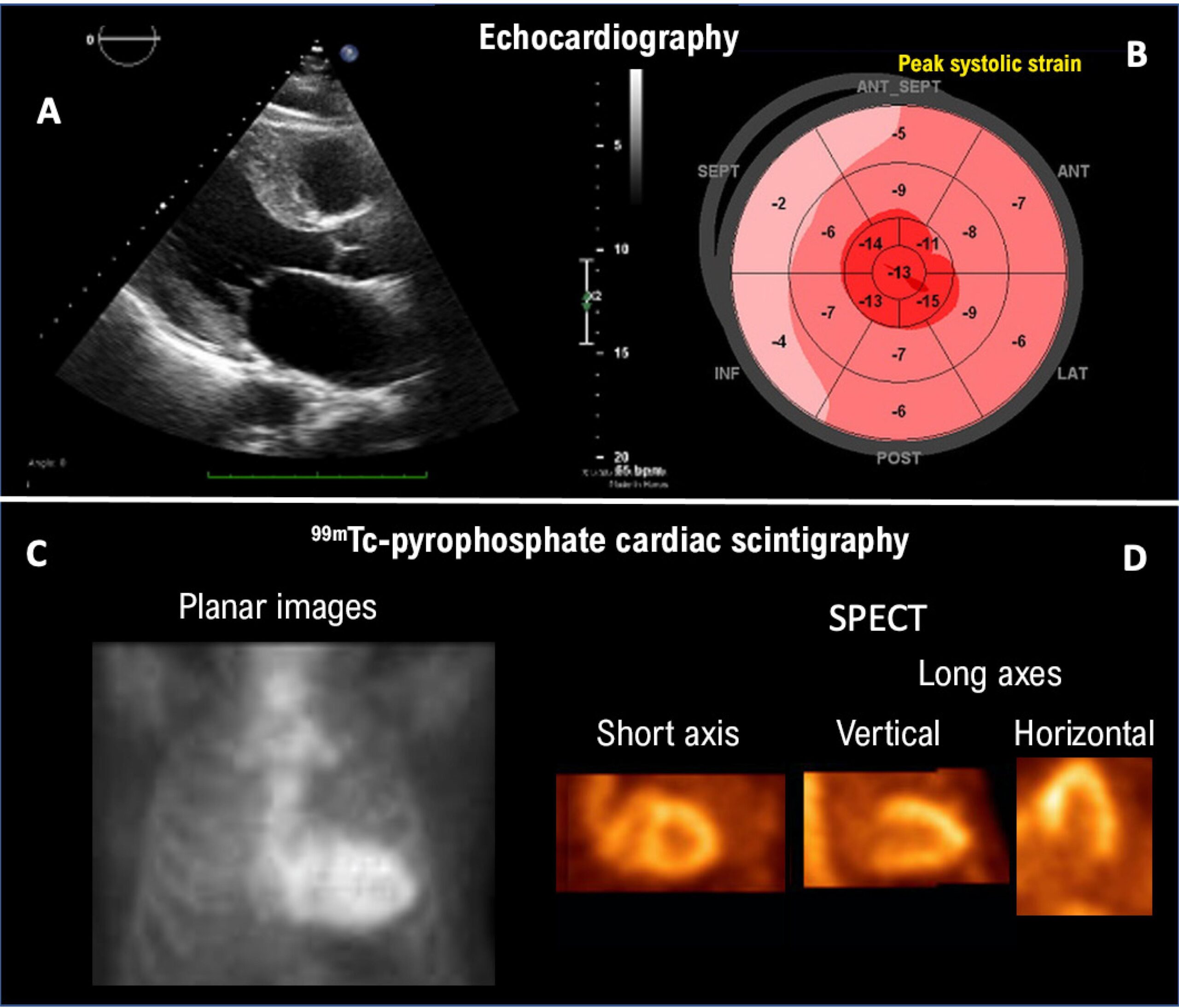
In view of the aspects mentioned above, it is important for investigation of the specific form of ATTR-CA, using bone marker scintigraphy, to begin after 2 key preliminary steps: 1. establishing high clinical suspicion of the presence of CA and 2. ruling out the presence of immunoglobulin light chains, which would lead us to diagnosis of AL-CA.

It is fundamental to establish high clinical suspicion, given that negative scintigraphy does not rule out the presence of CA in its various forms, particularly the AL form. In other words, in a significant percentage of cases with high clinical suspicion and negative scintigraphy, investigation should continue with tissue biopsy, including endomyocardial biopsy, in order to conclude diagnosis. It is clear that endomyocardial biopsy should only be performed in cases of high clinical suspicion, as it is an invasive method with risks that, although low, are inherent to the procedure.

[…]

  • Amyloidosis
  • Diagnostic Methods
  • Scintigraphy
Read Full Article
Creative Commons Attribution (CC BY) Creative Commons license
10/12/2021 DOI: 10.36660/abchf.20210022 Views 1
ABC
Artigo Original

Increased rate-pressure product as predictor for the absence of significant obstructive coronary artery disease in patients with positive exercise test

Luis Domingos Fornitano et al. Moacir Fernandes de Godoy

OBJECTIVE: To correlate values of rate-pressure product (RPP) above 30,000 mmHg.bpm with or without significant obstructive coronary artery disease (CAD) in patients with positive exercise test. METHODS: A retrospective analysus of 246 patients that had been submitted to Exercise Treadmill Test (ETT) up to 30 days before coronary angiography on suspicion of obstructive disease. The 165 patients in which the ETT was positive were analyzed considering as positive the presence of horizontal or descending depression of the ST segment for at least 1 mm, 0.08 seconds after J point. RESULTS: Among the 165 appraised patients, 50 (30.3%) reached RPP > 30,000 mmHg.bpm, of which 38 (76%) had normal coronary vessel angiography or low degree obstructive coronary artery disease and 12 (24%) had significant. Among the remaining 115 appraised patients with positive ETT and RPP < 30,000 mmHg.bpm, 59 (51.3%) were normal or with low significance obstructive coronary artery disease, and 56 (48.7%) had significant disease. (Odds Ratio = 0.3327 CI 95% = 0.1579 to 0.7009; P=0.0034). CONCLUSION: Based on data collected in the present investigation, it has been demonstrated that RPP above 30,000 mmHg.bpm stands as a relevant variable to predict the absence of significant obstructive coronariopathy in individuals with positive ET and as a useful tool in making clinical decisions.

  • Diagnostic Methods
  • Exercise Test
  • obstructive coronary artery disease
  • rate-pressure product
Read Full Article
Creative Commons Attribution (CC BY) Creative Commons license
20/02/2006 DOI: 10.1590/S0066-782X2006000200010
Noninvasive diagnosis of allograft vascular disease after heart transplantation
ABC
Original Article

Noninvasive diagnosis of allograft vascular disease after heart transplantation

Fernando Bacal et al. Noedir Antonio Groppo Stolf Viviane Cordeiro Veiga William A. Chalela … Cesar Grupi Ana Clara Rodrigues Eulógio E. Martinez Alfredo Inácio Fiorelli Luiz Felipe Pinho Moreira Edimar Alcides Bocchi Giovanni Bellotti José Antonio Franchini Ramires

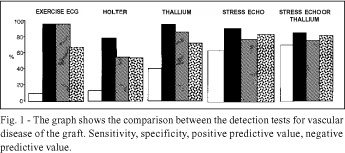
OBJECTIVE: To determine the predictive values of noninvasive tests for the detection of allograft vascular disease. METHODS: We studied 39 patients with mean ages of 48±13 years and a follow-up period of 86±13 months. The diagnosis of allograft vascular disease was made by cine-coronary arteriography, and it was considered as positive if lesions existed that caused > or = 50% obstruction of the lumen. Patients underwent 24h Holter monitoring, thallium scintigraphy, a treadmill stress test, and dobutamine stress echocardiography. Sensitivity, specificity, and positive and negative predictive values were determined in percentages for each method, as compared with the cine-coronary arteriography results. RESULTS: Allograft vascular disease was found in 15 (38%) patients. The Holter test showed 15.4% sensitivity, 95.5% specificity. For the treadmill stress test, sensitivity was 10%, specificity was 100%. When thallium scintigraphy was used, sensitivity was 40%, specificity 95.8%. On echocardiography with dobutamine, we found a 63.6% sensitivity, 91.3% specificity. When the dobutamine echocardiogram was associated with scintigraphy, sensitivity was 71.4%, specificity was 87%. CONCLUSION: In this group of patients, the combination of two noninvasive methods (dobutamine echocardiography and thallium scintigraphy) may be a good alternative for the detection of allograft vascular disease in asymptomatic patients with normal ventricular function.

  • allograft vascular disease
  • Diagnostic Methods
  • Heart Transplantation
Read Full Article
Creative Commons Attribution (CC BY) Creative Commons license
02/02/2001 DOI: 10.1590/S0066-782X2001000100004 Views 1

How to cite this article

EndNote RIS

Electronic Document Format (Vancouver)

Simões MV, Fernandes F. The Importance of the DEIC/GEMIC/SBC 2021 Position Statement on Diagnosis and Treatment of Cardiac Amyloidosis to Clinical Practice. Phenomenology, Humanities and Sciences – Fenomenologia, Humanidades e Ciências 2021;1(2):80-3.

Electronic Document Format (ABNT)

Simões, Marcus Vinicius; Fernandes, Fabio. The Importance of the DEIC/GEMIC/SBC 2021 Position Statement on Diagnosis and Treatment of Cardiac Amyloidosis to Clinical Practice. Phenomenology, Humanities and Sciences – Fenomenologia, Humanidades e Ciências, v. 1, n. 2, p. 80-83, Dec. 2021.

Electronic Document Format (APA)

Simões, M. V., & Fernandes, F. (2021). The Importance of the DEIC/GEMIC/SBC 2021 Position Statement on Diagnosis and Treatment of Cardiac Amyloidosis to Clinical Practice. Phenomenology, Humanities and Sciences – Fenomenologia, Humanidades e Ciências, 1(2), 80-83.

Electronic Document Format (ISO)

Simões, Marcus Vinicius and Fernandes, Fabio. The Importance of the DEIC/GEMIC/SBC 2021 Position Statement on Diagnosis and Treatment of Cardiac Amyloidosis to Clinical Practice. Phenomenology, Humanities and Sciences – Fenomenologia, Humanidades e Ciências [online]. 2021, vol. 1, n. 2, [cited 2026-10-14], pp. 80-83. Available from: <https://journals.cardiol.br/en/article/the-importance-of-the-deic-gemic-sbc-2021-position-statement-on-diagnosis-and-treatment-of-cardiac-amyloidosis-to-clinical-practice/>

EndNote RIS

Electronic Document Format (Vancouver)

Simões MV. Cardiac Scintigraphy with Bone Markers in Clinical Practice: When to Solicit the Exam? How to Interpret the Results?. Phenomenology, Humanities and Sciences – Fenomenologia, Humanidades e Ciências 2021;1(2):127-9.

Electronic Document Format (ABNT)

Simões, Marcus Vinicius. Cardiac Scintigraphy with Bone Markers in Clinical Practice: When to Solicit the Exam? How to Interpret the Results?. Phenomenology, Humanities and Sciences – Fenomenologia, Humanidades e Ciências, v. 1, n. 2, p. 127-129, Dec. 2021.

Electronic Document Format (APA)

Simões, M. V. (2021). Cardiac Scintigraphy with Bone Markers in Clinical Practice: When to Solicit the Exam? How to Interpret the Results?. Phenomenology, Humanities and Sciences – Fenomenologia, Humanidades e Ciências, 1(2), 127-129.

Electronic Document Format (ISO)

Simões, Marcus Vinicius. Cardiac Scintigraphy with Bone Markers in Clinical Practice: When to Solicit the Exam? How to Interpret the Results?. Phenomenology, Humanities and Sciences – Fenomenologia, Humanidades e Ciências [online]. 2021, vol. 1, n. 2, [cited 2026-10-14], pp. 127-129. Available from: <https://journals.cardiol.br/en/article/cardiac-scintigraphy-with-bone-markers-in-clinical-practice-when-to-solicit-the-exam-how-to-interpret-the-results/>

EndNote RIS

Electronic Document Format (Vancouver)

Fornitano LD, Godoy MF. Increased rate-pressure product as predictor for the absence of significant obstructive coronary artery disease in patients with positive exercise test. Arquivos Brasileiros de Cardiologia 2006;86(2):138-44.

Electronic Document Format (ABNT)

Fornitano, Luis Domingos; Godoy, Moacir Fernandes de. Increased rate-pressure product as predictor for the absence of significant obstructive coronary artery disease in patients with positive exercise test. Arquivos Brasileiros de Cardiologia, v. 86, n. 2, p. 138-144, Feb. 2006.

Electronic Document Format (APA)

Fornitano, L. D., & Godoy, M. F. (2006). Increased rate-pressure product as predictor for the absence of significant obstructive coronary artery disease in patients with positive exercise test. Arquivos Brasileiros de Cardiologia, 86(2), 138-144.

Electronic Document Format (ISO)

Fornitano, Luis Domingos and Godoy, Moacir Fernandes de. Increased rate-pressure product as predictor for the absence of significant obstructive coronary artery disease in patients with positive exercise test. Arquivos Brasileiros de Cardiologia [online]. 2006, vol. 86, n. 2, [cited 2026-10-14], pp. 138-144. Available from: <https://journals.cardiol.br/en/article/increased-rate-pressure-product-as-predictor-for-the-absence-of-significant-obstructive-coronary-artery-disease-in-patients-with-positive-exercise-test/>. ISSN 0066-782X

EndNote RIS

Electronic Document Format (Vancouver)

Bacal F, Stolf NAG, Veiga VC, Chalela WA, Grupi C, Rodrigues AC, Martinez EE, et al. Noninvasive diagnosis of allograft vascular disease after heart transplantation. Arquivos Brasileiros de Cardiologia 2001;76(1):36-42.

Electronic Document Format (ABNT)

Bacal, Fernando; Stolf, Noedir Antonio Groppo; Veiga, Viviane Cordeiro; Chalela, William A.; Grupi, Cesar; Rodrigues, Ana Clara; Martinez, Eulógio E.; Fiorelli, Alfredo Inácio; Moreira, Luiz Felipe Pinho; Bocchi, Edimar Alcides; Bellotti, Giovanni; Ramires, José Antonio Franchini. Noninvasive diagnosis of allograft vascular disease after heart transplantation. Arquivos Brasileiros de Cardiologia, v. 76, n. 1, p. 36-42, Feb. 2001.

Electronic Document Format (APA)

Bacal, F., Stolf, N. A. G., Veiga, V. C., Chalela, W. A., Grupi, C., Rodrigues, A. C., Martinez, E. E., Fiorelli, A. I., Moreira, L. F. P., Bocchi, E. A., Bellotti, G., & Ramires, J. A. F. (2001). Noninvasive diagnosis of allograft vascular disease after heart transplantation. Arquivos Brasileiros de Cardiologia, 76(1), 36-42.

Electronic Document Format (ISO)

Bacal, Fernando and Stolf, Noedir Antonio Groppo and Veiga, Viviane Cordeiro and Chalela, William A. and Grupi, Cesar and Rodrigues, Ana Clara and Martinez, Eulógio E. and Fiorelli, Alfredo Inácio and Moreira, Luiz Felipe Pinho and Bocchi, Edimar Alcides and Bellotti, Giovanni and Ramires, José Antonio Franchini. Noninvasive diagnosis of allograft vascular disease after heart transplantation. Arquivos Brasileiros de Cardiologia [online]. 2001, vol. 76, n. 1, [cited 2026-10-14], pp. 36-42. Available from: <https://journals.cardiol.br/en/article/noninvasive-diagnosis-of-allograft-vascular-disease-after-heart-transplantation/>. ISSN 0066-782X

  • About ABC Family
  • Internal Regulation
  • Editorial Board
  • Brazilian Society of Cardiology (SBC)

Issues

SBC Guidelines

  • Videos
  • Podcasts
  • News