Myocardial revascularization surgery without extracorporeal circulation minimizes postoperative bleeding and the need for transfusion
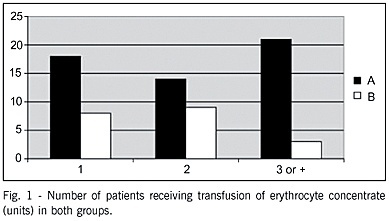
OBJECTIVE: To compare myocardial revascularization (MR) with and without extracorporeal circulation (ECC) in regard to postoperative bleeding and the need for blood and hemoderivate transfusion. METHODS: From November 2001 to February 2002, 186 patients undergoing myocardial revascularization were assessed, excluding those who underwent associated procedures. The patients were divided into 2 groups as follows: group A – comprising 116 patients undergoing MR with ECC; and group B – comprising 69 patients undergoing MR without ECC. Both groups were comparable in regard to pre- and intraoperative characteristics, except for the greater number of distal anastomoses (P=0.0004) in group A, and greater prothrombin activity (P=0.04) and INR (P=0.03) in group B. To avoid discrepancies between the groups, 140 patients with statistically similar characteristics were selected. RESULTS: Studying the paired groups, both the total bleeding volume in 24 hours (P=0.001) and the bleeding volume indexed for body surface (P=0.004) were greater in group A (609.6 ± 395.8 mL; 331.8 ± 225.8 mL/m², respectively) than in group B (437.2 ± 315 mL; 241 ± 173.9 mL/m², respectively). Although the need for transfusion was not significantly different between the groups (P=0.1), the amount of erythrocyte concentrate transfused was greater in group A (P=0.01). No statistical difference was observed in regard to transfusion of other hemocomponents and the need for surgical review of hemostasis. CONCLUSION: Myocardial revascularization without ECC was more advantageous than MR with ECC in regard to smaller postoperative blood loss and a lesser need for transfusion of erythrocyte concentrate. The repercussions of this finding may be innumerable, particularly in regard to minimization of morbid factors and hospital costs.
Imagens
Visualizador da galeria de imagens em tela cheia
Os comentários são moderados pela equipe editorial antes da publicação. As discussões devem ser baseadas em evidências e utilizar linguagem científica. Conflitos de interesse devem ser declarados.