Família ABC Arquivos Brasileiros de Cardiologia International Journal of Cardiovascular Sciences ABC Heart Failure & Cardiomyopathy ABC Imagem Cardiovascular
Português English
Família ABC
Português English
  • Sobre
    • Sobre a Família ABC
    • Regimento Interno
    • Conselho Editorial
    • Sociedade Brasileira de Cardiologia (SBC)
  • Edições
  • Diretrizes da SBC
  • Conteúdos
    • Vídeos
    • Podcasts
    • Notícias
  • Sobre
    • Sobre a Família ABC
    • Regimento Interno
    • Conselho Editorial
    • Sociedade Brasileira de Cardiologia (SBC)
  • Edições
  • Diretrizes da SBC
  • Conteúdos
    • Vídeos
    • Podcasts
    • Notícias

Família ABC

  • Família ABC
  • Arquivos Brasileiros de Cardiologia
  • International Journal of Cardiovascular Sciences
  • ABC Heart Failure & Cardiomyopathy
  • ABC Imagem Cardiovascular
Buscar em

Nenhum conteúdo encontrado.

Revistas
Ordenação
Tipos de artigo
Outros

  1. Início
  2. Palavra-chave: Heart Defects Congenital/surgery
IJCS
Original Article

Cardiovascular Risk Factors in Children and Adolescents with Fontan Circulation

Sandra Mari Barbiero et al. Rafael B. Carloto Danielly Steffen Pereira Gabriela C. Schwantes … Marcela Menuci Guimarães Maíra Ribas Goulart Daniela Schneid Schuh Lucia Campos Pellanda

Abstract

Background:

Long-term outcomes of patients with Fontan circulation are uncertain regarding the prevalence and role of risk factors (RFs) such as increased body mass index (BMI), arterial hypertension, and hypercholesterolemia.

Objectives:

To describe the prevalence of RFs in patients with univentricular heart, with variable follow-up times.

Methods:

This mixed cohort study was performed with 66 patients, who underwent blood count, fasting blood glucose, C-reactive protein (CRP), and lipid profile tests; systolic/diastolic blood pressure (SBP/DBP) measurements; and anthropometric and sociodemographic data collection. Cardiovascular RFs among first-degree relatives and physical activity habits were also assessed. Prevalence was described using proportions, with a 95% confidence interval. Continuous variables (height, weight, age, SBP, DBP) were described as means and standard deviations (m±SD). Associations between RFs were assessed using chi-squared or Fisher’s exact tests. Spearman’s correlation was used for analyzing CRP and the presence of 2 or more RFs. The Shapiro-Wilk test was used to check for data normality. Statistical significance considered p<0.05.

Results:

In our population, 19.7% were overweight, mean SBP was 89.44±37.4, and mean DBP was 60.0±26.08. The most prevalent diseases in the interviewees’ families were systemic arterial hypertension (30.3%), obesity (16.7%), and 2 or more cardiovascular RFs among first-degree relatives (13.8%). We observed a trend towards significance between the presence of 2 familial RFs and overweight, as well as a risk profile for cardiovascular disease. There was an association between the BMI percentile, the presence of 2 or more RFs (p<0.05), and CRP (p<0.01).

Conclusions:

Overweight is common in patients with univentricular heart, being related to more than 2 cardiovascular RFs among first-degree relatives; physical inactivity and changes in lipid profiles are also frequent.
  • cardiovascular diseases
  • Child, Adolescent
  • Fontan Procedure/methods
  • Heart Defects Congenital/surgery
  • Obesity
  • Physical Inactivity
  • Risk Factors
Ler artigo completo
Creative Commons Attribution (CC BY) Creative Commons license
22/04/2022 DOI: 10.36660/ijcs.20200357 Visualizações 1
Figura 1
ABC
Relato de Caso

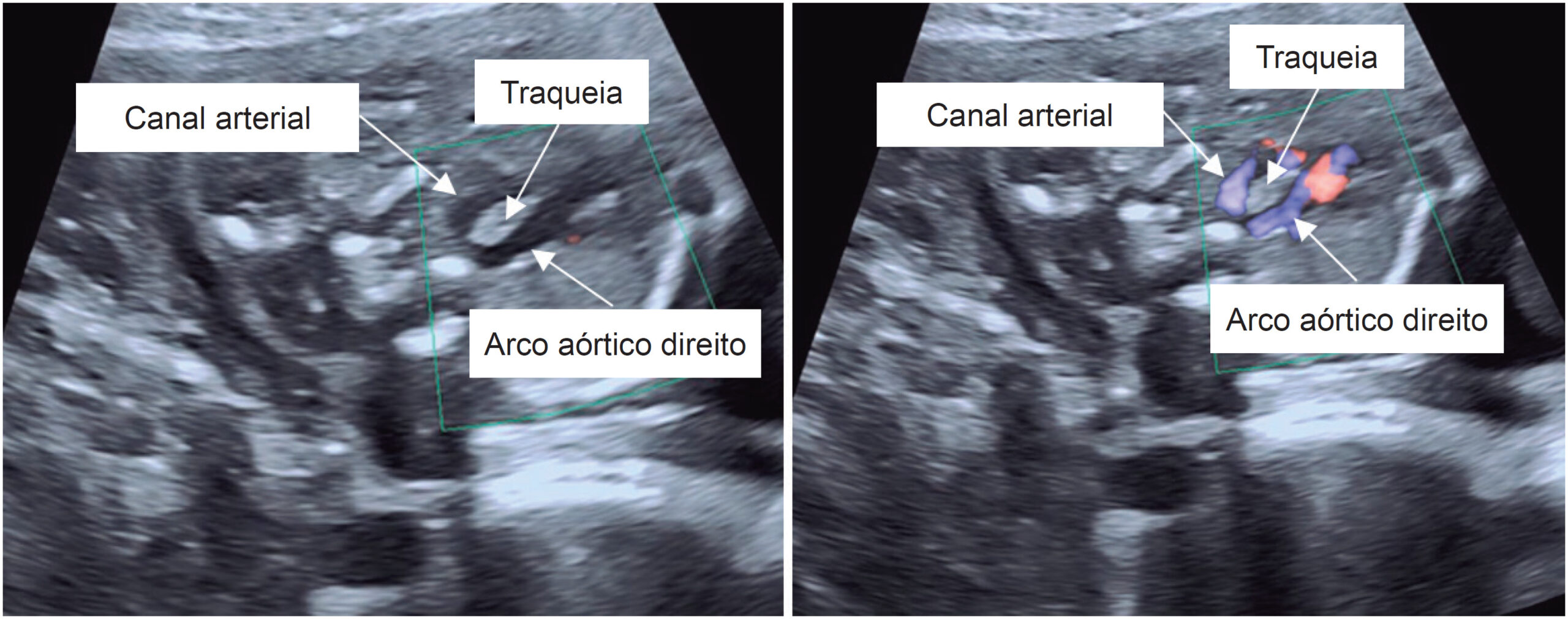
Diagnóstico Pré-Natal de Duplo Arco Aórtico

Natália Noronha et al. Angie Hobbs Patricia Caldas

Introdução

As anomalias congênitas do arco aórtico afetam 1-2% da população e compreendem uma grande variedade de anormalidades na posição e / ou padrão de ramificação do arco aórtico. O duplo arco aórtico (DAA) representa 1-2% de todas as anomalias do arco aórtico e é caracterizado pela persistência dos arcos aórticos embrionários esquerdo e direito. A anomalia pode ser encontrada isoladamente ou, com menor frequência, em associação com outras anormalidades cardiovasculares ou cromossômicas. O diagnóstico pré-natal de DAA pode ser desafiador, pois sua diferenciação de outras anormalidades do arco, como arco aórtico direito com canal arterial esquerdo ou com artéria subclávia esquerda aberrante, nem sempre é clara. Os autores descrevem um caso de diagnóstico pré-natal de DAA.

[…]

  • Aberrações Cromossômicas
  • Aorta Torácica/diagnosis
  • Broncomalácia/congênito
  • Cardiopatias Congênitas/cirurgia
  • Cardiopatias Congênitas/diagnóstico
  • Ecocardiografia/ métodos
  • Heart Defects Congenital/surgery
  • Paralisia das Cordas Vocais
  • Ultrassonografia/métodos
Ler artigo completo
Creative Commons Attribution (CC BY) Creative Commons license
05/02/2021 DOI: 10.36660/abc.20190310
IJCS
Editorial

Challenge in the Treatment of Children with Congenital Heart Disease: Reducing Waiting Time for Cardiac Surgery

Ana Flavia Malheiros Torbey et al. Aurea Grippa

Congenital heart disease is an important cause of mortality in the neonatal period. in Brazil, according to data from DATASUS from the period between 2012 and 2016, congenital heart disease is the third most common malformation in children younger than 28 days, with an estimated incidence of 1.3-1.7% and high mortality rate in this age range. They are also the third main cause of global mortality in the first 30 days of life, the main cause among congenital abnormalities. Therefore, 28,000 new cases per year are expected in Brazil. ,

The outcomes of congenital heart disease can be grouped into spontaneous resolution of minor lesions, such as some interatrial or interventricular communications or persistent arterial duct; conditions that require repair procedures (interventional catheterizations or surgeries); and those cases that only palliative procedures can be performed due to anatomical and physiological features. Thus, approximately 20% of cases do not require surgery and resolve spontaneously, and nearly half of the other 80% (22,400 children) will require cardiac surgery in the first year of life. ,

[…]

  • Health Services Accessibility
  • Heart Defects Congenital/surgery
  • Public Health
  • Public Policy
Ler artigo completo
Creative Commons Attribution (CC BY) Creative Commons license
29/05/2020 DOI: 10.36660/ijcs.20190013
IJCS
Original Article

Clinical and Epidemiological Profiles of Patients Admitted to a Pediatric Cardiac Intensive Care Unit

Juciane Rocha Guimarães et al. Isabel Cristina Britto Guimarães

Abstract

Background:

Congenital and acquired heart diseases are important causes of morbidity and mortality in children. In critical congenital heart defects, when treatment is not adequate, clinical manifestations may lead to death in the neonatal period.

Objective:

To establish the clinical and epidemiological profile of patients admitted to the pediatric cardiac intensive care unit (UTI) in a tertiary hospital.

Methods:

This was a cross-sectional study conducted from January 2013 to December 2014, based on analysis of patients’ medical records. The study sample was composed of 307 children and adolescents with congenial and acquired heart diseases. The score Risk Adjustement for Congenital Heart Surgery 1 (RACHS-1) was used for categorization of the various surgical procedures. Descriptive statistics were calculated using the Satistical Package for Social Sciences (SPSS). Categorical variables were compared using the Pearson’s chi-square test, considering a level of significance of 5%.

Results:

There was a predominance of patients aged between 28 days and one year (44%). Congenital heart diseases (91.9%) prevailed over acquired heart diseases (8.1%). Extracorporeal circulation was used in 138 patients who underwent surgical procedures, lasting from 12 to 261 minutes. Most patients (88.9%) were discharged from the ICU and 11.1% died. Using the score RACHS-1, corrective cardiac surgery was performed in 75.8% and paliative surgery in 24.2% of the patients.

Conclusions:

Patients aged between 28 days to one year, with cyanotic congenital heart disease, undergoing cardiac surgery with extracorporeal circulation duration longer than 120 minutes are at a higher risk of death.

  • Epidemiology
  • Heart Defects Congenital/surgery
  • Heart Septal Defects, Ventricular/Surgery
  • Heart Septal Defects/Surgery
  • Intensive Care Units, Pediatric
Ler artigo completo
Creative Commons Attribution (CC BY) Creative Commons license
03/02/2020 DOI: 10.36660/ijcs.20180070 Visualizações 1

Como citar este artigo

EndNote RIS

Formato de Documento Eletrônico (Vancouver)

Barbiero SM, Carloto RB, Pereira DS, Schwantes GC, Guimarães MM, Goulart MR, Schuh DS, et al. Cardiovascular Risk Factors in Children and Adolescents with Fontan Circulation. International Journal of Cardiovascular Sciences 2022;35(5):618-24.

Formato de Documento Eletrônico (ABNT)

Barbiero, Sandra Mari; Carloto, Rafael B.; Pereira, Danielly Steffen; Schwantes, Gabriela C.; Guimarães, Marcela Menuci; Goulart, Maíra Ribas; Schuh, Daniela Schneid; Pellanda, Lucia Campos. Cardiovascular Risk Factors in Children and Adolescents with Fontan Circulation. International Journal of Cardiovascular Sciences, v. 35, n. 5, p. 618-624, abr. 2022.

Formato de Documento Eletrônico (APA)

Barbiero, S. M., Carloto, R. B., Pereira, D. S., Schwantes, G. C., Guimarães, M. M., Goulart, M. R., Schuh, D. S., & Pellanda, L. C. (2022). Cardiovascular Risk Factors in Children and Adolescents with Fontan Circulation. International Journal of Cardiovascular Sciences, 35(5), 618-624.

Formato de Documento Eletrônico (ISO)

Barbiero, Sandra Mari and Carloto, Rafael B. and Pereira, Danielly Steffen and Schwantes, Gabriela C. and Guimarães, Marcela Menuci and Goulart, Maíra Ribas and Schuh, Daniela Schneid and Pellanda, Lucia Campos. Cardiovascular Risk Factors in Children and Adolescents with Fontan Circulation. International Journal of Cardiovascular Sciences [online]. 2022, vol. 35, n. 5, [citado 2026-10-14], pp. 618-624. Disponível em: <https://journals.cardiol.br/article/cardiovascular-risk-factors-in-children-and-adolescents-with-fontan-circulation-2/>. ISSN 2359-4802

EndNote RIS

Formato de Documento Eletrônico (Vancouver)

Noronha N, Hobbs A, Caldas P. Diagnóstico Pré-Natal de Duplo Arco Aórtico. Arquivos Brasileiros de Cardiologia 2021;116(2 suppl 1):4-7.

Formato de Documento Eletrônico (ABNT)

Noronha, Natália; Hobbs, Angie; Caldas, Patricia. Diagnóstico Pré-Natal de Duplo Arco Aórtico. Arquivos Brasileiros de Cardiologia, v. 116, n. 2 suppl 1, p. 4-7, fev. 2021.

Formato de Documento Eletrônico (APA)

Noronha, N., Hobbs, A., & Caldas, P. (2021). Diagnóstico Pré-Natal de Duplo Arco Aórtico. Arquivos Brasileiros de Cardiologia, 116(2 suppl 1), 4-7.

Formato de Documento Eletrônico (ISO)

Noronha, Natália and Hobbs, Angie and Caldas, Patricia. Diagnóstico Pré-Natal de Duplo Arco Aórtico. Arquivos Brasileiros de Cardiologia [online]. 2021, vol. 116, n. 2 suppl 1, [citado 2026-10-14], pp. 4-7. Disponível em: <https://journals.cardiol.br/article/diagnostico-pre-natal-de-duplo-arco-aortico/>. ISSN 0066-782X

EndNote RIS

Formato de Documento Eletrônico (Vancouver)

Torbey AFM, Grippa A. Challenge in the Treatment of Children with Congenital Heart Disease: Reducing Waiting Time for Cardiac Surgery. International Journal of Cardiovascular Sciences 2020;33(3):206-7.

Formato de Documento Eletrônico (ABNT)

Torbey, Ana Flavia Malheiros; Grippa, Aurea. Challenge in the Treatment of Children with Congenital Heart Disease: Reducing Waiting Time for Cardiac Surgery. International Journal of Cardiovascular Sciences, v. 33, n. 3, p. 206-207, maio. 2020.

Formato de Documento Eletrônico (APA)

Torbey, A. F. M., & Grippa, A. (2020). Challenge in the Treatment of Children with Congenital Heart Disease: Reducing Waiting Time for Cardiac Surgery. International Journal of Cardiovascular Sciences, 33(3), 206-207.

Formato de Documento Eletrônico (ISO)

Torbey, Ana Flavia Malheiros and Grippa, Aurea. Challenge in the Treatment of Children with Congenital Heart Disease: Reducing Waiting Time for Cardiac Surgery. International Journal of Cardiovascular Sciences [online]. 2020, vol. 33, n. 3, [citado 2026-10-14], pp. 206-207. Disponível em: <https://journals.cardiol.br/article/challenge-in-the-treatment-of-children-with-congenital-heart-disease-reducing-waiting-time-for-cardiac-surgery-2/>. ISSN 2359-4802

EndNote RIS

Formato de Documento Eletrônico (Vancouver)

Guimarães JR, Guimarães ICB. Clinical and Epidemiological Profiles of Patients Admitted to a Pediatric Cardiac Intensive Care Unit. International Journal of Cardiovascular Sciences 2020;33(4):333-5.

Formato de Documento Eletrônico (ABNT)

Guimarães, Juciane Rocha; Guimarães, Isabel Cristina Britto. Clinical and Epidemiological Profiles of Patients Admitted to a Pediatric Cardiac Intensive Care Unit. International Journal of Cardiovascular Sciences, v. 33, n. 4, p. 333-335, fev. 2020.

Formato de Documento Eletrônico (APA)

Guimarães, J. R., & Guimarães, I. C. B. (2020). Clinical and Epidemiological Profiles of Patients Admitted to a Pediatric Cardiac Intensive Care Unit. International Journal of Cardiovascular Sciences, 33(4), 333-335.

Formato de Documento Eletrônico (ISO)

Guimarães, Juciane Rocha and Guimarães, Isabel Cristina Britto. Clinical and Epidemiological Profiles of Patients Admitted to a Pediatric Cardiac Intensive Care Unit. International Journal of Cardiovascular Sciences [online]. 2020, vol. 33, n. 4, [citado 2026-10-14], pp. 333-335. Disponível em: <https://journals.cardiol.br/article/clinical-and-epidemiological-profiles-of-patients-admitted-to-a-pediatric-cardiac-intensive-care-unit-2/>. ISSN 2359-4802

  • Sobre a Família ABC
  • Regimento Interno
  • Conselho Editorial
  • Sociedade Brasileira de Cardiologia (SBC)

Edições

Diretrizes da SBC

  • Vídeos
  • Podcasts
  • Notícias