Subjective global assessment of nutritional status in cardiac patients
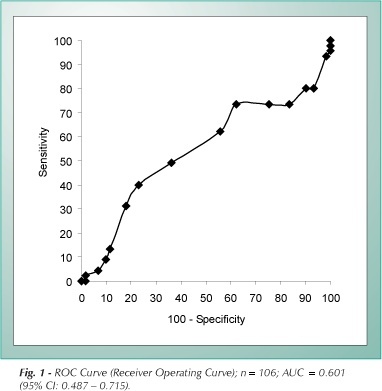
OBJECTIVE: To analyze the performance of Subjective Global Assessment of Nutritional Status (SGA) in diagnosing malnutrition in patients with heart disease. METHODS: One hundred and six hospitalized patients (53 with heart failure) completed an SGA questionnaire on their nutritional history (changes in body weight, dietary intake, gastrointestinal symptoms, functional capacity, and diagnosis) and underwent physical examination. Then, anthropometric measurements were obtained (body weight, mid-arm circumference, triceps skinfold thickness, and arm muscle circumference). Serum albumin, total lymphocyte count and anthropometric measurements were determined for the objective assessment of patients with congestive heart failure. An ROC curve was used to analyze sensitivity, specificity and accuracy of SGA compared to the objective assessment. RESULTS: Patients’ age was 57.7 ± 15.7, and the majority was male (67.9%). The ROC curve showed score 16 as SGA cut-off point with the highest sensitivity (62.2%) and specificity (55.7%). The area under the curve was 0.601 (95% CI: 0.487 – 0.715). Anthropometric assessment showed malnutrition prevalence at 51.9% by SGA and 42.5% by, with accuracy of 65.3% in men and 44.1% in women. In patients with congestive heart failure, SGA assessed malnutrition prevalence was 60.4%, while objective assessment was 32.1% with accuracy of 67.6% in men and 31.3% in women. CONCLUSION: SGA detected a greater number of malnourished patients than the objective evaluation. Its performance in identifying malnutrition was better in men. It also detected cardiac patients at nutritional risk.
Imagens
Visualizador da galeria de imagens em tela cheia
Os comentários são moderados pela equipe editorial antes da publicação. As discussões devem ser baseadas em evidências e utilizar linguagem científica. Conflitos de interesse devem ser declarados.