Cardiovascular responses to resistance exercise are affected by workload and intervals between sets
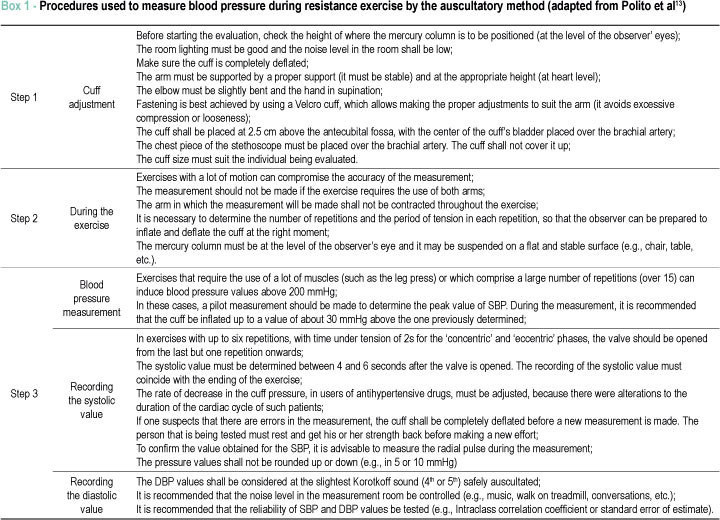
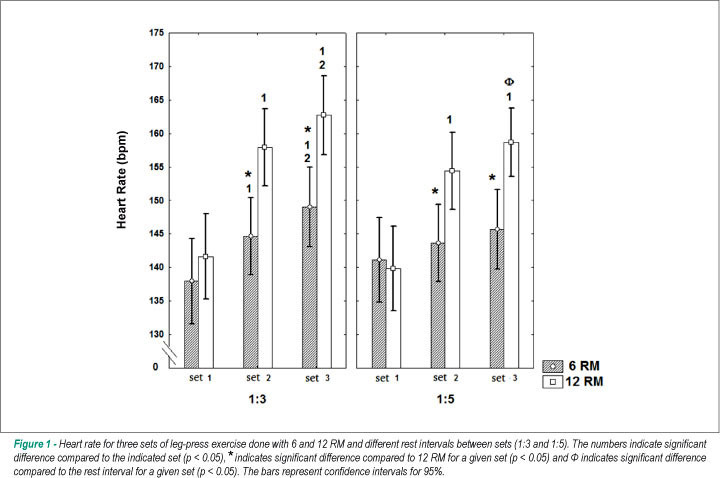
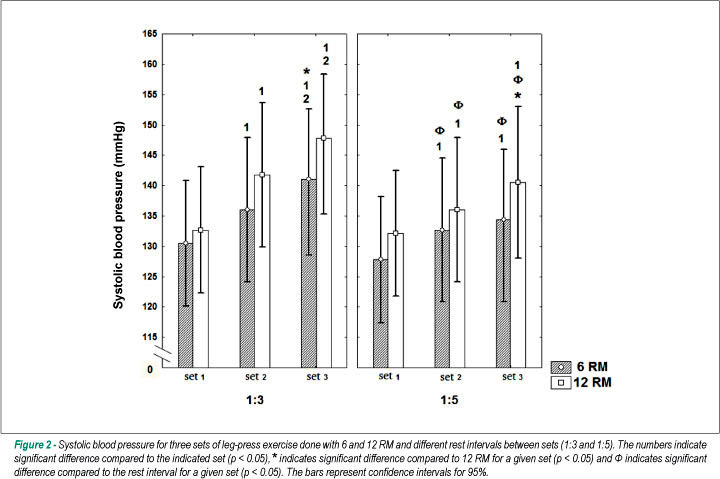
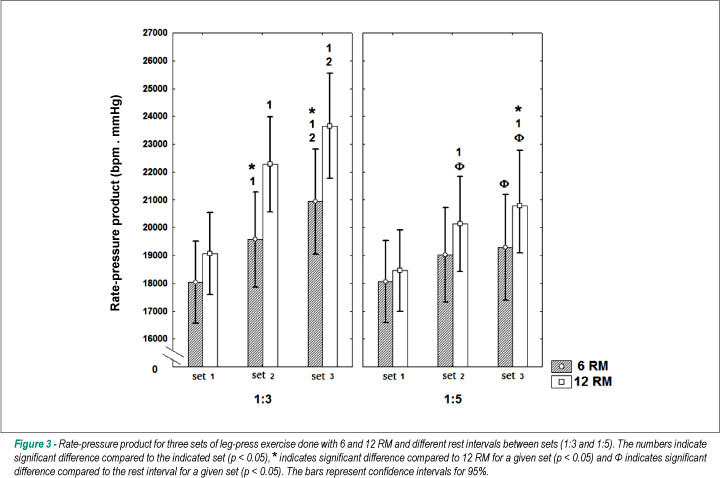
BACKGROUND: The control of cardiovascular responses during resistance exercise (RE) is important for patient safety. OBJECTIVE: To investigate the influence of repetition maximum (RM) and rest interval between sets (RI) on heart rate (HR), systolic blood pressure (SBP) and rate-pressure product (RPP) during RE. METHODS: Twenty healthy subjects (26 ± 5 years of age) underwent RE protocols involving three sets of leg press (6 and 12 RM) and RI proportional to the contraction time (1:3 and 1:5). The HR was checked on a continuous basis by using a cardiotachometer and the SBP was checked at the end of the sets, via a protocol validated by the auscultatory method. RESULTS: The HR was influenced by the workload (p = 0.008) and sets (p < 0.001), but not by the RI (p = 0.087). The SBP suffered from the isolated effect of the number of sets (p < 0.001) and RI (p = 0.017), but not from the workload (p = 0.95). The RPP rose in direct proportion to the workload (p = 0.036) and sets (p < 0.001), but in inverse proportion to the RI (p = 0.006). In 6 RM protocols, the variation in the HR was higher for RI = 1:3 (Δ = 11.2 ± 1.1 bpm) than for RI = 1:5 (Δ = 4.5 ± 0.2 bpm; p = 0.002), but there was no difference for 12 RM (Δ 1:3 = 21.1 ± 2.2 bpm; Δ 1:5 = 18.9 ± 2.0 bpm, p = 0.83). The RI influenced the variation in SBP in all loads (6 RM – Δ 1:3 = 10.6 ± 0.9 mmHg, Δ 1:5 = 6.6 ± 0.7 mmHg; p = 0.02 and 12 RM – Δ 1:3 = 15.2 ± 1.1 mmHg, Δ 1:5 = 8.4 ± 0.7 mmHg; p = 0.04). The RPP rose in proportion to the workload (p = 0.036) and to the sets (p < 0.001), but in inverse proportion to the RI (p = 0.006). With RI = 1:3, there was difference in RPP for 6 RM (Δ = 2,892 ± 189 mmHg.bpm) and 12 RM (Δ = 4,587 ± 300 mmHg.bpm; p = 0.018), but not with RI = 1:5 (6 RM: Δ = 1,224 ± 141 mmHg.bpm, 12 RM: Δ = 2,332 ± 194 mmHg.bpm; p = 0.58). CONCLUSION: Regardless of the workload, an increased RI was associated with lower cardiovascular responses during RE, especially of SBP.
Images
Image gallery fullscreen viewer
Comments are moderated by the editorial team before publication. Discussions should be evidence-based and use scientific language. Conflicts of interest should be declared.