ABC Family Arquivos Brasileiros de Cardiologia International Journal of Cardiovascular Sciences ABC Heart Failure & Cardiomyopathy ABC Imagem Cardiovascular
Português English
ABC Family
Português English
  • About
    • About ABC Family
    • Internal Regulation
    • Editorial Board
    • Brazilian Society of Cardiology (SBC)
  • Issues
  • SBC Guidelines
  • Content
    • Videos
    • Podcasts
    • News
  • About
    • About ABC Family
    • Internal Regulation
    • Editorial Board
    • Brazilian Society of Cardiology (SBC)
  • Issues
  • SBC Guidelines
  • Content
    • Videos
    • Podcasts
    • News

ABC Family

  • ABC Family
  • Arquivos Brasileiros de Cardiologia
  • International Journal of Cardiovascular Sciences
  • ABC Heart Failure & Cardiomyopathy
  • ABC Imagem Cardiovascular
Search in

No content found.

Journals
Ordering
Article types
Others

  1. Home
  2. Keyword: Time to Treatment
IJCS
Editorial

Difference in Treatment Response Between Men and Women with Acute Myocardial Infarction with ST-segment Elevation Even When Following Well-established Protocols

João Manoel Theotonio dos Santos

The study “Comparison of Clinical and Epidemiological Profiles Between Men and Women with ST-Elevation Myocardial Infarction in Salvador from 2021 to 2023” provides an important contribution by demonstrating that, even in a setting supported by a well-structured ST-elevation myocardial infarction (STEMI) protocol, relevant differences in clinical profiles between men and women persist. Although treatment strategies were homogeneous between sexes—a noteworthy finding in a country where healthcare inequities are often the rule—the observation that women present later, are older at the time of the event, and more frequently receive potent antiplatelet agents reinforces the need to understand acute coronary syndrome in women according to their specific pathophysiological and clinical characteristics.1

In recent years, increasing evidence has challenged the concept that myocardial infarction in women is simply “the same infarction, occurring later.” Contemporary data indicate that mechanisms such as coronary microvascular dysfunction, plaque erosion, and spontaneous coronary artery dissection are more prevalent among women, demanding greater diagnostic precision and tailored therapeutic strategies.2,3 In parallel, atypical symptom presentation and lower perceived cardiovascular risk contribute to delays in seeking care—a phenomenon consistently observed worldwide, including in high-income countries.4

[…]

  • ST Elevation Myocardial Infarction
  • Time to Treatment
  • Women
Read Full Article
Creative Commons Attribution (CC BY) Creative Commons license
12/06/2026 DOI: 10.36660/ijcs.20260023 Views 1
Figure 1
IJCS
Original Article

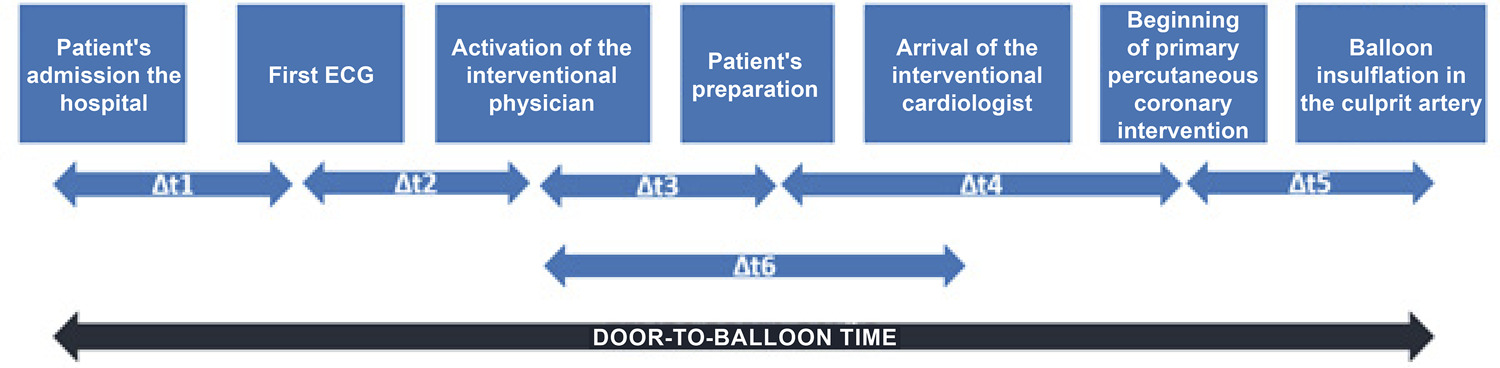
Door-to-balloon Time in Cardiovascular Emergency Care in a Hospital of Northern Brazil

Tárcio Sadraque Gomes Amoras et al. Taymara Barbosa Rodrigues Cláudia Ribeiro Menezes Christielaine Venzel Zaninotto Roseneide dos Santos Tavares

Abstract

Background

The use of an adequate door-to-balloon time (≤ 90 minutes) is crucial in improving the quality of care provided to patients with ST-segment elevation myocardial infarction (STEMI).

Objective

To determine the door-to-balloon time in the management of STEMI patients in a cardiovascular emergency department in a hospital of northern Brazil.

Methods

This was a cross-sectional study based on review of medical records. A total of 109 patients with STEMI admitted to the emergency department of a referral cardiology hospital in Pará State, Brazil, between May 2017 and December 2017. Correlations of the door-to-balloon time with length of hospital stay and mortality rate were assessed, as well as whether the time components of the door-to-balloon time affected the delay in performing primary percutaneous coronary intervention. Quantitative variables were analyzed by Spearman correlation and the G test was used for categorical variables. A p<0.05 was set as statistically significant.

Results

Median door-to-balloon time was 104 minutes. No significant correlation was found between door-to-balloon time and length of hospital stay or deaths, but significant correlations were found between door-to-balloon time and door-to-ECG time (p<0.001) and ECG-to-activation (of an interventional cardiologist) time (p<0.001).

Conclusion

The door-to-balloon time was longer the recommended and was not correlated with the length of hospital stay or in-hospital mortality. Door-to-ECG time and ECG-to-activation time contributed to the delay in performing the primary percutaneous coronary intervention. Int J Cardiovasc Sci. 2020; [online].ahead print, PP.0-0

  • Admitting Department, Hospital
  • Angioplasty, Balloon, Coronary
  • health care
  • Myocardial Infarction
  • Quality Indicators
  • Time to Treatment
Read Full Article
Creative Commons Attribution (CC BY) Creative Commons license
06/11/2020 DOI: 10.36660/ijcs.20190104 Views 1

How to cite this article

EndNote RIS

Electronic Document Format (Vancouver)

Santos JMT. Difference in Treatment Response Between Men and Women with Acute Myocardial Infarction with ST-segment Elevation Even When Following Well-established Protocols. International Journal of Cardiovascular Sciences 2026;39:e20260023.

Electronic Document Format (ABNT)

Santos, João Manoel Theotonio dos. Difference in Treatment Response Between Men and Women with Acute Myocardial Infarction with ST-segment Elevation Even When Following Well-established Protocols. International Journal of Cardiovascular Sciences, v. 39, e20260023, Jun. 2026.

Electronic Document Format (APA)

Santos, J. M. T. (2026). Difference in Treatment Response Between Men and Women with Acute Myocardial Infarction with ST-segment Elevation Even When Following Well-established Protocols. International Journal of Cardiovascular Sciences, 39, e20260023.

Electronic Document Format (ISO)

Santos, João Manoel Theotonio dos. Difference in Treatment Response Between Men and Women with Acute Myocardial Infarction with ST-segment Elevation Even When Following Well-established Protocols. International Journal of Cardiovascular Sciences [online]. 2026, vol. 39, [cited 2026-10-14], e20260023. Available from: <https://journals.cardiol.br/en/article/difference-in-treatment-response-between-men-and-women-with-acute-myocardial-infarction-with-st-segment-elevation-even-when-following-well-established-protocols/>. ISSN 2359-4802

EndNote RIS

Electronic Document Format (Vancouver)

Amoras TSG, Rodrigues TB, Menezes CR, Zaninotto CV, Tavares RS. Door-to-balloon Time in Cardiovascular Emergency Care in a Hospital of Northern Brazil. International Journal of Cardiovascular Sciences 2020;34(1):53-9.

Electronic Document Format (ABNT)

Amoras, Tárcio Sadraque Gomes; Rodrigues, Taymara Barbosa; Menezes, Cláudia Ribeiro; Zaninotto, Christielaine Venzel; Tavares, Roseneide dos Santos. Door-to-balloon Time in Cardiovascular Emergency Care in a Hospital of Northern Brazil. International Journal of Cardiovascular Sciences, v. 34, n. 1, p. 53-59, Nov. 2020.

Electronic Document Format (APA)

Amoras, T. S. G., Rodrigues, T. B., Menezes, C. R., Zaninotto, C. V., & Tavares, R. S. (2020). Door-to-balloon Time in Cardiovascular Emergency Care in a Hospital of Northern Brazil. International Journal of Cardiovascular Sciences, 34(1), 53-59.

Electronic Document Format (ISO)

Amoras, Tárcio Sadraque Gomes and Rodrigues, Taymara Barbosa and Menezes, Cláudia Ribeiro and Zaninotto, Christielaine Venzel and Tavares, Roseneide dos Santos. Door-to-balloon Time in Cardiovascular Emergency Care in a Hospital of Northern Brazil. International Journal of Cardiovascular Sciences [online]. 2020, vol. 34, n. 1, [cited 2026-10-14], pp. 53-59. Available from: <https://journals.cardiol.br/en/article/door-to-balloon-time-in-cardiovascular-emergency-care-in-a-hospital-of-northern-brazil/>. ISSN 2359-4802

  • About ABC Family
  • Internal Regulation
  • Editorial Board
  • Brazilian Society of Cardiology (SBC)

Issues

SBC Guidelines

  • Videos
  • Podcasts
  • News