ABC Family Arquivos Brasileiros de Cardiologia International Journal of Cardiovascular Sciences ABC Heart Failure & Cardiomyopathy ABC Imagem Cardiovascular
Português English
ABC Family
Português English
  • About
    • About ABC Family
    • Internal Regulation
    • Editorial Board
    • Brazilian Society of Cardiology (SBC)
  • Issues
  • SBC Guidelines
  • Content
    • Videos
    • Podcasts
    • News
  • About
    • About ABC Family
    • Internal Regulation
    • Editorial Board
    • Brazilian Society of Cardiology (SBC)
  • Issues
  • SBC Guidelines
  • Content
    • Videos
    • Podcasts
    • News

ABC Family

  • ABC Family
  • Arquivos Brasileiros de Cardiologia
  • International Journal of Cardiovascular Sciences
  • ABC Heart Failure & Cardiomyopathy
  • ABC Imagem Cardiovascular
Search in

No content found.

Journals
Ordering
Article types
Others

  1. Home
  2. Keyword: Syncope/physiopathology
Figure 1
IJCS
Original Article

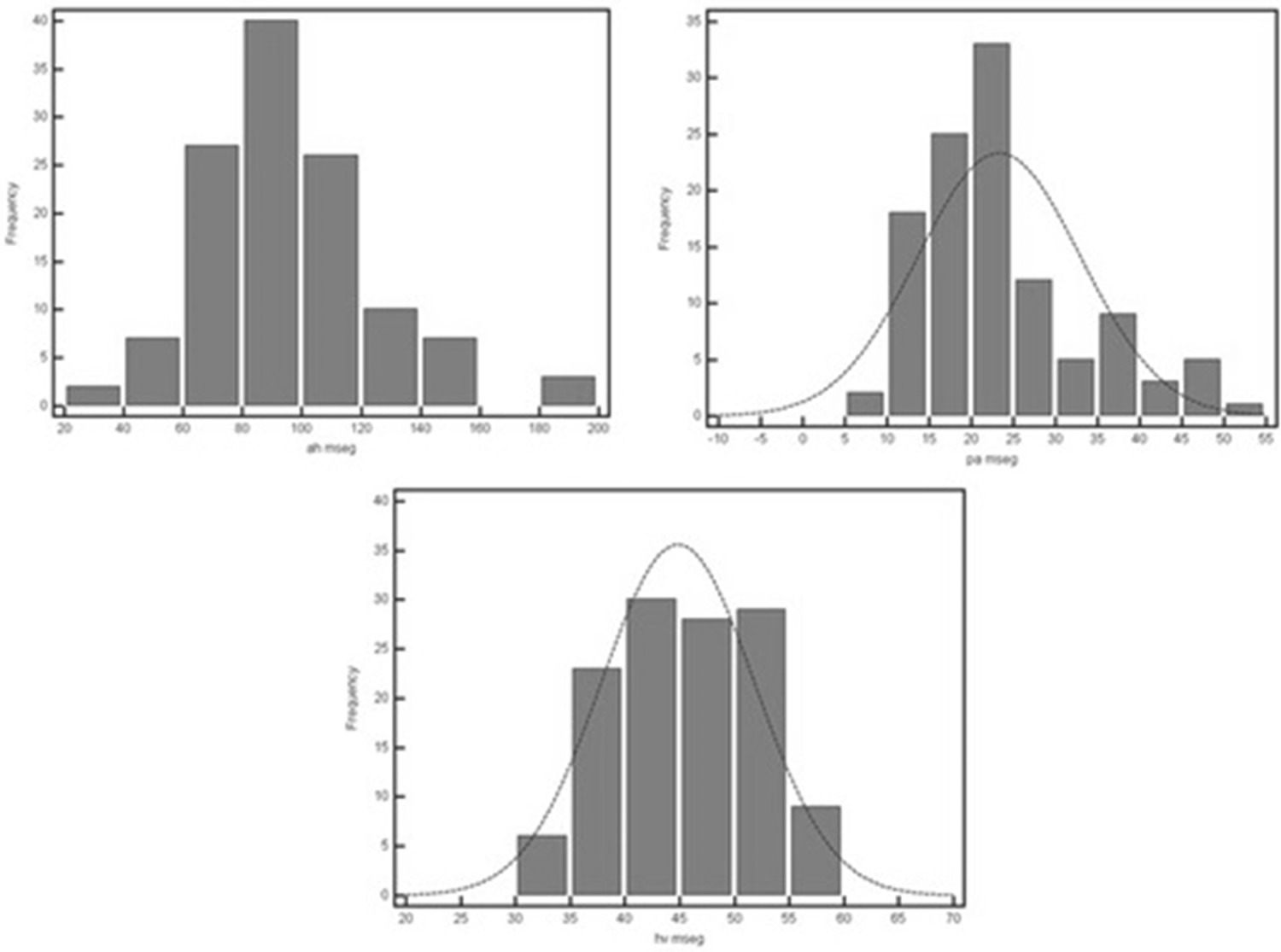
Analysis of Conduction Intervals in Normal Electrophysiological Studies: Establishment of Reference Values the Brazilian Population

Tiago Luiz Luz Leiria et al. Catarine Benta Lopes dos Santos Roberto Tofani Sant'anna Julia Santana Trombetta … Gabriela Osterkamp Marcelo Lapa Kruse Leonardo Martins Pires Gustavo Glotz Lima

Abstract

Background

In the investigation of cardiac rhythm disorders, a normal electrophysiological (EPS) study is associated with a favorable prognosis. One of the normality criteria is established by conduction intervals within expected range.

Objective

To establish reference values in EPS for the intracavitary conduction intervals (PA, AH and HV) in a Brazilian population.

Methods

A retrospective cohort study of the first 1,500 patients submitted to EPS ablation was performed at Instituto de Cardiologia do Rio Grande do Sul, Brazil. The EPS was considered normal if the test was performed for diagnostic purpose; absence of induced arrhythmias; and conduction intervals within the expected range. The REDCap software was used for data collection and management, and the SPSS Statistics 22.0 used for data analysis. Continuous variables were compared with Student’s t-test for independent samples and categorical variables with the chi-square test (X 2 ). Values of p ≤ 0.05 were considered significant.

Results

A total of 124 (8.3%) with EPS considered normal were included; mean age was 52 ± 21 years, and 63 were male. The mean values in milliseconds of PA, AH and HV were 23 ± 9, 88 ± 25 and 44 ± 7, respectively. The PA, AH, and HV percentile ranges were 13 – 25, 81-107 and 40 – 52, respectively. When the patients were divided into three age groups (1 to 18 years, 19 to 64 years and 65 or more), we observed that the group of older patients had significantly higher values of PA, AH and HV compared with younger patients.

Conclusion

This study showed that intracavitary conduction intervals in a sample of the Brazilian population were similar to previously published studies. Elderly patients tend to have higher values of intracavitary conduction intervals in EPS. Future studies including broader age ranges could enable the acquisition of more reliable and reproducible reference values. (Int J Cardiovasc Sci. 2020; [online].ahead print, PP.0-0)

  • Arrhythmias Cardiac
  • Brazil / epidemiology
  • Electrocardiography/methods
  • Predictive Value of Tests
  • Syncope/physiopathology
  • Syncope/therapy
  • Treatment Outcome
Read Full Article
Creative Commons Attribution (CC BY) Creative Commons license
09/03/2020 DOI: 10.36660/ijcs.20180087 Views 3
ABC
Editorial

Carotid Sinus Massage in Syncope Evaluation: A Nonspecific and Dubious Diagnostic Method

José Carlos Pachón Mateos

The study by Wu et al. questions the value of carotid sinus massage (CSM) for the investigation of syncope. It was well conducted, with two reasonably equivalent groups, with and without previous syncope, submitted to the same type of bilateral CSM, under rigorous evaluation of symptoms, cardiac rhythm and blood pressure. The authors found no difference in the response to CSM between the two groups. They concluded that CSM in the assessment of unexplained syncope would be a nonspecific and dubious diagnostic method. The results are clear and well structured. We agree with the authors’ conclusion about the study findings. The limitations suggested are rightful. There is no doubt that CSM is an empiric method, of uncertain results, and this type of study serves to alert to its drawbacks. However, why is CSM still included in the guidelines? Certainly because it is a simple, well-tolerated, low-cost, low-risk procedure as long as the technique and the contraindications are respected, and can be performed rapidly during tilt-test, establishing the diagnosis in up to 30% of elderly patients with syncope of unknown origin. However, as any other investigative method, it has important limitations that should be addressed cautiously. It is worth noting that the response to CSM depends on several investigator’s and patient’s factors, having value only when positive, when reproducing the spontaneous symptoms and when the patient’s clinical findings are compatible with reflex syncope. In addition, it has no power of exclusion.

Thus, despite these drawbacks, CSM continues valid according to the European Society of Cardiology guidelines, which consider it is indicated as class I, level of evidence B, for patients older than 40 years of age with syncope of unknown origin compatible with reflex origin. The diagnosis of carotid sinus syndrome (CSS) is confirmed if the CSM causes bradycardia (asystole) and/or hypotension that reproduce the spontaneous symptoms, and if the patients have clinical features compatible with the reflex mechanism of syncope, class I, level of evidence B. Although neurological complications are rare, the maneuver should be avoided in patients who already had an ischemic stroke, have a carotid murmur or important carotid vasculopathy. The history of syncope with positive CSM reproducing the symptoms confirms the diagnosis of CSS. However, a positive CSM without a history of syncope characterizes carotid sinus hypersensitivity, which, in elderly patients with unexplained syncope, can be a nonspecific finding and should be considered cautiously in the assessment of the syncope mechanism, because it is present in up to 40% of the cases.

[…]

  • Arrhythmias, Cardiac/complications
  • Carotid sinus/physiology
  • Syncope/etiology
  • Syncope/physiopathology
Read Full Article
Creative Commons Attribution (CC BY) Creative Commons license
01/07/2018 DOI: 10.5935/abc.20180134

How to cite this article

EndNote RIS

Electronic Document Format (Vancouver)

Leiria TLL, Santos CBL, Sant’anna RT, Trombetta JS, Osterkamp G, Kruse ML, Pires LM, et al. Analysis of Conduction Intervals in Normal Electrophysiological Studies: Establishment of Reference Values the Brazilian Population. International Journal of Cardiovascular Sciences 2020;33(5):488-94.

Electronic Document Format (ABNT)

Leiria, Tiago Luiz Luz; Santos, Catarine Benta Lopes dos; Sant’anna, Roberto Tofani; Trombetta, Julia Santana; Osterkamp, Gabriela; Kruse, Marcelo Lapa; Pires, Leonardo Martins; Lima, Gustavo Glotz. Analysis of Conduction Intervals in Normal Electrophysiological Studies: Establishment of Reference Values the Brazilian Population. International Journal of Cardiovascular Sciences, v. 33, n. 5, p. 488-494, Mar. 2020.

Electronic Document Format (APA)

Leiria, T. L. L., Santos, C. B. L. , Sant’anna, R. T., Trombetta, J. S., Osterkamp, G., Kruse, M. L., Pires, L. M., & Lima, G. G. (2020). Analysis of Conduction Intervals in Normal Electrophysiological Studies: Establishment of Reference Values the Brazilian Population. International Journal of Cardiovascular Sciences, 33(5), 488-494.

Electronic Document Format (ISO)

Leiria, Tiago Luiz Luz and Santos, Catarine Benta Lopes dos and Sant’anna, Roberto Tofani and Trombetta, Julia Santana and Osterkamp, Gabriela and Kruse, Marcelo Lapa and Pires, Leonardo Martins and Lima, Gustavo Glotz. Analysis of Conduction Intervals in Normal Electrophysiological Studies: Establishment of Reference Values the Brazilian Population. International Journal of Cardiovascular Sciences [online]. 2020, vol. 33, n. 5, [cited 2026-10-14], pp. 488-494. Available from: <https://journals.cardiol.br/en/article/analysis-of-conduction-intervals-in-normal-electrophysiological-studies-establishment-of-reference-values-the-brazilian-population/>. ISSN 2359-4802

EndNote RIS

Electronic Document Format (Vancouver)

Mateos JCP. Carotid Sinus Massage in Syncope Evaluation: A Nonspecific and Dubious Diagnostic Method. Arquivos Brasileiros de Cardiologia 2018;111(1):92-3.

Electronic Document Format (ABNT)

Mateos, José Carlos Pachón. Carotid Sinus Massage in Syncope Evaluation: A Nonspecific and Dubious Diagnostic Method. Arquivos Brasileiros de Cardiologia, v. 111, n. 1, p. 92-93, Jun. 2018.

Electronic Document Format (APA)

Mateos, J. C. P. (2018). Carotid Sinus Massage in Syncope Evaluation: A Nonspecific and Dubious Diagnostic Method. Arquivos Brasileiros de Cardiologia, 111(1), 92-93.

Electronic Document Format (ISO)

Mateos, José Carlos Pachón. Carotid Sinus Massage in Syncope Evaluation: A Nonspecific and Dubious Diagnostic Method. Arquivos Brasileiros de Cardiologia [online]. 2018, vol. 111, n. 1, [cited 2026-10-14], pp. 92-93. Available from: <https://journals.cardiol.br/en/article/carotid-sinus-massage-in-syncope-evaluation-a-nonspecific-and-dubious-diagnostic-method/>. ISSN 0066-782X

  • About ABC Family
  • Internal Regulation
  • Editorial Board
  • Brazilian Society of Cardiology (SBC)

Issues

SBC Guidelines

  • Videos
  • Podcasts
  • News