ABC Family Arquivos Brasileiros de Cardiologia International Journal of Cardiovascular Sciences ABC Heart Failure & Cardiomyopathy ABC Imagem Cardiovascular
Português English
ABC Family
Português English
  • About
    • About ABC Family
    • Internal Regulation
    • Editorial Board
    • Brazilian Society of Cardiology (SBC)
  • Issues
  • SBC Guidelines
  • Content
    • Videos
    • Podcasts
    • News
  • About
    • About ABC Family
    • Internal Regulation
    • Editorial Board
    • Brazilian Society of Cardiology (SBC)
  • Issues
  • SBC Guidelines
  • Content
    • Videos
    • Podcasts
    • News

ABC Family

  • ABC Family
  • Arquivos Brasileiros de Cardiologia
  • International Journal of Cardiovascular Sciences
  • ABC Heart Failure & Cardiomyopathy
  • ABC Imagem Cardiovascular
Search in

No content found.

Journals
Ordering
Article types
Others

  1. Home
  2. Keyword: Statistical
IJCS
Editorial

Risk Scores in Acute Coronary Syndrome: Current Applications and Future Perspectives

Pedro G. M. de Barros e Silva et al. Renato D. Lopes

Editorial referring to the article: Validation of the Grace Risk Score to Predict In-Hospital and 6-Month Post-Discharge Mortality in Patients with Acute Coronary Syndrome

Acute Coronary Syndrome (ACS) is the most common cause of death worldwide. Nevertheless, ACS represents a heterogenous group of diseases, encompassing since low-risk unstable angina (30-day mortality below 1%), until patients with ST-elevation myocardial infarction (STEMI) and cardiogenic shock (30-day mortality around 50%). Multivariable prediction models have been developed to classify short-term and long-term risk of these patients (). For patients with the diagnosis of ACS, the TIMI risk score and the Global Registry of Acute Coronary Events (GRACE) score have been largely used in clinical practice; the latter, despite being more complex, has shown better performance as a prognostic tool, including prognostic information not only about the acute phase but also about the risk within six months after the cardiac event.

[…]

  • Acute Coronary Syndrome / mortality
  • Forecasting
  • Models
  • Prognosis
  • Statistical
Read Full Article
Creative Commons Attribution (CC BY) Creative Commons license
09/03/2022 DOI: 10.36660/ijcs.20220006 Views 1
Figure 2
ABC
Original Article

Validation of an Artificial Intelligence Algorithm for Diagnostic Prediction of Coronary Disease: Comparison with a Traditional Statistical Model

Luis Correia et al. Daniel Lopes João Vítor Porto Yasmin F. Lacerda … Vitor C. A. Correia Gabriela O. Bagano Bruna S. B. Pontes Milton Henrique Vitoria de Melo Thomaz E. A. Silva André C Meireles

Abstract

Background:

Multivariate prognostic analysis has been traditionally performed by regression models. However, many algorithms capable of translating an infinity of patterns into probabilities have emerged. The comparative accuracy of artificial intelligence and traditional statistical models has not been established in the medical field.

Objective:

To test the artificial intelligence as an accurate algorithm for predicting coronary disease in the scenario of acute chest pain and evaluate whether its performance is superior to traditional statistical model.

Methods:

A consecutive sample of 962 patients admitted with chest pain was analyzed. Two probabilistic models of coronary disease were built using the first two-thirds of patients: a machine learning algorithm and a traditional logistic model. The performance of these two predictive strategies were evaluated in the remaining third of patients. The final logistic regression model had significant variables only, at the 5% significance level.

Results:

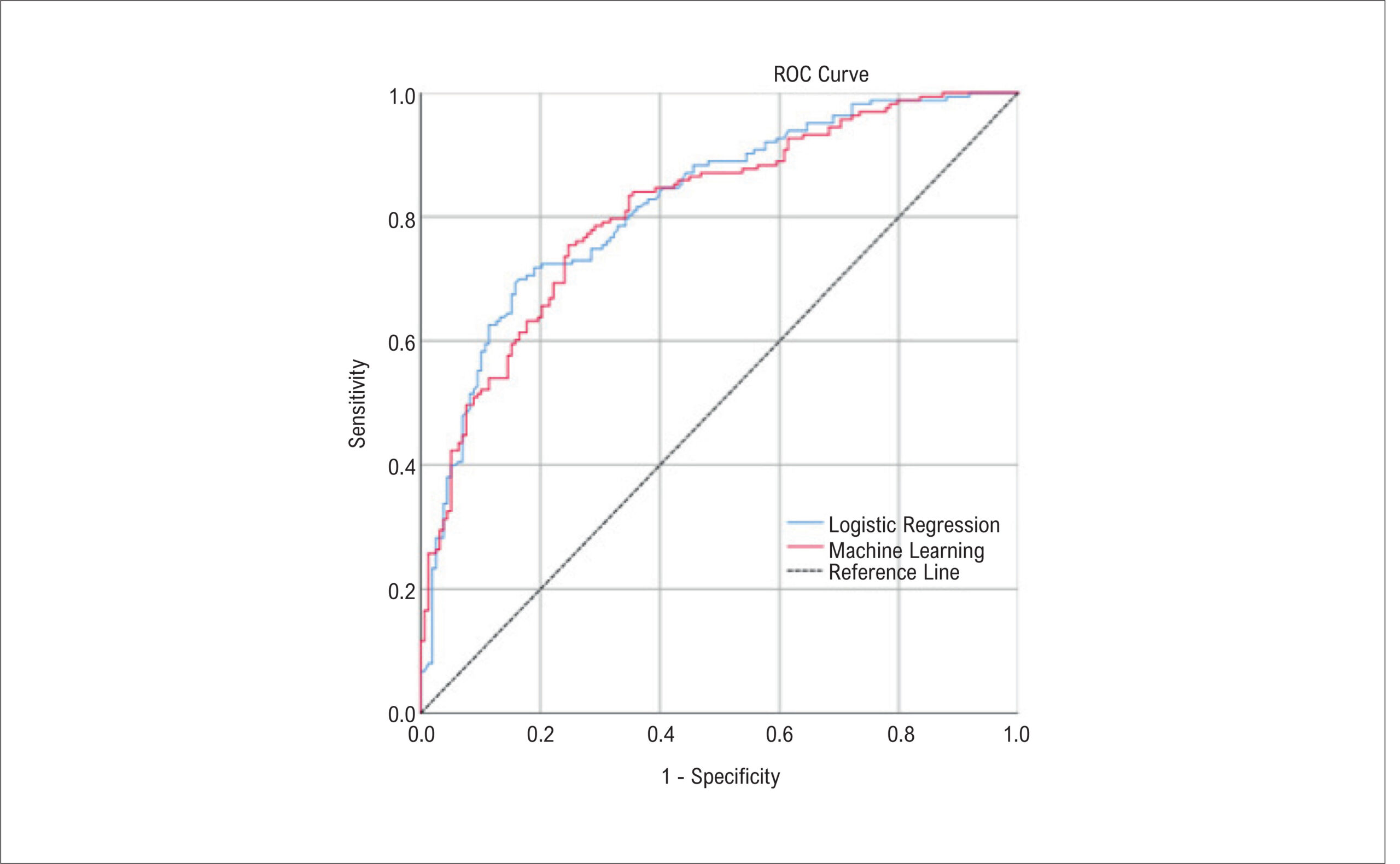
The training sample had an average age of 59 ± 15 years, 58% males, and a 52% prevalence of coronary disease. The logistic model was composed of nine independent predictors. The machine learning algorithm was composed of all candidates for predictors. In the test sample, the area under the ROC curve for prediction of coronary disease was 0.81 (95% CI = 0.77 – 0.86) for the machine learning algorithm, similar to that obtained in logistic model (0.82; 95% CI = 0.77 – 0.87), p = 0.68.

Conclusion:

The present study suggests that an accurate machine learning prediction tool did not prove to be superior to the statistical model of logistic regression.

  • Artificial Intelligence
  • Coronary Artery Disease/diagnostic
  • Data Interpretacion
  • Statistical
  • Validation Studies
Read Full Article
Creative Commons Attribution (CC BY) Creative Commons license
03/12/2021 DOI: 10.36660/abc.20200302 Views 2

How to cite this article

EndNote RIS

Electronic Document Format (Vancouver)

Silva PGMB, Lopes RD. Risk Scores in Acute Coronary Syndrome: Current Applications and Future Perspectives. International Journal of Cardiovascular Sciences 2022;35(2):181-3.

Electronic Document Format (ABNT)

Silva, Pedro G. M. de Barros e; Lopes, Renato D.. Risk Scores in Acute Coronary Syndrome: Current Applications and Future Perspectives. International Journal of Cardiovascular Sciences, v. 35, n. 2, p. 181-183, Mar. 2022.

Electronic Document Format (APA)

Silva, P. G. M. B. , & Lopes, R. D. (2022). Risk Scores in Acute Coronary Syndrome: Current Applications and Future Perspectives. International Journal of Cardiovascular Sciences, 35(2), 181-183.

Electronic Document Format (ISO)

Silva, Pedro G. M. de Barros e and Lopes, Renato D.. Risk Scores in Acute Coronary Syndrome: Current Applications and Future Perspectives. International Journal of Cardiovascular Sciences [online]. 2022, vol. 35, n. 2, [cited 2026-10-14], pp. 181-183. Available from: <https://journals.cardiol.br/en/article/risk-scores-in-acute-coronary-syndrome-current-applications-and-future-perspectives/>. ISSN 2359-4802

EndNote RIS

Electronic Document Format (Vancouver)

Correia L, Lopes D, Porto JV, Lacerda YF, Correia VCA, Bagano GO, Pontes BSB, et al. Validation of an Artificial Intelligence Algorithm for Diagnostic Prediction of Coronary Disease: Comparison with a Traditional Statistical Model. Arquivos Brasileiros de Cardiologia 2021;117(6):1061-70.

Electronic Document Format (ABNT)

Correia, Luis; Lopes, Daniel; Porto, João Vítor; Lacerda, Yasmin F.; Correia, Vitor C. A.; Bagano, Gabriela O.; Pontes, Bruna S. B.; Melo, Milton Henrique Vitoria de; Silva, Thomaz E. A.; Meireles, André C. Validation of an Artificial Intelligence Algorithm for Diagnostic Prediction of Coronary Disease: Comparison with a Traditional Statistical Model. Arquivos Brasileiros de Cardiologia, v. 117, n. 6, p. 1061-1070, Dec. 2021.

Electronic Document Format (APA)

Correia, L., Lopes, D., Porto, J. V., Lacerda, Y. F., Correia, V. C. A., Bagano, G. O., Pontes, B. S. B., Melo, M. H. V. , Silva, T. E. A., & Meireles, A. C. (2021). Validation of an Artificial Intelligence Algorithm for Diagnostic Prediction of Coronary Disease: Comparison with a Traditional Statistical Model. Arquivos Brasileiros de Cardiologia, 117(6), 1061-1070.

Electronic Document Format (ISO)

Correia, Luis and Lopes, Daniel and Porto, João Vítor and Lacerda, Yasmin F. and Correia, Vitor C. A. and Bagano, Gabriela O. and Pontes, Bruna S. B. and Melo, Milton Henrique Vitoria de and Silva, Thomaz E. A. and Meireles, André C. Validation of an Artificial Intelligence Algorithm for Diagnostic Prediction of Coronary Disease: Comparison with a Traditional Statistical Model. Arquivos Brasileiros de Cardiologia [online]. 2021, vol. 117, n. 6, [cited 2026-10-14], pp. 1061-1070. Available from: <https://journals.cardiol.br/en/article/validation-of-an-artificial-intelligence-algorithm-for-diagnostic-prediction-of-coronary-disease-comparison-with-a-traditional-statistical-model/>. ISSN 0066-782X

  • About ABC Family
  • Internal Regulation
  • Editorial Board
  • Brazilian Society of Cardiology (SBC)

Issues

SBC Guidelines

  • Videos
  • Podcasts
  • News