ABC Family Arquivos Brasileiros de Cardiologia International Journal of Cardiovascular Sciences ABC Heart Failure & Cardiomyopathy ABC Imagem Cardiovascular
Português English
ABC Family
Português English
  • About
    • About ABC Family
    • Internal Regulation
    • Editorial Board
    • Brazilian Society of Cardiology (SBC)
  • Issues
  • SBC Guidelines
  • Content
    • Videos
    • Podcasts
    • News
  • About
    • About ABC Family
    • Internal Regulation
    • Editorial Board
    • Brazilian Society of Cardiology (SBC)
  • Issues
  • SBC Guidelines
  • Content
    • Videos
    • Podcasts
    • News

ABC Family

  • ABC Family
  • Arquivos Brasileiros de Cardiologia
  • International Journal of Cardiovascular Sciences
  • ABC Heart Failure & Cardiomyopathy
  • ABC Imagem Cardiovascular
Search in

No content found.

Journals
Ordering
Article types
Others

  1. Home
  2. Keyword: Spirometry
IJCS
Editorial

Exercise-induced Bronchoconstriction and its Relevance in Public Health

Tales de Carvalho

The case report from Castro et al., entitles Exercise-Induced Bronchoconstriction: A Frequent, but Neglected Cause of Chest Pain, opportunely sheds light on a highly relevant question in terms of public health, as it treats important aspects that encompass from the diagnosis to the pharmacological treatment of Exercise-Induced Bronchoconstriction (EIB).–

EIB often leads to an isolated cough, as well as thoracic and abdominal pain, which should always be contemplated after having discarded other causes of dyspnea and exercise-induced chest pain.– It is an acute airway obstruction that is transitory and spontaneously reversible, and occurs during and after exercise and physical effort, regardless of the previous diagnosis of bronchial asthma. EIB normally arises 2 to 5 min after exercise, reaching a peak at 10 min and disappearing in up to 60 min.,,

[…]

  • Exercise Test
  • Exercise-induced asthma
  • Primary Health Care
  • Spirometry
Read Full Article
Creative Commons Attribution (CC BY) Creative Commons license
28/11/2022 DOI: 10.36660/ijcs.20220166 Views 2
ABC
Original Article

Ergospirometry and Echocardiography in Early Stage of Heart Failure with Preserved Ejection Fraction and in Healthy Individuals

Eduardo Lima Garcia et al. Márcio Garcia Menezes Charles de Moraes Stefani Luiz Cláudio Danzmann Marco Antonio Rodrigues Torres

Abstract

Background:

Heart failure with preserved ejection fraction is a syndrome characterized by changes in diastolic function; it is more prevalent among the elderly, women, and individuals with systemic hypertension (SH) and diabetes mellitus. However, in its early stages, there are no signs of congestion and it is identified in tests by adverse remodeling, decreased exercise capacity and diastolic dysfunction.

Objective:

To compare doppler, echocardiographic (Echo), and cardiopulmonary exercise test (CPET) variables – ergospirometry variables – between two population samples: one of individuals in the early stage of this syndrome, and the other of healthy individuals.

Methods:

Twenty eight outpatients diagnosed with heart failure according to Framingham’s criteria, ejection fraction > 50% and diastolic dysfunction according to the european society of cardiology (ESC), and 24 healthy individuals underwent Echo and CPET.

Results:

The group of patients showed indexed atrial volume and left ventricular mass as well as E/E’ and ILAV/A´ ratios significantly higher, in addition to a significant reduction in peak oxygen consumption and increased VE/VCO2 slope, even having similar left ventricular sizes in comparison to those of the sample of healthy individuals.

Conclusion:

There are significant differences between the structural and functional variables analyzed by Echo and CPET when comparing two population samples: one of patients in the early stage of heart failure with ejection fraction greater than or equal to 50% and another of healthy individuals.

  • Echocardiography
  • Heart Failure, Stroke Volume
  • outpatients
  • Spirometry
Read Full Article
Creative Commons Attribution (CC BY) Creative Commons license
31/07/2015 DOI: 10.5935/abc.20150085 Views 1
Cardiorespiratory optimal point: a submaximal variable of the cardiopulmonary exercise testing
ABC
Artigo Original

Cardiorespiratory optimal point: a submaximal variable of the cardiopulmonary exercise testing

Plínio Santos Ramos et al. Djalma Rabelo Ricardo Claudio Gil Soares de Araújo

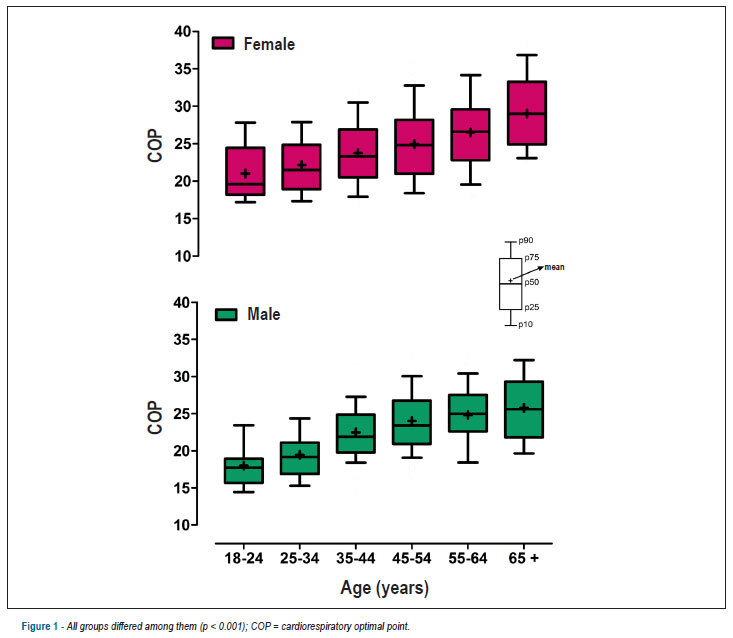
BACKGROUND: At the maximal Cardiopulmonary Exercise Testing (CPET), several ventilatory variables are analyzed, including the ventilatory equivalent for oxygen (VE/VO2). The minimum VE/VO2 value reflects the best integration between the respiratory and cardiovascular systems and may be called “Cardiorespiratory Optimal Point (COP)”. OBJECTIVE: To determine the behavior of the COP according to gender and age in healthy adults and verify its association with other CPET variables. METHODS: Of 2,237 individuals, 624 were selected (62% men and 48 ± 12 years), non- athletes, healthy, who were submitted to maximal CPET. COP or minimum VE/VO2 was obtained from the analysis of ventilation and oxygen consumption in every minute of CPET. We investigated the association between age and COP for both genders, as well as associations with: VO2max, VO2 at anaerobic threshold (VO2AT), oxygen uptake efficiency slope (OUES) and with maximum VE. We also compared the intensity of exertion (MET) at the COP, AT and VO2max. RESULTS: COP increases with age, being 23.2 ± 4.48 and 25.0 ± 5.14, respectively, in men and women = (p < 0.001). There are moderate and inverse associations with VO2max (r = -0.47; p < 0.001), with VO2AT (r = -0.42; p < 0.001) and with OUES (r = -0.34; p < 0.001). COP occurred, on average, at 44% do VO2max and before AT (67% of VO2max) (p < 0.001). CONCLUSION: COP, a submaximal variable, increases with age and is slightly higher in women. Being modestly associated with other ventilation measures, there seems to be an independent contribution to the interpretation of the cardiorespiratory response to CPET.

  • Exercise
  • Oxygen Consumption
  • Respiratory Function Tests
  • Spirometry
  • ventilation-perfusion ratio
Read Full Article
Creative Commons Attribution (CC BY) Creative Commons license
02/10/2012 DOI: 10.1590/S0066-782X2012005000091

How to cite this article

EndNote RIS

Electronic Document Format (Vancouver)

Carvalho T. Exercise-induced Bronchoconstriction and its Relevance in Public Health. International Journal of Cardiovascular Sciences 2022;35(6):824-5.

Electronic Document Format (ABNT)

Carvalho, Tales de. Exercise-induced Bronchoconstriction and its Relevance in Public Health. International Journal of Cardiovascular Sciences, v. 35, n. 6, p. 824-825, Nov. 2022.

Electronic Document Format (APA)

Carvalho, T. (2022). Exercise-induced Bronchoconstriction and its Relevance in Public Health. International Journal of Cardiovascular Sciences, 35(6), 824-825.

Electronic Document Format (ISO)

Carvalho, Tales de. Exercise-induced Bronchoconstriction and its Relevance in Public Health. International Journal of Cardiovascular Sciences [online]. 2022, vol. 35, n. 6, [cited 2026-10-14], pp. 824-825. Available from: <https://journals.cardiol.br/en/article/exercise-induced-bronchoconstriction-and-its-relevance-in-public-health/>. ISSN 2359-4802

EndNote RIS

Electronic Document Format (Vancouver)

Garcia EL, Menezes MG, Stefani CM, Danzmann LC, Torres MAR. Ergospirometry and Echocardiography in Early Stage of Heart Failure with Preserved Ejection Fraction and in Healthy Individuals. Arquivos Brasileiros de Cardiologia 2015;105(3):248-55.

Electronic Document Format (ABNT)

Garcia, Eduardo Lima; Menezes, Márcio Garcia; Stefani, Charles de Moraes; Danzmann, Luiz Cláudio; Torres, Marco Antonio Rodrigues. Ergospirometry and Echocardiography in Early Stage of Heart Failure with Preserved Ejection Fraction and in Healthy Individuals. Arquivos Brasileiros de Cardiologia, v. 105, n. 3, p. 248-255, Jul. 2015.

Electronic Document Format (APA)

Garcia, E. L., Menezes, M. G., Stefani, C. M., Danzmann, L. C., & Torres, M. A. R. (2015). Ergospirometry and Echocardiography in Early Stage of Heart Failure with Preserved Ejection Fraction and in Healthy Individuals. Arquivos Brasileiros de Cardiologia, 105(3), 248-255.

Electronic Document Format (ISO)

Garcia, Eduardo Lima and Menezes, Márcio Garcia and Stefani, Charles de Moraes and Danzmann, Luiz Cláudio and Torres, Marco Antonio Rodrigues. Ergospirometry and Echocardiography in Early Stage of Heart Failure with Preserved Ejection Fraction and in Healthy Individuals. Arquivos Brasileiros de Cardiologia [online]. 2015, vol. 105, n. 3, [cited 2026-10-14], pp. 248-255. Available from: <https://journals.cardiol.br/en/article/ergospirometry-and-echocardiography-in-early-stage-of-heart-failure-with-preserved-ejection-fraction-and-in-healthy-individuals/>. ISSN 0066-782X

EndNote RIS

Electronic Document Format (Vancouver)

Ramos PS, Ricardo DR, Araújo CGS. Cardiorespiratory optimal point: a submaximal variable of the cardiopulmonary exercise testing. Arquivos Brasileiros de Cardiologia 2012;99(5):988-96.

Electronic Document Format (ABNT)

Ramos, Plínio Santos; Ricardo, Djalma Rabelo; Araújo, Claudio Gil Soares de. Cardiorespiratory optimal point: a submaximal variable of the cardiopulmonary exercise testing. Arquivos Brasileiros de Cardiologia, v. 99, n. 5, p. 988-996, Oct. 2012.

Electronic Document Format (APA)

Ramos, P. S., Ricardo, D. R., & Araújo, C. G. S. (2012). Cardiorespiratory optimal point: a submaximal variable of the cardiopulmonary exercise testing. Arquivos Brasileiros de Cardiologia, 99(5), 988-996.

Electronic Document Format (ISO)

Ramos, Plínio Santos and Ricardo, Djalma Rabelo and Araújo, Claudio Gil Soares de. Cardiorespiratory optimal point: a submaximal variable of the cardiopulmonary exercise testing. Arquivos Brasileiros de Cardiologia [online]. 2012, vol. 99, n. 5, [cited 2026-10-14], pp. 988-996. Available from: <https://journals.cardiol.br/en/article/cardiorespiratory-optimal-point-a-submaximal-variable-of-the-cardiopulmonary-exercise-testing/>. ISSN 0066-782X

  • About ABC Family
  • Internal Regulation
  • Editorial Board
  • Brazilian Society of Cardiology (SBC)

Issues

SBC Guidelines

  • Videos
  • Podcasts
  • News